Larry Tanenbaum is a Canadian executive who grew his family's construction firm into a global civil engineering company before moving into sports ownership. Best known for his philosophy of community stewardship and generational investing, he navigated complex corporate rivalries to help build the Maple Leaf Sports & Entertainment empire. This profile catalogues his practical approach to infrastructure, talent management, and philanthropic strategy into 75 specific lessons.
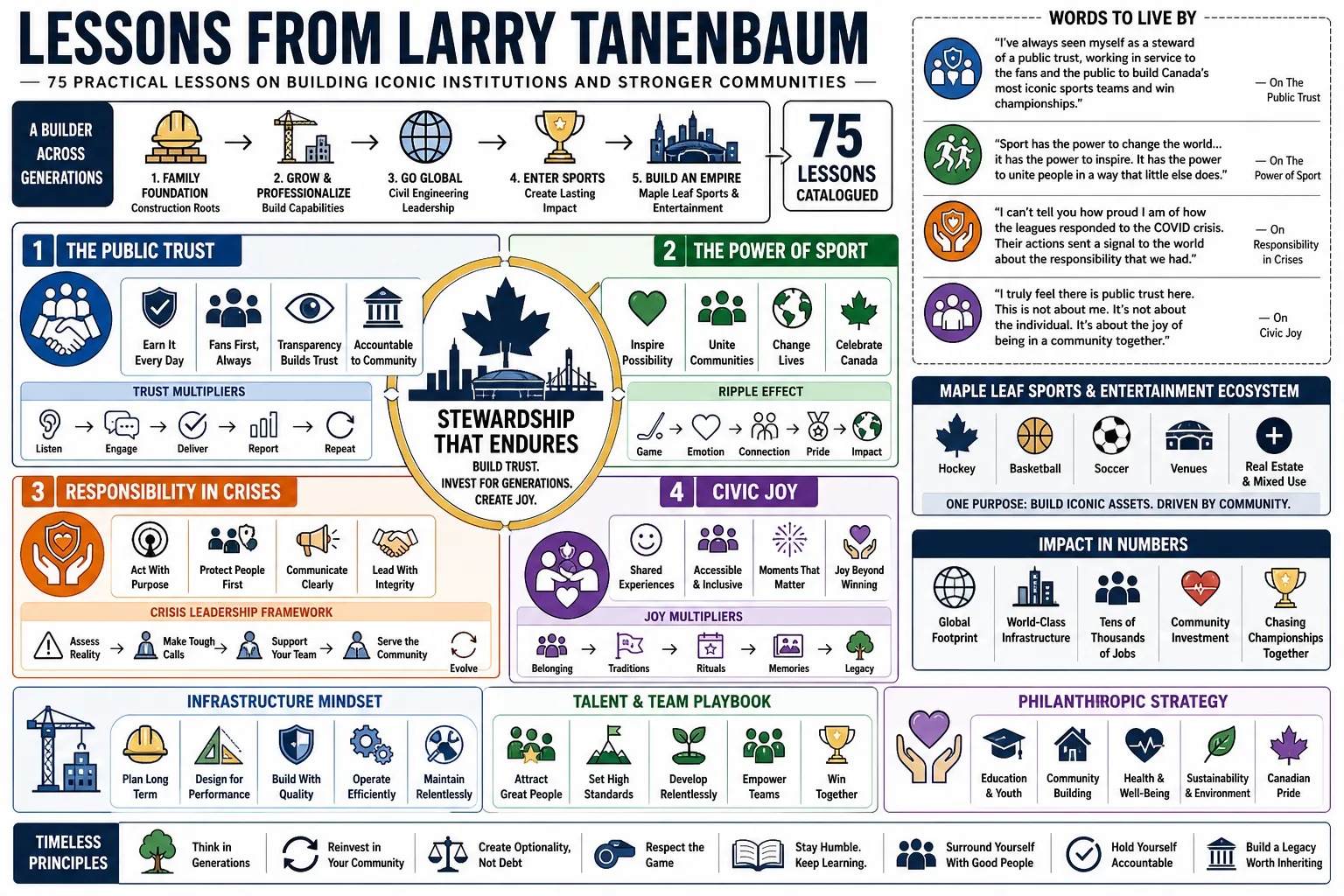
Part 1: The Public Trust and Community Stewardship
- On The Public Trust: "I’ve always seen myself as a steward of a public trust, working in service to the fans and the public to build Canada’s most iconic sports teams and win championships." — Source: [OMERS]
- On The Power of Sport: "Sport has the power to change the world... it has the power to inspire. It has the power to unite people in a way that little else does." — Source: [Sports Business Awards Retrospective]
- On Responsibility in Crises: "I can't tell you how proud I am of how the leagues responded to the COVID crisis. Their actions sent a signal to the world about the responsibility that we had." — Source: [Sports Business Journal]
- On Civic Joy: "I truly feel there is public trust here. This is not about me. It's not about the team. It's about all the people that get such joy from this." — Source: [Sports Business Journal]
- On Community Belonging: "Every conversation always starts with a discussion on a personal level... How you doing? How is the family doing? How are the kids?" — Source: [Sports Business Journal]
- On Institutional Value: Franchises are not merely business assets, but sporting and cultural institutions that belong inherently to the community they represent. — Source: [Sports Business Journal]
- On Giving Back: "It all goes back to the Tanenbaum family belief that if you take something out of the community like they have, you have to set the example for your children and your grandchildren; you have to give back." — Source: [Kilmer Group]
- On The Social Good: "The social good of sport has never been stronger than it is now." — Source: [Sports Business Journal]
- On Loyalty to the City: Born in Toronto, he has remained fiercely loyal to his hometown throughout his business career, viewing local investment as a civic duty rather than a standard economic play. — Source: [Leaders League]
- On Historical Roots: "We seek to make our community, province and country a better place. It begins with helping others, and it is something that is rooted in the traditions of our people that were taught to me by my parents." — Source: [Feduja]
Part 2: Infrastructure and "The Stamp of Construction"
- On Bricks and Mortar: "Every sports team needed a home. And the idea of building a stadium was attractive." — Source: [Sports Business Journal]
- On Passion vs. Vocation: His passion for sports completed him in ways that the bridges, tunnels, and roads he built as head of his family's construction conglomerate could not. — Source: [Sports Business Journal]
- On Quality Facilities: "The little things" in infrastructure, like highly specialized practice facilities, establish a serious professional identity for an organization. — Source: [AI-CIO]
- On Quiet Influence: "Larry's footprint is everywhere in this city... He is a man who looks for no personal credit. He is shy about getting his name in the paper." — Source: [Kilmer Group]
- On Concrete Achievements: His early focus at Kilmer Van Nostrand centered on massive civil engineering tasks—building subway systems in Toronto, Miami, Atlanta, and Caracas. — Source: [McGill University]
- On Building a Business Culture: "We're building a business and a culture that's based on excellence, on innovation, on partnership." — Source: [Jew of the Week]
- On Operational Footprints: His background in heavy construction informed his view that physical spaces dictate the operational ceiling of the teams that inhabit them. — Source: [Kilmer Group]
- On Legacy Building: The transition from constructing municipal transit to erecting sports arenas was driven by a desire to build the gathering places that define a city's heartbeat. — Source: [Sports Business Journal]
- On Hidden Value: Much of a city's actual strength lies underground or out of sight, a principle he applies to both civil engineering and organizational management. — Source: [McGill University]
Part 3: Generational Investing and Asset Valuation
- On Financial Horizons: "You can’t count on sports teams giving you multiple cashflow dividends... valuation increases are the metrics that you look to." — Source: [AI-CIO]
- On Independence: The OMERS acquisition provided essential liquidity to pursue independent sports ventures globally, proving that capital strategy buys operational freedom. — Source: [OMERS]
- On the Missing Link: Acquiring the Toronto WNBA expansion franchise was not just a business move, but an effort to fill a missing piece in the Canadian sports market. — Source: [Kilmer Group]
- On Timing: "Today just over 30 years ago I saw an opportunity to bring the NBA to Canada... It was the right time in the right place. And I jumped on the chance." — Source: [Bay Today]
- On Multi-Club Synergy: Establishing Kilmer Sports Ventures allowed him to look beyond North American leagues and acquire AS Saint-Étienne to build a globally syndicated portfolio. — Source: [The Score]
- On Community Anchors: "My teams are my family," illustrating that he views club acquisitions as integrating into long-standing community frameworks. — Source: [OneFootball]
- On Generational Horizons: He approaches ownership with the mindset of a generational builder, preferring assets that accrue cultural and financial equity over decades. — Source: [AI-CIO]
- On Economic Principles: Armed with a degree in economics, his strategy revolves around recognizing under-served markets like women's sports and deploying long-term capital. — Source: [Grokipedia]
- On Stability: Sustainable winning takes years of structural work rather than immediate reactions to market or on-field volatility. — Source: [OneFootball]
Part 4: Partnership and Consensus Building
- On the True Nature of Equity: "I've always believed in partnerships in my business life and having good partners. It doesn't really matter if you own 10% or 90% of something. You work just as hard at the task at hand." — Source: [Sports Business Journal]
- On Building Consensus: As the central figure at MLSE, he successfully acted as the vital glue between massive corporate rivals Bell and Rogers. — Source: [AI-CIO]
- On League Prioritization: He is highly respected for putting league-level interests above the immediate interests of his own teams, fostering broader ecosystem health. — Source: [Sports Business Journal]
- On Interpersonal Ethics: "Ethical behaviour is about conducting your relationships on an ethical basis. You're honest with people." — Source: [Jew of the Week]
- On Uniting Disparate Groups: His influence is often wielded behind the scenes, acting as a bridge builder rather than a dictator to secure multi-billion-dollar sports consortiums. — Source: [Sports Business Journal]
- On Quiet Power: His effectiveness on the NBA Board of Governors stems from a measured approach that commands respect through listening. — Source: [Sports Business Journal]
- On Keeping Notes: "I put most things down in writing. You work on so many things each day... and the next day you try to figure out what it was you were doing, and you need some notes." — Source: [Sports Business Journal]
- On Collaboration Over Control: A successful enterprise requires harmonizing differing corporate mandates and leveraging the strengths of partners while minimizing their friction. — Source: [AI-CIO]
- On Relational Capital: Before any term sheet is discussed, understanding a partner's family and personal motivations is required to ensure alignment. — Source: [Sports Business Journal]
Part 5: Talent Empowerment and Management
- On Non-Interference: "I have never been a fan of ownership that tries to manage a team. The day-to-day management should be managed by the professionals. They do it 24/7." — Source: [Sports Business Journal]
- On Removing the Reins: "It’s about getting the right people in the right positions to get things done, and then taking the reins off them so they can do just that." — Source: [Sports Business Journal]
- On Mentorship: His business model explicitly relies on identifying best-in-class executives and actively mentoring them while providing the capital to execute their vision. — Source: [Bridge Builder: Larry Tanenbaum]
- On Autonomy in Leadership: Capable owners do not seek credit for operational victories; they create an environment where domain experts hold the ultimate authority. — Source: [Sports Business Journal]
- On Executive Resilience: He protects his leadership teams from public and media pressure, providing a buffer that allows general managers to build for the long term. — Source: [Toronto Sun]
- On Selecting Leaders: Hiring former operators from rival leagues shows a commitment to proven track records over comfortable local hires. — Source: [The Score]
- On Organizational Design: A winning front office functions best when ownership focuses strictly on governance and capital allocation rather than player personnel. — Source: [Sports Business Journal]
- On Teamwork: "Teamwork leads to championships on and off the court," emphasizing that front-office synergy is a prerequisite to on-field victory. — Source: [Jew of the Week]
- On Maintaining Stability: When teams hit rough patches, he intentionally slows down organizational reaction times to prevent panic-driven turnover. — Source: [OneFootball]
Part 6: Resilience, Failure, and The Long Game
- On Inevitable Setbacks: "There isn’t a straight path to success; challenges and failures are inevitable but they can also be the greatest teachers." — Source: [Bridge Builder: Larry Tanenbaum]
- On Coming Back Stronger: Failures in business and sports are not endpoints, but rather practical opportunities to adapt, learn, and iterate toward a better outcome. — Source: [Bridge Builder: Larry Tanenbaum]
- On Ambition: "My dad... lives by the principle that you should have no small dreams and you should have great teams." — Source: [Bridge Builder: Larry Tanenbaum]
- On The Ultimate Validation: "Beyond any business success, winning that trophy was unbelievable." — Source: [Sports Business Journal]
- On Chasing the Pinnacle: "Still to get the Stanley Cup. That’s the thing I’m working for." — Source: [Toronto Sun]
- On Perpetual Curiosity: "You never stop learning, whether that's reading the Bible, the Talmud, the New Yorker or Engineering News Record." — Source: [Jew of the Week]
- On Core Principles: "Integrity, respect, trust, resilience, and giving back—these values are central to both my professional and personal life." — Source: [Lawrence M. Tanenbaum, Sinai Health]
- On Remaining Optimistic: Even amidst decades-long championship droughts, he maintains an unwavering public optimism about his franchises' ultimate success. — Source: [HFBoards]
- On A Century Forward: "This was the opening act of the next 100 years of the Toronto Maple Leafs and what a great way to start it... We all know what the goal is." — Source: [Toronto Sun]
Part 7: Philanthropy and Tikkun Olam
- On Tradition: "I think we all view this work as part of our community's tradition of tikkun olam. It is very basic, but so essential." — Source: [Feduja]
- On Generational Modeling: His children note they were motivated by acts of Tzedakah and Tikkun Olam, strengthened by the values and identity instilled in them. — Source: [Jewish Foundation Toronto]
- On Entrepreneurial Giving: He applies a specific energy to philanthropy, focusing on structural innovation and collaboration rather than merely writing checks for traditional aid. — Source: [LJTFF]
- On Active Philanthropy: "Larry and Judy have always seen their philanthropy not as a gift, but rather, as an investment." — Source: [Newswire]
- On Uniting Communities: "I’m going to continue building world-class organizations and use those platforms to unite communities and drive meaningful change." — Source: [Sports Business Awards Retrospective]
- On Leading by Example: Words and action must align; one cannot preach community responsibility without actively funding and supporting civic initiatives. — Source: [Jewish Foundation Toronto]
- On Educational Endowments: By supporting centers for Jewish Studies and Science in Sport, he merges his respect for heritage with modern academic funding. — Source: [University of Toronto]
- On Foundational Values: The Tanenbaum Family Foundation explicitly operates on four interconnected pillars: Compassion, Excellence, Innovation, and Collaboration. — Source: [LJTFF]
- On Duty to Society: True wealth is not defined by accumulation, but by the capacity to deploy capital in ways that sustainably repair the world. — Source: [Feduja]
- On Athletic Health: "I truly believe that sport unites us, inspires us and offers all people a path towards becoming their best selves... I’m proud to join with U of T and Sinai Health in transforming athlete health." — Source: [University of Toronto]
Part 8: Open Science and Societal Innovation
- On Breaking Silos: "The more we share, the faster we will find cures. It’s about breaking down silos and working together for the greater good." — Source: [Open Science at The Neuro Toolkit]
- On Open Data: "The idea is that all the data will be made public, and there will be no intellectual property. The advantage of that is that it brings down the cost for companies to interact with universities." — Source: [eScholarship]
- On The Reality of Research: "Research is about finding answers to questions, where failure is more common than success, and where the cost of success requires time, patience and investment." — Source: [Newswire]
- On Accelerating Discovery: "Open sharing... would accelerate the discovery, the understanding of the nervous system that would allow rational, targeted development of treatments." — Source: [eScholarship]
- On Scientific Optimism: "I’m optimistic that the research we support will lead to scientific breakthroughs that will strengthen health care and improve lives." — Source: [Tanenbaum Institute for Science in Sport]
- On Transformative Funding: His donation to establish the Tanenbaum Open Science Institute was a deliberate tactic to force legacy academic institutions to abandon restrictive patent models. — Source: [eScholarship]
- On Institutional Inspiration: "Judy and I continue to be inspired and rewarded by the researchers at Mount Sinai and the quiet success they are achieving." — Source: [Newswire]
- On Systemic Cures: By focusing heavily on research institutes, he treats medical research as a structural engineering problem where targeted capital removes bottlenecks. — Source: [University of Toronto]
- On Leveraging Capital for Health: The purpose of massive personal wealth is to underwrite the high-risk scientific exploration that governments and corporations often avoid. — Source: [Newswire]
- On The Ultimate Legacy: While sports deliver immediate civic joy, funding open-source medical breakthroughs represents the most permanent form of building for humanity. — Source: [eScholarship]