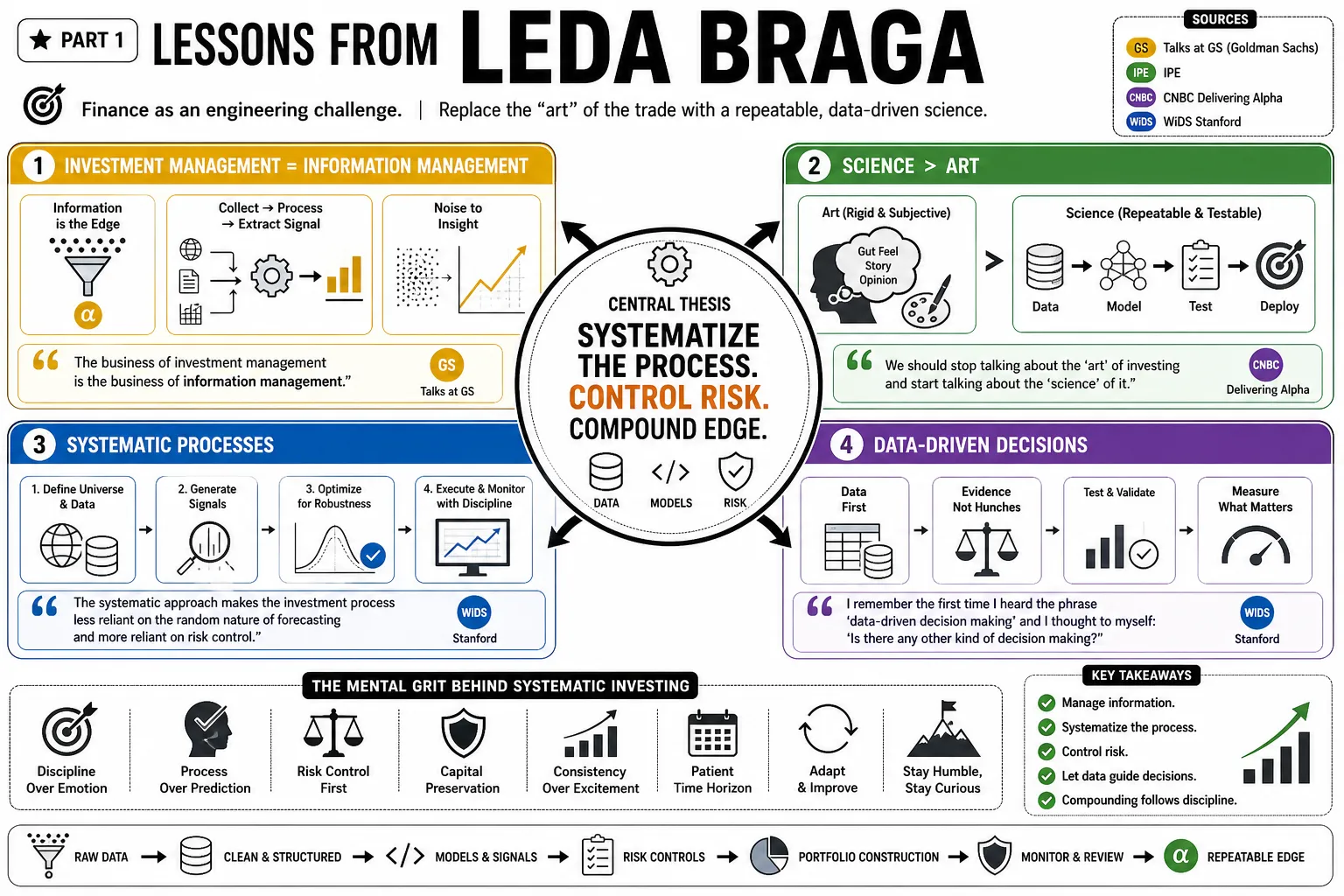
Lessons from Leda Braga
Leda Braga built Systematica Investments by treating finance as an engineering challenge rather than a collection of gut instincts. She replaced the "art" of the trade with the cold discipline of a repeatable, data-driven science. These are her insights on the logic of algorithms and the mental grit needed to manage risk in volatile markets.
Part 1: The Philosophy of Systematic Investing
- On investment management: "At the end of the day, the business of investment management is the business of information management." — Source: Business Insider coverage of Leda Braga at CNBC Delivering Alpha
- On the quant identity: Braga argues that systematic investing is becoming more accepted as markets, investors, and technology make information management central to the craft. — Reference: Business Insider coverage of Leda Braga at CNBC Delivering Alpha
- On science versus art: Braga frames systematic investing as a data and engineering discipline rather than a purely discretionary craft. — Reference: WiDS profile on applying data science to investment strategies
- On systematic processes: "The systematic approach makes the investment process less reliant on the random nature of forecasting and more reliant on risk control in portfolio construction." — Source: WiDS profile on Leda Braga
- On data-driven decisions: Braga treats systematic investment management as data science applied to markets, with the process designed around evidence rather than intuition alone. — Reference: WiDS profile on applying data science to investment strategies
- On reducing subjectivity: Braga's systematic approach pushes investment ideas into explicit processes that can be tested, monitored, and improved over time. — Reference: Money Maze quant investing series featuring Leda Braga
- On the advantage of systems: Braga argues that investors often distrust algorithms too quickly, even though systematic processes can be scrutinized, improved, and applied consistently. — Reference: Business Insider coverage of Leda Braga at CNBC Delivering Alpha
- On repeatability: The point of systematic investing is to make research, risk control, and portfolio construction less dependent on any one person's judgment. — Reference: WiDS profile on applying data science to investment strategies
- On knowledge compounding: In a systematic firm, investment knowledge is pushed into research, code, data infrastructure, and process so it can compound beyond one person's judgment. — Reference: Money Maze quant investing series featuring Leda Braga
Part 2: The Mechanics of the "Quant Factory"
- On feature engineering: "Nowadays, anything is a dataset, from collections of images and the number of clicks on a web page to sentiment or unformatted data. So we use feature engineering to understand the features of datasets." — Source: Hedgeweek coverage of Leda Braga at SS&C Deliver Europe
- On the research phase: Braga's version of systematic investing shifts human judgment toward research design, data processing, and portfolio construction rather than ad hoc trading-day discretion. — Reference: WiDS profile on applying data science to investment strategies
- On trend following: Braga's public discussions of quant investing emphasize systematic processes that observe market information and build rules around risk profiles rather than relying only on discretionary explanation. — Reference: Money Maze quant investing series featuring Leda Braga
- On systematic macro: The Money Maze quant series frames Braga's work around multiple forms of systematic investing, including trend-following and broader quant approaches, rather than a single discretionary macro view. — Reference: Money Maze quant investing series featuring Leda Braga
- On signal quality: Braga emphasizes that markets contain randomness and sparse data, so systematic investors need risk controls and careful data processing rather than blind faith in models. — Reference: WiDS profile on applying data science to investment strategies
- On model evolution: Braga describes AI and machine-learning methods as tools her industry has used for a long time, but argues their value depends on scoped use cases, controls, and continuing refinement. — Reference: Hedgeweek coverage of Leda Braga at SS&C Deliver Europe
- On industrializing alpha: Her systematic model treats alpha generation as an operating system: research, technology, data, and risk controls have to work together repeatedly. — Reference: Money Maze quant investing series featuring Leda Braga
- On trading velocity: Braga's public framing puts process and controls ahead of speed; faster tools help only when the underlying research and risk logic are sound. — Reference: Hedgeweek coverage of Leda Braga at SS&C Deliver Europe
- On alternative data: Braga emphasizes that the expansion of datasets only matters when a team can process, interpret, and control the data rigorously. — Reference: Hedgeweek coverage of Leda Braga at SS&C Deliver Europe
Part 3: Risk Management and the Discipline of Diversification
- On diversification: Her systematic approach leans on risk control and portfolio construction because forecasts are uncertain and market data contains randomness. — Reference: WiDS profile on applying data science to investment strategies
- On volatility targeting: Systematic investment management translates market information into rules for risk profiles, preferences, and portfolio construction. — Reference: WiDS profile on applying data science to investment strategies
- On emotional detachment: Braga argues that systematic processes can reduce the behavioral burden of discretionary trading, even though investors often judge algorithms more harshly than people. — Reference: Business Insider coverage of Leda Braga at CNBC Delivering Alpha
- On measurement: Braga's data-science framing puts measurement, risk control, and portfolio construction at the center of systematic investment management. — Reference: WiDS profile on applying data science to investment strategies
- On portfolio construction: The systematic approach makes the investment process less dependent on discretionary forecasting and more dependent on risk controls in portfolio construction. — Reference: WiDS profile on applying data science to investment strategies
- On liquidity: Braga's approach treats risk profiles, market constraints, and implementation discipline as part of the investment process, not afterthoughts. — Reference: Money Maze quant investing series featuring Leda Braga
Part 4: Crisis Discipline and Algorithm Restraint
- On crisis facts: During 2008, when people wanted to reduce risk, Braga asked which actual facts contradicted the long-term investment roadmap and found little had changed. — Reference: Finews, "That's How She Did It Back in 2008"
- On interfering with algorithms: The lesson Braga drew from 2008 was that the firm should interfere as seldom as possible with its algorithms. — Reference: Finews, "That's How She Did It Back in 2008"
Part 5: Leadership, Culture, and Cognitive Diversity
- On technical humility: Braga joked that her Systematica colleagues knew technologies she could not dream of, a useful reminder that systematic investing is a team craft. — Reference: Finews, "That's How She Did It Back in 2008"
- On collaboration: Systematica's own firm page puts open dialogue, mutual respect, and collective responsibility at the center of how the firm works. — Reference: Systematica Investments, Our Firm
- On integrity: Systematica frames capital management as a responsibility that requires transparency, accountability, fairness, and long-term trust. — Reference: Systematica Investments, Our Firm
Part 6: Lessons from the 2008 Financial Crisis
- On crisis performance: Finews reports that the BlueTrend fund made 43 percent in 2008 while much of the financial system was collapsing. — Reference: Finews, "That's How She Did It Back in 2008"
- On staying with the roadmap: Braga's response to panic was to test whether the hypotheses behind the strategy had actually been violated. — Reference: Finews, "That's How She Did It Back in 2008"
- On operational readiness: The concrete change she asked for in 2008 was not a model overhaul but postponing holidays so the team could stay fully available. — Reference: Finews, "That's How She Did It Back in 2008"
- On process restraint: Finews notes that Systematica stuck to the lesson of patience and made only a small number of changes in a year. — Reference: Finews, "That's How She Did It Back in 2008"
Part 7: Data, Research, and Technology Infrastructure
- On data over emotion: Systematica describes itself as guided by data rather than emotions, with discretionary interaction routed through research instead of ad hoc model overrides. — Reference: Systematica Investments, Our Firm
- On research interaction: The firm's philosophy is not that humans disappear, but that human judgment enters through rigorous research rather than discretionary intervention. — Reference: Systematica Investments, Our Firm
- On technology infrastructure: Systematica emphasizes proprietary technology, trading infrastructure, alternative data, and access to new markets as part of the investment edge. — Reference: Systematica Investments, Our Firm
Part 8: Continuous Improvement
- On continuous improvement: Systematica quotes Braga saying the firm may not know whether it is the best, but it works hard every day aiming to be that. — Reference: Systematica Investments, Our Firm