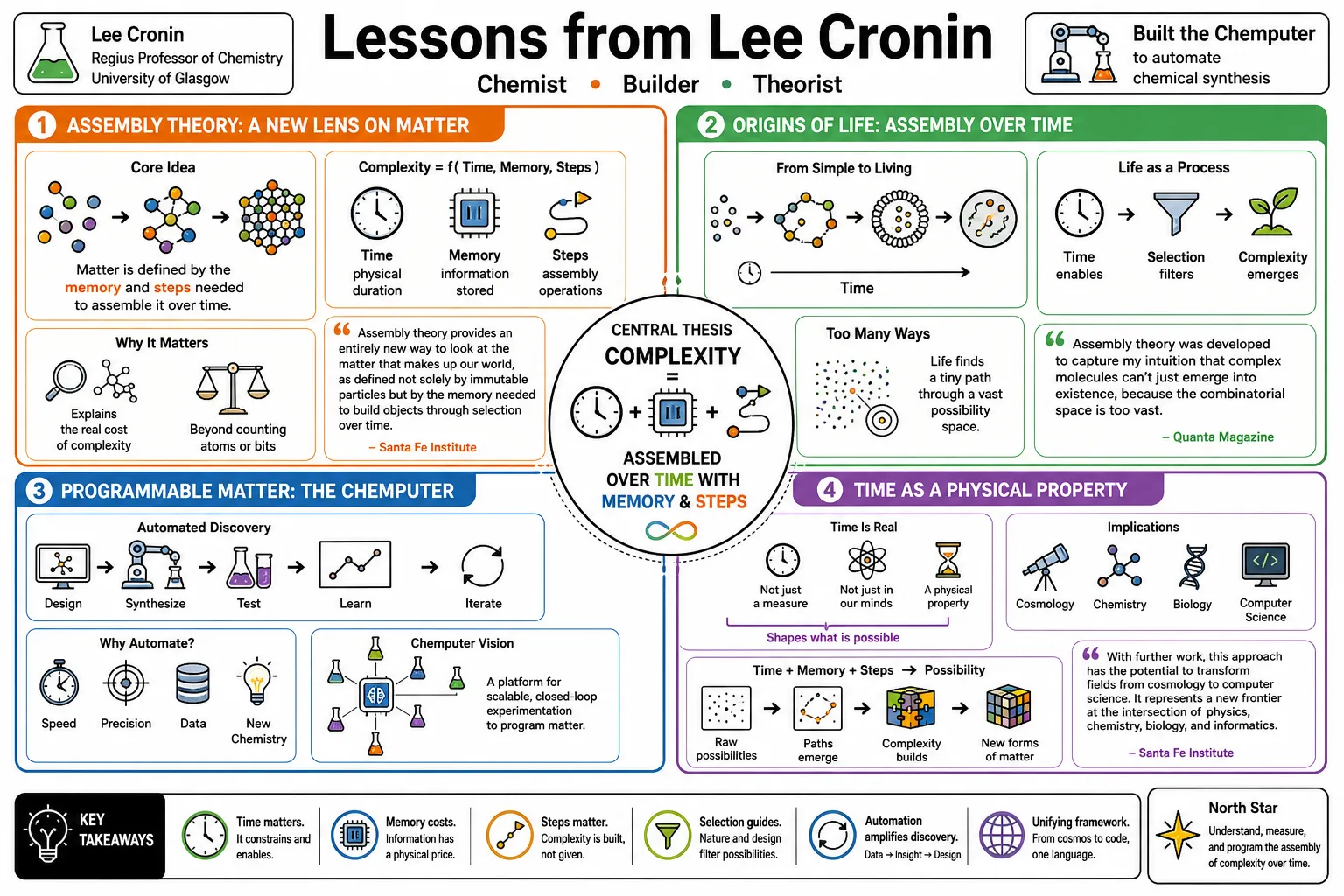
Lessons from Lee Cronin
Lee Cronin, Regius Professor of Chemistry at the University of Glasgow, built the "Chemputer" to automate chemical synthesis. He is best known for Assembly Theory, which measures a molecule's complexity by the physical memory and steps needed to assemble it over time. This profile covers his arguments on the origins of life and programmable matter, as well as his case for treating time as a physical property of the universe.
Part 1: Assembly Theory and the Physics of Complexity
- On Assembly Theory: "Assembly theory provides an entirely new way to look at the matter that makes up our world, as defined not solely by immutable particles but by the memory needed to build objects through selection over time." — Source: Santa Fe Institute
- On combinatorial space: "Assembly theory was developed to capture my intuition that complex molecules can't just emerge into existence, because the combinatorial space is too vast." — Source: Quanta Magazine
- On scientific unification: "With further work, this approach has the potential to transform fields from cosmology to computer science. It represents a new frontier at the intersection of physics, chemistry, biology, and information theory." — Source: Santa Fe Institute
- On measuring complexity: "If you want to understand if a molecule was produced by a living system or a random process, you must count the minimum number of steps required to build it from basic building blocks." — Source: Lex Fridman Podcast
- On the Assembly Index: "The assembly index is a measurable indicator of complexity. It allows us to objectively quantify how much selection was required to produce a specific object." — Source: PNAS
- On memory in physics: "Physics traditionally deals with states and laws, but assembly theory introduces memory as a physical requirement for the universe to construct complex structures, rather than simply mathematical laws." — Source: Aeon
- On breaking symmetry: "To make a complex molecule, the universe has to break symmetry repeatedly. Each step of assembly is a recorded memory of a symmetry-breaking event." — Source: Lex Fridman Podcast
- On physical history: "An object's complexity is literally its history. You cannot separate a complex molecule from the time and selection required to assemble it." — Source: Quanta Magazine
- On identifying selection: "When we see a molecule with a high assembly index, we are seeing undeniable evidence of historical selection." — Source: Nature Communications
- On the limits of randomness: "Randomness cannot reliably produce molecules with an assembly index above 15. The combinatorial explosion makes it mathematically impossible without a guided process." — Source: University of Glasgow
Part 2: Time as a Fundamental Property
- On the nature of time: "Time plays a fundamental role in understanding the development of novelty and creativity in the universe. It is more than a simple coordinate; it is the engine of creation." — Source: Glasp
- On consciousness and time: "My intuition is that the mechanism of consciousness requires time to be fundamental. You cannot have experience without the physical passage of time." — Source: Consciouscentric
- On time as memory: "In assembly theory, time is essentially the same thing as information, memory, causation, and selection. They are all made physical because they are features of objects." — Source: Medium
- On the universe's limits: "The universe is too big to contain itself, and the universe is not big enough to contain the future. Time is what allows the universe to continuously invent new states." — Source: Distillify
- On physical time: "Time must be a physical property of the universe, because it takes physical time to search through combinatorial space and assemble novelty." — Source: Big Think
- On the illusion of static physics: "Standard physics treats time as reversible, but when you look at complex molecules, the history of their assembly proves that time has a strict, irreversible direction." — Source: Aeon
- On creativity in physics: "The universe is infinitely creative. It uses time to test configurations, store the successful ones as memory, and build upon them." — Source: Consciouscentric
- On causality: "Causation is physical. You cannot build a complex molecule without the prior existence of simpler building blocks, meaning causality is physically encoded in the object's structure." — Source: Lex Fridman Podcast
- On time and objects: "We have to stop thinking of time as a background stage and start recognizing that objects themselves are structures built out of time." — Source: UCR
Part 3: The Origin of Life and the Biology Gap
- On origin of life research: "Origin of life research is a scam when researchers believe that solving a single aspect of the process will cause everything else to fall into place, rather than acknowledging the larger gap." — Source: Reddit Science AMA
- On the transition to biology: "I don't think people understand that evolution had to occur before biology, and there's a massive gap between complex chemistry and the first biological cell." — Source: Lex Fridman Podcast
- On synthetic biology limits: "Synthetic biologists are not able to make a fully artificial cell. It is not currently possible to do this in the laboratory. That means there's some non-genomic information in the cell that we don't know how to copy yet." — Source: Five With The Ral
- On life as an event: "Life is not a magic spark; it is a threshold of complexity where chemical memory becomes stable enough to reliably reproduce and undergo open-ended selection." — Source: The Well
- On RNA world: "I am skeptical that alien life, or even the earliest life on Earth, necessarily relied on RNA. RNA is too complex to be the absolute starting point of evolution." — Source: Five With The Ral
- On defining life: "Instead of looking for specific molecules like DNA, we should define life by the physical process of information processing and selection that allows objects to exist in high-combinatorial spaces." — Source: Lex Fridman Podcast
- On continuous emergence: "Life wasn't a singular lightning strike. It was a continuous bootstrapping process where simple molecular machines slowly gained the ability to dictate the assembly of other machines." — Source: University of Glasgow
- On the physics of life: "Biology is just chemistry that has remembered how to survive. To understand the origin of life, we need to understand the physics of how chemical memory is established." — Source: Aeon
- On experimental origins: "We cannot rely on philosophizing about the origin of life. We have to build chemical engines in the lab that search for the threshold of open-ended evolution." — Source: Big Think
Part 4: The Chemputer and Programmable Matter
- On the Chemputer: "The Chemputer is a universal chemical compound synthesis machine. It treats chemical synthesis as a form of computation where reaction code is executed on reconfigurable hardware." — Source: arXiv
- On digitizing chemistry: "Our goal is to 'app' chemistry, similar to how Apple transformed music, allowing for the discovery and distribution of chemical procedures in a digital, shareable format." — Source: The Guardian
- On universal synthesis: "By creating a Chemical Synthesis Turing Machine, we can move chemistry away from manual, labor-intensive processes toward a standardized, programmable format." — Source: PNAS
- On the Chempiler: "We built an AI-driven compiler, the chempiler, that translates chemical programs written in standard languages into physical chemical outputs through a robotic platform." — Source: Medium
- On reproducibility: "The biggest problem in chemistry is reproducibility. If you encode the synthesis as a digital program run by a Chemputer, you guarantee that anyone in the world can replicate the exact molecule." — Source: University of Glasgow
- On error correction in chemistry: "In chemical synthesis, error correction is a requirement for universality. This ties directly back to assembly theory, as a molecule's practical synthesizability limits its assembly index." — Source: arXiv
- On democratizing science: "If we can digitize synthesis, we can send a drug's code to a hospital anywhere in the world, and their local Chemputer can print the medicine on demand." — Source: TEDxCERN
- On code and matter: "We are blurring the line between software and matter. When a chemical recipe becomes a strict algorithm, the molecule itself becomes the output of a computation." — Source: The Guardian
- On the future of labs: "The chemistry lab of the future will not look like a room full of glass flasks; it will look like a server farm for synthesizing molecules." — Source: StackExchange
Part 5: Artificial Life and Synthetic Chemistry
- On creating alien life: "My drive to create artificial life in the laboratory comes from the sadness that our causal cones will likely never overlap with actual extraterrestrial life." — Source: Lex Fridman Podcast
- On the definition of artificial: "Creating artificial life doesn't mean building a robot; it means starting from inorganic chemicals and forcing them to cross the threshold into open-ended evolution." — Source: Big Think
- On the inorganic domain: "There is no physical law that says life must be carbon-based. If we can map the transition from chemistry to biology, we can theoretically initiate it in completely inorganic systems." — Source: University of Glasgow
- On life as hardware: "Biology is the most advanced manufacturing technology in the universe. If we can build artificial life from scratch, we master the ultimate form of nanotechnology." — Source: Lex Fridman Podcast
- On the ultimate experiment: "The ultimate proof of understanding life is not finding it on Mars, but compiling it from scratch in a machine here on Earth." — Source: The Well
- On chemical evolution: "In our lab, we use robotic systems to subject droplet networks to evolutionary pressure. We are trying to find the spark where chemistry starts optimizing itself." — Source: Nature Communications
- On synthetic consciousness: "If we successfully build an artificial chemical system capable of open-ended evolution, we will eventually have to ask if it is capable of rudimentary experience." — Source: Consciouscentric
- On biological exclusivity: "Earth's biology is just one specific solution to the problem of existence. By building artificial life, we are trying to find the other solutions that the universe allows." — Source: Aeon
- On the danger of life: "Creating life in the lab requires extreme caution, not because of a sci-fi monster, but because an optimizing chemical system could consume resources unpredictably." — Source: Lex Fridman Podcast
Part 6: Aliens and the Search for Extraterrestrial Life
- On alien biochemistry: "Alien life will likely be much stranger than we anticipate. It is highly improbable that they will use the exact same molecular machinery that we do." — Source: Five With The Ral
- On isolated causal cones: "Every star in the sky probably has planets and life is probably emerging on these planets. But I think the combinatorial space is so different... our causal cones are never going to overlap or not easily." — Source: Lex Fridman Podcast
- On agnostic biosignatures: "Assembly theory was designed as an agnostic biosignature. If we find a molecule with an assembly index above 15 on Titan or Mars, we know a complex selective process created it, regardless of its chemistry." — Source: Wikipedia
- On the ubiquity of life: "The universe is built to generate complexity. Given enough time and chemical variety, the emergence of life is a statistical inevitability." — Source: UCR
- On finding intelligence: "We assume alien intelligence will communicate via radio waves, but true intelligence might simply manifest as the capacity to build molecules of extreme assembly complexity." — Source: Lex Fridman Podcast
- On Fermi's Paradox: "The reason we haven't seen aliens isn't because they don't exist; it's because the universe is so vast and the specific chemical histories required to bridge our causal cones are impossibly narrow." — Source: Quanta Magazine
- On detecting aliens: "Instead of looking for specific atmospheric gases, we should send mass spectrometers to space to look for any molecular structure that is too complex to form by chance." — Source: NASA Astrobiology
- On alien technology: "If we encounter alien technology, it will likely be indistinguishable from their biology. The separation between machine and organism is a uniquely human artifact." — Source: Big Think
- On the nature of first contact: "First contact won't be a conversation; it will be the discovery of a physical artifact or molecule that definitively proves a history of non-random selection." — Source: The Well
Part 7: Evolution Before Biology
- On pre-biological selection: "Evolution did not start with DNA. Assembly theory posits that there is a mechanism for selection that occurs in chemistry long before genes ever emerge." — Source: Five With The Ral
- On chemical survival: "Before cells existed, molecules had to survive. The ones that persisted were the ones that could influence their environment to assemble more of themselves." — Source: Lex Fridman Podcast
- On the origin of memory: "Memory in the universe didn't begin with brains or DNA; it began the first time a molecule's structure biased the probability of a similar structure forming." — Source: Aeon
- On expanding the evolutionary paradigm: "Darwinian evolution is a special case of a broader physical principle. The universe naturally selects for objects that can maintain their complexity against entropy." — Source: Quanta Magazine
- On the ladder of complexity: "There is no missing link between chemistry and biology; there is a continuous ladder of increasing assembly complexity driven by environmental selection." — Source: PNAS
- On autocatalysis: "Autocatalytic sets are the precursor to life. When a network of chemicals starts catalyzing its own formation, it effectively 'remembers' its own existence." — Source: University of Glasgow
- On environmental programming: "The early Earth provided more than the ingredients for life; the fluctuations in temperature and chemistry provided the programming instructions that drove early selection." — Source: Lex Fridman Podcast
- On the necessity of death: "Even in pre-biology, destruction is necessary. Molecules must break apart to free up resources, driving the selection for more stable and resilient structures." — Source: Big Think
- On information theory in chemistry: "Evolution before biology is purely an information theory problem: how does a physical system extract information from its environment to prevent its own decay?" — Source: Santa Fe Institute
- On the inevitability of complexification: "Once a chemical system crosses a certain threshold of memory, it becomes easier to build more complex things than to revert to simpler states. The universe ratchets upwards." — Source: UCR
Part 8: Computing, Memory, and the Universe
- On universal computation: "The universe is not a simulation, but it is engaged in computation. It computes the future by selecting from the combinatorial possibilities of the present." — Source: Lex Fridman Podcast
- On the limits of algorithms: "Algorithms operate in a pre-defined space. The universe operates in an open-ended space where the rules of assembly can change as new structures emerge." — Source: Quanta Magazine
- On the definition of memory: "Memory is more than data storage; in the physical universe, memory is the specific sequence of operations required to build an object in the present." — Source: Medium
- On chemical computation: "A beaker of reacting chemicals is performing parallel computation on a scale that dwarfs traditional silicon microprocessors, simply by exploring combinatorial space." — Source: arXiv
- On the Turing limit: "When we build the Chemputer, we are testing the Turing limits of physical matter, asking if we can universally program the assembly of any physically possible molecule." — Source: PNAS
- On the physics of information: "Information is physical. It has mass and takes up space because information is simply the constraints on how an object was assembled." — Source: Santa Fe Institute
- On AI in chemistry: "Artificial intelligence is valuable for chemistry because it can navigate the vast combinatorial space of molecular assembly faster than human intuition." — Source: The Guardian
- On reality as a construct: "Reality is constructed through the accumulation of assembly steps. The more steps required to build a feature of the world, the more permanent it becomes." — Source: Consciouscentric
- On the role of observers: "Observers are simply objects with extremely high assembly indices that have gained the ability to measure the assembly of the environment around them." — Source: Lex Fridman Podcast
- On the future of discovery: "The future of science lies in recognizing that matter and information are identical. Once we map the assembly space of the universe, we can program matter as easily as software." — Source: TEDxCERN