Lenny Rachitsky is a former Airbnb product lead who transitioned into writing one of the most widely read newsletters on software development and growth. He is best known for systemizing the tacit knowledge of tech operators into actionable frameworks like the "racecar" growth model and the GAIN feedback system. This profile catalogs his specific methodologies for building products, structuring teams, and scaling companies from initial traction to enterprise maturity.
Part 1: The Product Manager's Role and Mindset
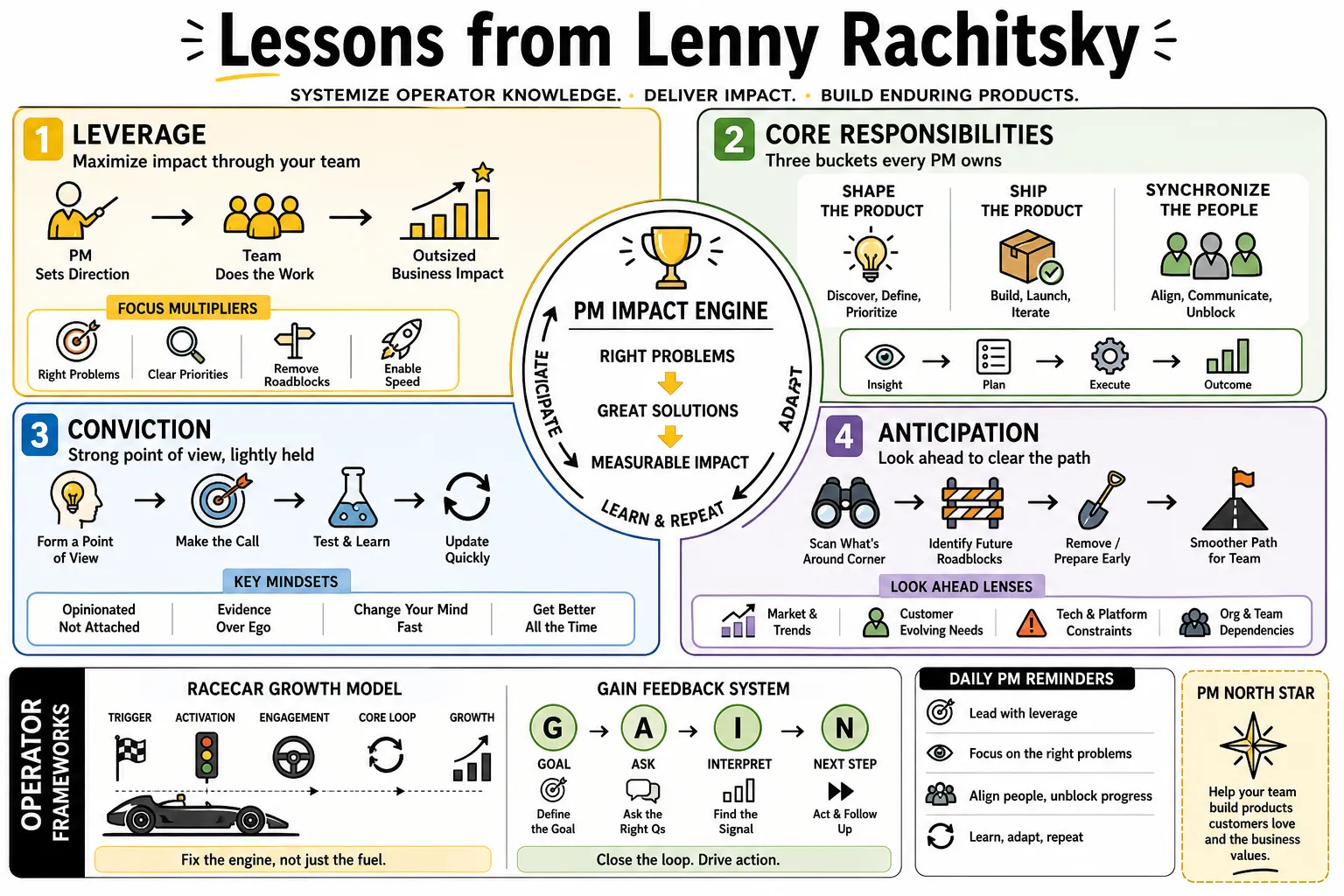
- On Leverage: "Your job as a PM is to deliver business impact by marshaling the resources of your team to identify and solve the most impactful customer problems." — Source: [Lenny's Newsletter]
- On Core Responsibilities: The product manager role breaks down into three concrete buckets: shape the product, ship the product, and synchronize the people. — Source: [Lenny's Newsletter]
- On Conviction: Great product managers always have a point of view, but they hold it loosely and are ready to quickly change their stance when presented with new information. — Source: [EarlyNode]
- On Anticipation: The best product managers look ahead to anticipate what is around the corner so they can clear roadblocks before the team even encounters them. — Source: [EarlyNode]
- On Falling in Love with the Problem: You should spend the majority of your time researching the problem space and customer pain points rather than brainstorming solutions. — Source: [Medium]
- On The Smallest Possible Product: Build the minimum version that enables user feedback, then evolve based on what you learn instead of over-investing in an unproven concept upfront. — Source: [Medium]
- On Brainstorming: Large group brainstorms are rarely where great ideas come from; the best insights usually surface through direct customer interviews and data dives. — Source: [Medium]
- On Raising the Bar: Resist the urge to settle for good enough. Push your team to produce clearer documents, run more valuable meetings, and design better user experiences. — Source: [Lenny's Newsletter]
- On Becoming a Product Manager: The most reliable way to transition into product management is to find internal opportunities at your current company to solve product-like problems before applying elsewhere. — Source: [EarlyNode]
- On Growth vs. Product: Most of product management is fundamentally about growth, whether you are trying to grow a metric, a business outcome, or a user base. — Source: [EarlyNode]
Part 2: The Habits of Great Product Managers
- On Communication: People judge the quality of your thinking by the quality of your writing and speaking, making clarity a primary job requirement. — Source: [Aaron Abraham]
- On Reliability: Build an aura of "I've got this." Colleagues should feel absolute confidence that if you take on a task, it will be completed without needing follow-up. — Source: [Lenny's Newsletter]
- On Hunting for Misalignment: Great product managers proactively look for cases where people have different information or conflicting goals and push everyone back into alignment. — Source: [Lenny's Newsletter]
- On Ruthless Prioritization: Focus is the greatest gift you can give a team, which means getting comfortable saying no to almost everything. — Source: [EarlyNode]
- On Protecting the Team: A manager must act as a filter against outside noise and executive whims so engineers and designers can stay in a flow state. — Source: [Lenny's Newsletter]
- On Looking for Blockers: You should endlessly hunt for bottlenecks or unmade decisions that are slowing the team down. — Source: [Lenny's Newsletter]
- On Building the Leadership Triad: The product manager must work as a single, unified leadership unit alongside their engineering manager and design manager. — Source: [Lenny's Newsletter]
- On Connecting Work to Mission: Frequently remind the team why their current project matters in the context of the company's larger mission to maintain motivation. — Source: [Lenny's Newsletter]
- On Amplifying Team Success: Give credit away constantly and celebrate the specific contributions of your teammates in public settings. — Source: [Lenny's Newsletter]
- On Bringing Good Vibes: Make the team a place where people actually want to work by maintaining a positive and productive environment. — Source: [Lenny's Newsletter]
Part 3: The Mechanics of Growth
- On Sustainable Growth: Real growth comes from a compounding engine or flywheel, not a series of one-off marketing hacks. — Source: [Creator Lab]
- On Core Growth Engines: There are four primary engines for consumer and B2B growth: performance marketing, virality, content/SEO, and direct sales. — Source: [Creator Lab]
- On Turbo Boosts: PR events, product launches, and influencer campaigns are turbo boosts that provide temporary spikes but cannot sustain long-term growth on their own. — Source: [Creator Lab]
- On Lubricants: Growth lubricants are the optimizations that make your main engine run smoother, such as improving conversion rates or reducing signup friction. — Source: [Creator Lab]
- On Fuel: Your growth engine is useless without fuel, which is the underlying market demand and the resources you pour into capturing it. — Source: [Creator Lab]
- On Virality: True virality only works when the product itself is remarkable enough that users naturally want to tell their friends about it. — Source: [Creator Lab]
- On Content as an Engine: SEO and user-generated content create highly scalable, self-reinforcing loops if the product naturally generates public artifacts. — Source: [Creator Lab]
- On Paid Ads: Paid acquisition is often better utilized as a secondary accelerant rather than the primary engine for an early-stage startup. — Source: [Kern.al]
- On Scaling Planning: The W Framework organizes growth planning by passing strategy down, receiving bottom-up proposals, integrating them at the top, and securing final team buy-in. — Source: [First Round Review]
Part 4: B2B and Enterprise Strategy
- On The Layering Game: You do not switch from product-led growth to sales-led growth; you layer an enterprise sales motion on top of your self-serve base. — Source: [Lenny's Newsletter]
- On Organic Inbound: Word of mouth remains the most powerful growth channel for top B2B companies because it indicates strong product-market fit. — Source: [Lenny's Newsletter]
- On The Enterprise Trap: Eighty percent of companies abandon their product-led initiatives once they start chasing enterprise buyers, leading to a dried-up pipeline. — Source: [Lenny Rachitsky YouTube]
- On Product-Led Sales: The modern enterprise bridge involves using product usage data to identify exactly which self-serve accounts are ready for a sales conversation. — Source: [Lenny Rachitsky YouTube]
- On Retention Before Acquisition: You must secure habitual product usage and retention before trying to scale acquisition, otherwise you are just filling a leaky bucket. — Source: [Lenny Rachitsky YouTube]
- On Singular vs. Multiplayer Mode: Product-led growth works best for collaboration tools with one-to-many relationships, while singular tools often require immediate outbound sales. — Source: [Lenny Rachitsky YouTube]
- On Reaching One Million ARR: The median time for top-tier B2B startups to hit one million dollars in annual recurring revenue is roughly two years from founding. — Source: [Kern.al]
- On Outbound Sales from Day One: If your product requires complex integration or behavioral changes, founders must lead outbound sales manually from the very beginning. — Source: [Lenny's Newsletter]
- On Winning Against the Status Quo: In B2B, your biggest competitor is rarely another startup; it is the status quo of spreadsheets, pen and paper, or doing nothing. — Source: [Podcast Addict]
Part 5: Airbnb Lessons and Scaling Marketplaces
- On Culture as a Competitive Advantage: Obsessing over values and internal rituals creates a tangible competitive advantage in hiring, retention, and execution speed. — Source: [Lenny's Newsletter]
- On Crystallizing the Problem: Do not just set a numerical goal; clearly define the exact customer or business problem your team is attempting to solve. — Source: [Lenny's Newsletter]
- On Thinking Bigger: Set uncomfortable goals that force the team to abandon incremental thinking and design entirely new approaches to the work. — Source: [Lenny's Newsletter]
- On Working Backward: Imagine the perfect eleven-star customer experience in detail, then work backward to build what is actually feasible today. — Source: [Lenny's Newsletter]
- On Autonomous Units: Give small teams a clear goal and the dedicated resources to own it completely without waiting on dependencies. — Source: [Lenny's Newsletter]
- On Lead Bullets: Marketplaces are usually built by layering many small, effective operational levers over time rather than discovering one magic silver bullet. — Source: [Lenny Rachitsky YouTube]
- On Supply-First Growth: Eighty percent of successful marketplaces focus entirely on building high-quality supply first, trusting that demand will naturally follow. — Source: [Sharetribe]
- On Removing Friction: Airbnb's transition to Instant Book drastically increased conversion by eliminating the friction of waiting for host approval. — Source: [Sharetribe]
- On Kickstarting Supply: Early marketplaces require unscalable methods like manual data scraping or door-to-door sales to secure the first cohort of users. — Source: [Lenny's Newsletter]
Part 6: Hiring and Building Teams
- On Hiring for Ambiguity: The most important trait to screen for in a product manager is their ability to navigate ambiguity and put structure around messy problems. — Source: [Podcast Addict]
- On The Superpower Question: Ask candidates what they are better at than most other people to understand their primary leverage point in a team setting. — Source: [Lenny's Newsletter]
- On The Sibling Test: Asking candidates what their siblings or parents would say about them cuts through rehearsed corporate answers and reveals genuine self-awareness. — Source: [Podcast Addict]
- On The Reference Question: Ask candidates directly what their previous colleagues will say during a reference check to force honesty about their weaknesses. — Source: [Lenny's Newsletter]
- On Waiting to Hire: Early-stage founders should hold off on hiring their first product manager for as long as possible, keeping direct ownership of the product themselves. — Source: [Lenny's Newsletter]
- On The Glue of the Team: If a product manager is not liked or respected by their engineers and designers, they will fail regardless of their technical or strategic skills. — Source: [Lenny's Newsletter]
- On Testing Grit: Asking candidates about the hardest thing they have ever done reveals their baseline for difficulty and resilience. — Source: [Levels.fyi]
- On Controversial Decisions: Having candidates describe a controversial product decision they were part of tests their ability to navigate conflict and tell a cohesive story. — Source: [Coda]
- On Unfair Secrets: Ask experienced hires for one unfair secret they have learned about making teams move faster to gauge their depth of operational insight. — Source: [Lenny's Newsletter]
Part 7: Performance, Feedback, and Leadership
- On Framing Feedback: Start difficult conversations by naming a shared goal so the recipient views the feedback as a path to success rather than an attack. — Source: [Lenny's Newsletter]
- On Action and Impact: Describe specific, observable behaviors without judgment, then explicitly state the impact those actions had on the team or the business. — Source: [Lenny's Newsletter]
- On Wise Feedback: Preface tough feedback by stating you have very high expectations and you know the person is capable of reaching them to boost follow-through. — Source: [Lenny Rachitsky YouTube]
- On Acknowledging Fault: Disarm resistance during a review by admitting how your own actions or lack of clarity as a manager might have contributed to the situation. — Source: [Lenny's Newsletter]
- On No Surprises: Formal performance reviews should never contain surprises; they are a synthesis of ongoing conversations aimed at career acceleration. — Source: [Lenny's Newsletter]
- On The Three Ws: Lock in behavior change by defining exactly what the change is, when it will happen, and who is accountable. — Source: [Lenny's Newsletter]
- On Self-Reviews: Employees should structure their self-assessments by stating the situation, the specific action they took, the quantified result, and the scope of impact. — Source: [Lenny's Newsletter]
- On The Pre-Read: Managers should provide a written review document ahead of the meeting that clearly outlines accomplishments, superpowers, and one or two specific development areas. — Source: [Lenny's Newsletter]
- On The LNO Framework: Teach reports to categorize tasks by leverage, neutral, or overhead to prevent them from over-investing time in low-impact work. — Source: [Lenny's Newsletter]
Part 8: Creator Economy and Community Building
- On The Power of Writing: Writing is a tool for thinking. You rarely know what you actually believe about a topic until you are forced to write it down. — Source: [Podcast Addict]
- On Extreme Iteration: High quality is the result of relentless refinement. Taking a single piece of content through dozens of drafts is what makes complex ideas feel simple and inevitable. — Source: [Podcast Addict]
- On Primary Research as a Moat: Doing primary research on behalf of others by interviewing dozens of experts creates value that is incredibly difficult for competitors to replicate. — Source: [Lenny Rachitsky YouTube]
- On The Community Flywheel: Content acts as the initial hook to get people in, but the peer-to-peer community is the glue that keeps them coming back and paying. — Source: [Substack]
- On Signal-to-Noise Ratio: Making a community paid and invite-only acts as a natural filter, ensuring that members are serious, professional, and invested in the conversation. — Source: [Substack]
- On Building With the Community: Set the initial tone and structure, but let power users lead the discussions and dictate the direction of new community initiatives. — Source: [Substack]
- On Platform Choice: Build your community on platforms where your audience already spends their working hours, which is why Slack works so well for tech professionals. — Source: [Lenny's Newsletter]
- On The Invisible Treadmill: Being a solo creator comes with a hidden treadmill of continuous deadlines; you must manage scope creep to maintain a high baseline of personal happiness. — Source: [Podcast Addict]
- On The Lindy Effect: Focus on creating evergreen content that will remain relevant for years rather than chasing temporary news cycles or platform trends. — Source: [Podcast Addict]
- On Career Transitions: The best career moves often come from responding to market pull rather than executing a rigid top-down plan. — Source: [Podcast Addict]