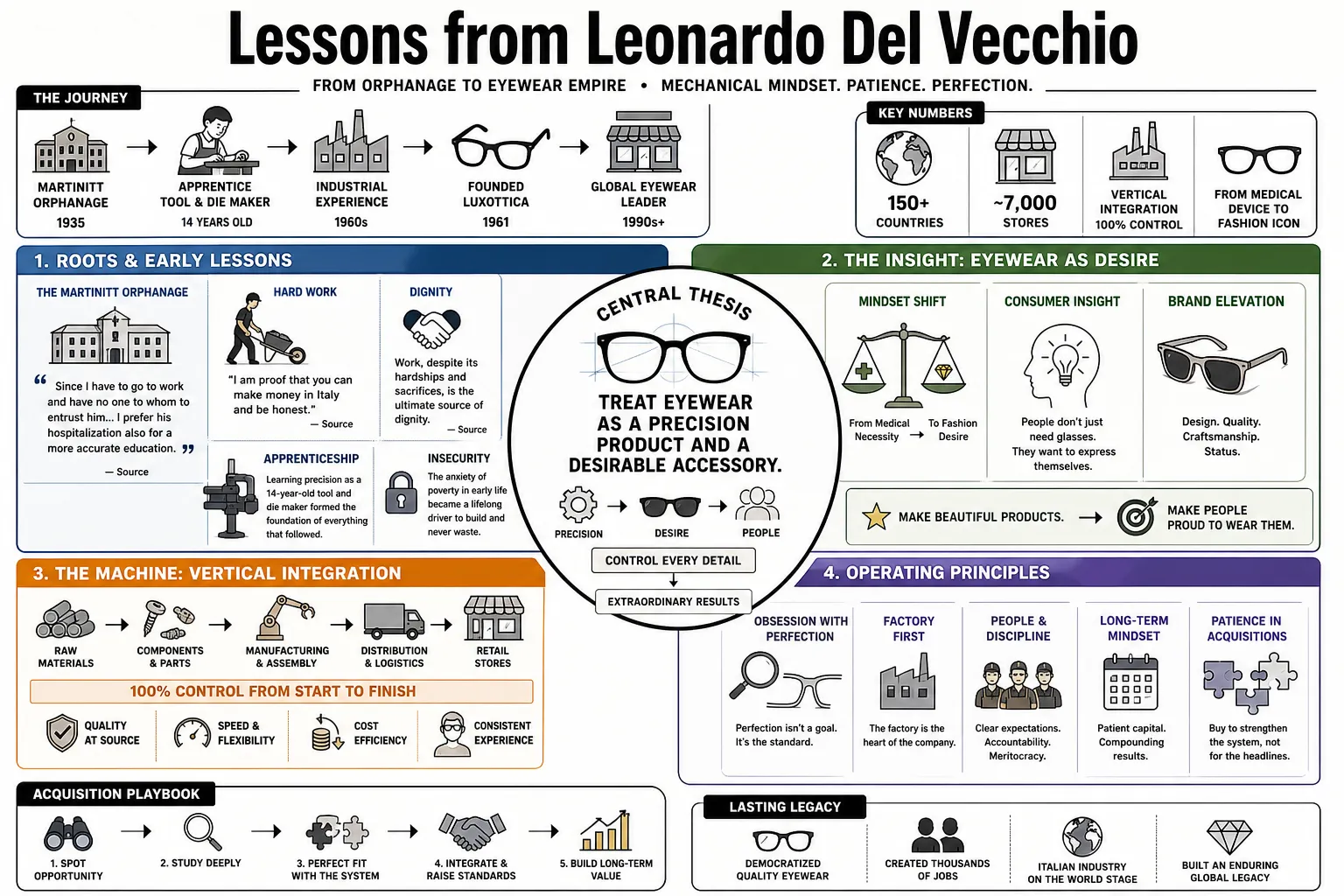
Leonardo Del Vecchio spent his early childhood in a Milanese orphanage before apprenticing as a metalworker and eventually founding Luxottica. He is known for realizing that eyeglasses could be sold as high-end accessories rather than just medical devices, vertically integrating his company to control everything from raw materials to the retail storefront. This profile documents his mechanical approach to building an eyewear empire, his patient acquisition strategies, and his unyielding demand for perfection on the factory floor.
Part 1: The Martinitt Orphanage & Early Lessons
- On The Martinitt Orphanage: "Since I have to go to work and have no one to whom to entrust him... I prefer his hospitalization also for a more accurate education." — Source: [Tommaso Ebhardt Biography]
- On Hard Work: "I am proof that you can make money in Italy and be honest." — Source: [QuoteFancy]
- On Dignity: Work, despite its inherent hardships and sacrifices, is the ultimate source of human dignity and self-respect. — Source: [Made in Italy Community]
- On Apprenticeship: Learning precision as a 14-year-old tool and die maker formed the manufacturing foundation that later defined Luxottica's entire production philosophy. — Source: [Forbes]
- On Insecurity: The anxiety of poverty in early life fueled a relentless pursuit of control, turning personal insecurity into a drive to build a business that could never be taken away. — Source: [Leaders League]
- On Success Secrets: There is no secret formula to success; it is simply the natural byproduct of decades of unyielding, daily hard work. — Source: [Hey.com]
- On Humble Beginnings: He frequently reminded his children and executives that true value comes from the effort you put into your work, not the title on your door. — Source: [Financial Times]
- On Overcoming Despair: During times of global crisis, he publicly urged people not to surrender to anger and despair, drawing on his own childhood survival instincts. — Source: [Made in Italy Community]
- On Self-Reliance: Growing up without a father taught him early on that if he wanted something built, he had to figure out how to build it himself. — Source: [Fondazione Leonardo Del Vecchio]
Part 2: The Art of Vertical Integration
- On The Value Chain: "Finally, after 50 years, two products which are naturally complementary, namely frames and lenses, will be designed, manufactured and distributed under the same roof." — Source: [Hartford Business]
- On Control: True market dominance requires controlling every stage of the product's life cycle, from raw metal to the storefront display. — Source: [Luxus Plus]
- On Manufacturing Evolution: Moving away from being a mere parts supplier to producing finished frames in the 1970s was the single most critical margin-expanding decision of his early career. — Source: [20/20 Magazine]
- On Retail Access: Acquiring LensCrafters in 1995 wasn't just about owning stores; it was about securing an unfiltered, direct pipeline to the end consumer. — Source: [Forbes]
- On Global Scale: "If you have to sail, it's better to choose the big sea rather than the small one." — Source: [Hey.com]
- On The Essilor Merger: Uniting the world's largest lens manufacturer with the leader in frames was the ultimate realization of a lifelong strategy for a fully integrated global player. — Source: [Luxuo]
- On Cost Advantages: Global operations should be leveraged to achieve massive cost advantages, but never at the expense of a single millimeter of product quality. — Source: [Bloomberg]
- On Self-Sufficiency: If a component is essential to the final product, you must eventually learn how to make it yourself better than your suppliers can. — Source: [Financial Times]
- On Distribution Networks: Buying Sunglass Hut provided an immediate, global footprint that no competitor could replicate organically within a decade. — Source: [Forbes]
Part 3: Elevating Eyewear to Fashion
- On Product Transformation: Eyeglasses are not just tools for correcting vision; they are highly visible accessories that sit on the most important part of the human body. — Source: [Fondazione Leonardo Del Vecchio]
- On The Armani Partnership: The 1988 licensing agreement with Giorgio Armani was the proof-of-concept that high-fashion brands could successfully extend their aesthetic into optical wear. — Source: [BS Capital Markets]
- On Brand Licensing: Managing the production for prestigious global brands requires treating their logo with the same exacting reverence as you treat your own. — Source: [Luxus Plus]
- On Design Integration: You cannot build a luxury accessory by simply slapping a designer label on a generic frame; the design language must be integrated into the manufacturing process from day one. — Source: [EssilorLuxottica]
- On Status Symbols: By partnering with houses like Chanel and Prada, he effectively turned a medical necessity into a global status symbol. — Source: [20/20 Magazine]
- On Consumer Psychology: People will pay a premium for eyewear when it stops being a reminder of failing eyesight and becomes a statement of personal identity. — Source: [Forbes]
- On Craftsmanship: The intersection of Italian fashion and eyewear is rooted in an uncompromising dedication to traditional craftsmanship married to modern scale. — Source: [Made in Italy Community]
- On Aesthetic Excellence: A frame must look beautiful even when it is sitting empty on a table, long before it is worn by the customer. — Source: [Tommaso Ebhardt Biography]
- On Market Creation: He didn't just capture market share in the optical industry; he actively expanded the market by making people want multiple pairs of glasses for different outfits. — Source: [Financial Times]
- On Luxottica's Identity: The company's DNA is a hybrid of a tough, industrial manufacturing floor and a refined Milanese design studio. — Source: [Bloomberg]
Part 4: The Predator’s Patience: M&A Strategy
- On Ray-Ban: When asked at a trade fair who would sell Ray-Ban following Luxottica's acquisition, he simply replied, "Me." — Source: [20/20 Magazine]
- On Growth Appetite: He operated with the philosophy that "appetite comes with eating," constantly scanning the horizon for the next logical acquisition. — Source: [Hey.com]
- On Strategic Patience: He was known as a predator in the market—observant and deeply patient, waiting years for the exact right moment to acquire a struggling competitor. — Source: [Leaders League]
- On The GrandVision Deal: "It is the realization of a vision that has guided my actions and the growth of Luxottica over all these years." — Source: [Forbes]
- On Brand Turnarounds: Ray-Ban was struggling when he bought it in 1999, but by applying his manufacturing discipline, he increased its sales tenfold. — Source: [Financial Times]
- On Oakley: Acquiring Oakley wasn't just about gaining a sports brand; it was about absorbing their superior lens technology and fierce customer loyalty. — Source: [Forbes]
- On Negotiation: You enter a negotiation not to compromise, but to secure the missing piece of your industrial puzzle on your own terms. — Source: [Tommaso Ebhardt Biography]
- On Consolidation: The fragmentation of the eyewear industry was an inefficiency he spent fifty years methodically correcting. — Source: [Bloomberg]
- On Merger Execution: A merger on paper is meaningless unless you can aggressively unify the underlying manufacturing floors and supply chains. — Source: [EssilorLuxottica]
Part 5: Leadership and Corporate Welfare
- On Employee Value: The passion and commitment of the factory workers are the fundamental, irreplaceable engine of the company's long-term success. — Source: [Fondazione Leonardo Del Vecchio]
- On Corporate Welfare: Providing free canteens for workers in the 1970s was not charity; it was a pragmatic investment in the dignity and health of his workforce. — Source: [Made in Italy Community]
- On Shared Success: On his 80th birthday, giving 9 million euros worth of shares to his employees was his way of acknowledging that he did not build the empire alone. — Source: [Forbes]
- On Leading by Example: He maintained a hands-on approach for decades, believing a CEO cannot manage a factory floor they haven't personally walked. — Source: [Leaders League]
- On Personal Responsibility: If a product fails, the failure belongs to the leadership, never to the worker on the assembly line. — Source: [Tommaso Ebhardt Biography]
- On Action Over Words: He was an intensely private, shy leader who preferred to let his company's balance sheet do the talking. — Source: [4Books]
- On Loyalty: You earn generational loyalty from your workforce by protecting their jobs during economic downturns, not by cutting them at the first sign of trouble. — Source: [Financial Times]
- On Community Investment: Building Luxottica in the remote Agordo valley proved that world-class industrial hubs can be built outside major cities if you invest in the local community. — Source: [Fondazione Leonardo Del Vecchio]
- On Executive Pragmatism: Recognizing when to step back and empower professional managers is the hardest, but most necessary, test of a founder's ego. — Source: [Medium]
- On Humanity in Business: He agreed to his biography strictly to pass on his core values: kindness, tenacity, hard work, talent, and heart. — Source: [Sperling & Kupfer]
Part 6: Perfectionism and Product Quality
- On Perfection: "If you want to stay in the market you must always seek perfection." — Source: [Hey.com]
- On Ambition: "I want to be the best at everything I do. That's all." — Source: [Hey.com]
- On Quality as a Strategy: Perfection is not an abstract ideal; it is a concrete, necessary baseline for keeping customers returning without complaint. — Source: [Leaders League]
- On Detail Orientation: The difference between a good pair of glasses and a great one lies in fractions of a millimeter on the hinge. — Source: [Tommaso Ebhardt Biography]
- On First Impressions: High-quality work leads to immediate repeat orders, eliminating the wasteful friction of revisions and returns. — Source: [Hey.com]
- On Compromise: Never cut the quality of the materials to save a penny on the margins, because the consumer will eventually feel the difference on their face. — Source: [20/20 Magazine]
- On Innovation: True perfection requires constantly upgrading your machinery long before your current equipment actually breaks. — Source: [EssilorLuxottica]
- On The Standard of Excellence: He operated under the fixed idea of "essere il più bravo" (being the best), applying it to every mold and lens that left his factory. — Source: [Apple Books]
- On Consistency: Delivering excellence must be so relentless and reliable that the product ultimately markets itself. — Source: [Hey.com]
Part 7: Financial Strategy & Long-Term Vision
- On Patient Capital: Through his holding company Delfin, he demonstrated that immense wealth should be deployed strategically over decades, not flipped for quarterly gains. — Source: [Financial Times]
- On Institutional Influence: Acquiring significant stakes in Mediobanca and Generali was a method of anchoring his industrial success within the bedrock of Italian finance. — Source: [Bloomberg]
- On Long-Term Horizons: A true entrepreneur builds a company with the assumption that it must outlast them by at least a century. — Source: [Forbes]
- On Diversification: While eyewear was his empire, he understood the necessity of diversifying his family's wealth into real estate, banking, and insurance to ensure generational stability. — Source: [Iconic Billionaires]
- On Governance: He viewed his investments in major financial institutions not just as passive holdings, but as platforms to push for more aggressive, modernized corporate governance in Italy. — Source: [Financial Times]
- On Market Timing: You don't build a massive net worth by rushing; you build it by hoarding cash and waiting for the market to undervalue the assets you want. — Source: [Leaders League]
- On National Pride: Despite operating globally, he deliberately used his capital to strengthen and protect the Italian corporate ecosystem from foreign hostile takeovers. — Source: [BS Capital Markets]
- On Structural Independence: Moving Delfin to Luxembourg wasn't merely about taxes; it was a structural play to ensure his holding company had the legal flexibility to operate as a global entity. — Source: [Financial Times]
- On Debt: Leverage is a tool to be used surgically for massive acquisitions, not a crutch for funding daily operations. — Source: [Tommaso Ebhardt Biography]
Part 8: Life, Wealth, and Legacy
- On Taxes and Ethics: "I don't like paying taxes, but I like sleeping at night." — Source: [AZQuotes]
- On Core Priorities: "The values of life are most important." — Source: [QuoteFancy]
- On Succession: Resolving family succession requires the same ruthless clarity and legal structuring as negotiating a corporate merger. — Source: [Financial Times]
- On Discipline: The habits formed in an orphanage—waking early, respecting the rules, and avoiding waste—are the exact habits required to run a multinational corporation. — Source: [Made in Italy Community]
- On Wealth: Money is simply the measuring stick of industrial success; it is never the underlying motivation for someone who genuinely loves to work. — Source: [Forbes]
- On Public Attention: He spent his life avoiding the press because time spent managing a public image is time stolen from managing the factory floor. — Source: [La Feltrinelli]
- On Ego: The truest mark of a confident founder is the willingness to hire executives who are significantly smarter than they are in specific domains. — Source: [EssilorLuxottica]
- On Endurance: Business is a marathon where the finish line constantly moves; the moment you stop running, you have already lost. — Source: [Medium]
- On Simplicity: His life proved that you can transform an entire global industry by adhering to a handful of simple, unyielding rules. — Source: [4Books]
- On Immortality: You cannot live forever, but you can build an institution so thoroughly integrated into the daily lives of millions that your work essentially becomes immortal. — Source: [Tommaso Ebhardt Biography]