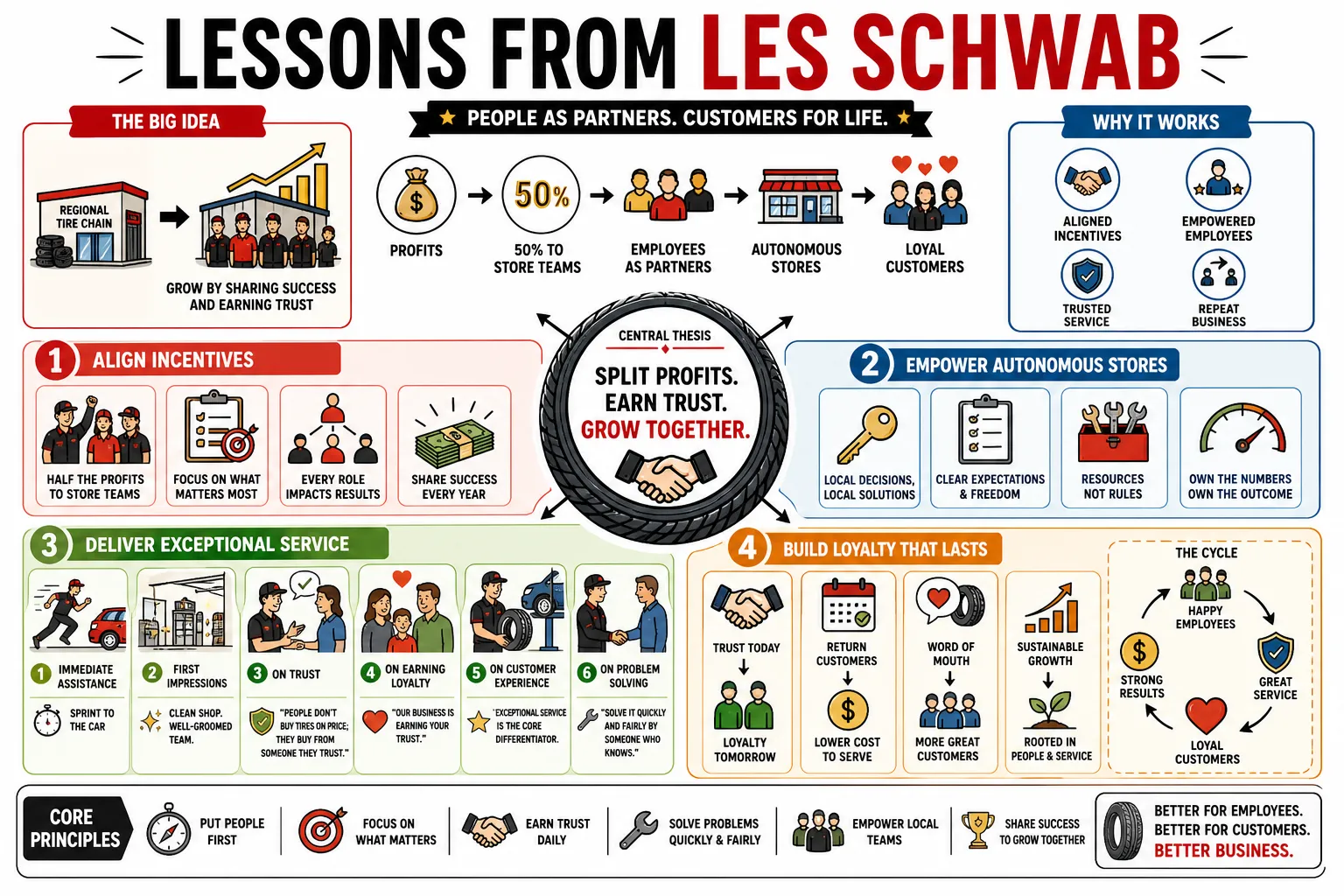
Lessons from Les Schwab
Les Schwab grew a regional tire chain into a major independent business in the Pacific Northwest by splitting profits directly with his employees. Giving half the profits to store managers and floor workers effectively turned hourly staff into partners. This collection details his practical methods for aligning incentives, running autonomous stores, and earning repeat customers.
Part 1: Customer Trust and Service
- On Trust: "People don't buy tires on price; they buy from someone they trust." — Source: [Biography Nuts]
- On Earning Loyalty: "Our business is earning your trust." — Source: [Les Schwab Official]
- On Customer Experience: "Exceptional service is the core differentiator in a crowded retail market, rather than a corporate policy." — Source: [Daniel Scrivner]
- On Immediate Assistance: "Employees sprinting to a customer's car as soon as they pull into the parking lot sets the tone for urgent, dedicated care." — Source: [Farnam Street]
- On First Impressions: "Cleanliness in the shop and well-groomed employees immediately signal professionalism and reliability to new customers." — Source: [Masters Invest]
- On Problem Solving: "Customers want their problem solved quickly and fairly by someone who knows what they're doing, rather than simply buying a product." — Source: [Blas.com]
- On Guaranteeing Work: "Standing behind every product and service you offer is what turns a one-time buyer into a lifelong patron." — Source: [Les Schwab Official]
- On Word of Mouth: "The best marketing strategy is a customer who leaves the store surprised by how well they were treated." — Source: [Daniel Scrivner]
- On Going the Extra Mile: "Small, unexpected conveniences like checking the brakes while fixing a tire build an unshakeable foundation of customer appreciation." — Source: [Masters Invest]
- On Reliability: "Being there when the customer needs you, especially during emergencies, is the ultimate test of a service-oriented business." — Source: [Peter Esho]
Part 2: The Profit-Sharing Philosophy
- On Sharing Wealth: "I encourage you to share profits with your employees... don't get jealous if they start to make some money... that's the whole idea." — Source: [Blas.com]
- On Legacy and Wealth: "I never could understand why more business people don’t share with their employees. What nicer thing can they do with their profits? You can’t take it with you." — Source: [Biography Nuts]
- On The 50% Solution: "Distributing half of a store's profits directly to the people running it transforms them from wage earners into business partners." — Source: [Farnam Street]
- On Incentive Alignment: "When front-line workers have a direct financial stake in the outcome, their goals naturally align with the long-term health of the company." — Source: [Masters Invest]
- On Ownership Mentality: "Profit sharing serves as a structural mechanism to make every employee think and act like an owner, rather than a discretionary bonus." — Source: [Daniel Scrivner]
- On Financial Transparency: "Trusting employees with the store's financial realities empowers them to make smarter, cost-conscious decisions." — Source: [Blas.com]
- On Sustainable Growth: "A business scales more effectively when the people driving the growth share proportionately in the rewards." — Source: [Peter Esho]
- On Motivation: "Financial participation provides a level of daily motivation that no amount of top-down management directives can achieve." — Source: [Farnam Street]
- On Retention: "Generous profit-sharing programs drastically reduce turnover, keeping institutional knowledge and customer relationships intact." — Source: [Masters Invest]
- On Fairness: "If you want people to work as hard as you do, you have to be willing to pay them according to the value they create." — Source: [Daniel Scrivner]
Part 3: Hard Work and Execution
- On Shortcuts: "Life is hard for the man who thinks he can take a short cut." — Source: [Peter Kang]
- On Repetition: "Whatever you do, you must do it with gusto, you must do it in volume. It is a case of repeat, repeat, repeat." — Source: [Hey.com]
- On Execution: "Ideas are cheap; the real value is built through the relentless, day-to-day execution of basic business fundamentals." — Source: [Masters Invest]
- On Consistency: "Success comes from doing the ordinary things extraordinarily well every single day, rather than relying on a single brilliant move." — Source: [Daniel Scrivner]
- On Hustle: "Physical energy and visible urgency in the workplace create an atmosphere of competence that customers can literally feel." — Source: [Farnam Street]
- On Overcoming Adversity: "Humble beginnings and early hardships forge the resilience necessary to navigate the brutal realities of retail." — Source: [Biography Nuts]
- On Focus: "Stick to what you know best and dominate that niche through sheer force of effort and volume." — Source: [Blas.com]
- On Setting the Pace: "Leaders must model the work ethic they expect; you cannot lead a fast-paced retail operation from behind a desk." — Source: [Masters Invest]
- On Discipline: "The unglamorous work of inventory management and store maintenance is exactly what separates great operations from mediocre ones." — Source: [Daniel Scrivner]
Part 4: Empowering Employees
- On Autonomy: "Pushing decision-making down to the store level ensures that choices are made by those closest to the customer." — Source: [Farnam Street]
- On Trusting Your Team: "If you hire the right people and align their incentives, you have to step back and let them run the operation." — Source: [Masters Invest]
- On Store Independence: "Treat each retail location as its own independent enterprise, giving the manager the freedom to adapt to their specific local market." — Source: [Daniel Scrivner]
- On Eliminating Bureaucracy: "Corporate bloat slows down response times; a decentralized structure keeps the business agile and responsive." — Source: [Peter Esho]
- On Responsibility: "Giving employees real authority means allowing them to make mistakes, provided they learn from them and protect the customer." — Source: [Blas.com]
- On Local Leadership: "A successful store manager must act as the mayor of their operation, deeply embedded in and accountable to their community." — Source: [Farnam Street]
- On Feedback: "Front-line workers possess the most accurate information about what the customer actually wants; management's primary job is to listen." — Source: [Masters Invest]
- On Micro-Management: "Constantly looking over the shoulder of your employees stifles their initiative and caps the company's potential." — Source: [Daniel Scrivner]
- On Empowerment: "True empowerment involves giving someone the tools, the training, and the financial upside, and then getting out of their way." — Source: [Blas.com]
Part 5: Leadership and Ego
- On Pride vs. Ego: "Pride commits us to do the job better. Ego tricks us into believing we can do no wrong." — Source: [Blas.com]
- On Humility in Leadership: "Pride in performance. Pride in accomplishments well done. But never confuse pride with ego." — Source: [Daniel Scrivner]
- On Admitting Mistakes: "The moment a leader believes their own myth, they stop learning and the business begins to stagnate." — Source: [Masters Invest]
- On Shared Credit: "A great founder deflects praise to the store managers and floor workers who actually interact with the customers daily." — Source: [Peter Esho]
- On Groundedness: "Staying connected to the daily realities of the shop floor prevents executives from making detached, academic decisions." — Source: [Farnam Street]
- On Self-Awareness: "Knowing what you don't know is a competitive advantage; hire people smarter than you and listen to them." — Source: [Blas.com]
- On Servant Leadership: "The role of headquarters is to provide the stores with the support they need to succeed, rather than issuing top-down commands." — Source: [Masters Invest]
- On Arrogance: "Corporate arrogance is the quickest way to alienate your workforce and your loyal customer base." — Source: [Daniel Scrivner]
- On Practicality: "Business theories matter less than the practical reality of whether a customer leaves your store happy and willing to return." — Source: [Biography Nuts]
Part 6: Hiring and Building People
- On Mutual Success: "I encourage you in every way possible to ‘Build People.’ If you make people under you successful, what happens to you? Aren’t you also then successful?" — Source: [Blas.com]
- On Promoting from Within: "Creating a strict policy of internal promotion ensures that every manager intimately understands the grunt work of the business." — Source: [Farnam Street]
- On Upward Mobility: "Showing entry-level tire technicians a clear, viable path to lucrative store management creates fierce loyalty." — Source: [Masters Invest]
- On Treating Employees Like Family: "When you genuinely care about the personal and financial well-being of your staff, they treat the business as their own." — Source: [Daniel Scrivner]
- On Hiring for Character: "Skills can be taught on the shop floor, but a strong work ethic and inherent honesty must be hired." — Source: [Blas.com]
- On Mentorship: "Senior managers have a core duty to identify and train the next generation of leaders within the company." — Source: [Peter Esho]
- On Institutional Knowledge: "Long-tenured employees are the most valuable asset a company has, as they carry the culture and operational secrets." — Source: [Farnam Street]
- On Opportunity: "The American dream functions in retail when the business structure rewards hard work over pedigree." — Source: [Masters Invest]
- On High Expectations: "Building people means holding them to an uncompromising standard of performance while providing the support they need to reach it." — Source: [Daniel Scrivner]
Part 7: Community and Reciprocity
- On Free Services: "Providing free flat repairs, regardless of where the tire was purchased, is an investment in goodwill that pays massive dividends." — Source: [Farnam Street]
- On Reciprocity: "When you give value to a community without immediately asking for money, you trigger a natural human desire to return the favor." — Source: [Blas.com]
- On Local Integration: "A business should be an active, visible participant in the local community, supporting schools and local causes." — Source: [Masters Invest]
- On Rural Markets: "Overlooked, smaller markets often harbor the most fiercely loyal customers if they are treated with genuine respect." — Source: [Daniel Scrivner]
- On Building Relationships: "Retail is a decades-long relationship built on repeated interactions of trust." — Source: [Peter Esho]
- On Generosity as Strategy: "Fixing a stranger's tire for free looks like an upfront cost, but functions as the cheapest and most effective customer acquisition tool." — Source: [Farnam Street]
- On Reputation: "In smaller communities, your reputation is your entire business; one bad interaction can cost you families of customers." — Source: [Masters Invest]
- On Doing the Right Thing: "Sometimes the best business decision is simply helping someone in a tough spot on the side of the road." — Source: [Blas.com]
- On Brand Identity: "A brand is the collective memory of how your employees made people feel during emergencies." — Source: [Daniel Scrivner]
- On Long-Term Trust: "Earning the right to sell someone their next set of tires starts years before they actually need them." — Source: [Farnam Street]
Part 8: Long-Term Vision and Growth
- On Independent Ownership: "Remaining independent allows a company to prioritize its employees and customers over the short-term demands of Wall Street." — Source: [Masters Invest]
- On Patient Capital: "True wealth and enduring businesses are built slowly, compounding small operational advantages over decades." — Source: [Blas.com]
- On Expanding Carefully: "The availability of trained, internal management talent should dictate growth timelines, rather than the mere availability of capital." — Source: [Daniel Scrivner]
- On Core Competencies: "Resist the urge to diversify into unrelated businesses; deep expertise in one specific area is highly defensible." — Source: [Peter Esho]
- On Reinvestment: "A significant portion of profits must continually be funneled back into improving store conditions and employee compensation." — Source: [Farnam Street]
- On Vendor Relationships: "Treat suppliers fairly and pay them promptly; strong supply chain relationships are critical during economic downturns." — Source: [Masters Invest]
- On Economic Moats: "A culture of extreme employee loyalty and unmatched customer service creates a barrier to entry that competitors cannot simply buy." — Source: [Blas.com]
- On Staying the Course: "As the company grows, the biggest threat is forgetting the basic, blue-collar principles that originally made it successful." — Source: [Daniel Scrivner]
- On Legacy: "The true measure of a founder's success is the number of employees they helped become financially secure." — Source: [Masters Invest]