Lessons from Lew Frankfort
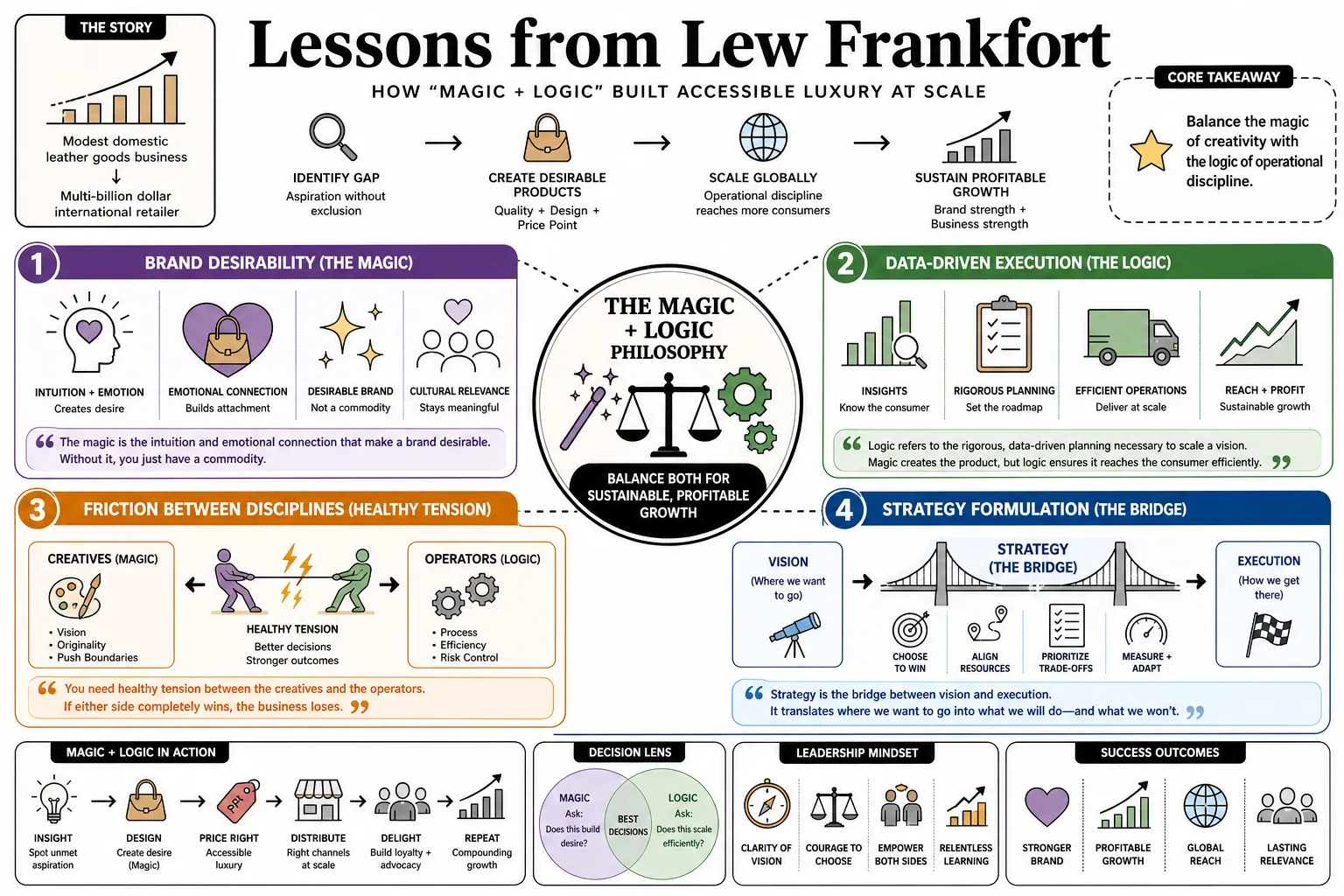
As CEO of Coach, Lew Frankfort turned a modest domestic leather goods business into a multi-billion dollar international retailer by identifying the gap that became the accessible luxury market. This collection outlines his "magic and logic" philosophy, detailing how he balanced creative intuition with strict operational discipline.
Part 1: The Magic and Logic Philosophy
- On Balancing Forces: "Sustainable, profitable growth requires a balance between two opposing but essential forces: the magic of creativity and the logic of operational discipline." — Source: [Bag Man: The Story Behind the Improbable Rise of Coach]
- On Brand Desirability: "The magic is the intuition and emotional connection that make a brand desirable. Without it, you just have a commodity." — Source: [92nd Street Y with Gary Vaynerchuk]
- On Data-Driven Execution: "Logic refers to the rigorous, data-driven planning necessary to scale a vision. Magic creates the product, but logic ensures it reaches the consumer efficiently." — Source: [McKinsey Author Talks]
- On Friction Between Disciplines: "You need healthy tension between the creatives and the operators. If either side completely wins, the business loses." — Source: [Bag Man: The Story Behind the Improbable Rise of Coach]
- On Strategy Formulation: "Strategy is the bridge between vision and execution. It translates the magic into a logical business plan." — Source: [Harvard Business Review]
- On Institutionalizing Magic: "You cannot rely on a single creative genius forever. You have to build systems that allow magic to be replicated and scaled." — Source: [Masters of Scale Podcast]
- On Avoiding Dilution: "As you grow, the logic often tries to override the magic to cut costs. Leaders must defend the creative core to prevent brand dilution." — Source: [92nd Street Y with Gary Vaynerchuk]
- On Left vs. Right Brain: "A great retail organization operates as a unified brain, marrying the analytical left with the intuitive right." — Source: [Bag Man: The Story Behind the Improbable Rise of Coach]
- On Measuring Success: "Logic allows you to measure the impact of your magic. If the numbers aren't following the creative shifts, you need to adjust." — Source: [McKinsey Author Talks]
- On The Final Formula: "Magic plus logic isn't a one-time initiative. It is the permanent operating system for a legacy brand." — Source: [Bag Man: The Story Behind the Improbable Rise of Coach]
Part 2: Defining Accessible Luxury
- On Spotting the Gap: "We recognized a massive white space between traditional European high luxury and standard mass-market leather goods." — Source: [Harvard Business Review]
- On Aspirational Pricing: "Accessible luxury means pricing a product high enough to maintain aspiration, but low enough to invite a broader demographic to participate." — Source: [Bag Man: The Story Behind the Improbable Rise of Coach]
- On Quality as the Baseline: "You cannot fake accessible luxury. The craftsmanship and materials must genuinely rival the high-end houses, even if the price does not." — Source: [92nd Street Y with Gary Vaynerchuk]
- On Shifting Demographics: "We realized that working women were gaining significant purchasing power and wanted professional, stylish bags that didn't require a month's salary." — Source: [Masters of Scale Podcast]
- On Redefining Value: "Value in our space isn't about being cheap. It is about the ratio of exceptional make and design relative to the retail price." — Source: [Bloomberg]
- On Market Positioning: "We refused to compete on price alone. We competed on the proposition that you could own a piece of luxury every day." — Source: [Bag Man: The Story Behind the Improbable Rise of Coach]
- On Consumer Psychology: "People want to feel good about what they carry. Accessible luxury provides that emotional lift without the financial guilt." — Source: [McKinsey Author Talks]
- On Category Creation: "When you invent a category, you have to educate the consumer on why it exists. We had to prove that our quality justified the new tier." — Source: [Harvard Business Review]
- On Sustaining the Niche: "The danger of accessible luxury is drifting too far in either direction. Go too high, you lose your base; go too low, you lose your halo." — Source: [Bag Man: The Story Behind the Improbable Rise of Coach]
Part 3: Customer Obsession and Empathy
- On Immersive Curiosity: "I frequently posed as a reporter in our stores just to watch how customers physically interacted with the products." — Source: [92nd Street Y with Gary Vaynerchuk]
- On Building Legacy Brands: "For an aspirational brand to become a legacy brand, everything comes down to a single product, a single consumer, and the relationship that they have." — Source: [Bag Man: The Story Behind the Improbable Rise of Coach]
- On Identifying Unmet Needs: "Consumers often cannot articulate what they want next. You have to observe their frustrations to find the white space." — Source: [Masters of Scale Podcast]
- On Rejecting Assumptions: "Never assume you know your customer better than they know themselves. The moment you stop asking questions, you start losing market share." — Source: [McKinsey Author Talks]
- On Generational Shifts: "Gen Z shares a surprising amount of DNA with the youth of the 1960s—they are deeply value-driven and demand absolute authenticity from brands." — Source: [Bloomberg]
- On Feedback Loops: "We built systems to ensure that what a store associate heard on the floor on Tuesday made it to the design team by Thursday." — Source: [Harvard Business Review]
- On Empathy as Strategy: "Understanding the consumer isn't a marketing tactic; it is the foundation of product development." — Source: [Bag Man: The Story Behind the Improbable Rise of Coach]
- On The Outsider Perspective: "Coming in without fashion experience allowed me to look at the business strictly through the eyes of the consumer, not the industry." — Source: [Masters of Scale Podcast]
- On In-Store Experience: "The physical store is the ultimate expression of the brand's empathy. It should feel like stepping into a solution." — Source: [92nd Street Y with Gary Vaynerchuk]
- On Relentlessness: "You have got to be tenacious, you have got to be relentless, and you have got to be curious about who is buying your product." — Source: [Bag Man: The Story Behind the Improbable Rise of Coach]
Part 4: Scaling and Growth Dynamics
- On Retail Fundamentals: "The combination of three metrics—traffic, conversion, and ticket—leads to a store's total sales. Everything else is secondary." — Source: [Bag Man: The Story Behind the Improbable Rise of Coach]
- On Goal Setting: "A well-run retail business not only measures traffic, conversion, ticket, and same-store sales, but combines that data to set and achieve new targets." — Source: [McKinsey Author Talks]
- On Global Manufacturing: "If you want to give consumers the best possible value, you must make products where the expertise lives, supervised by craftspeople who truly understand make." — Source: [Bloomberg]
- On Expanding Channels: "We didn't just build stores; we built a multi-channel engine incorporating catalogs and early e-commerce before aggressively scaling." — Source: [Harvard Business Review]
- On Managing Growth Limits: "Growth can disguise operational flaws. You have to audit your processes more harshly when revenue is climbing." — Source: [Masters of Scale Podcast]
- On Product Assortment: "As we scaled, we learned that broadening the assortment was dangerous if it diluted the core competency of leather goods." — Source: [Bag Man: The Story Behind the Improbable Rise of Coach]
- On Entering New Markets: "You cannot export an American brand directly to Asia without localizing the nuances of the in-store experience." — Source: [92nd Street Y with Gary Vaynerchuk]
- On Inventory Control: "Over-expansion often leads to excess inventory, which leads to discounting. Discounting is the fastest way to erode an aspirational brand." — Source: [McKinsey Author Talks]
- On Patience in Scaling: "We took our time testing the multi-channel approach domestically before we ever attempted to scale it internationally." — Source: [Bag Man: The Story Behind the Improbable Rise of Coach]
Part 5: Hiring and Team Building
- On Unconventional Resumes: "When I was recruited, they wanted two things: someone with zero fashion experience, and someone with good values." — Source: [Masters of Scale Podcast]
- On Immersive Interviewing: "I rely on immersive interviewing. I want to understand a candidate's behavioral fit and values, not just rehearse their resume." — Source: [McKinsey Author Talks]
- On Servant Leadership: "Managers that spend all of their time lifting their people up and serving their people—those are the people that never leave." — Source: [Bag Man: The Story Behind the Improbable Rise of Coach]
- On Career Development: "If you help employees leave the organization by building their resume and giving them exciting work, they actually end up staying longer." — Source: [92nd Street Y with Gary Vaynerchuk]
- On Cultural Fit: "You can teach someone the mechanics of retail, but you cannot teach them integrity or intrinsic curiosity." — Source: [Harvard Business Review]
- On Building Trust: "Trust within an executive team is built by publicly acknowledging mistakes and refusing to assign blame during a crisis." — Source: [Bag Man: The Story Behind the Improbable Rise of Coach]
- On Evaluating Talent: "I look for self-awareness above almost all other traits. Leaders who lack self-awareness inevitably damage the culture." — Source: [Masters of Scale Podcast]
- On Empowering Creatives: "You have to give designers the psychological safety to propose wild ideas without fear of immediate financial scrutiny." — Source: [92nd Street Y with Gary Vaynerchuk]
- On Retaining Top Performers: "The best way to keep top talent is to give them problems that are slightly too big for them to solve easily." — Source: [McKinsey Author Talks]
- On The Cost of Bad Hires: "A toxic high-performer will cost you more in cultural decay than they will ever make you in quarterly revenue." — Source: [Bag Man: The Story Behind the Improbable Rise of Coach]
Part 6: Leadership and Authenticity
- On The Fear of Failure: "A haunting fear of failure can be a powerful engine for a founder, as long as it drives preparation rather than paralysis." — Source: [Bag Man: The Story Behind the Improbable Rise of Coach]
- On Public Sector Roots: "My time in New York City government taught me how to operate with scarce resources and prioritize purpose over ego." — Source: [Harvard Business Review]
- On Managing Pressure: "The dark side of leadership is the isolation. You have to actively build a support system to maintain your mental health under pressure." — Source: [92nd Street Y with Gary Vaynerchuk]
- On Staying Grounded: "No matter how large the company gets, the CEO must still understand how the zipper on the flagship product functions." — Source: [Masters of Scale Podcast]
- On Authenticity in Crisis: "Consumers and employees can smell corporate spin. When things go wrong, plainspoken honesty is your most valuable asset." — Source: [McKinsey Author Talks]
- On Navigating Change: "Change management isn't about writing a memo; it is about proving to your team that the new direction is safer than staying still." — Source: [Bag Man: The Story Behind the Improbable Rise of Coach]
- On The Role of the CEO: "The primary job of the chief executive is to protect the brand's long-term equity from short-term financial pressures." — Source: [Harvard Business Review]
- On Vulnerability: "Owning your blind spots publicly gives your direct reports the permission to step up and fill those gaps." — Source: [92nd Street Y with Gary Vaynerchuk]
- On Leaving a Mark: "You don't measure a career by the market cap at retirement, but by the resilience of the culture you leave behind." — Source: [Bag Man: The Story Behind the Improbable Rise of Coach]
Part 7: Retail Strategy and Brand Legacy
- On Store Architecture: "A retail environment should dictate the mood of the shopper the moment they cross the threshold." — Source: [Harvard Business Review]
- On The Purpose of Physical Retail: "Stores are no longer just points of distribution; they are the primary physical manifestation of the brand's promise." — Source: [Masters of Scale Podcast]
- On Avoiding Complacency: "The moment a legacy brand assumes it has guaranteed relevance, it begins to die." — Source: [Bag Man: The Story Behind the Improbable Rise of Coach]
- On Brand Architecture: "We viewed the brand not as a single aesthetic, but as a framework that could adapt to different lifestyles while retaining its core DNA." — Source: [McKinsey Author Talks]
- On Adapting to Trends: "You must chase the consumer, not the competitor. If you only watch rivals, you will always be one step behind the market." — Source: [92nd Street Y with Gary Vaynerchuk]
- On Product Lifecycles: "We learned to ruthlessly edit our collections. Keeping a dying product alive out of nostalgia only confuses the customer." — Source: [Bag Man: The Story Behind the Improbable Rise of Coach]
- On Outlet Strategy: "Outlets serve a distinct purpose in inventory management, but they must be carefully ring-fenced so they don't cannibalize full-price perception." — Source: [Bloomberg]
- On Digital Integration: "E-commerce should remove friction, while the physical store should add emotion. They serve different but complementary roles." — Source: [Harvard Business Review]
- On Defending the Moat: "Your brand's moat is built entirely out of consumer trust. Every defect or poor customer service interaction removes a brick." — Source: [Bag Man: The Story Behind the Improbable Rise of Coach]
Part 8: The Next Chapter: Mentorship and Investing
- On Selecting Investments: "Through the Benvolio Group, I look for founders who possess that rare combination of relentless drive and deep consumer empathy." — Source: [Masters of Scale Podcast]
- On Founder Mindsets: "The best early-stage founders are obsessed with the problem they are solving, not just the valuation they want to achieve." — Source: [McKinsey Author Talks]
- On Applying Past Lessons: "The mechanics of scaling a consumer brand remain largely the same today as they were thirty years ago; only the channels have changed." — Source: [92nd Street Y with Gary Vaynerchuk]
- On Disruptive Brands: "Disruption in retail rarely comes from new technology alone. It comes from applying new technology to an age-old consumer frustration." — Source: [Bloomberg]
- On Advising Young CEOs: "My primary advice to new CEOs is to spend less time in boardrooms and more time on the shop floor." — Source: [Bag Man: The Story Behind the Improbable Rise of Coach]
- On Identifying Value: "An authentic origin story is one of the most underpriced assets a startup can have. You cannot manufacture heritage." — Source: [Harvard Business Review]
- On Sustainable Models: "Growth at all costs is a dangerous thesis for consumer brands. Profitable unit economics must be proven early." — Source: [McKinsey Author Talks]
- On Evaluating Markets: "I prefer investing in categories that feel stagnant. Complacent incumbents provide the best white space for energetic startups." — Source: [Masters of Scale Podcast]
- On The Long Game: "Building something of lasting value requires a multi-decade timeline. If you are only optimizing for the next quarter, you are trading." — Source: [Bag Man: The Story Behind the Improbable Rise of Coach]