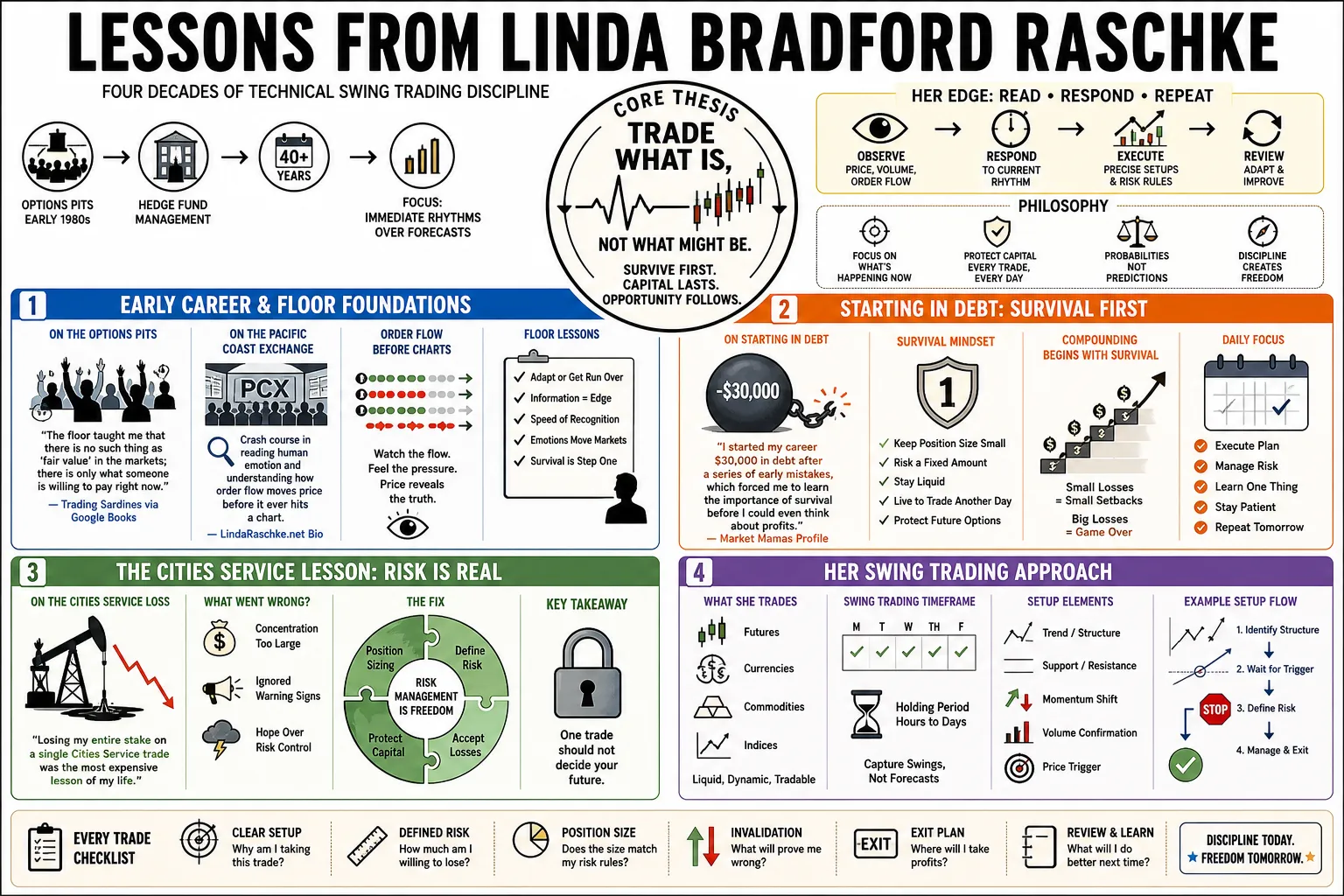
Lessons from Linda Bradford Raschke
Linda Bradford Raschke started on the floor of the Pacific Coast Stock Exchange in the early 1980s before moving into hedge fund management. She built a forty-year career on technical swing trading, favoring immediate market rhythms over the uncertainty of long-term forecasting. This profile breaks down the specific rules and setups she refined through four decades of daily trading.
Part 1: Early Career and Floor Foundations
- On the Options Pits: "The floor taught me that there is no such thing as 'fair value' in the markets; there is only what someone is willing to pay right now." — Source: Trading Sardines via Google Books
- On Starting in Debt: "I started my career $30,000 in debt after a series of early mistakes, which forced me to learn the importance of survival before I could even think about profits." — Source: Market Mamas Profile
- On the Pacific Coast Exchange: "My time on the PCX was a crash course in reading human emotion and understanding how order flow moves price before it ever hits a chart." — Source: LindaRaschke.net Bio
- On the Cities Service Loss: "Losing my entire stake on a single Cities Service trade was the most expensive lesson I ever paid for, but it cemented the rule that you never let one position ruin you." — Source: The New Market Wizards by Jack Schwager
- On Floor Resilience: "In the pits, if you let a bad trade affect your next one, you were eaten alive; you had to develop a short memory for pain." — Source: Chat With Traders Ep. 048
- On Early Mentorship: "I learned more from watching the old-timers on the floor handle losing streaks than I ever did from watching them make money." — Source: Better System Trader Interview
- On the Philadelphia Exchange: "Moving to the Philadelphia Exchange expanded my view of the markets and taught me that different venues have different 'personalities' and rhythms." — Source: Wikipedia Profile
- On the Transition to the Screen: "Moving from the floor to the screen was like learning to fly by instruments instead of sight; the data was the same, but the sensory inputs changed completely." — Source: Chat With Traders Ep. 154
- On Grit: "Success in this business isn't about brilliance; it's about the grit to get back up after the market knocks you down for the hundredth time." — Source: Trading Sardines Memoir
Part 2: The Logic of Price and Tape Reading
- On Price as the Primary Indicator: "Price is your only indicator today; everything else is a derivative that lags behind the actual truth of the tape." — Source: Scribd Strategy Guide
- On Manual Data Entry: "I still advise traders to jot down prices every five minutes manually; it’s the only way to internalize the flow and 'feel' the support and resistance levels." — Source: Substack Research Notes
- On the Rubber Band Effect: "Market extremes are like a rubber band being stretched; the further price moves from the mean, the more violent the eventual snapback will be." — Source: AzQuotes Collection
- On Market Truth: "The market is truth because it reflects all forces that bear upon it; as long as the trader recognizes this, they are safe." — Source: StockManiacs Philosophy
- On Tape Reading Fundamentals: "Tape reading is simply the art of identifying whether supply or demand is currently in control of the immediate price action." — Source: LindaRaschke.net Resources
- On Market Equilibrium: "Most of the time, the market is just looking for a price where both buyers and sellers are equally unhappy; that's equilibrium." — Source: Futures Radio Show Interview
- On Following the Flow: "You don't need to know why the market is moving; you only need to know that it is moving and which direction the momentum is favoring." — Source: Market Bulls Profile
- On Breadth and Volume: "Volume is the fuel for the move, but breadth tells you if the whole army is marching or just a few scouts." — Source: Quantified Strategies Analysis
- On Objective Reality: "The tape doesn't have an opinion and it doesn't have an ego; it only has the last price traded, which is the only objective reality we have." — Source: Chat With Traders YouTube
Part 3: High-Probability Setups and Frameworks
- On the Taylor Trading Technique: "The Taylor technique teaches us that markets move in a natural three-day cycle of accumulation and distribution that repeats regardless of the era." — Source: Traders Log Analysis
- On the Turtle Soup Setup: "Turtle Soup is designed to profit from the false breakouts that occur when everyone is looking for a trend continuation at the wrong time." — Source: Street Smarts via SoBrief
- On the 80-20 Rule: "If a market opens in the bottom 20% of its range and closes in the top 80%, there is a high probability of follow-through the next morning." — Source: Street Smarts via Amazon
- On The Anti Strategy: "The Anti is my favorite pattern because it catches the second leg of a move after the weak hands have been shaken out during a consolidation." — Source: Medium Trading Guide
- On the 3-10 Oscillator: "The 3-10 oscillator is a momentum tool that highlights when the 'slingshot' is loaded for a powerful short-term trade." — Source: Lizard Indicators Documentation
- On the Holy Grail (ADX): "A strong ADX above 30 indicates a trend so powerful that the first pullback to the 20-period EMA is almost always a high-probability buy." — Source: Delphic Trading holy Grail
- On the 3-Day Cycle: "Understanding the 'Buy Day,' 'Sell Day,' and 'Short Day' allows you to anticipate the market's next move rather than just reacting to it." — Source: MyShareTrading TTT Guide
- On Short-Term Precision: "I believe only short-term price swings can be predicted with precision; the further out you forecast, the more noise replaces the signal." — Source: The New Market Wizards Interview
- On Gap Fills: "Gaps represent a sudden imbalance in supply and demand; how the market reacts after the gap tells you everything about the strength of the move." — Source: LindaRaschke.net Trading Tips
- On the 3-Bar Triangle: "A 3-bar triangle is a sign of volatility compression; it’s the market coiling its energy before an explosive range expansion." — Source: Market Bulls Strategy Summary
Part 4: Managing Risk and Protecting the Stake
- On Never Averaging a Loss: "Adding to a losing position is the fastest way to turn a professional mistake into a career-ending disaster." — Source: Macro Ops Rules
- On the 20% Rule: "Never let a significant winner turn into a loser; if it moves 20% against you from the peak, the trade is no longer behaving correctly." — Source: TraderGav Risk Management
- On Staying in the Game: "Longevity is the only metric that matters in trading; you can't participate in the windfalls if you've already lost your chips." — Source: Chat With Traders Ep. 048
- On Cost of Doing Business: "You must view losses as the necessary cost of doing business, similar to rent or inventory for a traditional shopkeeper." — Source: Macro Ops Blog
- On Stop Losses: "A stop loss is not just a price level; it is the point at which your original thesis for entering the trade has been proven wrong." — Source: New Trader U Profile
- On Trailing Stops: "Use trailing stops to lock in profits based on the market's rhythm, not arbitrary targets that the market doesn't care about." — Source: Quantified Strategies Interview Summary
- On Capital Preservation: "The real skill in this business is not making money; it is keeping the money you have already made during the difficult periods." — Source: Talking Trading Interview
- On Small Losses: "I strive to keep my losses small so that my average win can easily cover three or four mistakes without damaging my equity curve." — Source: Better System Trader Ep. 046
- On Exit Discipline: "It is easy to get into a trade, but the exit is where the professional separates themselves from the amateur." — Source: Goodreads Quotes
Part 5: The Daily Routine and Professionalism
- On the Game Plan: "I never enter the market without a written game plan; it acts as an anchor that prevents emotional reactions during the heat of battle." — Source: New Trader U Article
- On Undisturbed Judgment: "Do your analysis when the market is closed so your judgment is undisturbed by the flickering ticks and the noise of the crowd." — Source: The New Market Wizards via Amazon
- On Pre-Market Rituals: "My morning routine is sacred; it is the time I use to align my mental state and prepare for the day's likely scenarios." — Source: Chat With Traders Ep. 154
- On Post-Market Analysis: "Every evening I review what I did right and, more importantly, what I did wrong; the market is the best teacher if you are willing to listen." — Source: LindaRaschke.net Blog
- On Record-Keeping: "Meticulous record-keeping is mandatory; if you don't know your numbers, you don't have a business, you have a hobby." — Source: Macro Ops Trading Sardines Review
- On Trading as a Sport: "I view trading as a high-performance sport like music or athletics; it requires constant practice, focus, and physical stamina." — Source: Futures Radio Show Ep. 195
- On Professional Immersion: "To succeed, you must be completely immersed in the markets; you cannot be a part-time trader and expect full-time professional results." — Source: Scribd Wisdom
- On Order and Function: "Order creates a well-functioning world; I maintain a clean workspace and a structured day to minimize cognitive load." — Source: Trading Sardines via Google Books
- On Outsourcing Weaknesses: "I am terrible at administrative tasks, so I hired assistants to handle them; focus 100% of your energy where your edge lies." — Source: Quantified Strategies Interview
- On Trading Readiness: "If you aren't prepared for the open, you are already behind the curve; the first 30 minutes often set the tone for the entire session." — Source: TradersLog TTT Review
Part 6: Market Psychology and Discipline
- On Ego Control: "The market doesn't care about your opinion, your feelings, or your needs; it only cares about the next order being filled." — Source: AzQuotes Collection
- On Independent Thought: "If you have to ask someone else for their opinion on a trade, you shouldn't be in the position; you've already lost your edge." — Source: Chat With Traders Ep. 048
- On Consistency over Perfection: "You don't need to be right all the time to be a successful trader; you just need to be consistent in following your rules." — Source: New Trader U Profile
- On Handling Drawdowns: "Drawdowns are the price we pay for the privilege of trading; how you handle them defines your professional character." — Source: Trading Sardines Memoir
- On Gratitude and Optimism: "Gratitude leads to optimism, and a positive attitude is 90% of the game when things aren't going your way." — Source: Goodreads Quotes
- On Confidence and Research: "Confidence doesn't come from success; it comes from the thousands of hours of research you've done into your patterns." — Source: Chat With Traders Ep. 048
- On the Mental Gap: "The gap between knowing what to do and actually doing it is where most traders fail; discipline is the bridge that crosses that gap." — Source: New Trader U Article
- On Discipline as a Skill: "Discipline is not a trait you are born with; it is a skill that you must practice and strengthen every single day in the markets." — Source: Market Focus Profile
- On Managing Emotions: "You can't eliminate emotions from trading, but you can create a process that prevents them from controlling your execution." — Source: Futures Radio Show Interview
- On Self-Correction: "I realize I will always make mistakes; my goal is to recognize them faster and correct them immediately without shame." — Source: Trading Sardines via Google Books
Part 7: Evolving with the Markets
- On Market Darwinism: "The markets are constantly evolving; it is a game of Darwinism where you either adapt to the new regime or you perish." — Source: Chat With Traders Ep. 048
- On the Entrepreneurial Edge: "A trader must think like an entrepreneur, always looking for new opportunities and ways to improve the bottom line." — Source: Chat With Traders YouTube
- On Technology as a Tool: "Technology should serve your process, not replace it; a computer can crunch numbers, but it can't feel the rhythm of the tape." — Source: Better System Trader Ep. 046
- On Adapting to Volatility: "Volatility is our best friend, but you must adjust your position sizing to account for the wider swings to stay in the game." — Source: LindaRaschke.net Blog
- On Continuous Research: "The moment you think you have the market figured out is the moment it will teach you a very expensive lesson in humility." — Source: Macro Ops Rules
- On Skill over System: "I could give away my entire system and it wouldn't matter; the skill is in the execution, which cannot be automated or taught easily." — Source: The New Market Wizards by Jack Schwager
- On Changing Regimes: "A setup that worked perfectly for two years may stop working tomorrow; you must always be testing and questioning your assumptions." — Source: Better System Trader Ep. 046
- On Innovation: "I am always looking for new ways to model market behavior, even after forty years; the day you stop learning is the day you should retire." — Source: Talking Trading Interview
- On Flexibility: "A professional trader has no permanent bias; be a bull when the tape is strong and a bear when it rolls over." — Source: Market Mamas Blog
Part 8: Performance and Longevity
- On the Skill of Not Losing: "The real secret to high performance is the skill of not losing money; the profits take care of themselves when you manage the risk." — Source: Chat With Traders Ep. 048
- On Windfalls vs. The Grind: "Professional trading is a steady grind punctuated by a few large windfalls; don't chase the windfalls, just stay for the grind." — Source: New Trader U Profile
- On Trading vs. Teaching: "If you can trade well, you don't need to teach; I share my work because I love the community, but the tape is my primary boss." — Source: Chat With Traders Ep. 048
- On a Legacy of Grit: "I want to be remembered as a trader who had the grit to survive every market cycle and the honesty to admit when she was wrong." — Source: Trading Sardines Memoir
- On Professional Longevity: "Longevity comes from not letting the highs get too high or the lows get too low; keep your head level and stay in the game." — Source: Market Bulls Profile
- On Trading Sardines: "Understand that in the markets, value is just a consensus narrative; we are trading sardines, not eating them." — Source: Trading Sardines via Google Books
- On Rare Events: "The 'impossible' happens in the markets far more often than the models predict; always leave room for the unimaginable." — Source: Macro Ops Trading Sardines Review
- On Compound Consistency: "Consistency is the most powerful force in the universe; a steady 2% a month is far better than a 50% gain followed by a 40% loss." — Source: New Trader U Article
- On Final Wisdom: "At the end of the day, it's just you and the tape; if you can look yourself in the mirror and know you followed your process, you've won." — Source: Trading Sardines Memoir