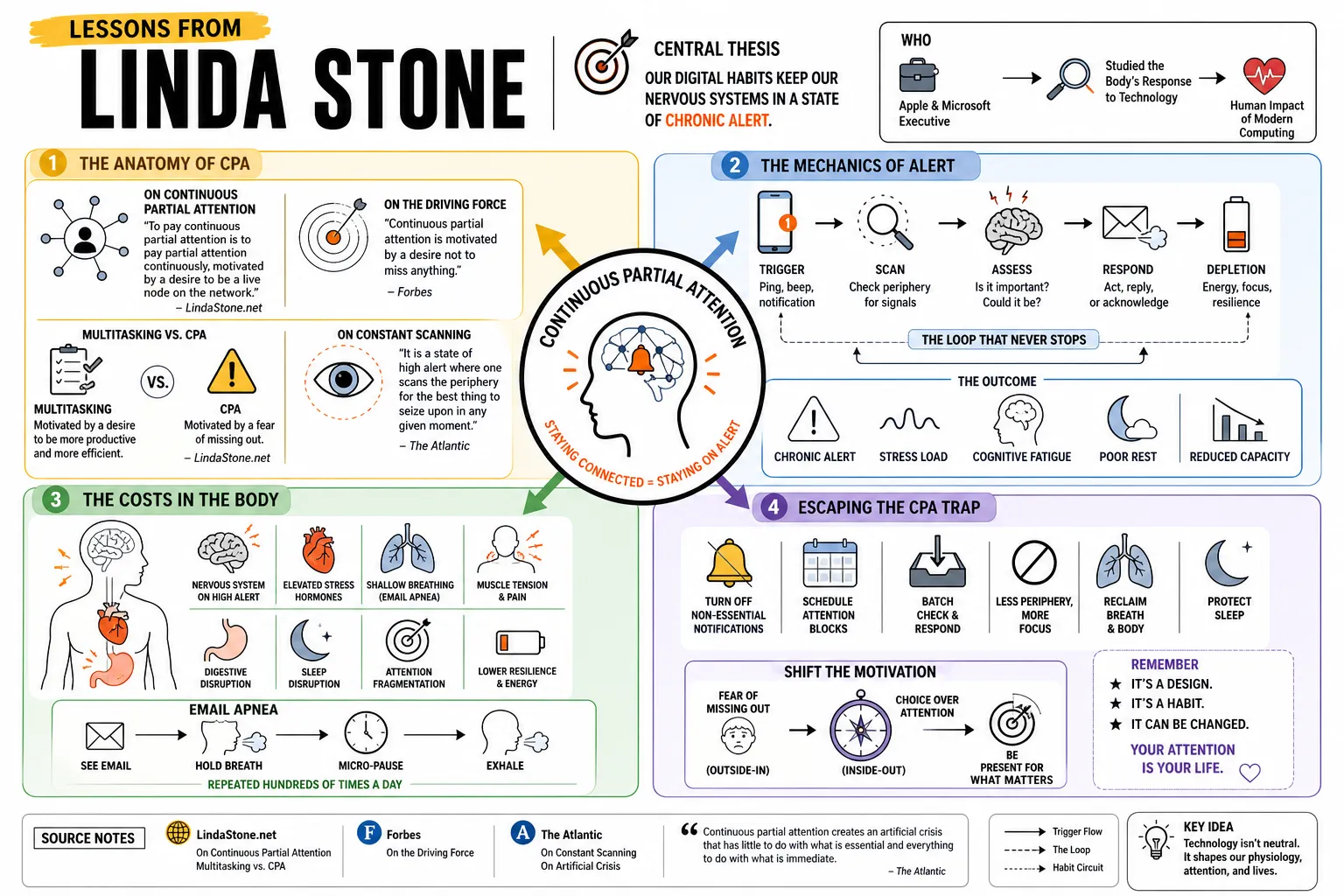
Linda Stone spent years as an executive at Apple and Microsoft before leaving to study the physical costs of our relationship with technology. She coined concepts like "continuous partial attention" and "email apnea" to describe how digital tools lock our nervous systems into chronic alert. This collection gathers her observations on the quiet ways modern computing affects the human body.
Part 1: The Anatomy of Continuous Partial Attention
- On Continuous Partial Attention: "To pay continuous partial attention is to pay partial attention continuously, motivated by a desire to be a live node on the network." — Source: LindaStone.net
- On the Driving Force: "Continuous partial attention is motivated by a desire not to miss anything." — Source: Forbes
- On Multitasking vs. CPA: "When we multi-task, we are motivated by a desire to be more productive and more efficient. With continuous partial attention, we are motivated by a fear of missing out." — Source: LindaStone.net
- On Constant Scanning: "It is a state of high alert where one scans the periphery for the best thing to seize upon in any given moment." — Source: The Atlantic
- On Artificial Crisis: "Continuous partial attention mimics an ongoing state of crisis." — Source: Edge.org
- On Overstimulation: "In large doses this behavior can make people feel overwhelmed, overstimulated, and powerless." — Source: LindaStone.net
- On the Hunter Mode: "The hunter mode of attention is about scanning the environment and being alert to every stray input, which was historically essential for survival but is exhausting today." — Source: NPR
- On the Farmer Mode: "We must rebuild our farmer skills, the ability to focus deeply, stay with a sequential task, and be present." — Source: The Atlantic
- On Adaptation: "While scanning the horizon for predators was an adaptive survival trait, in the digital age, remaining constantly hyper-alert has become maladaptive." — Source: Wired
- On Connection: "We feel most alive when we are connected, plugged in, and in the know, constantly asking what we can gain in any given moment." — Source: Forbes
Part 2: Email Apnea and the Physiology of Screens
- On Email Apnea: "Email apnea is the temporary absence or suspension of breathing, or shallow breathing, while doing email." — Source: LindaStone.net
- On the 80 Percent Rule: "Eighty percent of the people I tested in my informal kitchen table science experiments held their breath or altered their breathing while checking email." — Source: New York Times
- On Anticipation: "I would inhale with anticipation, but I wouldn't exhale because so many emails would be streaming in, and this would go on for hours." — Source: NPR
- On Screen Apnea: "As we moved from desktop computers to mobile devices, email apnea evolved into screen apnea, affecting us whenever we text or look at digital displays." — Source: LindaStone.net
- On the Fight or Flight Response: "This chronic breath-holding puts us in a state of fight or flight, affecting our emotions, physiology, and attention." — Source: HuffPost
- On Chemical Dumps: "By breathing irregularly, the body triggers a nervous response, tensing, dumping chemicals into the nervous system, and confusing the body." — Source: New York Times
- On Chronic Stress: "Your fight or flight system becomes up-regulated because you are constantly trying to stay on top of an overwhelming stream of input." — Source: The Atlantic
- On the Exceptions: "The twenty percent who did not hold their breath were typically musicians, dancers, and high-performance athletes trained to maintain breath control." — Source: NPR
- On Missing Exhales: "We wonder where our attention has gone, and it turns out it is right where we left it, alongside our ability to breathe fully." — Source: LindaStone.net
- On Physical Threats: "The body perceives an overflowing inbox and constant alerts as physical threats, launching a survival response to mundane office tasks." — Source: Edge.org
Part 3: From Apple to Microsoft: Lessons in Leadership
- On Corporate DNA: "A company's culture is dictated by the era in which it was born, explaining why older tech companies struggle to adapt to new paradigms." — Source: InformationWeek
- On Microsoft's Era: "Microsoft was a child of the PC era, which shaped its foundational culture and made transitioning to the social internet age more difficult." — Source: InformationWeek
- On Being a Bridge: "My role often involved acting as a bridge between the highly technical world of engineering and the nuanced world of human social sciences." — Source: Edge.org
- On Building Virtual Worlds: "Creating social computing groups early on revealed that technology is fundamentally a container for human interaction." — Source: Edge.org
- On Intentional Direction: "Leaders must be intentional about breaking free from the constant noise to get their bearings; speed is not a substitute for direction." — Source: Forbes
- On the Illusion of Efficiency: "Corporate culture often rewards the illusion of efficiency that comes with multitasking, rather than the deep work required for true innovation." — Source: The Atlantic
- On Technology and Scale: "Working on multimedia hardware and publishing at Apple taught me that adoption relies heavily on user experience rather than raw technical capability." — Source: LindaStone.net
- On Pausing: "Taking time to pause and reflect is a necessary leadership skill that is heavily penalized in fast-moving tech environments." — Source: NPR
- On Shifting Paradigms: "The tech industry frequently assumes the next product will solve a problem that the previous product created." — Source: InformationWeek
Part 4: The Attention Economy and Connection
- On the Power of Attention: "Attention is the most powerful tool of the human spirit." — Source: LindaStone.net
- On the Ultimate Gift: "People hunger for more attention. Full attention will be the aphrodisiac of the future." — Source: The Atlantic
- On Accessibility: "We are so accessible, we are inaccessible." — Source: Edge.org
- On Finding the Switch: "We cannot find the off switch on our devices, nor can we find the off switch on ourselves." — Source: LindaStone.net
- On Scarcity: "As we become more distributed across networks, our undivided presence becomes the rarest and most valuable resource we can offer." — Source: Wired
- On the Cost of Connection: "The desire to be connected everywhere leaves us physically present but mentally absent from the people right in front of us." — Source: HuffPost
- On Enhancing Attention: "We can enhance or augment our attention with practices like meditation and exercise, or diffuse it with digital technologies." — Source: LindaStone.net
- On Personal Responsibility: "We are fully responsible for how we choose to use this extraordinary tool of human attention." — Source: Forbes
- On True Connection: "Deep connection requires a nervous system that feels safe enough to focus on one person without scanning the room for better options." — Source: NPR
Part 5: Rethinking Productivity and Presence
- On Human-as-Machine Productivity: "Our focus has been on technologies that promote human-as-machine style productivity, leading directly to burnout and poor health." — Source: Edge.org
- On Digital Multitasking: "Digital multitasking gives you a false sense of being on top of things without ever getting to the bottom of anything." — Source: The Atlantic
- On the Never-Ending List: "It is time to retire the never-ending list and stop measuring our daily worth by how many unchecked boxes remain." — Source: HuffPost
- On Lossy Compression: "We need to approach information with lossy compression, discarding the non-essential and keeping only the perspective that makes sense for us." — Source: LindaStone.net
- On Surfing Streams: "If we stop trying to catch every piece of data and instead surf parallel streams, the digital world becomes easier to navigate." — Source: Wired
- On the Tyranny of the Mind: "The mind, for many of us, is often tyrannical towards the body, demanding we stay up late and skip walks to finish a task." — Source: LindaStone.net
- On Being Everywhere Else: "We have developed a habit of being everywhere except where we actually are physically." — Source: HuffPost
- On the Firehose of Data: "We are conditioned to try and capture the entire firehose of information, which is a physical and cognitive impossibility." — Source: InformationWeek
- On the Illusion of Catching Up: "There is no bottom to the inbox and no end to the feed; the idea of catching up is a fundamental design flaw of the modern internet." — Source: The Atlantic
Part 6: Human Design and Technology's Impact
- On Prosthetics for the Mind: "Personal technologies today act as prosthetics for our minds, helping us schedule, calculate, and remember." — Source: Edge.org
- On Prosthetics for the Being: "Our opportunity is to create personal technologies that are prosthetics for our beings, supporting our physical and emotional health." — Source: LindaStone.net
- On Conscious Computing: "We must usher in an era of conscious computing, where tools are designed to support our full human potential." — Source: Edge.org
- On the Quantified Self: "The Quantified Self movement grew around the belief that numbers provide an insight into our bodies that our emotions cannot." — Source: LindaStone.net
- On the Essential Self: "The Essential Self is everything that exceeds what can be measured by trackers and algorithms." — Source: NPR
- On Bodymind Harmony: "We need a movement that addresses our sense of self and brings us into a more harmonious relationship with our bodymind." — Source: Edge.org
- On Technology and Alteration: "Technology goes beyond distraction to fundamentally alter our baseline physiological state." — Source: The Atlantic
- On the Evolution of Devices: "As screens got smaller and closer to our faces, the physical toll on our posture and respiration intensified." — Source: LindaStone.net
- On Metrics of Success: "When we design tools optimized solely for time-on-site, we strip away the user's agency and biological comfort." — Source: Wired
Part 7: Breath, Body, and Nervous System Regulation
- On the Breath-Emotion Loop: "Breathing determines emotion, and emotion determines breathing." — Source: LindaStone.net
- On the Vagus Nerve: "Disrupted breathing is directly linked with the vagus nerve, which oversees basic fight and flight responses." — Source: NPR
- On the Animal Brain: "When we hold our breath at a screen, we signal to our animal brain that we are in physical danger." — Source: New York Times
- On Vagal Tone: "Exercises that contribute to healthy vagal tone are as important as the physical act of breathing itself." — Source: LindaStone.net
- On Glucose Dumping: "Shallow breathing causes the liver to dump glucose and the heart rate to increase, leading to physical exhaustion from sitting in a chair." — Source: Edge.org
- On the Slow Exhale: "The simplest way to stimulate the vagus nerve and recruit the parasympathetic system is through a slow, deliberate exhale." — Source: NPR
- On the Vagal Brake: "The vagus nerve functions as an active brake, allowing us to rapidly calm down or mobilize depending on the signals we send it." — Source: The Atlantic
- On Postural Collapse: "Sitting hunched over devices compresses the diaphragm, making full, regulating breaths biomechanically impossible." — Source: LindaStone.net
- On Neuroception: "Our neural circuits constantly distinguish whether situations are safe or dangerous without our conscious awareness." — Source: Edge.org
- On Reclaiming Safety: "If our nervous system detects safety through steady breathing, it drops its defensive posture, allowing for higher cognitive functions." — Source: New York Times
Part 8: The Future of Attention and Well-being
- On Regenerative Attention: "We must shift toward regenerative attention, where our interactions restore our energy rather than deplete it." — Source: LindaStone.net
- On Being Over-Hunted: "Modern society leaves us feeling over-hunted; we need spaces where we are not constantly bombarded by alerts." — Source: The Atlantic
- On Nurturing Focus: "True productivity in the future will require the farmer's patience to nurture an idea without seeking immediate, intermittent rewards." — Source: Forbes
- On the Shift in Value: "As raw information becomes cheaper, the ability to synthesize it with a calm, focused mind becomes exponentially more valuable." — Source: Edge.org
- On Unplugging: "Taking regular, intentional breaks from digital interfaces is not a luxury, but a biological necessity." — Source: NPR
- On Designing for Humans: "The next frontier of hardware and software design will prioritize biological regulation alongside computational speed." — Source: Wired
- On Choosing Presence: "In the end, deciding where to point our attention is the most consequential choice we make every day." — Source: LindaStone.net
- On Breaking the Loop: "Awareness of screen apnea is the first step; catching yourself holding your breath breaks the automatic loop of digital anxiety." — Source: HuffPost
- On the Ultimate Luxury: "Being completely unreachable, even for a short time, will become the ultimate modern luxury." — Source: The Atlantic