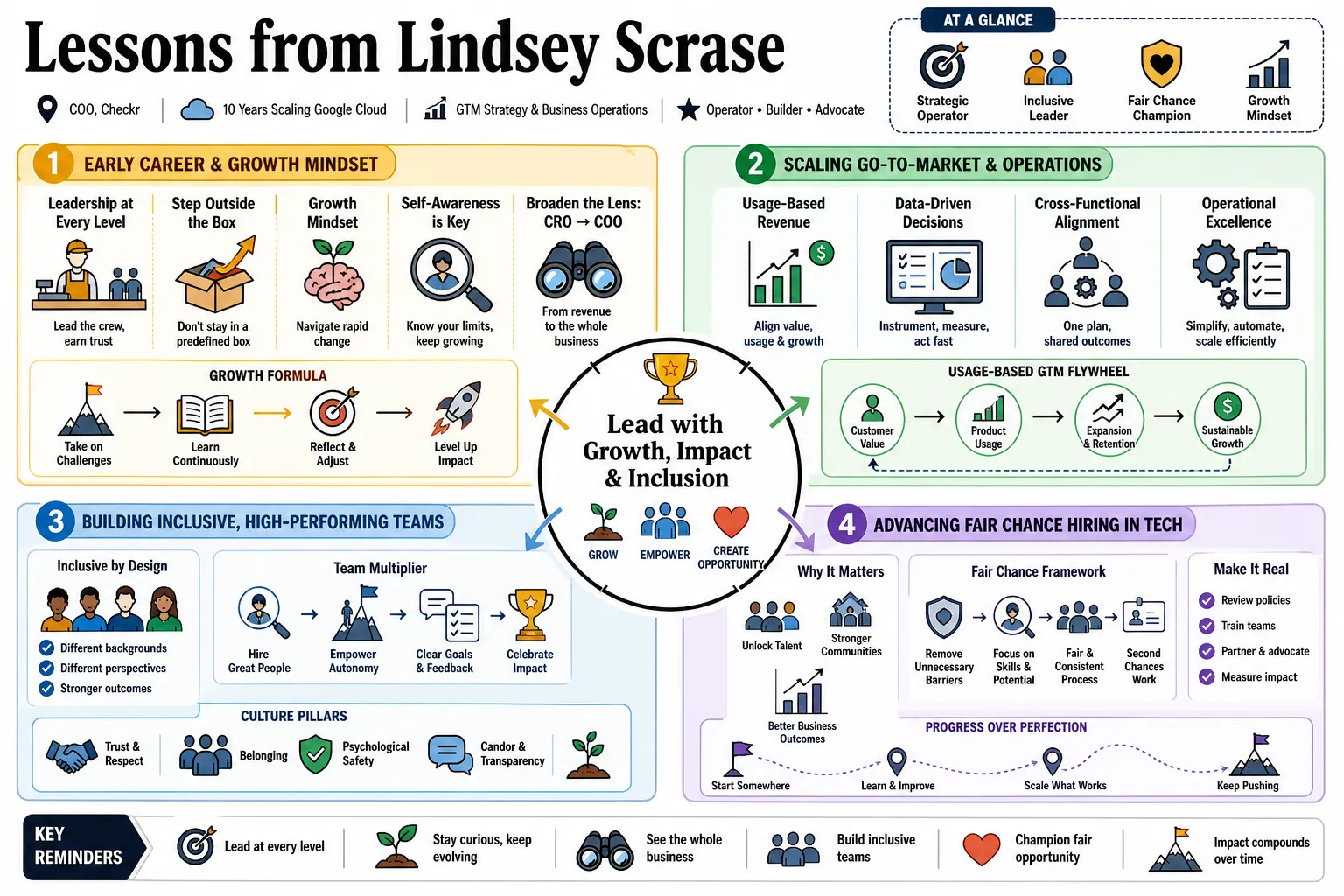
Lessons from Lindsey Scrase
Lindsey Scrase is the Chief Operating Officer at Checkr, where she runs go-to-market strategy and business operations. She previously spent a decade scaling Google Cloud for startups and mid-market companies. This profile outlines her approach to managing usage-based revenue, building inclusive teams, and advancing fair chance hiring in tech.
Part 1: Early Career and Growth Mindset
- On early leadership: "Leadership is required at every level, even when running a crew at a fast-food restaurant early in your career." — Source: Women to Watch Media
- On career trajectory: "Do not let yourself stay in a predefined box; growth requires constantly stepping outside of your comfort zone." — Source: Women to Watch Media
- On continuous learning: Scrase argues that fast-growth companies should look for people with the mindset and intrinsic capabilities to keep growing, not only for exact prior experience. — Reference: Scrase essay on hiring for growth
- On self-awareness: Scrase's culture model includes transparency, accountability, and leaders sharing both what is working and what they are struggling with. — Reference: WorkRamp interview on trust and culture
- On adapting to new roles: "Transitioning from a CRO to a COO requires broadening your perspective from pure revenue generation to complete operational efficiency." — Source: SaaStr
- On navigating early career hurdles: "The foundational skills of customer service and team coordination learned in entry-level jobs translate directly into corporate executive leadership." — Source: Women to Watch Media
- On personal evolution: "Leaders must evolve their skill sets as their organizations scale; what worked at one stage will inevitably break at the next." — Source: SaaStr
- On embracing discomfort: "The most significant professional breakthroughs often occur immediately after periods of intense discomfort and steep learning curves." — Source: Women to Watch Media
- On demonstrating capability: Scrase says some of her strongest leaders earned stretch roles by showing grit, tenacity, humility, and openness to coaching before their resumes looked perfect. — Reference: Scrase essay on upleveling talent
Part 2: Diversity and Representation in Tech
- On the imperative of DEI: "First and foremost, increasing diversity and representation is the right thing to do." — Source: Google Cloud Blog
- On the business case for diversity: "The data and research show that diverse teams drive better business results, because diversity of perspectives leads to better problem solving." — Source: Google Cloud Blog
- On serving customers: "Diverse teams better serve their customers because they reflect the varied perspectives of the market they are trying to reach." — Source: Google Cloud Blog
- On isolation in leadership: "I have experienced what it's like being the only woman in the room and with no women above me." — Source: Google Cloud Blog
- On systemic change: "True inclusion requires dismantling the systemic barriers that prevent underrepresented groups from advancing into executive roles." — Source: Women to Watch Media
- On building inclusive environments: "Fostering an inclusive environment is not a passive activity; it requires active, intentional effort from the leadership team every day." — Source: Google Cloud Blog
- On intersectional representation: "Intersectionality in hiring ensures that a wider range of life experiences are brought to the table to solve complex technical problems." — Source: Women to Watch Media
- On diverse hiring practices: Scrase pushes companies to expand candidate pools beyond traditional networks, referrals, and resume filters that reinforce bias. — Reference: Scrase essay on expanding candidate pools
- On the burden of representation: "It is essential for companies to ensure that the burden of DEI work does not fall solely on the shoulders of underrepresented employees." — Source: Google Cloud Blog
Part 3: Go-To-Market and Scaling Revenue
- On data-driven GTM: "Go-to-market strategies must be fundamentally rooted in data and an objective analysis of customer behavior." — Source: Checkr Blog
- On moving upmarket: "Successfully moving into the enterprise space requires a complete realignment of your sales signals and operational support structures." — Source: SaaStr
- On mature sales organizations: "Managing a mature go-to-market organization means balancing the need for predictable revenue with the agility to test new markets." — Source: SaaStr
- On enterprise sales cycles: "Enterprise sales are inherently slower; teams must build patience and sustained engagement models into their operating rhythm." — Source: SaaStr
- On scaling operations: "When scaling operations from mid-market to enterprise, every internal process must be fortified to handle increased complexity." — Source: SaaStr
- On aligning teams: "Sales, marketing, and product teams must have perfectly aligned incentives to prevent friction during rapid growth phases." — Source: Checkr Blog
- On customer retention: "Revenue growth requires creating a seamless, value-driven experience for existing customers alongside net-new acquisition." — Source: Checkr Blog
- On market expansion: "Expanding into new markets requires deeply understanding the specific regulatory and operational hurdles of those localized environments." — Source: SaaStr
- On forecasting accuracy: "Accurate forecasting in a complex GTM motion depends on rigorously tracking leading indicators, rather than relying exclusively on lagging revenue metrics." — Source: SaaStr
- On building generational businesses: "To build a lasting SaaS business, you must transition from selling a tool to selling a fundamental operational capability." — Source: SaaStr
Part 4: Leading Usage-Based Revenue Models
- On transactional dynamics: "A usage-based pricing model creates a highly transactional business environment that differs radically from traditional SaaS subscriptions." — Source: SaaStr
- On managing consumption: "Revenue management in a usage-based system requires tracking actual platform consumption just as closely as closed-won contracts." — Source: SaaStr
- On compensation restructuring: "You must frequently audit and restructure sales compensation plans to ensure they are driving actual usage, rather than just initial commitments." — Source: SaaStr
- On misaligned incentives: "If commission structures do not reflect the transactional nature of the product, sales reps will optimize for the wrong behaviors." — Source: SaaStr
- On revenue predictability: "Predicting revenue in a usage-based model requires sophisticated data modeling that accounts for seasonal variations in your customers' underlying businesses." — Source: SaaStr
- On customer onboarding: "In usage-based models, the onboarding process is the most sensitive phase; if customers do not deploy quickly, revenue is permanently lost." — Source: SaaStr
- On customer success integration: "Customer success teams must be deeply integrated into the revenue engine to proactively identify and resolve bottlenecks in platform utilization." — Source: SaaStr
- On pricing elasticity: "You have to constantly test pricing elasticity to find the exact point where usage volume offsets the reduction in per-transaction margins." — Source: SaaStr
- On identifying churn risk: "A drop in daily or weekly usage is the earliest and most accurate indicator of churn in a consumption-based business." — Source: SaaStr
- On scaling infrastructure: "The technical infrastructure must scale in lockstep with the revenue model to prevent latency issues from artificially capping customer usage." — Source: SaaStr
Part 5: Fostering Company Culture
- On culture as a driver: "A strong, resilient company culture is a fundamental driver of sales performance and overall business success." — Source: WorkRamp Podcast
- On building trust: "Nurturing loyalty and trust within teams is an absolute requirement for weathering the inevitable challenges of scaling a high-growth company." — Source: The Org
- On empathetic leadership: "Balancing the hard metrics of operational efficiency with the soft skills of empathetic leadership is a marker of modern executive management." — Source: WorkRamp Podcast
- On operationalizing values: "Company values must be operationalized into daily workflows and performance reviews; otherwise, they are just words on a wall." — Source: The Org
- On maintaining culture during growth: "As a company scales rapidly, the culture must evolve intentionally to accommodate new perspectives without losing its foundational identity." — Source: WorkRamp Podcast
- On transparent communication: "Transparency from leadership regarding company goals and challenges builds a culture of mutual respect and collective ownership." — Source: The Org
- On psychological safety: "Creating an environment of psychological safety allows teams to take calculated risks and learn from failures without fear of retribution." — Source: WorkRamp Podcast
- On cross-functional collaboration: "Silos destroy culture; leaders must actively facilitate cross-functional collaboration to ensure the organization moves as a single cohesive unit." — Source: The Org
- On celebrating wins: "Regularly acknowledging and celebrating both small milestones and major victories is essential for maintaining team morale and momentum." — Source: WorkRamp Podcast
Part 6: Navigating the Startup Ecosystem
- On supporting early-stage growth: "We strive to support startups at all stages with the right technology and offerings to help them scale quickly and securely." — Source: Google Cloud Blog
- On tech infrastructure: "Startups require cloud infrastructure that provides the agility to pivot and the security to handle enterprise-grade compliance from day one." — Source: Google Cloud Blog
- On impactful innovation: "It is incredibly exciting to see the many different ways technology allows startups to effect change on societal levels." — Source: Google Cloud Blog
- On startup ecosystems: "A thriving startup ecosystem relies on established technology partners providing accessible tools, alongside capital investment." — Source: Google Cloud Blog
- On scaling from SMB to Mid-Market: Scrase's background includes running global revenue for Google Workspace and Google Cloud Platform across SMB and mid-market businesses before joining Checkr. — Reference: WorkRamp interview on Google Cloud and Checkr
- On resource allocation: Scrase says moving from Google Cloud to Checkr made speed and fast decision-making a major positive change of startup operating life. — Reference: WorkRamp interview on joining a late-stage startup
- On operational AI: The COO Alliance episode frames Scrase's Checkr role around operational efficiency, innovation, and navigating complex leadership challenges. — Reference: COO Alliance episode on Checkr operations leadership
- On vendor partnerships: "Strategic vendor partnerships can serve as a massive force multiplier for startups operating with limited internal engineering resources." — Source: Google Cloud Blog
- On market disruption: Scrase describes Checkr as an API-first HR tech company disrupting background checks with a data-driven process and a fair-chance hiring mission. — Reference: WorkRamp interview on Checkr's market mission
Part 7: Hiring for Problem-Solving and Humility
- On core competencies: Scrase recommends hiring for the right mindset and intrinsic capabilities, especially when exact past experience is not the best predictor of success. — Reference: Scrase essay on intrinsic capabilities
- On the importance of humility: Scrase names humility and openness to coaching as traits she has seen in strong sales leaders who did not have the exact expected background. — Reference: Scrase essay on humility in hiring
- On evaluating adaptability: Scrase warns against hyper-specific resume filters and favors candidates who can pivot with the changing needs of the company. — Reference: Scrase essay on avoiding hyper-specific resumes
- On avoiding brilliant jerks: Scrase's leadership model emphasizes trust, accountability, and unity because high-functioning teams require more than individual performance. — Reference: WorkRamp interview on high-functioning teams
- On interview techniques: The POZcast listing for Scrase highlights hiring for problem-solving ability, assessing humility in interviews, and Checkr's fair-chance mission. — Reference: POZcast listing on Scrase's hiring interview
- On diverse skill sets: Scrase argues that teams should diversify work experience, life experience, age, and background instead of leaning on narrow networks. — Reference: Scrase essay on diverse candidate pools
- On coaching for humility: Scrase builds trust by making space for leaders to share challenges, admit what is hard, and connect as whole people. — Reference: WorkRamp interview on trust-building rituals
- On onboarding execution: Scrase says coming into Checkr required ramping quickly, understanding the existing team, and honoring the past while setting the future plan. — Reference: WorkRamp interview on entering a new company
- On scaling hiring: Scrase's hiring advice is to scale on the right timeline without losing the company's soul, especially during fast-growth periods. — Reference: Scrase essay on scaling hiring thoughtfully
Part 8: Fair Chance Hiring and Mission-Driven Work
- On the fair chance mission: "Fair chance hiring is a strategic business decision that helps companies tap into a broader, highly motivated, and often overlooked talent pool." — Source: Checkr Blog
- On removing barriers: "Our primary objective is to make hiring more equitable by removing systemic, historical barriers for candidates with criminal records." — Source: Checkr Blog
- On individualized assessments: "Employers must move away from automatic disqualifications and implement individualized assessments that review records in the context of the specific role." — Source: Checkr Blog
- On employee loyalty: "Data consistently shows that individuals hired through fair chance programs exhibit significantly higher retention rates and organizational loyalty." — Source: Prosperco
- On mission alignment: Scrase ties Checkr's operating model to candidate fairness and advancing hiring for people affected by the justice system. — Reference: WorkRamp interview on Checkr's mission
- On practicing what you preach: "A company cannot advocate for fair chance hiring externally if it does not actively champion and implement those same principles internally." — Source: Checkr Blog
- On the moral imperative: "Providing job opportunities to individuals with criminal records is an explicit moral imperative." — Source: Checkr Blog
- On bias in screening: "Technology must be used to mitigate human bias in the background screening process, ensuring fairer outcomes for all candidates." — Source: Checkr Blog
- On community impact: "When companies embrace fair chance hiring, the positive economic impact ripples outward, strengthening the surrounding communities." — Source: Prosperco
- On the future of work: "The future of the workforce depends on our ability to look past an individual's worst day and assess their actual potential to contribute." — Source: Checkr Blog