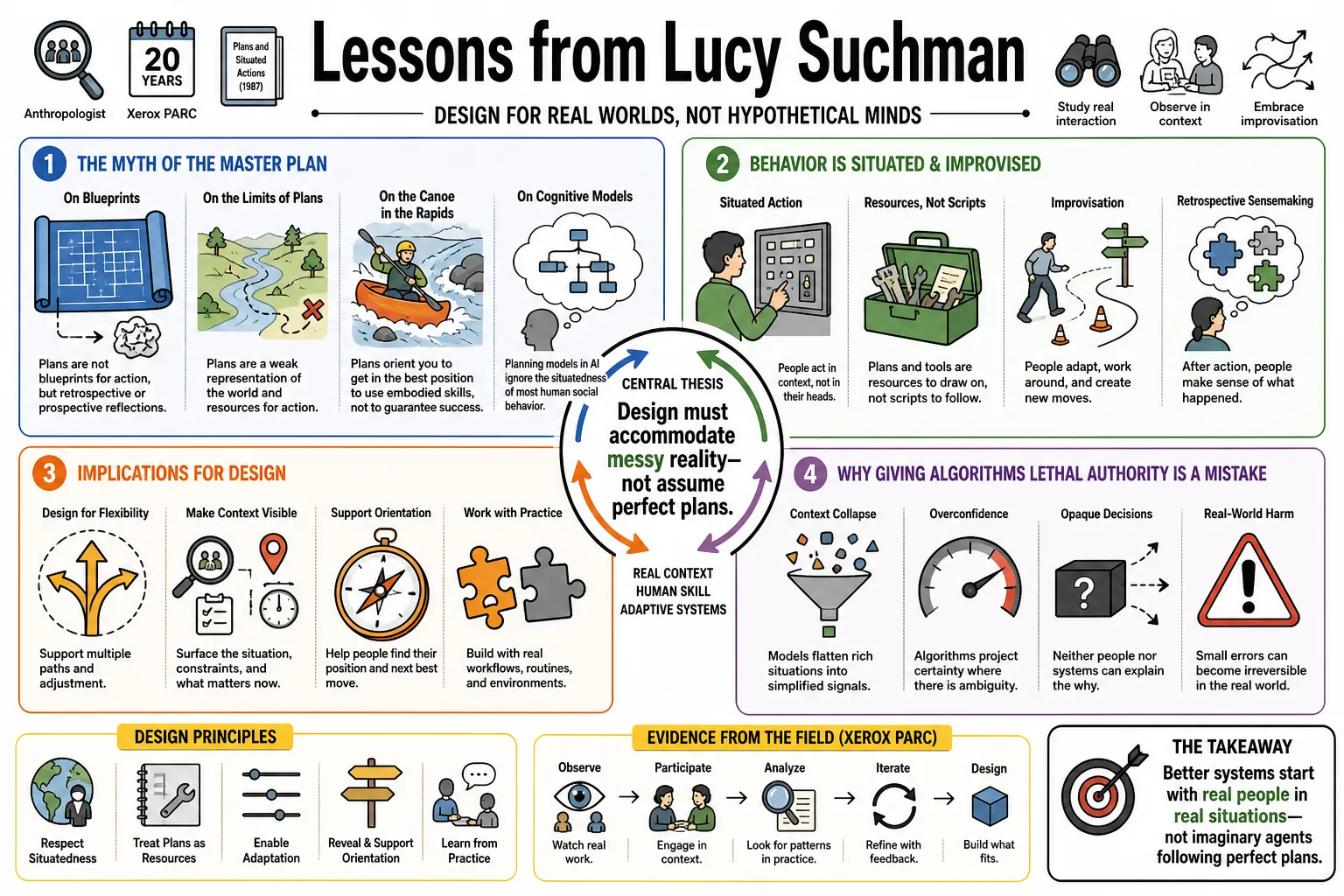
Lucy Suchman spent twenty years as an anthropologist at Xerox PARC studying how people actually interact with machines. Her 1987 book, Plans and Situated Actions, showed that human behavior isn't driven by step-by-step mental programs, but by context and improvisation. This profile outlines her case that design must accommodate that messy reality, and why giving algorithms lethal authority is a mistake.
Part 1: The Myth of the Master Plan
- On Blueprints: "Plans are not blueprints for action, but retrospective or prospective reflections on it." — Source: [Stavelin]
- On the Limits of Plans: "Plans are best viewed as a weak form of representation of the world, and as resources for action, rather than as its determinants." — Source: [Morten Hertzum]
- On the Canoe in the Rapids: "The purpose of the plan in this case is not to get your canoe through the rapids, but rather to orient you in such a way that you can obtain the best possible position from which to use those embodied skills." — Source: [Morten Hertzum]
- On Cognitive Models: "The planning model of interaction favored by the majority of AI researchers does not take sufficient account of the situatedness of most human social behavior." — Source: [UCLA]
- On Problem Definitions: "A definition of a problem emerges while exploring possible actions in a context, rather than from the clear formulation of a plan." — Source: [Interface Critique]
- On Instruction Incompleteness: "Building upon the insights of ethnomethodology, instructions share with other forms of prescriptive representation (recipes, plans, laws, etc.) a kind of irremediable incompleteness." — Source: [SSOAR]
- On Purposeful Action: "However planned, purposeful actions are inevitably situated actions." — Source: [Stavelin]
- On Ad Hoc Problem Solving: "Human action is fundamentally ad hoc, meaning it is improvised in response to the immediate, unfolding situation." — Source: [END Conference]
- On Plans as Artifacts: "Plans are better conceptualized as a genre of artefact created as a resource for action and communication... rather than an algorithmic specification that determines action." — Source: [Interface Critique]
- On Cognitive Psychology's Blindspot: "Treating human behavior as a series of logical steps ignores how we constantly re-evaluate our actions in response to our immediate environment." — Source: [D-NB]
Part 2: Situated Action and Human Practice
- On Situated Action: "The term situated action underscores the view that every course of action depends in essential ways upon its material and social circumstances." — Source: [END Conference]
- On Coherence: "The coherence of situated action is tied in essential ways to the local particularities of the context." — Source: [Stavelin]
- On Social Facts: "The objective reality of social facts is not the fundamental principle of social studies, but social studies' fundamental phenomenon." — Source: [Colby College]
- On Mutual Intelligibility: "The mutual intelligibility and objectivity of the social world is an achievement... located entirely within our interactions." — Source: [N. Ehrlich]
- On Common Sense: "Our common sense of the social world is not the precondition for our interaction, but its product." — Source: [Colby College]
- On Meaning Construction: "Meaning is not stored 'in' a message; it is constructed in the moment through the boundaries of the perceivable." — Source: [Interface Critique]
- On the Limits of Rules: "No matter how detailed a rule or procedure is, applying it requires situated judgment that cannot be fully formalized." — Source: [SSOAR]
- On Improvisation: "Rather than following internal scripts, human intelligence is rooted in our ability to repair and improvise in response to the messy, unpredictable reality of the world." — Source: [Pageplace]
- On Context Dependency: "You cannot understand an action without understanding the specific material and social environment that necessitated it." — Source: [International Journal of Design]
Part 3: The Xerox PARC Copier Studies
- On the Copier Experiment: "Two computer scientists spent an hour and a half making prints, filling the room with paper but unable to make a single two-sided print." — Source: [UCLA]
- On Machine Blindness: "The machine had access only to a very small subset of the observable actions of its users." — Source: [UCLA]
- On Human-Machine Asymmetry: "I located the problem of human-machine communication in continued and deep asymmetries between person and machine." — Source: [UCLA]
- On the Big Green Button: "The green button actually masked the labor that was needed to become familiar with the machine and incorporate it effectively into use." — Source: [Dokumen]
- On Marketing Illusions: "The marketing campaign tried to obscure that any learning was required to use the more advanced functions of the machine." — Source: [Andreas Lloyd]
- On the Anthropologist's Role: "At PARC I encountered other disciplines seemingly asking similar questions, but this time about human-computer interaction, or interactive machines." — Source: [University of Bologna]
- On User Confusion: "When a machine acts unexpectedly, the user assumes the machine is making a rational choice based on a shared context that the machine does not actually possess." — Source: [Blogspot]
- On Observing Breakdowns: "Studying where technology fails provides the clearest visibility into the hidden social rules that users rely on to navigate the world." — Source: [UX Magazine]
- On Ethnography in Tech: "Using video ethnography to record actual use proved more valuable for design than theoretical assumptions about how a product should work." — Source: [UCLA]
Part 4: Reconfiguring Human-Machine Boundaries
- On Shifting the Question: "The question shifts from debates over the status of human-like machines, to that of how humans and machines are enacted as similar or different in practice." — Source: [University of Benghazi]
- On Agency: "Agency is not an attribute but the ongoing reconfigurings of the world." — Source: [Andreas Lloyd]
- On Social Agents: "It does not matter, in ascribing 'social agent' status, what a thing is in itself; what matters is where it stands in a network of social relations." — Source: [WordPress]
- On Boundaries: "I take the boundaries between persons and machines to be discursively and materially enacted rather than naturally effected." — Source: [UCLA]
- On the Servant Metaphor: "The servant troubles the distinction between we-human-subjects-inventors with a lot to do and them-object-things that make it easier for us." — Source: [Pageplace]
- On Artifactuality: "In creating computational technologies, designers increasingly evidence a desire to naturalize them, to obscure their artifactuality." — Source: [Interface Critique]
- On the Mirror Image: "The rhetoric of AI seeks to mirror human intelligence, neglecting how the gap gets closed by people interpreting, aligning, fitting in, configuring." — Source: [Interface Critique]
- On Expanding Analysis: "This requires expanding our unit of analysis, while recognizing the inevitable cuts or boundaries through which technological systems are constituted." — Source: [Goodreads]
- On Enacted Difference: "We must examine how and when the categories of human or machine become relevant... and with what discursive and material consequences." — Source: [University of Benghazi]
Part 5: Feminist Technoscience and "The Cut"
- On Situated Knowledges: "Objective knowledge is not achieved through a view from nowhere, but by acknowledging that all knowledge is situated, partial, and embodied." — Source: [Tidsskrift]
- On Materialized Figurations: "Technologies are forms of materialized figuration; that is, they bring together assemblages of stuff and meaning into more and less stable arrangements." — Source: [WordPress]
- On the Apparatus: "The apparatus takes on a profoundly performative role in world making... designating the arrangements through which entities become onto-epistemologically discernable." — Source: [Lancaster University]
- On Boundary Projects: "Objects themselves are boundary projects... As such, they can be assessed only in their relations to the sites of their use." — Source: [Lancaster University]
- On Feminist STS: "Feminist theory provides the critical tools necessary to deconstruct the closed-world imaginaries of AI and militarism." — Source: [FQS]
- On Locating the User: "Feminist theory shifts the focus from universal users to located actors with specific accountabilities." — Source: [Interface Critique]
- On the God Trick: "The field of artificial intelligence often relies on the illusion of the god trick—assuming data can provide a perfect map of the world without a human observer." — Source: [Tidsskrift]
- On Intra-action: "Replacing interaction with intra-action emphasizes that subjects and objects do not pre-exist their relationship, but emerge through it." — Source: [Andreas Lloyd]
- On the Limits of Datafication: "We must recognize the onto-epistemological boundaries of what can actually be turned into data without erasing its lived reality." — Source: [Barnard Center]
Part 6: Design, Interfaces, and Artful Integration
- On the Interface: "The interface is a field site where assumptions about personhood, competence, communication, control, failure, and agency become operational." — Source: [Church of Spiralism]
- On System Expectations: "A system tells the user what kind of action it recognizes, and the user discovers what kind of person the system expects them to be." — Source: [Church of Spiralism]
- On Artful Integration: "System design must include not only the design of innovative technologies, but their artful integration with the rest of the social and material world." — Source: [Interface Critique]
- On the Limits of Design: "We need less a reinvented anthropology as or for design than a critical anthropology of design." — Source: [Oxford University Press]
- On Collective World-Making: "What does it mean to move from a discourse of design as a process of individual creativity to design as a collective practice of world-making?" — Source: [Maynooth University]
- On Accountable Rationality: "The designer's project is to imbue the machine with grounds for behaving in ways that are accountably rational and intelligible to others." — Source: [Interface Critique]
- On the Anthropological Gaze: "The anthropological gaze, insofar as it is defined by its traditional attention to the Other, vicariously renders exotic those on whom it is turned." — Source: [Lancaster University]
- On Boundary-Crossing: "Responsibly developing technology must be a boundary-crossing activity, taking place through the deliberate creation of situations that allow for the meeting of different partial knowledges." — Source: [arXiv]
- On Discovering Human Enterprise: "Technical development must go hand in hand with the discovery of just what the human enterprises are for which these new technologies might prove useful." — Source: [Interface Critique]
- On Relational Design: "Designing is most of all a question of reconfiguring the relationship between human and machine, between practice and the materialized figuration of that practice." — Source: [Interface Critique]
Part 7: Demystifying Artificial Intelligence
- On the AI Imaginary: "The prevailing figuration in Euro-American imaginaries is one of autonomous, rational agency, and projects of artificial intelligence reiterate that culturally specific imaginary." — Source: [Medium]
- On the Hype Cycle: "Raising alarm over machine superintelligence serves the self-serving purpose of reasserting AI's promise while redirecting debate away from mundane algorithmic failures." — Source: [Sam Kinsley]
- On the Out-of-Control Narrative: "Oscillations between the AI-as-threat and AI-as-savior narratives both rely on the same myth of machine autonomy that ignores the social infrastructures sustaining them." — Source: [Interface Critique]
- On Closed Worlds: "Military AI treats the world as a closed loop of data, purposefully ignoring the incomputable contingencies of real life." — Source: [YouTube]
- On Universalizing the Creator: "AI development often features specifically located individuals conceiving technologies made in their own image, while figuring the latter as universal." — Source: [University of Benghazi]
- On the Arms Race Narrative: "The premise that we are in an AI arms race is a self-serving argument that makes uncritical investment appear imperative." — Source: [Tech Policy Press]
- On False Promises: "AI promises that a machine can perceive, decide and act more quickly in a complex environment with more accuracy than a human... we have no evidence for this." — Source: [Tech Policy Press]
- On the Illusion of Intelligence: "We should resist the proposition that AI is the definitive technology of our age, as this narrative serves those invested in its expansion." — Source: [UFMG]
- On Human-in-the-Loop Fallacies: "Human oversight of autonomous systems doesn't mean much when the inherent design and aim of the system is to maximize speed and destruction." — Source: [WordPress]
Part 8: Autonomous Weapons and Located Accountability
- On Project Maven: "The problem with Project Maven is that there is way more surveillance data than humans can analyze and translate into actionable intelligence." — Source: [Tech Policy Press]
- On Autonomous Killing: "There is something particularly repugnant in automating this most difficult of ethical decisions; killing people." — Source: [ICRAC]
- On the Principle of Distinction: "Autonomous weapons systems are inherently unlawful and could never be made lawful because there is no way to encode the specifications to distinguish between civilians and combatants." — Source: [Cybernews]
- On the Limits of Algorithmic Targeting: "The premise that legitimate target identification could be rendered sufficiently unambiguous to be automated reliably is at this point unfounded." — Source: [Tech Policy Press]
- On Dehumanization: "Turning people into data points or objects of interest through algorithmic profiling dehumanizes them and makes it easier to justify killing." — Source: [Tech Policy Press]
- On Located Accountability: "Responsible technology development is an entry into networks of working relations, which involves locating those who have power over its production." — Source: [Carnegie Mellon University]
- On Detached Intimacy: "Developers are effectively encouraged to be ignorant of their own positions within the social relations that comprise technical systems." — Source: [Sam Kinsley]
- On Embodied Responsibility: "It is precisely the fact that our vision of the world is a vision from somewhere... which makes us personally responsible for it." — Source: [Sam Kinsley]
- On the Military-Industrial Complex: "Project Maven is a reformation of the Military-Industrial Complex for the contemporary moment, where big tech is really taking the lead." — Source: [Tech Policy Press]
- On the Ultimate Responsibility: "It is humans who must take the responsibility for the cultural assumptions, political interests, and life-and-death consequences embedded within these operations." — Source: [WordPress]