Lynn Conway changed how microchips are designed by inventing scalable rules that decoupled chip design from manufacturing, allowing anyone to print complex systems on silicon. After being fired by IBM in 1968 for her gender transition, she rebuilt her career from scratch, ultimately becoming a powerful advocate for transgender visibility and exposing how marginalized innovators are often erased from history.
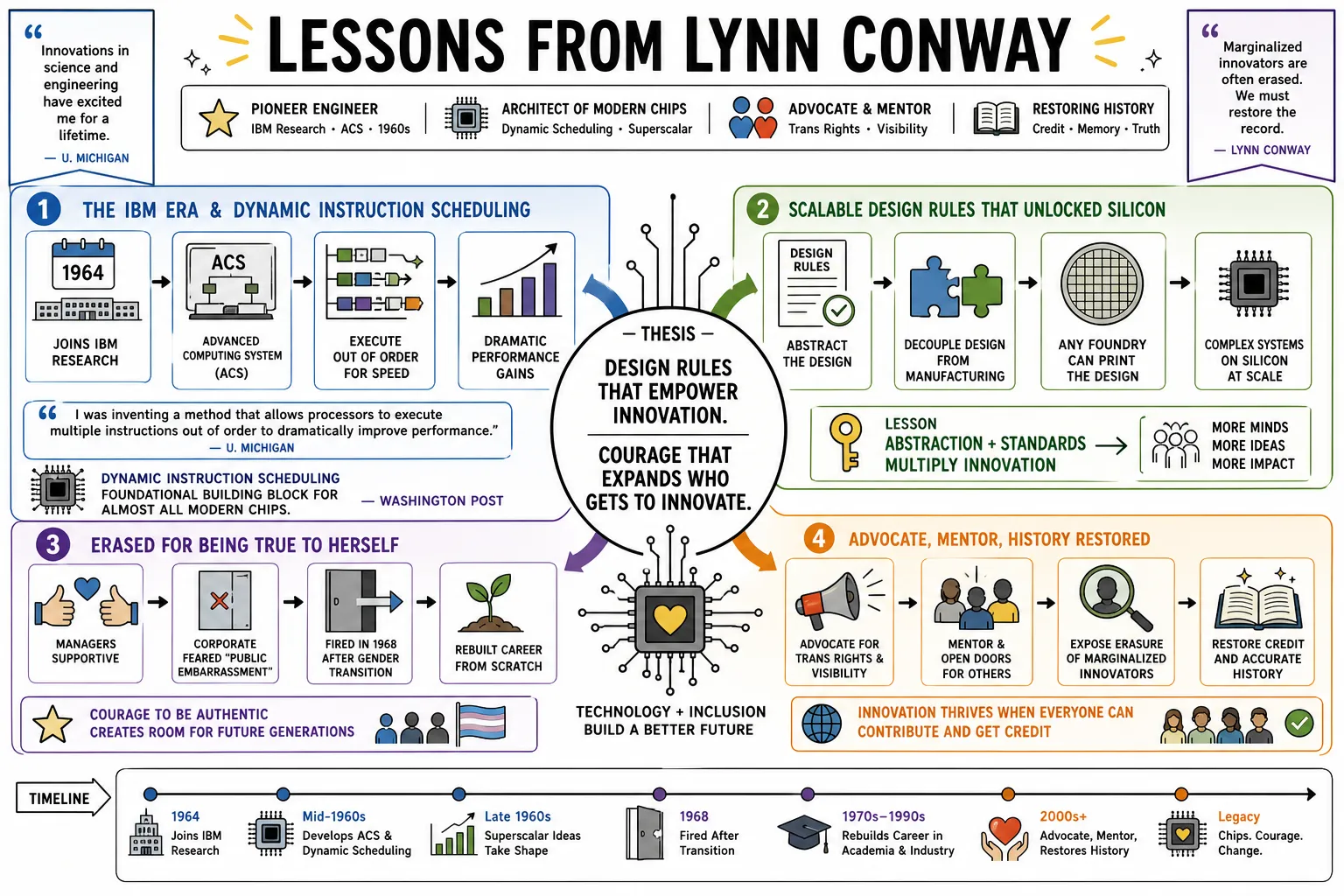
Part 1: The IBM Era and Dynamic Instruction Scheduling
- On joining IBM Research in 1964: "Innovations in science and engineering have excited me for a lifetime, as they have for many friends and colleagues." — Source: University of Michigan
- On the Advanced Computing System (ACS): "I was inventing a method that allows processors to execute multiple instructions out of order to dramatically improve performance." — Source: University of Michigan
- On superscalar architecture: "The dynamic instruction scheduling I developed at IBM became a foundational building block for almost all modern computer chips." — Source: Washington Post
- On the initial response to her transition at IBM: "My immediate managers were supportive, but corporate leadership feared the 'public embarrassment' of employing a transgender woman." — Source: Los Angeles Times
- On being fired by Thomas J. Watson Jr. in 1968: "You can't change what happened, and in fact, if you look at what happened from all perspectives, it pretty much was the only thing that could have happened." — Source: Washington Post
- On contextualizing her dismissal: "When you connect the dots, you see it as a sign of the times." — Source: Washington Post
- On IBM's 2020 formal apology: "I didn't know how to react... I started to tear up. I didn't know when it started that Diane was going to apologize on IBM's behalf." — Source: Forbes
- On the meaning of the apology event: "Instead of just being a resolution of what had happened in 1968, it became a heartfelt group celebration of how far we've all come since then." — Source: Forbes
- On holding grudges: "I don't go around holding grudges. That's just bad karma." — Source: Los Angeles Times
Part 2: Stealth Mode and Personal Transition
- On the immediate aftermath of 1968: "Shamed as a social outcast, I'd lost my family, friends and social support. Fired by IBM, I'd lost a promising research career." — Source: HuffPost
- On the dangers of the era: "In many cities I could've been arrested, or worse yet, institutionalized." — Source: HuffPost
- On taking a new identity: "Evading those fates, I completed my transition, took on a secret new identity, and started all over as a contract programmer." — Source: HuffPost
- On the fear of exposure: "Any 'outing' and I'd have become unemployable . . . Fear channeled me into 'stealth-mode'." — Source: HuffPost
- On living in stealth: "From 1969 until 1999, I lived in total stealth. My contributions for which I am well-known in my professional fields were all made in my new life, without revealing my past." — Source: University of Victoria
- On the cost of invisibility: "I didn't mind being invisible in my field back then or that no one had a clue what I was doing . . . I was thrilled to even have a job." — Source: HuffPost
- On liberation: "Gender transition not only saved my life, it liberated me into a freedom to live, to enjoy life and to be me!" — Source: University of Victoria
- On the impact of joy: "The joy I felt permeated my entire being, and enabled me to do a lot of cool creative work in my career." — Source: University of Victoria
- On defining stealth: "I came to give the secret life into which it forced me a name: 'stealth.'" — Source: University of Michigan
Part 3: Xerox PARC and the VLSI Revolution
- On her early days at PARC: "I made a kind of matrix of the two opportunities and a whole bunch of factors to cross-compare and weighted some of those and kind of came up with a decision method to decide to go to PARC." — Source: Computer History Museum
- On the excitement at PARC: "It was a time of great excitement, a time when we felt we were changing the world." — Source: IEEE Solid-State Circuits Magazine
- On scaling chip design: "We figured out how to remove tons of unnecessary design rules and optimizations, so that it all came clear." — Source: IEEE Solid-State Circuits Magazine
- On the shift away from specialized experts: "You don't need people that know how to minimize gates... all these people that are working these different specialties and optimize them are now going to be displaced." — Source: Computer History Museum
- On simplifying processes: "The net result would be it would be way more powerful than something similarly implemented that had been optimized at each level of abstraction." — Source: Computer History Museum
- On seeing silicon differently: "What hadn't occurred to people was that there was a vast domain of potential creative works that could also be printed in silicon, that weren't just microprocessors or memory chips." — Source: Computer History Museum
- On the scope of VLSI: "It opened up an envelope of lots of other things you could do other than making just a computer." — Source: Computer History Museum
- On her collaboration with Carver Mead: "We used the early ARPANET to democratize chip design, moving it out of the hands of a few semiconductor giants and into universities." — Source: Computer History Museum
- On the 'Introduction to VLSI Systems' textbook: "It became the 'bible' of the field, introducing structured methods that let architects design chips without needing to be experts in device physics." — Source: IEEE Solid-State Circuits Magazine
- On being the hidden hand: "I was hidden in the back-rooms of Xerox Palo Alto Research Center decades before, launching innovations as the hidden-hand behind the VLSI microelectronics revolution." — Source: HuffPost
Part 4: Democratizing Chip Design via MPC79
- On the MPC79 experiment: "In 1979, we organized a massive experiment where 129 students from 12 universities submitted designs via ARPANET, which were fabricated and returned in weeks." — Source: Computer History Museum
- On the joy of the MIT course: "I'd love to get an award for simply creating one of the greatest-ever MIT hacks. It was so much fun!" — Source: Computer History Museum
- On empowering students: "Each student could learn how and then design their own silicon chip." — Source: Computer History Museum
- On the speed of learning: "They didn't know VLSI had just been invented; they didn't even need to understand it when they started." — Source: Computer History Museum
- On minimizing cognitive load: "They were just given the minimum set of knowledge needed to start making things." — Source: Computer History Museum
- On engineering as a social act: "The MPC79 project was a techno-social movement as much as a technical achievement." — Source: Computer History Museum
- On the viral spread of technology: "I used my training in anthropology to 'infect' the academic community with new design rules, leading to the rapid, viral spread of VLSI technology." — Source: IEEE Solid-State Circuits Magazine
- On MOSIS (Metal Oxide Semiconductor Implementation Service): "It proved that multiproject wafers could successfully share fabrication costs among many different designers." — Source: Computer History Museum
- On the precursor to modern commerce: "The MPC79 network adventure was a precursor to modern electronic commerce and modern foundry services." — Source: IEEE Solid-State Circuits Magazine
Part 5: The Matilda Effect and Erasure
- On discovering her own erasure: "As a woman, I disappeared from history and so did my innovations." — Source: University of Michigan
- On the Matilda Effect: "Recognition of women's work is often systematically suppressed or attributed to their male colleagues." — Source: University of Victoria
- On the Matthew Effect: "This is seldom deliberate—rather, it's a result of the accumulation of advantage by those who are expected to innovate." — Source: University of Victoria
- On coining the 'Conway Effect': "Almost all people are blind to innovations, especially those made by folks they don't expect to make innovations." — Source: University of Michigan
- On societal expectations: "Since I didn't #LookLikeanEngineer, few people caught on to what I was really doing back in the 70s and 80s." — Source: University of Michigan
- On overcoming the blindness: "To be able to 'win at innovation,' women must be expected to be able to win. The culture must change." — Source: University of Michigan
- On reclaiming her legacy: "It wasn't until 1999, when my early work at IBM was being researched, that I realized I had to step forward and tell the whole story." — Source: IEEE Solid-State Circuits Magazine
- On the 'disappeared': "Trapped inside their closed memetic system, the transreparatists never noticed they'd become OUR objects of study." — Source: IEEE Solid-State Circuits Magazine
- On being an outsider: "Kind of always being a bit shy and on the outside, I think I've tended to be a keen observer and trying to figure out kind of what's happening." — Source: Computer History Museum
- On the long game of truth: "I reflected on how the mechanisms of history had allowed my work to be attributed to others, and I decided to simply do science on it." — Source: IEEE Solid-State Circuits Magazine
Part 6: Transgender Advocacy and Visibility
- On the necessity of authenticity: "If you can't be who you are, you can't do what you do." — Source: University of Michigan
- On shifting barriers: "From the 1970s to 1999 I was recognized as breaking the gender barrier in the computer science field as a woman, but in 2000 it became the transgender barrier I was breaking." — Source: University of Michigan
- On the purpose of her website: "My initial goal for this website was to illuminate and normalize the issues of gender identity and the processes of gender transition." — Source: University of Michigan
- On the degrees of visibility: "I'd been 'out' for 15 years... or so I'd thought... But 'out' has many shades of grey — and even in recent years I kept on shyly holding back, covering in the darker shadows." — Source: HuffPost
- On empowerment through adversity: "We are highly empowered – in ways that people may not understand – because of the joyfulness we feel in having been able to do what we do in spite of the difficulties." — Source: Los Angeles Times
- On finding societal place: "We find a place in society where we actually have joy in just living." — Source: Los Angeles Times
- On fighting pathologization: "I became an activist against psychiatry's pathologization of gender variance." — Source: HuffPost
- On the White House invitation: "As my husband and I walked towards the White House, I reflected back on my gender transition in 1968. I realized how far the world had come." — Source: HuffPost
- On questioning constraints: "Why not question everything?" — Source: University of Michigan
- On being a pioneer: "When you're a pioneer, you have to be able to see things that other people don't see yet." — Source: University of Michigan
Part 7: Innovation, Friction, and "Going Meta"
- On dealing with the unexpected: "When Weirdness breaks out, don't get upset . . . Do Science On It!" — Source: HuffPost
- On analytical thinking: "Go-Meta! When noticing something unusual, quickly ask yourself 'What's this an instance of?'" — Source: HuffPost
- On systems-level perspective: "By going meta, you'll begin envisioning forests instead of merely seeing trees." — Source: HuffPost
- On the nature of invention: "I think the most exciting moments, the things that I was proud of because I knew there were so many latent possibilities in something, is when a cool idea occurred." — Source: Computer History Museum
- On synthesizing concepts: "Sometimes taking a bunch of cool ideas and imagining how to cause some kind of happening or cool hack that you could do... it's savoring the moment." — Source: Computer History Museum
- On preparing for breakthroughs: "There was no way to know at the time, of course, that all of those failed projects had prepared and positioned me to launch a revolution in what would become known as 'VLSI design'." — Source: IEEE Solid-State Circuits Magazine
- On quiet resilience: "Courage isn't loud. Sometimes it's a quiet decision to keep going, to keep creating." — Source: University of Michigan
- On persistence: "You have to persist through the setbacks and the failures and just keep going. That's what it takes to make a real difference." — Source: University of Michigan
- On intent: "To be a revolutionary, first embrace that you want to be a revolutionary." — Source: IEEE Solid-State Circuits Magazine
Part 8: Philosophy on Life and the Future
- On shaping tomorrow: "If you want to change the future, start living as if you're already there." — Source: University of Michigan
- On embracing change: "By embracing, rather than fearing, accelerating social change, you'll experience a most wondrous effect." — Source: University of Michigan
- On the techno-social horizon: "You'll live far further into the unfolding techno-social future than you ever dared dream." — Source: University of Michigan
- On shifting focus away from power: "Focus on building your social capital as learners and contributors, innovators, leaders and explorers — instead of merely seeking money and formal positions and the trappings of power." — Source: University of Michigan
- On social agility: "You'll expand your social agility and your lifelong opportunities to team up with cool people, go exploring, have exciting adventures, and leave tracks behind." — Source: University of Michigan
- On continuous learning: "I'm a perennial beginner, never afraid to take on learning how to do new things." — Source: University of Michigan
- On the joy of exploring: "It's the learning that's fun, the exploring that's fun." — Source: IEEE Solid-State Circuits Magazine
- On looking forward at graduation: "Graduates, your accomplishments to this point — as impressive as they are — pale in comparison to those that lay ahead. It's why we call the ceremony today commencement, not completion." — Source: University of Michigan
- On evolving ideas: "Consistency is for small minds." — Source: University of Michigan