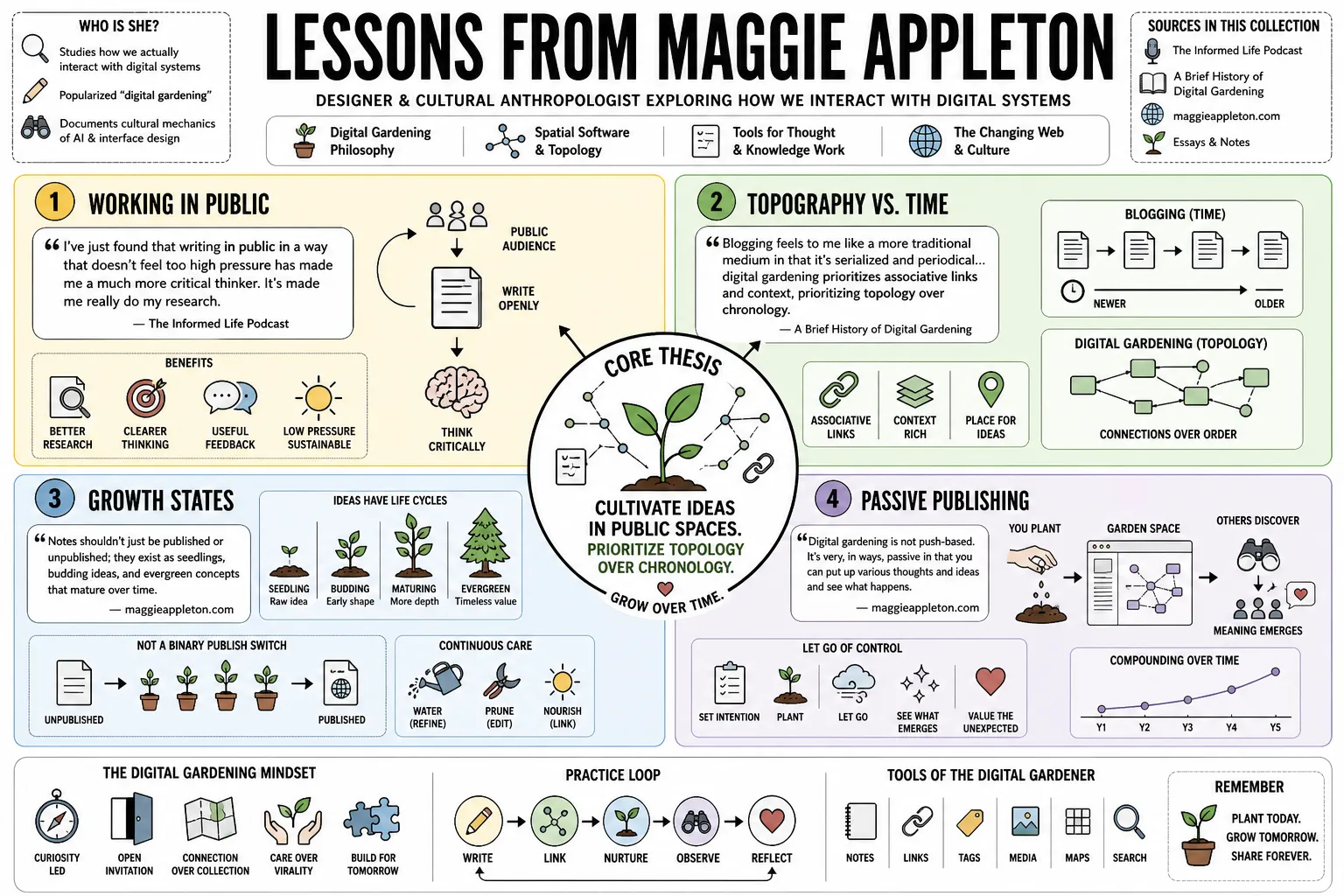
Lessons from Maggie Appleton
Designer and cultural anthropologist Maggie Appleton studies how we actually interact with digital systems. Best known for popularizing "digital gardening," she documents the cultural mechanics driving artificial intelligence and interface design. This collection gathers her work on spatial software, tools for thought, and the changing web.
Part 1: The Ethos of Digital Gardening
- On Working in Public: "I've just found that writing in public in a way that doesn't feel too high pressure has made me a much more critical thinker. It's made me really do my research." — Source: The Informed Life Podcast
- On Topography vs. Time: "Blogging feels to me like a more traditional medium in that it's serialized and periodical... digital gardening prioritizes associative links and context, prioritizing topology over chronology." — Source: A Brief History of Digital Gardening
- On Growth States: "Notes shouldn't just be published or unpublished; they exist as seedlings, budding ideas, and evergreen concepts that mature over time." — Source: maggieappleton.com
- On Passive Publishing: "Digital gardening is not push-based. It's very, in ways, passive in that you can put up very small things that are totally unpolished and might not seem worth publishing." — Source: The Informed Life Podcast
- On Epistemic Modesty: "Gardening embraces the idea of putting out half-baked thoughts with clear indicators that they are incomplete, lowering the barrier to sharing." — Source: maggieappleton.com
- On Contextual Linking: "Links in a garden shouldn't just be navigational; they should carry semantic meaning, telling the reader exactly why two concepts relate." — Source: A Brief History of Digital Gardening
- On the Death of the Feed: "The chronological feed prioritizes recency over relevance, whereas gardens help escape the endless scroll by rewarding curiosity-driven exploration." — Source: A Brief History of Digital Gardening
- On Anti-Performative Sharing: "Cultivating a personal wiki open to the world shifts the focus away from performative thought leadership toward the genuine process of learning." — Source: maggieappleton.com
- On Maintenance: "It is this growing garden of interlinked content where you are just going back and cleaning up and revisiting and adding to bits over time." — Source: The Informed Life Podcast
- On Historical Roots: "The digital garden concept isn't new; it traces back to the 1990s web, Mark Bernstein’s hypertext theories, and Eastgate Systems." — Source: A Brief History of Digital Gardening
Part 2: The Expanding Dark Forest & Generative AI
- On the Internet's Ecology: "The web feels like a dark forest because anything you say sincerely will either drown in clickbait or attract a Twitter mob." — Source: ffconf Presentation
- On AI-Generated Floods: "When language models can churn out millions of human-like words, images, and videos in seconds, it expands the dark forest by industrializing the production of low-quality, uninspired content." — Source: The Expanding Dark Forest and Generative AI
- On Human Centipede Epistemology: "When LLMs generate text based on the web, and humans publish that text back to the web to be trained on again, it creates a degrading feedback loop of original thought." — Source: The Expanding Dark Forest and Generative AI
- On the Retreat to the Cozy Web: "We've retreated into the cosy web of Discords and Substacks where nothing is indexable... Real human relationships happen there." — Source: ffconf Presentation
- On Proof of Personhood: "As synthetic media becomes indistinguishable from reality, we will culturally demand new, costly signals to verify that content was made by flesh-and-blood humans." — Source: The Expanding Dark Forest and Generative AI
- On Manufactured Serendipity: "AI search summaries threaten the chaotic serendipity of the open web by presenting neat, homogenized answers over weird, human rabbit holes." — Source: maggieappleton.com
- On Inverse Turing Tests: "The future of the internet might require humans to constantly prove to other humans that they are not automated bots." — Source: The Expanding Dark Forest and Generative AI
- On Friction as a Signal: "High-friction formats like analog art, live performances, or highly idiosyncratic website layouts become valuable exactly because AI struggles to mimic them." — Source: The Expanding Dark Forest and Generative AI
- On Knowledge Loss: "The tragedy of the cozy web is that while relationships thrive in private, the actual knowledge generated is unindexable and lost to the broader internet." — Source: ffconf Presentation
- On LLMs as Cultural Mirrors: "Language models are not intelligent minds; they are statistical reflections of our collective cultural tropes, biases, and historical data." — Source: Language Model Sketchbook
Part 3: Home-Cooked Software & Barefoot Developers
- On Home-Cooked Code: "It's software someone might build for themselves, their family and friends, their neighborhood and community. It solves local problems for local people." — Source: Local-First Conference
- On Barefoot Developers: "Barefoot developers are non-professionals who use modern tools to build good enough software for hyper-local problems ignored by tech giants." — Source: Home-Cooked Software and Barefoot Developers
- On Stop Forcing Everyone to Code: "I think we need to stop harassing normal nurses, teachers, and therapists to code when they don't want to. Barefoot developers are going to be people who live in this middle bit." — Source: Local-First Conference
- On AI as Glue: "Language models give you a bunch of disconnected lego pieces... Language model legos need glue." — Source: Local-First Conference
- On Scale as an Anti-Pattern: "Building for millions of users forces software into lowest-common-denominator homogenization, stripping away its cultural specificities." — Source: Home-Cooked Software and Barefoot Developers
- On Local-First Architecture: "For home-cooked software to be truly liberating, the data must live locally on the user's device, not held hostage in a corporate cloud." — Source: Home-Cooked Software and Barefoot Developers
- On Bespoke Workflows: "The most powerful productivity systems are highly idiosyncratic; they cannot be downloaded off a shelf, they must be slowly forged to fit the individual." — Source: maggieappleton.com
- On Coding Through Prompts: "If given access to a language model, and kind of taught how to prompt it in a way where they can clearly ask for what they want, it can write the code for them." — Source: Local-First Conference
- On Economic Viability: "The beauty of barefoot software is that it completely ignores venture capital economics; it exists solely for its utility to a small group of people." — Source: Home-Cooked Software and Barefoot Developers
- On Agency over Consumerism: "Empowering users to build their own tiny apps transforms them from passive consumers of SaaS into active creators of their own digital environments." — Source: Local-First Conference
Part 4: Visual Metaphors & Interface Design
- On Condensing Meaning: "You've kind of distilled the essence of what could have been hundreds of words into something that just fits into a single image... you're able to condense much more meaning into a smaller space." — Source: The Informed Life Podcast
- On Tangible Abstractions: "I really love the ways that visuals can make otherwise abstract ideas that we have to grapple with in digital design and programming very tangible and very real." — Source: The Informed Life Podcast
- On Anthropomorphizing Tech: "Drawing concepts as physical objects or characters helps bridge the gap between human intuition and the rigid logic of machines." — Source: maggieappleton.com
- On the Desktop Metaphor: "Modern computing relies on physical-world analogies like files, folders, and desktops because humans struggle to manipulate raw data natively." — Source: maggieappleton.com
- On Breaking the Metaphor: "The limitation of UI design is that physical metaphors eventually break down when dealing with concepts like cloud computing or version control." — Source: maggieappleton.com
- On Metaphorical Debt: "When we inherit legacy metaphors from previous eras of tech, they constrain our ability to invent entirely new paradigms for interacting with computers." — Source: maggieappleton.com
- On Illustration as Explanation: "A good visual essay doesn't just decorate text; it serves as the primary load-bearing structure for the argument." — Source: maggieappleton.com
- On Spatial Organization: "The human brain tracks information spatially; interfaces that respect object permanence are inherently more navigable." — Source: The Informed Life Podcast
- On Concept Mapping: "Drawing out the relationships between ideas forces a designer to confront inconsistencies in an application's mental model." — Source: maggieappleton.com
Part 5: Tools for Thought & Information Architecture
- On Cognitive Scaffolding: "Tools for thought are not just storage systems; they act as external scaffolds that expand the working memory of the human brain." — Source: maggieappleton.com
- On Bidirectional Linking: "The shift from hierarchical folders to networked graphs more accurately mirrors the associative nature of human memory." — Source: A Brief History of Digital Gardening
- On Tool Lock-in: "Moving knowledge between different apps highlights how much our thinking is constrained by the proprietary data models of the tools we use." — Source: maggieappleton.com
- On the Collector's Fallacy: "Saving articles into a database feels like learning, but true knowledge only emerges through the active process of summarizing and linking." — Source: maggieappleton.com
- On End-User Programming: "The best tools for thought eventually blur the line between user and developer, allowing users to modify the software's behavior to fit their mind." — Source: Home-Cooked Software and Barefoot Developers
- On Folksonomies: "Bottom-up tagging systems created by users are often more resilient and culturally accurate than rigid, top-down taxonomies." — Source: maggieappleton.com
- On Friction in Note-Taking: "Some friction is necessary in note-taking; if it's too easy to capture information, we bypass the cognitive friction required for actual comprehension." — Source: maggieappleton.com
- On Interoperability: "True ownership of knowledge requires files to exist in open, plain-text formats rather than being trapped in SaaS silos." — Source: Local-First Conference
- On System Decay: "Every personal knowledge system eventually experiences entropy; the goal isn't a perfect system, but one that can be continually remixed." — Source: maggieappleton.com
Part 6: Embodied Cognition & Spatial Interfaces
- On Thinking with the Body: "Cognition does not happen exclusively in the brain; it is deeply entangled with our physical movements and spatial environments." — Source: maggieappleton.com
- On Flat Screens: "The two-dimensional nature of standard computing interfaces severely limits our natural human ability to use spatial memory to locate items." — Source: maggieappleton.com
- On the Infinite Canvas: "Tools like Miro and FigJam succeed because they tap into our evolutionary preference for laying things out in a physical, navigable space." — Source: maggieappleton.com
- On Object Permanence: "Digital elements should ideally stay where we left them, mimicking the reliability of the physical world instead of shifting via responsive algorithms." — Source: maggieappleton.com
- On Gestural Interfaces: "Moving beyond keyboard and mouse to interfaces that respond to natural hand and body movements aligns better with our somatic intelligence." — Source: maggieappleton.com
- On Wayfinding in Data: "Navigating a complex codebase or digital library is functionally similar to wilderness wayfinding; both require landmarks and spatial anchors." — Source: maggieappleton.com
- On Mind-Body Dualism in Tech: "The software industry falsely treats the mind as a computer processing inputs, ignoring how mood, environment, and physical sensation drive logic." — Source: maggieappleton.com
- On Memory Palaces: "Ancient mnemonic techniques prove that linking abstract data to specific physical locations is the most robust way to retain complex information." — Source: maggieappleton.com
- On the Limits of Text: "While text is powerful, it strips away the physical context of communication, leaving a lossy representation of human thought." — Source: maggieappleton.com
Part 7: Folk Epistemologies & The Co-creation of Knowledge
- On Folk Models: "Users develop deeply held, often technically incorrect, folk models of how algorithms work to help them survive digital environments." — Source: maggieappleton.com
- On Algorithmic Gossip: "Communities co-create knowledge about platforms by sharing anecdotes and urban legends about what the algorithm is prioritizing today." — Source: maggieappleton.com
- On Tacit Knowledge: "The most valuable insights in any discipline cannot be explicitly written down; they are tacit, requiring hands-on mimicry and cultural immersion." — Source: maggieappleton.com
- On Epistemic Hubris: "Software engineers often mistake their technical understanding of a system for the definitive truth, dismissing the valid lived experiences of end-users." — Source: maggieappleton.com
- On Pattern Recognition: "Humans are heavily biased to find agency and intent within systems, which is why we anthropomorphize recommendation algorithms as judges or gatekeepers." — Source: maggieappleton.com
- On Shadow Bans: "The phenomenon of the shadow ban illustrates how platforms create epistemic uncertainty, forcing users to constantly guess if they are speaking into a void." — Source: maggieappleton.com
- On Superstition as Survival: "Performing weird rituals is a rational user response to opaque, shifting technological rules governing modern social platforms." — Source: maggieappleton.com
- On Community Sense-Making: "When platforms withhold documentation, users band together to reverse-engineer functionality through collective trial and error." — Source: maggieappleton.com
- On AI Hallucinations: "Treating LLM fabrications as bugs ignores that these models are fundamentally associative dreamers; their untruths are a feature of their probabilistic nature." — Source: Language Model Sketchbook
Part 8: The Cultural Anthropology of Technology
- On Technoculture: "Technology is not a neutral layer sitting beneath society; it is deeply intertwined with human ritual, status, and cultural mechanics." — Source: maggieappleton.com
- On Digital Artifacts: "A piece of software should be studied like an anthropological artifact, revealing the unstated assumptions and power dynamics of its creators." — Source: maggieappleton.com
- On the Myth of the Neutral Tool: "Design is inherently political; every default setting gently coerces users toward a specific ideological way of living." — Source: maggieappleton.com
- On Being a Hybrid: "I call myself like a really bad developer or a mediocre developer... identifying as a hybrid allows one to bypass gatekeeping and explore the artistic, non-optimized edges of code." — Source: DevTools.fm Podcast
- On Tech Tribalism: "Software communities operate exactly like traditional tribes, complete with signaling, shibboleths, and purity tests regarding framework choices." — Source: maggieappleton.com
- On the Developer Aesthetic: "The visual language of tech—dark modes, monospaced fonts, and raw terminals—is a performative aesthetic designed to signal mastery and insider status." — Source: maggieappleton.com
- On Magic vs. Mechanics: "To the average user, advanced software operates identically to magic, requiring faith in invisible forces rather than mechanical understanding." — Source: maggieappleton.com
- On Cultural Translation: "The role of the visual essayist is that of a translator, taking the opaque dialects of engineering and rendering them legible to the broader culture." — Source: The Informed Life Podcast
- On the Slow Web: "Rejecting the hyper-financialization of tech means building things that are slow, weird, culturally specific, and utterly unscalable." — Source: Home-Cooked Software and Barefoot Developers