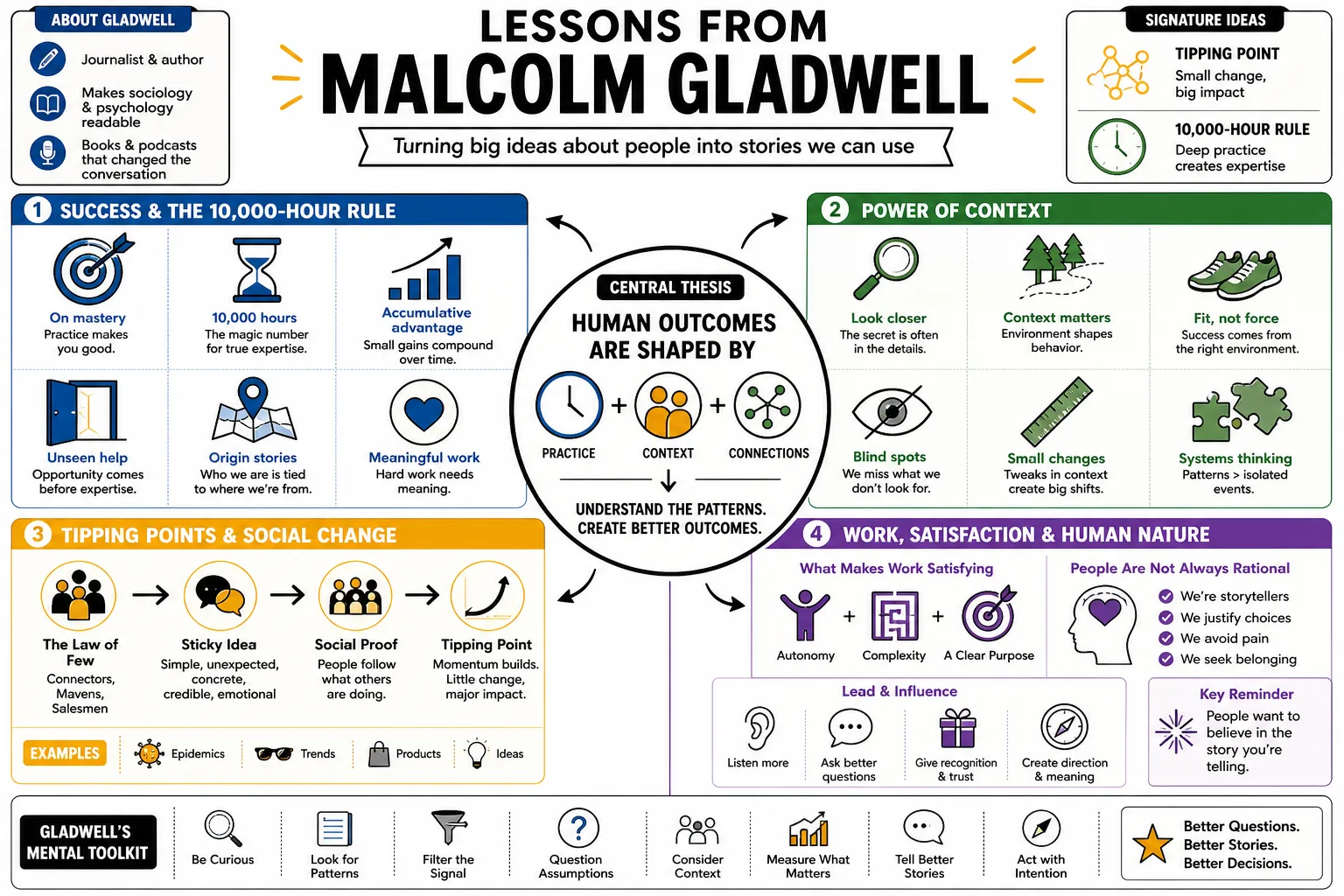
Lessons from Malcolm Gladwell
Journalist and author Malcolm Gladwell made his name turning dense sociology and psychology into readable stories. He popularized ideas like the "10,000-hour rule" and the "tipping point," changing how people talk about expertise and social trends. This profile collects the core arguments from his books and podcasts to outline his practical take on human behavior.
Part 1: Success and the 10,000-Hour Rule
- On mastery: "Practice isn't the thing you do once you're good. It's the thing you do that makes you good." — Source: [Outliers]
- On true expertise: "Researchers have settled on what they believe is the magic number for true expertise: ten thousand hours." — Source: [Outliers]
- On accumulated advantage: "Success is the result of what sociologists like to call 'accumulative advantage'." — Source: [Outliers]
- On unseen help: "But before he could become an expert, someone had to give him the opportunity to learn how to be an expert." — Source: [Outliers]
- On origin stories: "Who we are cannot be separated from where we're from." — Source: [Outliers]
- On meaningful labor: "Hard work is a prison sentence only if it does not have meaning." — Source: [Outliers]
- On satisfying work: "Those three things—autonomy, complexity, and a connection between effort and reward—are, most people will agree, the three qualities that work has to have if it is to be satisfying." — Source: [Outliers]
- On extreme achievement: "The people at the very top don’t work just harder or even much harder than everyone else. They work much, much harder." — Source: [Outliers]
- On circumstances of birth: "When and where you are born, what your parents did for a living, and what the circumstances of your upbringing were make a significant difference in how well you do in the world." — Source: [Outliers]
- On routine: "No one who can rise before dawn three hundred sixty days a year fails to make his family rich." — Source: [Outliers]
Part 2: Intuition and Snap Judgments
- On quick decisions: "There can be as much value in the blink of an eye as in months of rational analysis." — Source: [Blink]
- On missing explanations: "We’re a bit too quick to come up with explanations for things we don’t really have an explanation for." — Source: [Blink]
- On understanding: "The key to good decision making is not knowledge. It is understanding. We are swimming in the former. We are desperately lacking in the latter." — Source: [Blink]
- On first impressions: "Our snap judgments and first impressions can be educated and controlled." — Source: [Blink]
- On thin-slicing: "The ability of our unconscious to find patterns in situations and behavior based on very narrow slices of experience." — Source: [Blink]
- On insight: "Insight is not a lightbulb that goes off inside our heads. It is a flickering candle that can easily be snuffed out." — Source: [Blink]
- On escalating taste: "When we become expert in something, our tastes grow more esoteric and complex." — Source: [Blink]
- On major life choices: "When making a decision of minor importance, I have always found it advantageous to consider all the pros and cons. In vital matters, however, such as the choice of a life partner, it is better to use your unconscious." — Source: [Lifehack]
- On learning boundaries: "We learn by example and by direct experience because there are real limits to the adequacy of verbal instruction." — Source: [Lifehack]
- On the visionary mind: "The visionary starts with a clean sheet of paper, and re-imagines the world." — Source: [AZ Quotes]
Part 3: Social Epidemics and Tipping Points
- On critical mass: "The tipping point is that magic moment when an idea, trend, or social behavior crosses a threshold, tips, and spreads like wildfire." — Source: [The Tipping Point]
- On contagious emotion: "Emotion is contagious." — Source: [The Tipping Point]
- On community narratives: "Communities have their own stories, and those stories are contagious." — Source: [The Tipping Point]
- On driving belief change: "If you want to bring a fundamental change in people's belief and behavior... you need to create a community around them, where those new beliefs can be practiced and expressed and nurtured." — Source: [The Tipping Point]
- On information brokers: "The word Maven comes from the Yiddish, and it means one who accumulates knowledge." — Source: [The Tipping Point]
- On rare social gifts: "The success of any kind of social epidemic is heavily dependent on the involvement of people with a particular and rare set of social gifts." — Source: [The Tipping Point]
- On the cost of empathy: "Caring about someone deeply is exhausting." — Source: [The Tipping Point]
- On initiating trends: "There are exceptional people out there who are capable of starting epidemics. All you have to do is find them." — Source: [The Tipping Point]
- On emotional mirroring: "We imitate each other's emotions as a way of expressing support and caring … as a way of communicating with each other." — Source: [The Tipping Point]
- On maintaining friendships: "To be someone's best friend requires a minimum investment of time. More than that, though, it takes emotional energy." — Source: [The Tipping Point]
Part 4: Underdogs and Overcoming Adversity
- On hidden advantages: "There is a set of advantages that have to do with material resources, and there is a set that have to do with the absence of material resources—and the reason underdogs win as often as they do is that the latter is sometimes every bit the equal of the former." — Source: [David and Goliath]
- On the illusion of strength: "Giants are not what we think they are. The same qualities that appear to give them strength are often the sources of great weakness." — Source: [David and Goliath]
- On earning courage: "Courage is what you earn when you've been through the tough times and you discover they aren't so tough after all." — Source: [David and Goliath]
- On beneficial struggles: "There are such things as 'desirable difficulties.'" — Source: [David and Goliath]
- On the trap of elite resources: "We don't spend enough time thinking about the ways in which those kinds of material advantages limit our options." — Source: [David and Goliath]
- On practicing failure: "My upbringing allowed me to be comfortable with failure... our ability to deal with failure was very highly developed. And so we look at most situations and see much more of the upside than the downside." — Source: [David and Goliath]
- On relative positioning: "What matters, in determining the likelihood of getting a science degree, is not just how smart you are. It's how smart you feel relative to the other people in your classroom." — Source: [David and Goliath]
- On the limits of privilege: "We spend a lot of time thinking about the ways that prestige and resources and belonging to elite institutions make us better off." — Source: [David and Goliath]
- On unexpected outcomes: The traditional narrative of the strong defeating the weak is statistically incorrect when the weak refuse to play by conventional rules. — Source: [David and Goliath]
Part 5: Trust and Misunderstanding Strangers
- On the anatomy of belief: "You believe someone not because you have no doubts about them. Belief is not the absence of doubt. You believe someone because you don't have enough doubts about them." — Source: [Talking to Strangers]
- On double standards: "We think we can easily see into the hearts of others based on the flimsiest of clues. We jump at the chance to judge strangers. We would never do that to ourselves, of course." — Source: [Talking to Strangers]
- On our truth bias: "We default to truth—even when that decision carries terrible risks—because we have no choice." — Source: [Talking to Strangers]
- On the limits of transparency: "We need to accept that the search to understand a stranger has real limits. We will never know the whole truth. We have to be satisfied with something short of that." — Source: [Talking to Strangers]
- On false confidence: "The conviction that we know others better than they know us... leads us to talk when we would do well to listen." — Source: [Talking to Strangers]
- On modern communication: "The modern world is not two brothers feuding for control of the Ottoman Empire. It is Cortés and Montezuma struggling to understanding each other through multiple layers of translators." — Source: [Talking to Strangers]
- On human deception: We assume people who are lying will act nervous or avoid eye contact, but skilled deceivers know how to mimic the exact behaviors we associate with honesty. — Source: [Talking to Strangers]
- On judging contexts: "Don't look at the stranger and jump to conclusions. Look at the stranger's world." — Source: [Talking to Strangers]
- On the necessity of trust: Society would collapse if we treated every interaction with the skepticism of a detective; our vulnerability to deception is the required cost of social cooperation. — Source: [Talking to Strangers]
Part 6: Writing and Storytelling
- On capturing attention: "Titles are ads for your work." — Source: [MasterClass]
- On building suspense: Professionals deliberately withhold information to create tension or humor, ensuring the audience stays engaged until the reveal. — Source: [MasterClass]
- On finding fresh ideas: "Leave your little island." Breakthrough ideas come from stepping outside your own field and applying patterns from one discipline to another. — Source: [MasterClass]
- On the writing process: Do not wait until research is entirely finished before drafting; the act of writing reveals which details are actually interesting. — Source: [MasterClass]
- On public speaking: Delivering a speech is not simply reading text aloud; it is a discrete performance that demands ten times the preparation a novice expects. — Source: [Manner of Speaking]
- On connecting with experts: When addressing an expert audience, acknowledging your own lack of depth early on disarms the room and establishes a foundation of rapport. — Source: [Better Marketing]
- On making the abstract real: Abstract concepts only land when they are tethered to specific characters, physical quirks, and sensory details. — Source: [Ethos3]
- On reading as an active process: "A book … is a living and breathing document that grows richer with each new reading." — Source: [The Tipping Point]
- On the storytelling deficit: "We have, as human beings, a storytelling problem." — Source: [MasterClass]
Part 7: Technology and Warfare
- On ideological stubbornness: "The more you invest in a set of beliefs—the greater the sacrifice you make in the service of that conviction—the more resistant you will be to evidence that suggests that you are mistaken. You don't give up. You double down." — Source: [The Bomber Mafia]
- On the nature of conflict: "All war is absurd." — Source: [The Bomber Mafia]
- On discarding custom: "Proficimus more irretenti: 'We make progress unhindered by custom.'" — Source: [The Bomber Mafia]
- On the birthplace of innovation: "Revolutions are birthed in conversation, argument, validation, proximity…" — Source: [The Bomber Mafia]
- On the morality of technology: The central tragedy of modern warfare is the inevitable collision between idealistic technological promises and the brutal pragmatism required to win. — Source: [The Bomber Mafia]
- On true believers: Innovators who hold onto revolutionary theories with religious zeal eventually blind themselves to the evidence when their strategies fail in the field. — Source: [The Bomber Mafia]
- On unforeseen variables: A perfectly engineered technology, like a precision bombsight, can be rendered useless by a single unaccounted variable in the natural environment, such as a high-altitude jet stream. — Source: [The Bomber Mafia]
- On the compromise of doctrine: When theoretical warfare fails, commanders are forced to abandon their moralized doctrines in favor of the devastatingly effective tactics they initially opposed. — Source: [The Bomber Mafia]
- On shared grief: "When one member of a couple dies, some part of the other dies along with the partner." — Source: [The Bomber Mafia]
Part 8: Reexamining History and Unconventional Wisdom
- On second chances for the past: History is rarely settled; digging into neglected details proves that "the past deserves a second chance" to be correctly understood. — Source: [Revisionist History]
- On systemic vs. individual failure: Often, when we blame individual shortcomings for a disaster, we are missing the broader systemic factors that practically guaranteed the failure. — Source: [Revisionist History]
- On the value of surprise: If you ask a question and receive an answer that genuinely surprises you, you have found a worthwhile avenue of inquiry. — Source: [Revisionist History]
- On conformity vs. logic: The "threshold model of collective behavior" explains why people abandon successful but unconventional methods to avoid the social discomfort of standing out. — Source: [Revisionist History]
- On two types of genius: True innovation is split between "young geniuses" who strike early with raw talent, and "experimental innovators" who require decades of trial and error to produce their masterpieces. — Source: [Revisionist History]
- On the limits of satire: While satire feels powerful to its creators, it often fails to change minds because audiences map their pre-existing political biases onto the joke. — Source: [Revisionist History]
- On zooming in to see the big picture: You do not need to study an entire society to understand it; a deep, qualitative analysis of a highly specific, niche example will usually reveal the broader societal truth. — Source: [Revisionist History]
- On the power of rules: Seemingly trivial rules, like those governing private clubs or tax codes, are the actual mechanisms through which power and wealth are quietly protected and transferred. — Source: [Revisionist History]
- On questioning common sense: The most dangerous assumptions a society makes are the ones disguised as pure common sense, as they are rarely subjected to skeptical review. — Source: [Revisionist History]