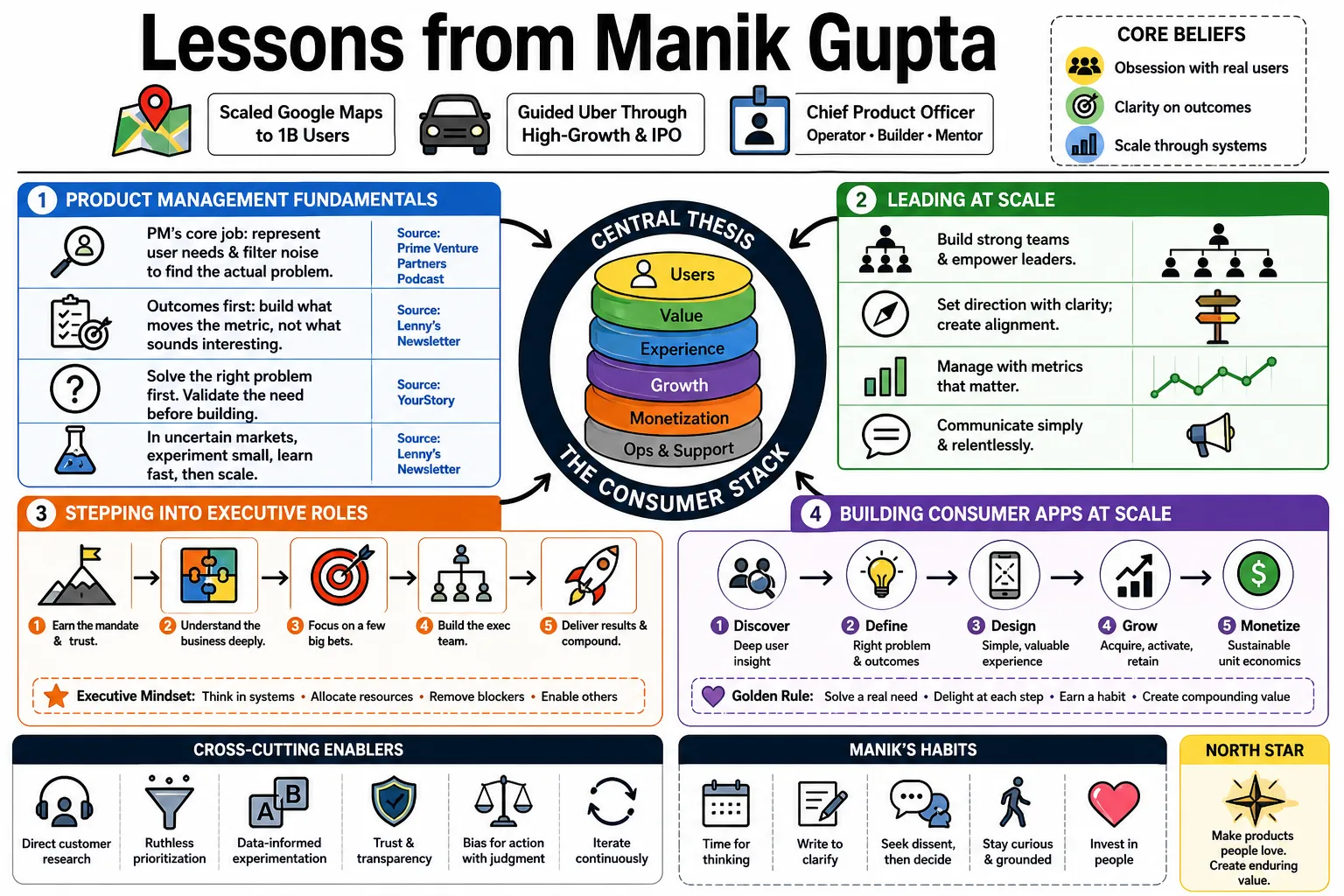
Lessons from Manik Gupta
Manik Gupta led the product teams that scaled Google Maps to a billion users and later guided Uber through its high-growth phase and IPO as Chief Product Officer. He favors direct customer research over rigid frameworks and defined the operational "consumer stack." This collection gathers his practical advice on managing large organizations, stepping into executive roles, and building consumer apps at scale.
Part 1: Product Management Fundamentals
- On the core job of a PM: "A product manager's primary responsibility is to represent the user's needs accurately within the organization, filtering the noise to find the actual problem." — Source: Prime Venture Partners Podcast
- On prioritization under pressure: "Clear business outcomes force a rigorous and rapid approach to prioritization. You cannot build what sounds interesting; you have to build what moves the metric." — Source: Lenny's Newsletter
- On problem selection: "Solving the right problem is often harder and more important than finding the right solution. Too many teams rush to build without validating the underlying need." — Source: YourStory
- On market experimentation: "When you are in a market that is fast growing and super early, the ability to understand, work and experiment with customer patterns is massive." — Source: YourStory
- On the transition from consulting: "Consulting teaches you how to break down a problem, but product management requires you to live with the consequences of the solution you build." — Source: Medium
- On building trust: "Trust is the currency of product management. You build it by being transparent about your failures and rigorous about your successes." — Source: Prime Venture Partners Podcast
- On continuous learning: "The best product managers are those who never assume they know everything about their domain. The market changes too quickly for arrogance." — Source: Lenny's Podcast
- On technical fluency: "You do not need to write the code, but you must understand the technical constraints and possibilities to earn the respect of your engineering counterparts." — Source: CPO Mastery Podcast
- On product-company fit: "Product-market fit is insufficient on its own; you also need company-product fit to ensure what you build aligns with the internal incentives and structure of your organization." — Source: Lenny's Newsletter
- On execution speed: "A perfect strategy executed too late is a failed strategy. Speed of iteration serves as a primary competitive advantage." — Source: South Asian Trailblazers
Part 2: The Voice of the Customer
- On customer research: "The best product managers are those who conduct extensive research, talk to the maximum number of customers, and develop a clear perspective based on those interactions." — Source: YourStory
- On user empathy: "You have to become the undisputed voice of the customer in the room. If you are not advocating for them, no one else will." — Source: Prime Venture Partners Podcast
- On interpreting feedback: "Customers will tell you what they want, but it is your job to figure out what they actually need. Build to solve the problem they are experiencing rather than the feature they ask for." — Source: Lenny's Podcast
- On qualitative versus quantitative data: "Data tells you what is happening, but talking to users tells you why it is happening. You need both to make informed decisions." — Source: YourStory
- On finding edge cases: "Pay attention to the users who are hacking your product to do something it was not designed for. That behavior usually hides your next big feature." — Source: Lenny's Newsletter
- On continuous discovery: "Customer research is never a one-time phase at the beginning of a project; it is a continuous habit that must be maintained throughout the product lifecycle." — Source: Prime Venture Partners Podcast
- On avoiding confirmation bias: "It is easy to find data that supports your hypothesis. The real skill is actively seeking out customer feedback that proves you wrong." — Source: Lenny's Podcast
- On global perspectives: "When building for a global audience, you cannot rely on intuition developed in Silicon Valley. You have to get on the ground and understand local constraints." — Source: South Asian Trailblazers
- On local information: "Local information is the final frontier." — Source: VerySpatial
- On mapping the world: "My prediction is over the next 10 years we will continue to make significant progress on this. I am not entirely sure that we will solve the problem because it is a very difficult problem to solve. But at the same time, I do feel that we are reaching a point where we will be getting much better at it." — Source: Global News
Part 3: Scaling and Growth
- On distribution advantages: "At Google Maps, the product was pre-installed on billions of devices, meaning distribution was solved. At Uber, we had to earn every single download." — Source: CPO Mastery Podcast
- On hyper-growth challenges: "When a company scales from a few hundred to over a thousand people quickly, the systems that worked yesterday will break today. You have to constantly rebuild the machine while driving it." — Source: Lenny's Newsletter
- On platform thinking: "To truly scale, you must move from building isolated features to adopting a platform-thinking mindset, creating foundational capabilities that other teams can build upon." — Source: Podbean
- On measuring success at scale: "As you grow, vanity metrics become dangerous. You have to relentlessly focus on core business outcomes and ensure every product team's goals roll up to those metrics." — Source: Prime Venture Partners Podcast
- On international expansion: "Scaling globally requires a delicate balance between a unified core product and localized features that address specific regional needs." — Source: South Asian Trailblazers
- On organizational debt: "Similar to technical debt, fast-growing companies accumulate organizational debt. If you do not periodically pause to clarify roles and processes, velocity will grind to a halt." — Source: Lenny's Podcast
- On building for 100 million users: "Designing an app for ten thousand users is about engagement; designing for a hundred million users is about edge cases, reliability, and extreme simplicity." — Source: Lenny's Newsletter
- On adapting to new environments: "The transition from a free, distribution-heavy product like Google Maps to a transactional, margin-focused business like Uber requires fundamentally rewiring how you evaluate success." — Source: CPO Mastery Podcast
- On the value of speed: "When scaling rapidly, the cost of moving slowly is usually higher than the cost of making a reversible mistake." — Source: YourStory
- On resource allocation: "In a high-growth environment, prioritization is less about what you choose to do and more about what you have the discipline to explicitly ignore." — Source: Prime Venture Partners Podcast
Part 4: Leadership and Influence
- On cross-functional alignment: "When running large teams across engineering, design, and data science, your ability to align everyone with a shared vision, rather than giving orders, is a strict requirement." — Source: YourStory
- On leading without authority: "A product manager rarely has direct reports initially. Your success depends entirely on your ability to influence through logic, data, and a compelling narrative." — Source: Lenny's Podcast
- On single-threaded leadership: "You need a single-threaded leader who has clear accountability and can make decisions across functions. This prevents team members from feeling disconnected from the decision-making process." — Source: Lenny's Newsletter
- On hiring talent: "Building exceptional teams requires hiring people who are highly talented, humble, collaborative, and scrappy enough to navigate ambiguity." — Source: Microsoft Bay Area Blog
- On creating culture: "Culture is defined by the worst behavior you are willing to tolerate as a leader. You have to actively enforce the values you want to see." — Source: Prime Venture Partners Podcast
- On managing large organizations: "The shift from individual contributor to a CPO is a shift from solving product problems to solving organizational design problems." — Source: Lenny's Podcast
- On decision frameworks: "When teams are paralyzed by indecision, the leader's job is not necessarily to make the decision for them, but to provide the framework that makes the answer obvious." — Source: Lenny's Newsletter
- On shielding the team: "A good leader acts as an umbrella, protecting the product team from executive churn and organizational politics so they can focus on shipping." — Source: Prime Venture Partners Podcast
- On the importance of humility: "No matter how senior you get, you must retain the willingness to admit when your hypothesis was wrong and pivot based on new evidence." — Source: South Asian Trailblazers
Part 5: Building Consumer Products
- On the consumer stack: "There is a fundamental consumer stack of components a company needs to have in place to successfully build and scale consumer products." — Source: Lenny's Newsletter
- On product simplicity: "Consumer apps must be ruthlessly simple. If a user has to think about how to navigate your interface, you have already lost them." — Source: Lenny's Podcast
- On retention over acquisition: "Acquiring users is a marketing challenge; retaining them is a product challenge. You cannot fill a leaky bucket regardless of how good your top-of-funnel is." — Source: Prime Venture Partners Podcast
- On the role of design: "Design extends beyond how a product looks to define exactly how it works. A seamless user experience serves as the primary differentiator in crowded consumer markets." — Source: YourStory
- On habit formation: "The most successful consumer products solve a specific problem while integrating themselves into the daily habits of the user." — Source: Lenny's Podcast
- On emotional connection: "Utility brings a user to your app, but emotional resonance is what keeps them coming back and advocating for it to others." — Source: South Asian Trailblazers
- On the danger of feature bloat: "Adding features to satisfy a vocal minority often degrades the experience for the silent majority. You have to protect the core value proposition." — Source: Lenny's Newsletter
- On mapping and location: "Ground truth dictates success. Making maps more accurate and comprehensive requires bridging the gap between digital data and physical reality." — Source: GeekWire
- On balancing sides of a marketplace: "In a two-sided marketplace like Uber, a product change that benefits the rider cannot fundamentally break the economics or experience for the driver." — Source: CPO Mastery Podcast
Part 6: Career Inflection Points
- On career growth: "Career progression in product management is rarely a straight line. You have to actively look for opportunities to create inflection points in your trajectory." — Source: Lenny's Podcast
- On capturing industry waves: "Strategic positioning dictates long-term success. You must look at the macro trends in technology and place yourself in a position to ride the next big wave." — Source: YourStory
- On playing the long game: "Do not optimize for short-term title bumps. Optimize for environments where you will be challenged, where you can build trust, and where you can learn from exceptional peers." — Source: Prime Venture Partners Podcast
- On learning from adversity: "You often learn the most about your own capabilities, and the capabilities of your team, during the most difficult, high-pressure situations." — Source: Lenny's Newsletter
- On transitions: "Moving between different company cultures, like from Google to Uber to Microsoft, forces you to unlearn old habits and adapt your leadership style to new contexts." — Source: Microsoft Bay Area Blog
- On the value of general management: "To advance to the highest levels of product leadership, you must stop thinking like a feature builder and start thinking like a general manager." — Source: Prime Venture Partners Podcast
- On mentorship: "Seek out mentors who will give you harsh truths rather than mere encouragement. Growth happens when your blind spots are exposed." — Source: South Asian Trailblazers
- On entrepreneurial experience: "Founding a startup early in your career teaches you a level of ownership and scrappiness that serves you well even when you transition to massive corporations." — Source: YourStory
- On taking risks: "If you are completely comfortable in your current role, you are likely stagnating. Step into positions where you feel slightly underqualified." — Source: Lenny's Podcast
Part 7: The Role of the CPO
- On the evolving CPO role: "The CPO role is increasingly becoming that of a technical product leader who is accountable across multiple technical domains to ensure unified decision-making." — Source: Lenny's Newsletter
- On connecting the dots: "At the executive level, your primary job is to connect the dots across different organizational silos to ensure a cohesive strategy." — Source: Lenny's Podcast
- On resource delegation: "A CPO cannot micromanage product specs. You have to delegate heavily and focus on whether the resource allocation matches the strategic priorities of the business." — Source: Prime Venture Partners Podcast
- On executive communication: "When communicating with the board or the CEO, you must translate complex product roadmaps into clear business impacts and risk assessments." — Source: CPO Mastery Podcast
- On hiring leaders: "As a CPO, your most important product is the team you build. Hiring strong directors and VPs who can operate autonomously is the only way to scale yourself." — Source: Lenny's Newsletter
- On managing failure: "When a major product launch fails, the CPO must take public accountability while internally focusing on the systemic flaws that led to the failure, rather than blaming individuals." — Source: YourStory
- On setting the vision: "You must paint a compelling picture of where the product will be in three years, and then work backward to define the milestones required to get there." — Source: Prime Venture Partners Podcast
- On cross-functional empathy: "A great CPO understands the inherent tensions between engineering's desire for perfect architecture and the business's need for speed, and actively mediates that balance." — Source: Lenny's Podcast
- On organizational design: "The org chart is a product itself. If the organizational structure does not match the product architecture, you will inevitably ship your internal communication barriers to the user." — Source: Lenny's Newsletter
Part 8: Optimism and the Future
- On technological optimism: "It is incredibly useful to maintain an optimistic stance about technology. Optimism is what drives the ambition to build things that have not existed before." — Source: Lenny's Podcast
- On AI integration: "The next wave of consumer applications will move beyond featuring AI as a bolt-on feature; they will be fundamentally redesigned around generative capabilities." — Source: CDO Magazine
- On applying tech to public health: "Technology has an obligation to serve the public good, which is why building user-centered apps for frontline efforts during crises is a strict necessity." — Source: YourStory
- On the permanence of maps: "While we will make massive strides in mapping technology, representing the physical world digitally is a problem that continues to evolve as the world itself changes." — Source: Global News
- On solving real problems: "The most enduring tech companies are those that look past the hype cycle and apply new technologies to solve persistent, unglamorous human problems." — Source: Prime Venture Partners Podcast
- On communications platforms: "Building community products like Teams or Skype requires understanding that communication goes beyond data transfer to facilitate human connection at scale." — Source: Microsoft Bay Area Blog
- On lifelong curiosity: "The moment you stop being curious about how new technologies work is the moment your skills begin to atrophy. Stay eternally curious." — Source: South Asian Trailblazers
- On the tech industry's responsibility: "As our products reach hundreds of millions of people, product leaders must transition from asking whether we can build something to asking whether we should build it." — Source: Lenny's Newsletter
- On the future of product management: "The discipline of product management will continue to become more technical and more business-oriented simultaneously, demanding leaders who can comfortably inhabit both worlds." — Source: Lenny's Podcast