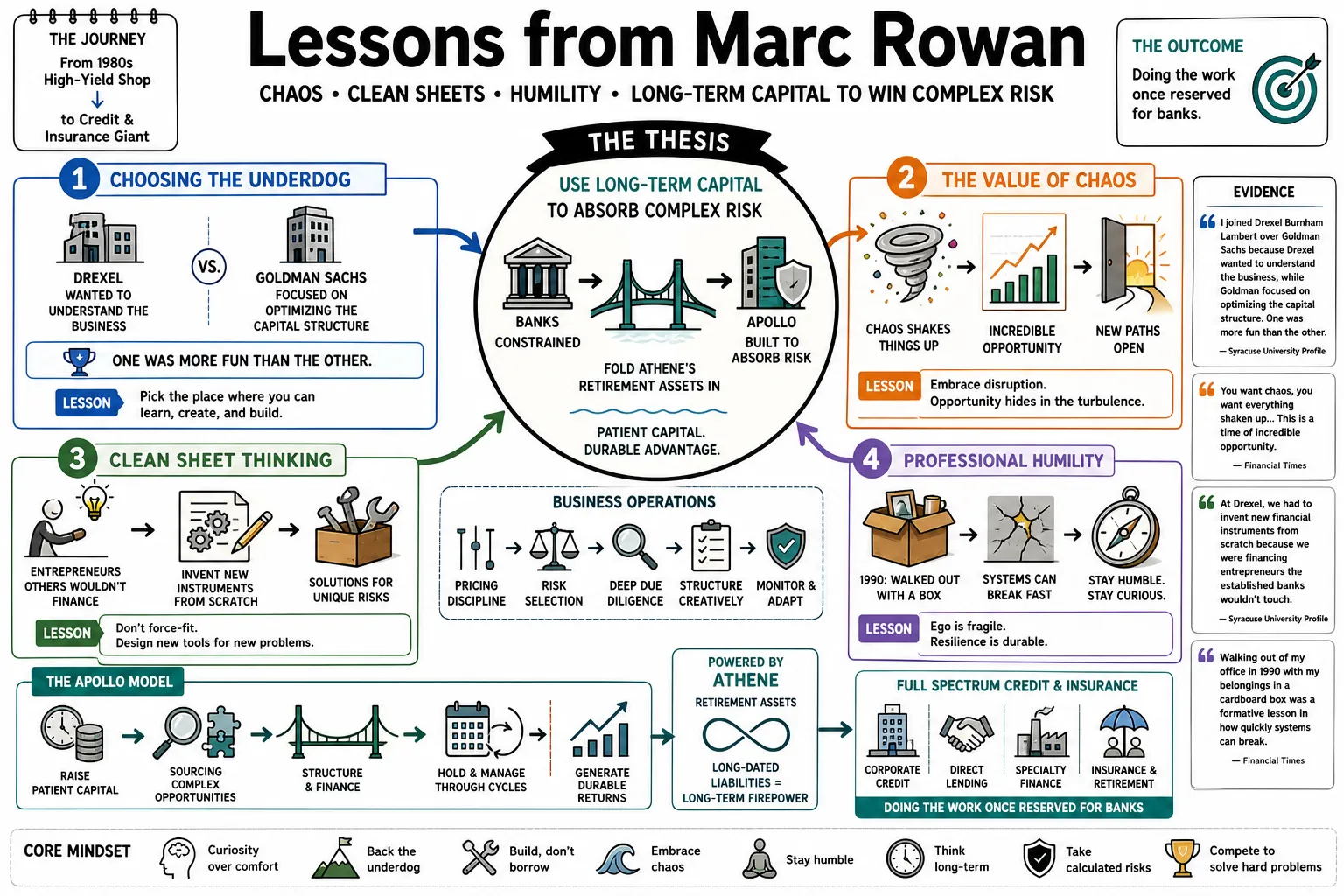
Lessons from Marc Rowan
Marc Rowan turned Apollo from a 1980s high-yield shop into a credit and insurance giant that now does the work once reserved for banks. By folding Athene’s retirement assets into the firm, he built a model for using long-term capital to swallow the complex risks that traditional lenders can no longer handle.
Part 1: The Drexel Years and the Wisdom of Chaos
- On Choosing the Underdog: "I joined Drexel Burnham Lambert over Goldman Sachs because Drexel wanted to understand the business, while Goldman focused on optimizing the capital structure. One was more fun than the other." — Source: Syracuse University Profile
- On the Value of Chaos: "You want chaos, you want everything shaken up... This is a time of incredible opportunity." — Source: Financial Times
- On Clean Sheet Thinking: "At Drexel, we had to invent new financial instruments from scratch because we were financing entrepreneurs the established banks wouldn't touch." — Source: Syracuse University Profile
- On Professional Humility: "Walking out of my office in 1990 with my belongings in a cardboard box was a formative lesson in how quickly systems can break." — Source: Financial Times
- On Business Operations: "Because we financed below-investment-grade companies, I was forced to understand the operations of a business to judge its credit, not just its balance sheet." — Source: Syracuse University Profile
- On Contextual Vision: "Michael Milken taught us to look at the bigger context—not just the immediate deal, but why a specific trend or industry would be successful in the future." — Source: Syracuse University Profile
- On Ethical Vigilance: "Observing the legal downfall of my mentors and the firm itself instilled a focus on the critical role of ethics and the long-term consequences of aggressive engineering." — Source: Syracuse University Profile
- On Founding in Wreckage: "Apollo was founded in the wreckage of Drexel’s collapse; we were essentially a group of people who knew how to find value where others saw only failure." — Source: Financial Times
- On the Drexel Network: "The world of finance is small; the relationships I built at Drexel with Leon Black and Josh Harris became the foundation for everything that followed." — Source: Syracuse University Profile
Part 2: The Philosophy of Apollo
- On the Core Mantra: "Purchase price matters." — Source: Apollo Global Management
- On Alpha Generation: "We are in the alpha generation business, providing excess return per unit of risk." — Source: Goldman Sachs Talks at GS
- On Complexity: "The greatest opportunities are found in complexity and chaos where others are unwilling to do the work." — Source: Bloomberg Wealth with David Rubenstein
- On Interdisciplinary Value: "Opportunities live between fields of expertise." — Source: Norges Bank In Good Company
- On Market Volatility: "I like where we sit." — Source: Bloomberg Wealth with David Rubenstein
- On the Simple Model: "We operate a really simple business. We invest assets, we earn a return on those assets, and we pay out benefits." — Source: Apollo Retirement Services Presentation
- On Avoiding Crowds: "If you want to escape the Mag 7, but still want to be invested, it is very difficult to do efficiently in public markets." — Source: Puck News
- On the Role of Alts: "I believe alternatives will soon make up 50% of individual portfolios as investors seek true diversification." — Source: Goldman Sachs Talks at GS
- On Underwriting vs. Luck: "There are no bad asset classes, only bad underwriters." — Source: Apollo Global Management
- On Investment Grade Focus: "95% of our portfolio is fixed income, of which 97% is investment grade; private investment grade is just investment grade." — Source: Apollo Global Management
Part 3: The New Architecture of Finance
- On the Industrial Renaissance: "Whether it’s infrastructure, energy transition, data centers, or defense, we are in a massive capital-intensive period." — Source: Puck News
- On Banks as Lenders: "Traditional banks are short-term lenders, ill-suited for the long-dated, complex financing required for today’s industrial growth." — Source: Puck News
- On the Transition to Markets: "We are moving from a bank-led lending system to an investment marketplace." — Source: Morningstar Interview
- On Capital Constraints: "Our industry will find that it is limited in its growth by its capacity to find good investments rather than by its capacity to raise capital." — Source: Norges Bank In Good Company
- On Market Convergence: "Everything that exists in the public markets—repo, borrowing, market making, daily pricing—is coming to the private markets." — Source: Private Markets Insights
- On Fixed Income Replacement: "Institutions are looking at private assets not just in their alternatives bucket, but in their fixed income bucket for fixed income replacement." — Source: Markets Media
- On Bespoke Financing: "Private credit providers act as the 'new banks,' offering tailored solutions that public markets cannot easily standardize." — Source: Morningstar Interview
- On Global Demand: "The need for capital in the real economy is the largest secular growth opportunity for the next 30 years." — Source: Core Group USA
- On Liquidity Premia: "Investors should be compensated with a premium for giving up daily liquidity without necessarily taking on more credit risk." — Source: Morningstar Interview
- On Tradeability: "We are working to make private credit more tradeable by creating secondary markets for private investment-grade debt." — Source: Private Equity Wire
Part 4: The Athene Flywheel
- On the Merger Synergy: "The merger with Athene connects retirement savings with the need for capital in the real economy." — Source: Apollo Retirement Services Presentation
- On Cost of Capital: "We pay out benefits to retirees; that’s our cost of capital." — Source: Apollo Retirement Services Presentation
- On Competitive Advantage: "If the only thing you buy is public investment grade fixed income, you have no advantage over any other company in the industry." — Source: Apollo Global Management
- On Long-term Lifestyle: "Others following what we do will find out that this is not a trade; it is a lifestyle." — Source: Apollo Global Management
- On Insurance Liabilities: "The insurance company is a terrible place to take credit risk, but a wonderful place to take liquidity risk." — Source: Apollo Global Management
- On the Retirement Crisis: "Solving the retirement income gap is the 'holy grail' for our industry." — Source: Core Group USA
- On Guaranteed Income: "The big opportunity is to think about retirement in terms of simple, guaranteed lifetime income." — Source: Core Group USA
- On Sticky Capital: "Having permanent capital allows us to invest through cycles without the pressure of redemptions." — Source: Goldman Sachs Talks at GS
- On the Asset-Liability Match: "Successful insurance-driven asset management requires a perfect understanding of when you owe the money and how you earn the return." — Source: Apollo Global Management
Part 5: Rethinking Risk and Liquidity
- On the Primary Cause of Failure: "The mismatch of borrowing short and lending long is the primary cause of financial failure, from Drexel to Lehman to FTX." — Source: Conversations with Tyler
- On the Definition of Risk: "Public is not safe or risky, private is not safe or risky... they are just differing degrees of liquidity." — Source: Norges Bank In Good Company
- On Redemptions: "If you can't meet 5% redemptions per quarter, you're an idiot." — Source: CNBC Invest in America Forum
- On Opaque Markets: "I reject the notion that private credit is opaque; lenders often have more direct access to a borrower's management and data than public bondholders do." — Source: Morningstar Interview
- On Levered Lending: "Private investment grade is not the same as what’s happening in the headlines today when people talk about levered lending." — Source: Apollo Global Management
- On Underwriting Discipline: "Success in credit is defined by the ability to be a good steward of capital who avoids doing stupid things during periods of complacency." — Source: Stock Insights AI
- On Universal Credit: "Credit is credit; the risk doesn't change just because it isn't traded on an exchange every second." — Source: Morningstar Interview
- On Liquidity Misconceptions: "Investors overvalue liquidity in their portfolios; you shouldn't pay for liquidity you don't actually need." — Source: Goldman Sachs Talks at GS
- On Software Over-leverage: "I expect a shakeout in software-concentrated private credit portfolios where AI disruption meets excessive debt." — Source: Stock Insights AI
Part 6: Leadership and the Servant CEO
- On the Servant Leader: "I’m a servant leader... my job is to make their job easier." — Source: Conversations with Tyler
- On Doing 'Nothing': "I used to think I was actually quite good at doing things. Now I do nothing; I remove obstacles for others." — Source: Conversations with Tyler
- On Debate Culture: "There’s very little that gets done in the way of dicta here; I have to get the buy-in of 200 people to successfully run this organization." — Source: Conversations with Tyler
- On Moral Authority: "I have a windowless office off the trading floor... it’s given me tremendous moral authority when it comes to the arrangement of people’s offices." — Source: Conversations with Tyler
- On Office Design: "The productivity increase from the 'casual collisions' of people seeing each other in the cafeteria and coffee bar is real." — Source: Conversations with Tyler
- On Organizational Momentum: "The best way to judge a company is by its momentum; without it, every small issue becomes an impediment." — Source: Goldman Sachs Talks at GS
- On Hiring Passion: "When hiring 22-year-olds, they have to love their job; you can’t fake this job for very long." — Source: Conversations with Tyler
- On the First Year: "Your first year at Apollo is mostly useless while you learn the system." — Source: Conversations with Tyler
- On Reputation Management: "Everyone's coming back. The world is so interconnected that your reputation is just the sum of the people who will vouch for you." — Source: Wharton Graduation Keynote
- On Culture as Queen: "If cash is king, culture is queen; it is the internal compass that directs the organization during a crisis." — Source: Wharton Graduation Keynote
Part 7: Career Strategy and Personal Mastery
- On Mastery: "Become the absolute expert in whatever you are responsible for. If you become the expert, people seek out your input." — Source: Goldman Sachs Talks at GS
- On Asking 'Why': "Ask people who disagree with you why they disagree. You've learned very little by speaking, and a lot by asking." — Source: Apollo Career Tips
- On Proactive Change: "Accept change or change will be visited upon you." — Source: Apollo Career Tips
- On Innate Fit: "Success comes from finding something that fits with what you’re innately good at; I am a puzzle solver." — Source: Wharton Graduation Keynote
- On Life Stages: "Spend your 20s on your career, your 30s on your family, and your 40s and 50s on contribution." — Source: Wharton Graduation Keynote
- On the 20s Grind: "In your 20s, focus entirely on your career and paying back debt." — Source: Wharton Graduation Keynote
- On Interpersonal Help: "Help others without expecting an immediate return; those people will eventually come back into your life." — Source: Wharton Graduation Keynote
- On Intellectual Humility: "Never act like the smartest person in the room, regardless of your degree." — Source: Wharton Graduation Keynote
- On Learning Curves: "In your second year, you're at 30% capacity; by the third, you feel like you've been here a decade." — Source: Conversations with Tyler
Part 8: Reforming Institutions
- On University Governance: "Large complex global corporations can be run with boards no larger than 10; 50 people on a university board is insane." — Source: Conversations with Tyler
- On Institutional Neutrality: "Universities should not take official stances on political or social issues." — Source: The Daily Pennsylvanian
- On Management Standards: "Higher education has faced 20 years of bad management by trustees who have forgotten their core mission." — Source: The Economic Times
- On Meritocracy: "We need a compact for academic excellence that ties funding to merit-based admissions and standardized testing." — Source: The Daily Pennsylvanian
- On Academic Accountability: "Academia needs a come-to-Jesus moment regarding its business model and governance." — Source: The Economic Times
- On Board Ineffectiveness: "Massive boards at universities are just window dressing and rewards for contributions, not bodies for true oversight." — Source: Conversations with Tyler
- On Future Blueprints: "Higher education needs a fundamental rethink to maintain global excellence." — Source: Conversations with Tyler
- On Philanthropic Ties: "I support Penn because they allowed me to finish my degree and pay tuition later when my father passed away; that act of grace built my loyalty." — Source: Syracuse University Profile
- On the Duty of Trustees: "The job of a trustee is to ensure the long-term health of the institution, not to be popular in the short term." — Source: The Economic Times