Mario Gabriele founded The Generalist, a newsletter that applies the narrative depth of long-form journalism to the mechanics of venture capital. Through deep-dive essays and analysis, he turned an interest in strategy into a standalone media property and a venture fund. This profile curates his core ideas on evaluating early-stage founders and the mechanics of modern business.
Part 1: Writing and Storytelling
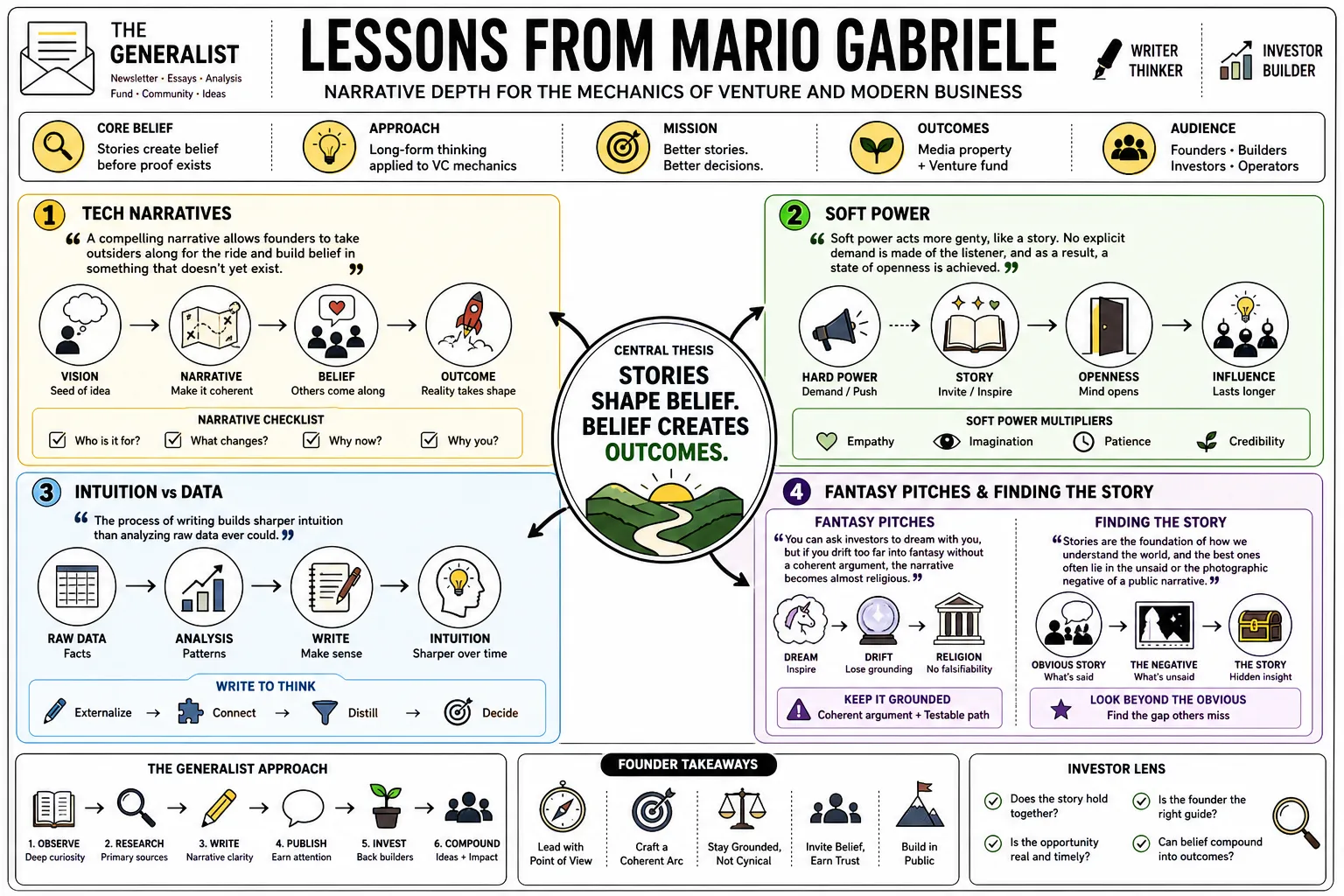
- On Tech Narratives: "A compelling narrative allows founders to take outsiders along for the ride and build belief in something that doesn't yet exist." — Source: [Metamuse Podcast]
- On Soft Power: "Soft power acts more gently, like a story. No explicit demand is made of the listener, and as a result, a state of openness is achieved." — Source: [The Generalist]
- On Intuition vs Data: "The process of writing builds sharper intuition than analyzing raw data ever could." — Source: [Creator Lab]
- On Fantasy Pitches: "You can ask investors to dream with you, but if you drift too far into fantasy without a coherent argument, the narrative becomes almost religious." — Source: [Metamuse Podcast]
- On Finding the Story: "Stories are the foundation of how we understand the world, and the best ones often lie in the unsaid or the photographic negative of a public narrative." — Source: [Dialectic FM]
- On Journalism Meets VC: "There is immense value in bridging the gap between high-level investment analysis and the narrative quality of long-form journalism." — Source: [The Nathan Barry Show]
- On Generosity in Writing: "The ability to communicate clearly and meet the reader where they are is a strong signal of overall product quality." — Source: [Summation Podcast]
- On Editing: "Distilling a massive public filing down to its essential insights requires stripping away the noise to find the actual market dynamics at play." — Source: [The S-1 Club]
- On Symbolism: "The content of soft power is inherently symbolic, enforcing values and norms through narrative rather than mandates." — Source: [The Generalist]
- On Information Density: "A good briefing should give the reader a massive information advantage without making them feel like they are reading a textbook." — Source: [Metamuse Podcast]
Part 2: The Art of Research
- On Obsessive Observation: "Great writing comes from noticing details and making connections that others overlook during their research." — Source: [Dialectic FM]
- On Speed-Running Conviction: "The goal of deep research is to quickly understand a complex company or technology well enough to form a defensible opinion." — Source: [Metamuse Podcast]
- On Original Reporting: "Interviewing practitioners and insiders yields original insights that you simply cannot get from secondary sources." — Source: [The Nathan Barry Show]
- On Synthesizing Complexity: "You have to take a three-hundred page financial document and boil it down to the few variables that actually dictate the company's future." — Source: [The S-1 Club]
- On Depth Over Brevity: "While the internet favors quick takes, there is a durable market for long-form pieces that serve as essential reading on a specific subject." — Source: [Creator Lab]
- On Building Advantages: "Spending time where others are skimming is how you build a lasting information advantage in any market." — Source: [Hummingbird Ventures]
- On The Human Element: "When evaluating companies, you must look at the psychic weirdness and the sacrifice behind elite performance." — Source: [Dialectic FM]
- On Finding Truth: "Research is less about aggregating facts and more about figuring out what is actually true in a given market." — Source: [Summation Podcast]
- On Asking Questions: "The right question to an insider will crack open a company's strategy faster than reading their public relations materials." — Source: [The Generalist]
- On Information Diets: "You have to consume high-quality inputs if you expect your writing to output genuinely unique insights." — Source: [The Nathan Barry Show]
Part 3: Understanding Founders
- On Early Stage Investing: "At the earliest stages, a founder's storytelling ability is a massive differentiator between success and failure." — Source: [How They Grow]
- On Founder Psychology: "Up to ninety-five percent of early-stage investing comes down to evaluating the individual entrepreneur and their specific drive." — Source: [Generalist Capital]
- On Ambition: "You should look for unresolved ambition or strange, raw edges in a founder rather than a perfectly polished resume." — Source: [Dialectic FM]
- On Authenticity: "I am often skeptical of narratives about perfect childhoods. True drive usually comes from a place of genuine character and past friction." — Source: [Hummingbird Ventures]
- On High Conviction: "Founders who possess deep conviction can bend the reality of a market to fit their vision." — Source: [Creator Lab]
- On Sacrifice: "Building a world-beating company requires a level of personal sacrifice that most people are unwilling to endure." — Source: [The Generalist]
- On Communication: "A founder's ability to articulate their vision clearly is a proxy for how they will recruit talent and sell to customers." — Source: [Metamuse Podcast]
- On Pedigree: "Traditional markers like elite degrees matter far less than the texture of someone's mind and their hunger to win." — Source: [Generalist Capital]
- On Founder Relationships: "Treat investing as a way to partner with individuals and help them solve complex problems, rather than just acting as capital." — Source: [Summation Podcast]
Part 4: Media and Business
- On the Mullet Strategy: "Media businesses can operate like a mullet: writing and brand building in the front, venture capital and deal flow in the back." — Source: [Hustle Fund]
- On Competitive Advantage: "Design the game around your one thing. Figure out your comparative advantage and double down on it at the expense of everything else." — Source: [Dialectic FM]
- On Value Creation: "My guiding principle is always to figure out where I can generate the most value over replacement." — Source: [Indie Hackers]
- On Showrunning: "A modern newsletter can evolve from a solo project into a showrunning operation that brings in guest experts to elevate the product." — Source: [The Generalist]
- On Community: "Building in public creates accountability and fosters a much deeper connection with your early readers." — Source: [Medium]
- On Action vs Planning: "Avoid over-deliberating. Taking action generates the exact information you need to improve your strategy." — Source: [Dialectic FM]
- On Media Empires: "A single high-quality media property can serve as an engine for venture capital by attracting founders who want their stories told." — Source: [Summation Podcast]
- On Monetization: "You monetize trust, and trust is built by consistently delivering deep, uncompromising research over a long period." — Source: [The Nathan Barry Show]
- On Content Differentiation: "If you want to stand out in media, you have to find the intersection of literary skill and analytical rigor." — Source: [Creator Lab]
Part 5: Building The Generalist
- On Getting Started: "Publishing my business plan publicly was a way to force my own hand and commit to the path of building the publication." — Source: [Medium]
- On Growth Spikes: "Consistent output is the baseline, but you need strategic spikes like viral threads or product drops to step-function your growth." — Source: [Indie Hackers]
- On Reader Trust: "Treat your readers' attention as a scarce resource. Never publish filler just to hit a deadline." — Source: [The Generalist]
- On The S-1 Club: "Collaborating with operators to break down financial filings turned a standard newsletter format into a multi-perspective masterclass." — Source: [Substack Notes]
- On Going Full-Time: "Transitioning from a corporate job to full-time writing required a disciplined morning routine and a willingness to bet on my own output." — Source: [The Nathan Barry Show]
- On Finding Niches: "I didn't want to just cover the news; I wanted to decode the structural forces driving the tech industry." — Source: [Creator Lab]
- On Quality Control: "As a writer gets better, they must demand more of themselves and explore deeper themes instead of optimizing for cheap distribution." — Source: [Dialectic FM]
- On Business Models: "The traditional media model relies on volume, but a niche publication thrives on extreme depth and high lifetime value per reader." — Source: [Hustle Fund]
- On Feedback Loops: "The comments, emails, and pushback from smart readers are the best editorial steering mechanism a writer can have." — Source: [The Generalist]
Part 6: Investing Philosophy
- On Value-Add Investing: "If you want to be on the cap table, you have to offer something distinct, whether that is a unique thesis or a specific approach to storytelling." — Source: [Generalist Capital]
- On Long-Termism: "Focus on the future by analyzing the underlying forces that shape it, rather than chasing the aesthetic of short-term trends." — Source: [Hummingbird Ventures]
- On Deal Flow: "Writing long-form research allows you to meet founders exactly where they are and gain access to deals traditional investors miss." — Source: [Summation Podcast]
- On Market Truths: "The search for investments is essentially a process of trying to understand what is objectively true in a noisy market." — Source: [Creator Lab]
- On Early Metrics: "The texture of someone's mind is a far better predictor of early-stage success than standard metrics like customer acquisition cost." — Source: [Generalist Capital]
- On Being Distinct: "Investing is a competitive sport. You have to find a wedge that makes you completely different from the fifty other funds pitching a founder." — Source: [Hustle Fund]
- On Capital as a Commodity: "Money is the least differentiated product in the world. You have to bring insight, network, or narrative power to the table." — Source: [The Nathan Barry Show]
- On Pattern Matching: "Relying too heavily on historical pattern matching will blind you to the bizarre, idiosyncratic founders who actually build the future." — Source: [Hummingbird Ventures]
- On Conviction: "When you find a founder with the right raw edges and a massive market, you have to be willing to bet with absolute conviction." — Source: [Dialectic FM]
Part 7: Strategy and Markets
- On Acquisitions: "The right acquisition can change everything. It can unlock new markets, establish new moats, and accelerate growth at the perfect time." — Source: [How They Grow]
- On Unsexy Industries: "There is massive value in companies that solve hard problems in unsexy industries through deep domain expertise and relentless distribution." — Source: [The Generalist]
- On Infrastructure: "Businesses building the foundational layers of emerging technologies capture the most durable value over the long run." — Source: [Generalist Capital]
- On Execution: "A brilliant strategy requires a mix of vision, operational acuity, financial discipline, and flawless timing to actually work." — Source: [How They Grow]
- On Reality Shaping: "Reality is story-shaped. The way a market perceives a company's narrative fundamentally dictates its valuation and strategic options." — Source: [Dialectic FM]
- On Market Dynamics: "Understanding a company means understanding the invisible forces and incentives that dictate the behavior of its competitors." — Source: [The Generalist]
- On Moats: "A strong narrative can act as a moat in the early days, buying a company the time it needs to build actual technological or network defenses." — Source: [Creator Lab]
- On Scale: "The transition from a startup to a sprawling enterprise tests whether a founder's original story can stretch to cover entirely new business lines." — Source: [Summation Podcast]
- On Timing: "A purchaser who finds the perfect business at the ideal time can stave off decline and completely reset their trajectory." — Source: [How They Grow]
Part 8: Creative Process and Mindset
- On Personal Growth: "Pick environments with no speed limits. Let your own learning curve slow you down, nothing else." — Source: [The Generalist Notes]
- On Discipline: "My background in fiction workshops taught me the sheer value of a regular, uncompromising writing cadence." — Source: [Metamuse Podcast]
- On Interesting vs Useful: "I have shifted away from writing what is merely actionable toward writing what I find deeply interesting." — Source: [Dialectic FM]
- On Morning Routines: "Writing early in the morning before the noise of the day sets in is how I protect my creative energy." — Source: [The Nathan Barry Show]
- On Fiction: "Studying fiction and creative writing provides a structural toolkit that makes business analysis significantly more readable." — Source: [Metamuse Podcast]
- On Taking Bets: "You have to be willing to try things publicly. Imperfect action is always better than perfect deliberation." — Source: [Dialectic FM]
- On Intellectual Curiosity: "If you follow your genuine curiosity down the rabbit hole, the resulting work will always resonate more with the reader." — Source: [The Generalist]
- On Avoiding Hacks: "Listicles and distribution hacks might work in the short term, but they degrade the quality of your thinking over time." — Source: [Creator Lab]
- On Focus: "You have to ruthlessly protect your time to do the deep work required to understand complex systems." — Source: [Summation Podcast]
- On the Craft: "Writing is a tool for thought. It forces you to confront the gaps in your own understanding and articulate a clearer view of reality." — Source: [The Generalist]