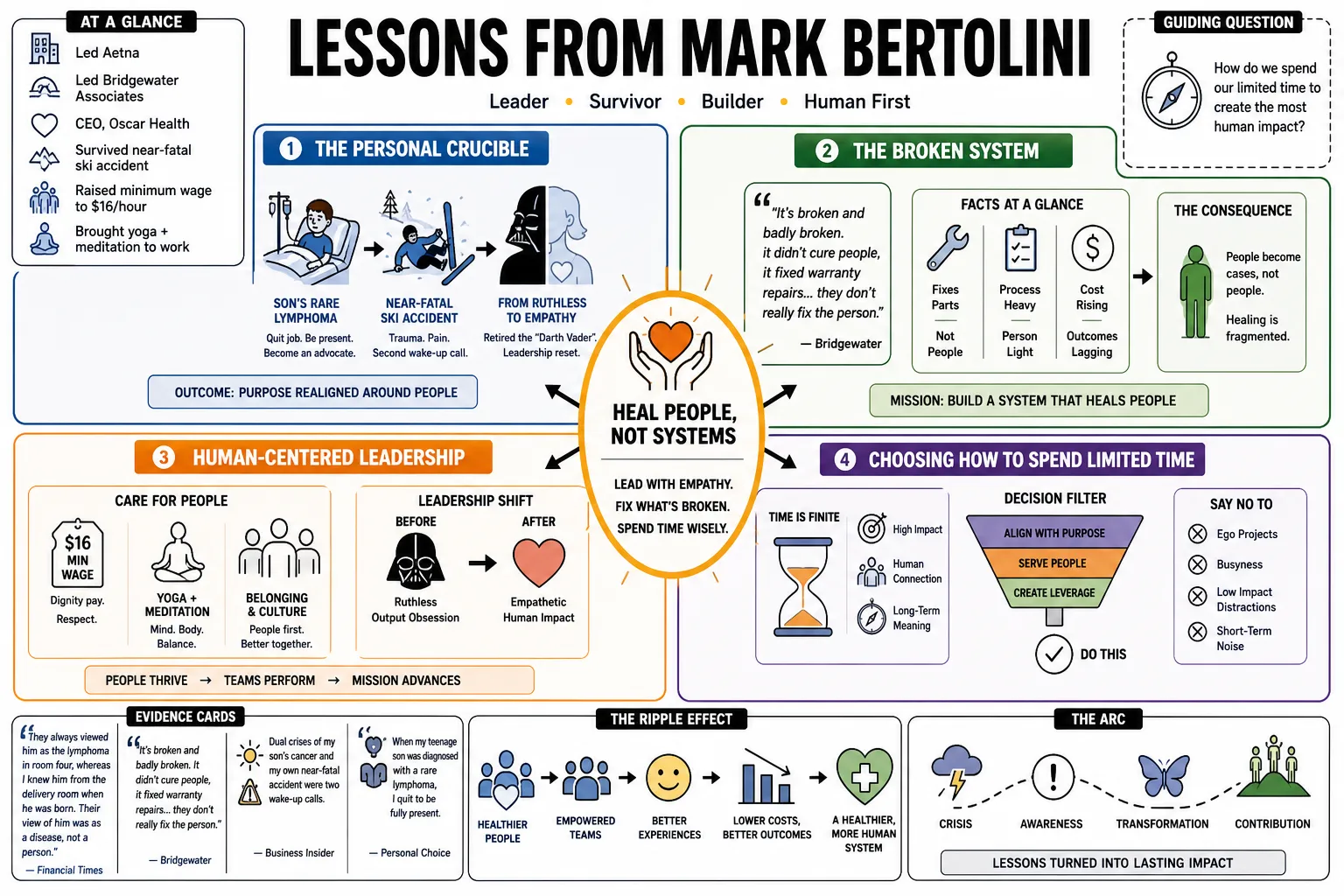
Lessons from Mark Bertolini
Mark Bertolini led Aetna and Bridgewater Associates before becoming CEO of Oscar Health. After surviving a severe ski accident, he drew attention for raising his company's minimum wage to $16 an hour and bringing yoga and meditation into the workplace. Here, he discusses managing chronic pain, fixing the American healthcare system, and deciding how to spend limited time.
Part 1: The Personal Crucible
- On the dehumanization of patients: "Lesson one was that they always viewed him as the lymphoma in room four, whereas I knew him from the delivery room when he was born. Their view of him was as a disease, not a person." — Source: Financial Times
- On the healthcare system's approach to healing: "It's broken and badly broken. It didn't cure people, it fixed warranty repairs… they don't really fix the person." — Source: Bridgewater
- On the shift from ruthlessness to empathy: The dual crises of his son's cancer and his own near-fatal ski accident served as two wake-up calls, transitioning his leadership style away from a "Darth Vader" persona. — Source: Business Insider
- On personal medical advocacy: When his teenage son was diagnosed with a rare lymphoma, he quit his executive job to move into the hospital and personally manage the care plan when standard options failed. — Source: GetWellBe
- On the ultimate family sacrifice: After his son's cancer treatments severely damaged his kidneys, Bertolini personally donated a kidney to his son in 2007. — Source: Read the Profile
- On surviving a broken neck: After hitting a tree while skiing in 2004, he suffered a broken neck and permanent nerve damage, forcing him to reconstruct his approach to physical and mental endurance. — Source: Mindful.org
- On the limits of traditional medicine: His personal recovery journey highlighted the stark limitations of conventional pain management, driving him to seek alternative therapies. — Source: GetWellBe
- On identifying with the patient: Sitting in a hospital room watching his son fight for his life fundamentally altered how he viewed the customers buying insurance from his company. — Source: Financial Times
- On taking responsibility for health outcomes: He recognized that if standard protocols offered little hope for his son, he had to take direct control rather than passively accept the prognosis. — Source: GetWellBe
- On vulnerability as a leader: Experiencing profound physical trauma stripped away his corporate armor and forced him to lead from a place of exposed human vulnerability. — Source: Business Insider
Part 2: Mindfulness and Pain Management
- On identity and suffering: "I still have my pain, I'm aware of my pain, I am not my pain." — Source: Menda Health
- On mental breakthroughs: "The biggest breakthroughs in managing my pain occurred as a result of the meditative practice." — Source: Mindful.org
- On controlling the mind: "Learning new ways to think about the pain and new ways to control it had huge impacts on my ability to manage it." — Source: Mindful.org
- On the nature of recovery: "Recovery is a state of mind. It's not just a physical practice, and that if you get your mind in the right place, you can do almost anything managing pain." — Source: CBS News
- On corporate meditation: "I think we should do meditation and yoga at work." — Source: QuoteFancy
- On bringing yoga to Aetna: He pioneered programs at the insurance giant that gave employees access to yoga and mindfulness, measuring the results rigorously. — Source: Fierce Healthcare
- On the business case for mindfulness: Aetna's internal data showed that participating employees experienced reduced stress, better sleep, decreased pain, and higher productivity. — Source: Menda Health
- On destigmatizing alternative therapy: He fought to ensure that yoga and meditation were not dismissed as "voodoo medicine" in the corporate boardroom. — Source: Business Insider
- On long-term chronic pain: He lives with constant nerve pain that feels like a burning sensation down his arm, managing it daily through focused breathing rather than opioids. — Source: CBS News
- On holistic corporate strategy: He views investments in employee mental well-being not as optional perks, but as core components of a sustainable business model. — Source: Business Insider
Part 3: Redefining the Social Compact
- On the necessity of a living wage: "If people can't make ends meet at home with food, benefits, health, and health care in particular, how can they be present, engaged, knowledge workers when they come to work?" — Source: QuoteFancy
- On the broader corporate obligation: "It’s not just about paying people, it’s about the whole social compact." — Source: Washington Post
- On industry leading the way: "Why can’t private industry step forward and make the innovative decisions on how to do this?" — Source: Washington Post
- On raising the floor: In 2015, he made the unprecedented move to raise Aetna’s minimum hourly wage to $16, directly impacting the lowest-paid workers in the company. — Source: Forbes
- On restoring corporate trust: He stated his goal was to "reestablish the credibility of corporate leadership in the eyes of the American public." — Source: Forbes
- On accessible leadership: He wanted his management style to be perceived by his employees as "approachable, real, and tangible." — Source: Forbes
- On lowering out-of-pocket costs: Alongside the wage increase, he improved healthcare benefits specifically for lower-income employees to prevent medical debt. — Source: Healthcare Dive
- On the ROI of fair pay: He framed the wage hike as a sound business strategy designed to reduce turnover, attract better talent, and boost overall productivity. — Source: Fierce Healthcare
- On addressing income inequality: He recognized that a CEO making millions while front-line workers struggled to buy groceries was an unsustainable contradiction in a health company. — Source: Washington Post
- On the social determinants of health: He frequently points out that housing, food security, and income are far more predictive of a person's health than medical interventions. — Source: Business Insider
Part 4: Mission-Driven Leadership
- On the true purpose of business: "Genuine leadership is not about dollars and market share but about improving lives and communities." — Source: Goodreads
- On Radical Capitalism: He calls himself a "radical capitalist," believing that businesses must serve all stakeholders—employees, customers, and society—rather than strictly enriching shareholders. — Source: The Daily Economy
- On financial margins: "No margin, no mission... The only difference between a for-profit and a not-for-profit is the for-profit pays taxes." — Source: Wave.co
- On organizational maturity: "The first level is your employees hate you. The second level is your employees fear you. The third level is when your employees praise you. The fourth level, you are invisible because your organization takes care of itself." — Source: Substack
- On finding the divine: He encourages managers to look for "the divine in me" and advocates for face-to-face town halls to grasp the reality of the workforce. — Source: Goodreads
- On breaking the status quo: "I believe our healthcare system is fundamentally broken, and all the players involved... fight to maintain a status quo from which they are benefiting." — Source: Chief Executive
- On corporate relevance: "If we're not influencing healthcare and are just paying claims, we're dead." — Source: Chief Executive
- On capitalism's flaws: He has acknowledged that unchecked capitalism can create deep societal divides if leaders do not actively correct for it. — Source: The Daily Economy
- On empathy as a tool: He views empathy not as a soft skill, but as a hard requirement for understanding what the market and employees actually need to succeed. — Source: Goodreads
Part 5: Fixing the Healthcare Machine
- On the revenue model of health: "You make money on a fee-for-service basis. I make money by keeping people healthy. You need a different revenue model..." — Source: Board Member
- On fee-for-service: He has long argued that paying for the volume of medical procedures actively harms patient outcomes and inflates costs. — Source: Board Member
- On the need for bipartisanship: "Anything of major social import needs to be bipartisan." — Source: Healthcare Dive
- On political failure: "When it's not bipartisan, that's when things blow up." — Source: Healthcare Dive
- On the Affordable Care Act's early struggles: In 2017, he publicly stated the ACA exchanges were in a "death spiral" due to an unbalanced risk pool that punished insurers. — Source: Washington Post
- On premium tax credits: More recently, he has pushed for legislative compromises on tax credits to keep the individual insurance market functioning and accessible. — Source: Fierce Healthcare
- On community-based care: He believes healthcare must move out of massive hospital systems and into local communities where patients actually live and work. — Source: Chief Executive
- On the definition of health: He defines health not as the absence of disease, but as a person's ability to live a productive and economically stable life. — Source: Forbes
- On preventative investment: He argues the system will only work when insurers and providers are financially rewarded for preventing hospital admissions rather than executing them. — Source: Board Member
Part 6: Reimagining the Insurance Model
- On consumer choice: "The individual market offers employees and consumers the ability to choose their own product, choose their own network, choose their own coverage at a cost that's affordable and competitive." — Source: Oscar Health
- On transparency in purchasing: He likes the individual market because "employees can see what they're buying," knowing exactly which doctors and hospitals are in their network. — Source: Oscar Health
- On the failure of group insurance: "More small business owners, working Americans and gig workers are running the market as group insurance fails to meet their affordability needs." — Source: Fierce Healthcare
- On decoupling insurance from employment: He argues that when people change jobs, they shouldn't have to change their doctors or navigate a completely new health plan. — Source: Oscar Health
- On disciplined growth: As CEO of Oscar Health, he executed "decisive actions with a disciplined pricing, distribution and product strategy to go after profitable growth as competitors pulled back." — Source: Fierce Healthcare
- On operational turnarounds: He confidently led Oscar on a path to profitability, projecting a "$750 million in earnings from operations in 2026." — Source: 247 Wall St
- On using AI in customer service: "Our Agentic AI bot for care guides reduced response times by 67% during peak open enrollment periods." — Source: 247 Wall St
- On automated health agents: He championed Oswell, an industry-first health agent that handles 86% of member questions with high accuracy without human intervention. — Source: 247 Wall St
- On the future of the individual market: He believes the stability of the individual market proves that consumers prioritize maintaining their health coverage above almost all other expenses. — Source: Fierce Healthcare
Part 7: The Bridgewater Experience
- On Radical Transparency: "The idea of radical transparency is not to be brutally truthful, it's to share your thinking and make your thinking accessible to everybody." — Source: Read the Profile
- On constant evaluation: Reflecting on Bridgewater's Dot Collector system, he noted, "You get scored every time you open your mouth." — Source: Read the Profile
- On transitioning power: He was brought in as co-CEO of Bridgewater to help navigate the notoriously difficult transition away from the firm's legendary founder, Ray Dalio. — Source: Bridgewater
- On building an institution: His mandate was to evolve the hedge fund from a "founder-led boutique" into a "lasting, employee-driven institution." — Source: Bridgewater
- On shared leadership: He operated as co-CEO alongside Nir Bar Dea, demonstrating a willingness to share executive control in a highly intense corporate culture. — Source: Business Insider
- On knowing when to step back: After successfully stabilizing the firm's post-founder transition, he willingly stepped down from the co-CEO role after one year to return to the board as an independent director. — Source: Business Insider
- On cultural adaptation: He proved that an executive rooted in healthcare and insurance could successfully adapt to the hyper-analytical, algorithm-driven world of quantitative finance. — Source: Wave.co
- On truth over comfort: He embraced a culture where making mistakes was acceptable, provided they were surfaced immediately and analyzed deeply by the collective. — Source: Read the Profile
- On the mechanics of thought: He valued systems that forced employees to not just state their opinions, but to explicitly diagram the logic and data behind their conclusions. — Source: Read the Profile
Part 8: The Philosophy of Time and Purpose
- On the ultimate resource: "Who you spend your time with and how you spend it every day are the two most important decisions you will make." — Source: Business Insider
- On evaluating relationships: "Every day when you wear this ring, look at it and ask yourself: am I spending my time with the right people doing right things? And if you're not, run." — Source: Invest Like the Best
- On Memento Mori: He wears a skull ring daily as a physical reminder of his own mortality, ensuring he doesn't waste days on meaningless corporate battles. — Source: Business Insider
- On the Dalai Lama's advice: When struggling with difficult people, he recalls advice from the Dalai Lama: "In your heart, you need to find compassion for the journey they're on... but physically, run." — Source: Invest Like the Best
- On ruthless prioritization: Experiencing near-death gave him absolute clarity on saying no to projects or people that do not align with his core mission. — Source: Invest Like the Best
- On protecting personal energy: He treats his time and attention as highly finite resources, cutting ties swiftly with environments that drain them. — Source: Business Insider
- On compassionate distance: He learned that it is possible to wish someone well from afar while completely removing them from your daily operational orbit. — Source: Invest Like the Best
- On the urgency of leadership: He operates with a sense of urgency born from trauma, believing leaders don't have the luxury of decades to slowly fix broken systems. — Source: Chief Executive
- On the daily check-in: His philosophy requires an active, daily audit of one's surroundings, refusing to let inertia dictate his calendar or his associates. — Source: Invest Like the Best