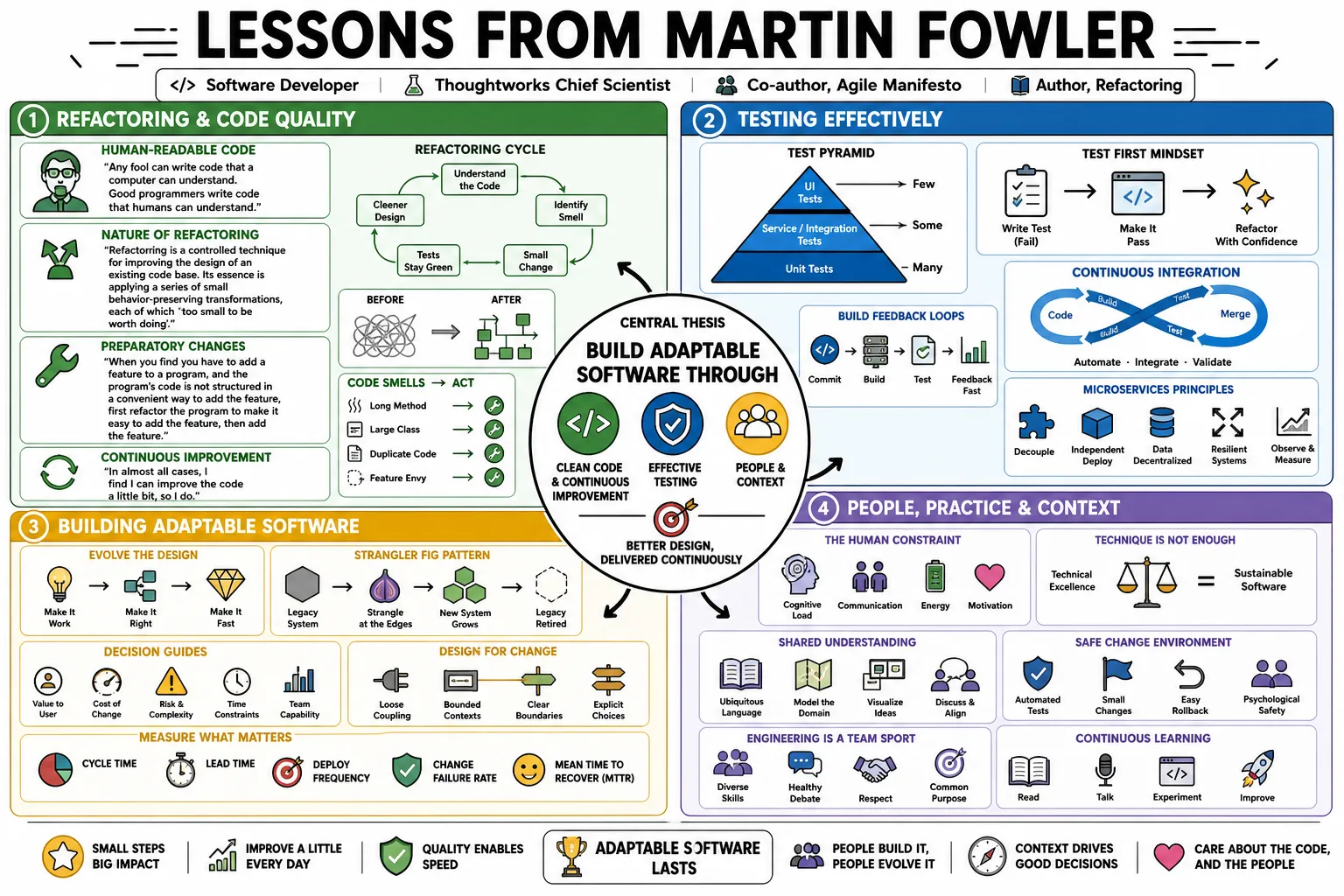
Lessons from Martin Fowler
Martin Fowler is a software developer and Thoughtworks Chief Scientist who co-authored the Agile Manifesto and wrote Refactoring. He is known for explaining how to improve existing code design and documenting the mechanics of practices like continuous integration and microservices. This profile covers his work on building adaptable software, testing it effectively, and working within the human constraints of engineering.
Part 1: Refactoring and Code Quality
- On human-readable code: "Any fool can write code that a computer can understand. Good programmers write code that humans can understand." — Source: [Goodreads]
- On the nature of refactoring: "Refactoring is a controlled technique for improving the design of an existing code base. Its essence is applying a series of small behavior-preserving transformations, each of which 'too small to be worth doing'." — Source: [MartinFowler.com]
- On preparatory changes: "When you find you have to add a feature to a program, and the program's code is not structured in a convenient way to add the feature, first refactor the program to make it easy to add the feature, then add the feature." — Source: [Refactoring.com]
- On continuous improvement: "In almost all cases, I'm opposed to setting aside time for refactoring. In my view refactoring is not an activity you set aside time to do. Refactoring is something you do all the time in little bursts." — Source: [QuoteFancy]
- On naming: If you see a badly named method, it is imperative that you change it because code is for humans first, and humans need clear labels. — Source: [Refactoring.com]
- On comments as a smell: "When you feel the need to write a comment, first try to refactor the code so that any comment becomes superfluous." — Source: [Goodreads]
- On the Rule of Three: The first time you do something, you just do it; the second time you wince but do it anyway; the third time you do something similar, you refactor. — Source: [GitHub]
- On pacing: The key to effective refactoring is recognizing that you go faster when you take tiny steps, ensuring the code is never broken so you can compose small steps into substantial changes. — Source: [Goodreads]
- On ignoring performance initially: Most of the time you should ignore performance when refactoring; if it introduces slow-downs, finish refactoring first and do performance tuning afterwards. — Source: [MartinFowler.com]
- On taking responsibility: "Refactoring means I never have to say I'm sorry—I just fix it." — Source: [WikiQuote]
Part 2: Agile and Iterative Development
- On the core of Agile: Traditional engineering tries to predict the future with a fixed plan, whereas Agile assumes requirements will change and builds a process to adapt to that change. — Source: [MartinFowler.com]
- On people over process: Software is a creative, human endeavor, and instead of trying to make people pluggable into a process, the process should support the people. — Source: [YouTube]
- On when to use iterative methods: "When to use iterative development? You should use iterative development only on projects that you want to succeed." — Source: [AZQuotes]
- On redefining success: "If you think of success as 'on time and on budget,' that’s actually rather at odds with Agile thinking. Success is based on value delivered." — Source: [MartinFowler.com]
- On forced adoption: You cannot impose Agile on a team against their will, because doing so immediately violates the principle of prioritizing individuals and interactions over processes. — Source: [MartinFowler.com]
- On semantic diffusion: The word "Agile" has been co-opted by an industry selling standardized processes and certifications that ignore the manifesto's actual values. — Source: [MartinFowler.com]
- On the "mushy stuff": While developers love discussing tools, the true core of Agile is the difficult, intangible work of establishing values, culture, and healthy human interaction. — Source: [MartinFowler.com]
- On technical prerequisites: Agility is impossible without high technical quality; if your code is a mess, you cannot adapt quickly. — Source: [MartinFowler.com]
- On false predictability: "One of the big dangers is to pretend that you can follow a predictable process when you can't." — Source: [QuoteFancy]
- On the origins of the name: The term "Agile" was chosen at the Snowbird meeting simply as the best word to describe the lightweight methods they were practicing without depending on stable requirements. — Source: [AgileManifesto.org]
Part 3: Testing and Test-Driven Development
- On testing and speed: "I find that writing unit tests actually increases my programming speed." — Source: [Thoughtworks]
- On self-testing code: "The most important thing is to have self-testing code, meaning that you run a single command and your whole project tests itself. Then the way to get there is secondary." — Source: [GitHub]
- On debugging: With rigorous testing, bugs are caught straight away before they can hide, avoiding the frustrating and time-wasting process of deep debugging. — Source: [MartinFowler.com]
- On test difficulty as a design smell: "If your test is hard to write, your design's bad. It's nothing wrong, it's not the test's fault. You've got a bad design, so change the design." — Source: [YouTube]
- On the "Goldilocks Zone" of testing: You lack sufficient tests if you cannot confidently change the code, but you have too many if changing the code requires more effort to update tests than the code itself. — Source: [MartinFowler.com]
- On the test pyramid: A healthy testing strategy requires a large foundation of fast unit tests, a middle layer of integration tests, and a very small number of brittle UI tests. — Source: [MartinFowler.com]
- On duplication: One of the most valuable rules of Extreme Programming is avoiding duplication, famously summarized as "Once and only once." — Source: [MartinFowler.com]
- On the rhythm of XP: The core cycle of TDD is Red-Green-Refactor: write a failing test, make it pass as simply as possible, and then clean up the resulting code. — Source: [Thoughtworks]
- On evolutionary design: Software design should grow, adapt, and evolve continuously over time guided by tests rather than being exhaustively planned upfront. — Source: [GitHub]
Part 4: Software Architecture and Design
- On what architecture is: "Architecture is about the important stuff. Whatever that is." — Source: [Medium]
- On irreversibility: "Software architecture is those decisions which are both important and hard to change." — Source: [MartinFowler.com]
- On architectural "puffery": Architecture is often just a word developers use when they want to talk about design but want to inflate it to sound more important. — Source: [MartinFowler.com]
- On the economics of design: A good architecture is economically vital because without it, adding new capabilities in the future becomes progressively slower and more expensive. — Source: [MartinFowler.com]
- On human limits in software: "Software is not limited by physics, like buildings are. It is limited by imagination, by design, by organization. In short, it is limited by properties of people, not by properties of the world." — Source: [MotleyBytes]
- On distributed objects: The First Law of Distributed Object Design is simple: do not distribute your objects unless absolutely necessary. — Source: [MartinFowler.com]
- On the modern architect's role: "Enterprise Architects no longer make choices, but help others make the right choice and then radiate that information." — Source: [MartinFowler.com]
- On fear of change: "If you're afraid to change something it is clearly poorly designed." — Source: [AZQuotes]
- On simplicity over completeness: "Comprehensiveness is the enemy of comprehensibility." — Source: [QuoteFancy]
- On defining patterns: "A pattern is an idea that has been useful in one practical context and will probably be useful in others." — Source: [QuoteFancy]
Part 5: Microservices and Continuous Integration
- On the Monolith First rule: "Almost all the successful microservice stories have started with a monolith that got too big and was broken up. Almost all the cases where I've heard of a system that was built as a microservice system from scratch, it has ended up in serious trouble." — Source: [MartinFowler.com]
- On structural foundations: "If you can't build a well-structured monolith, what makes you think you can build a well-structured set of microservices?" — Source: [MartinFowler.com]
- On defining microservices: It is an architectural style that approaches a single application as a suite of small services, each running in its own process and communicating with lightweight mechanisms. — Source: [MartinFowler.com]
- On microservice prerequisites: If an organization lacks baseline competencies like rapid infrastructure automation and advanced monitoring, they should avoid the microservice style entirely. — Source: [MartinFowler.com]
- On organizational attitude: "In many ways, microservices is an organizational attitude in as much as it is technological attitude." — Source: [SPDeveloper]
- On defining CI: "Continuous Integration is a software development practice where members of a team integrate their work frequently, usually each person integrates at least daily — leading to multiple integrations per day." — Source: [AZQuotes]
- On priority in CI: "Nobody has a higher priority task than fixing the build." — Source: [MartinFowler.com]
- On testing in CI: "Imperfect tests, run frequently, are much better than perfect tests that are never written at all." — Source: [MartinFowler.com]
- On reducing integration pain: The overarching mantra of Extreme Programming and Continuous Integration is "If it hurts, do it more often." — Source: [MartinFowler.com]
Part 6: Technical Debt and System Health
- On the tragedy of technical debt: The tragedy of technical debt is that it often stems from a conscious decision to trade quality for speed, yet the resulting speed gain is almost always short-lived. — Source: [MartinFowler.com]
- On losing tomorrow: "If you can get today's work done today, but you do it in such a way that you can't possibly get tomorrow's work done tomorrow, then you lose." — Source: [Goodreads]
- On the Technical Debt Quadrant: Technical debt should be understood across two axes—reckless versus prudent, and deliberate versus inadvertent—to properly categorize why shortcuts were taken. — Source: [MartinFowler.com]
- On Sacrificial Architecture: Sometimes the most pragmatic approach is to design a system with the explicit understanding that you will throw it away and replace it within a few years. — Source: [MartinFowler.com]
- On bad habits: "I'm not a great programmer; I'm just a good programmer with great habits." — Source: [Goodreads]
- On continuous delivery necessity: You cannot successfully implement complex architectures like microservices without the strict operational discipline of continuous delivery and infrastructure automation. — Source: [InfoQ]
- On treating databases poorly: Many domain model implementations treat the relational database like an unwanted relative shut in the attic, rather than integrating it thoughtfully. — Source: [MartinFowler.com]
- On Blue-Green Deployment: You can drastically reduce downtime and risk during releases by maintaining two identical production environments and routing traffic between them. — Source: [MartinFowler.com]
- On Event Sourcing: For systems requiring perfect auditability, all changes to application state should be stored immutably as a sequence of events rather than just saving the current state. — Source: [MartinFowler.com]
Part 7: AI, Tooling, and "Vibe Coding"
- On the AI Security Trifecta: An AI agent becomes lethally dangerous when it combines access to private data, exposure to untrusted external content, and the ability to communicate outward. — Source: [Soren Learning]
- On prompt injection risks: If an AI system processes untrusted input while having access to sensitive data, attackers can easily trick it into exfiltrating your private information. — Source: [MartinFowler.com]
- On hallucinations as features: Hallucinations in Large Language Models are not bugs; they are the fundamental creative nature of the technology, as LLMs are probabilistic engines, not deterministic databases. — Source: [YouTube]
- On the AI "Genie": Developers should view LLMs as tutors or exploratory genies, using them to draft ideas while humans remain the strict architects and reviewers. — Source: [YouTube]
- On the learning trap of AI: Relying on AI to generate code without deeply understanding the underlying logic strips developers of their ability to effectively maintain the system later. — Source: [MartinFowler.com]
- On "Vibe Coding": Building software merely by prompting LLMs and accepting the output without looking at the underlying code introduces massive hidden maintenance risks. — Source: [MartinFowler.com]
- On keeping human agency: The human programmer must always maintain agency over the codebase, verifying the AI's suggestions against automated tests rather than trusting them blindly. — Source: [MartinFowler.com]
- On AI speeding up bad practices: If an organization already has poor testing and deployment practices, adding AI coding assistants will simply allow them to generate legacy code faster. — Source: [YouTube]
- On LLMs and evolutionary design: Even with AI assistants, the principles of evolutionary design remain critical, as the generated code must still be continually refactored to remain comprehensible. — Source: [MartinFowler.com]
Part 8: People, Organization, and Career
- On the "Forest vs. Desert" divide: Teams using rigorous XP practices operate safely in a high-speed "forest," while those lacking discipline struggle in a slow "desert," and it is almost impossible to explain the forest to someone who has only seen the desert. — Source: [YouTube]
- On the 49/49/2 rule: Success in technical professions is roughly 49% domain knowledge, 49% intuitive sense for the problem, and only 2% the actual technical methods or tools. — Source: [YouTube]
- On over-indexing on tools: Most software developers vastly overvalue the 2% of their job that involves specific technical tools, while ignoring the 98% that actually creates business value. — Source: [YouTube]
- On growing juniors: An organization's greatest hidden strength is its systemic ability to turn junior developers into senior developers. — Source: [YouTube]
- On the danger of only hiring seniors: Companies that refuse to hire junior developers fail to build a sustainable culture and miss out on the clarity that comes from seniors having to mentor and explain their thinking. — Source: [YouTube]
- On architectural simplicity: Avoid distribution and concurrency whenever possible, as they are massive complexity boosters that should only be deployed when the trade-offs are strictly necessary. — Source: [MartinFowler.com]
- On shared understanding: The primary function of any design document or architectural diagram is not to be perfectly comprehensive, but to establish a shared baseline of understanding among the team. — Source: [MartinFowler.com]
- On continuous learning: The software industry changes rapidly, and the most effective engineers focus on learning core patterns and principles that remain stable beneath the churn of new frameworks. — Source: [MartinFowler.com]
- On the ultimate goal: The entire point of adopting practices like continuous integration, refactoring, and agile is to create a work environment where software delivery is routine, low-stress, and consistently valuable to users. — Source: [MartinFowler.com]