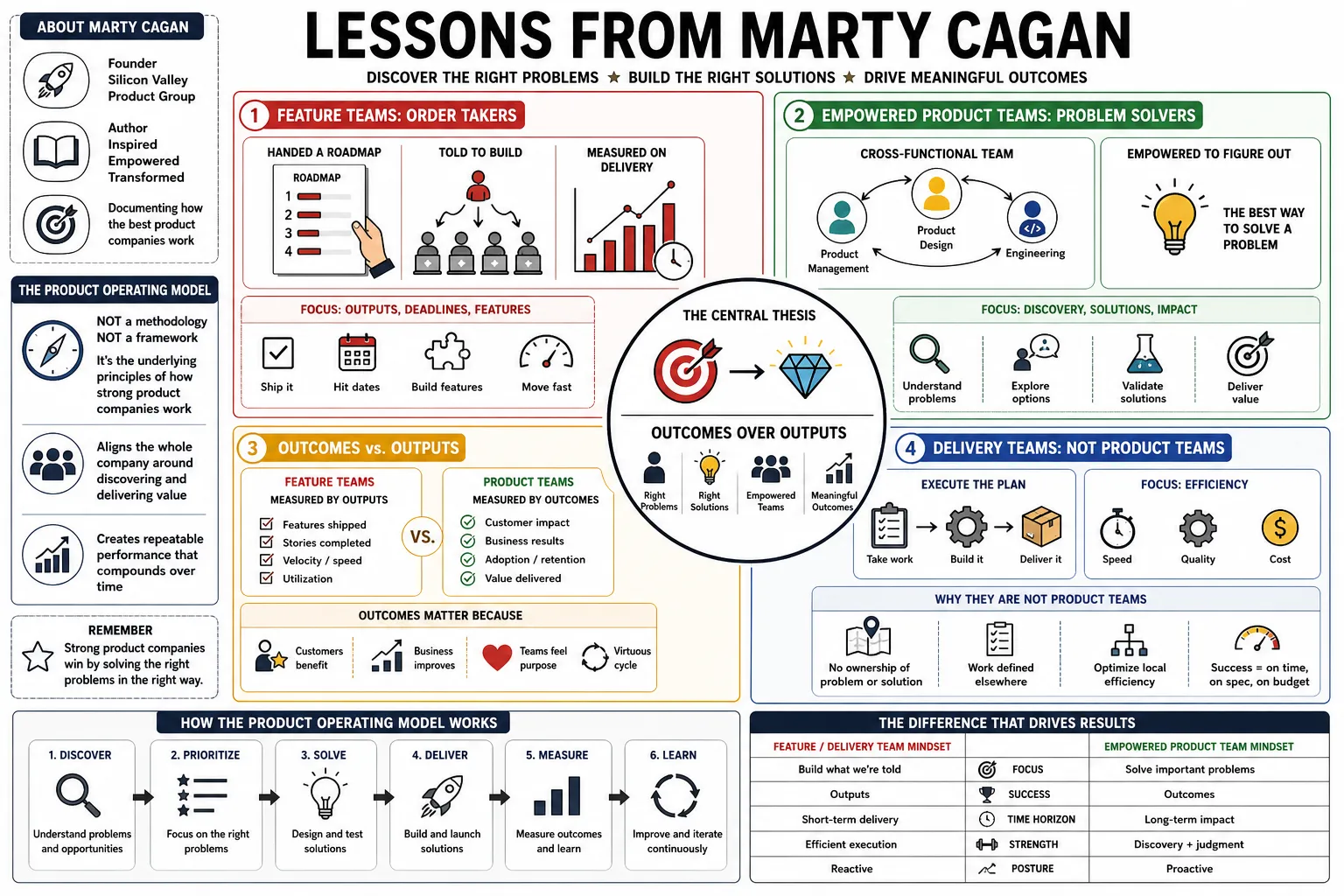
Marty Cagan is the founder of Silicon Valley Product Group and author of Inspired, Empowered, and Transformed. He built his career documenting how the best tech companies actually figure out what to build and how to ship it. This collection distills his arguments on product discovery and team mechanics to show exactly what separates strong organizations from everyone else.
Part 1: The Product Operating Model
- On the Product Operating Model: "The product operating model is not a methodology or a framework. It is the underlying principles of how strong product companies actually work." — Source: [Transformed]
- On Feature Teams: "A feature team is fundamentally an order-taking team. They are handed a roadmap of features, told to build them, and measured on delivery." — Source: [Product vs. Feature Teams]
- On Empowered Product Teams: "A product team is a cross-functional group of people (usually product management, product design, and engineering) empowered to figure out the best way to solve a problem." — Source: [Empowered Product Teams]
- On Outcomes vs. Outputs: "Product teams are measured by business outcomes. Feature teams are measured by outputs." — Source: [Product vs. Feature Teams]
- On Delivery Teams: "Delivery teams are not product teams. They are developers who are simply trying to write code for the features they are handed, with no product manager or designer." — Source: [Product vs. Feature Teams]
- On the IT Mindset: "The traditional IT mindset treats technology as a cost center, funding projects instead of products, and separating the business from the technology." — Source: [The IT Mindset]
- On the Purpose of a Product Team: "The purpose of a product team is to solve problems in ways our customers love, yet work for our business." — Source: [Empowered]
- On Technology and Value: "In the product model, technology is not just the implementation detail. It is the core driver of the business value." — Source: [Inspired]
- On Consistent Delivery: "Great companies don't just get lucky once. They have an operating model that allows them to consistently deliver value over time." — Source: [The Product Operating Model]
Part 2: Product Discovery & Risk
- On the Goal of Discovery: "The purpose of product discovery is to separate the good ideas from the bad as quickly and cheaply as possible." — Source: [Product Discovery]
- On the Four Big Risks: "Before we build, we must address four big risks: value, usability, feasibility, and business viability." — Source: [The Four Big Risks]
- On Value Risk: "Value risk answers the hardest question: Will the customer actually buy this, or choose to use it?" — Source: [The Four Big Risks]
- On Usability Risk: "Usability risk simply asks: Can the user figure out how to use the solution we are proposing?" — Source: [The Four Big Risks]
- On Feasibility Risk: "Feasibility risk is for the engineers to answer: Can we build this with the time, skills, and technology we have?" — Source: [The Four Big Risks]
- On Viability Risk: "Viability risk ensures the solution works for the various constraints of our business, including sales, marketing, finance, and legal." — Source: [The Four Big Risks]
- On Sourcing Ideas: "The best ideas rarely come from executives; they come from the people interacting directly with the enabling technology and the customers." — Source: [Inspired]
- On Prototyping: "A prototype is not code you can deploy. It is a way to test an assumption rapidly before you commit to writing production code." — Source: [Discovery Prototypes]
- On Iteration Speed: "If you are not embarrassed by your first release, you waited too long to get feedback from real users." — Source: [Lenny's Podcast]
- On Customer Validation: "We cannot rely on surveys or focus groups. We need to put prototypes in front of real users to observe their actual behavior." — Source: [Customer Discovery]
Part 3: Strategy & Vision
- On Product Vision: "The product vision describes the future we are trying to create, typically looking three to five years out. It should be inspiring and emotionally engaging." — Source: [Product Vision vs. Strategy]
- On Product Strategy: "Product strategy is the specific sequence of steps, products, or releases we plan to deliver on the path to realizing the product vision." — Source: [Product Strategy - The Details]
- On Focus: "Strategy is fundamentally about deciding what not to do. Without focus, teams spread themselves too thin to make a meaningful impact." — Source: [Product Strategy - Focus]
- On Product Principles: "Product principles describe the fundamental beliefs of your organization and the nature of the products you want to create." — Source: [Product Principles]
- On Market Alignment: "A good product strategy aligns with the broader business strategy and actively uses the company's unique strengths or assets." — Source: [Product Strategy - Alignment]
- On Leadership's Role in Strategy: "It is the responsibility of product leadership to provide the strategic context that teams need to make good localized decisions." — Source: [Empowered]
- On Insights: "Strong product strategies are built on a foundation of unique insights into the market, the underlying technology, or the customer's behavior." — Source: [Product Strategy - Insights]
- On Sequencing: "We must sequence our work to tackle the riskiest assumptions and the most critical business bottlenecks first." — Source: [Product Strategy - Sequencing]
- On Flexibility: "The vision should be stubborn, but the strategy must remain highly flexible as we learn what actually works in the market." — Source: [Product Vision vs. Strategy]
Part 4: Missionaries vs. Mercenaries
- On John Doerr's Rule: "As John Doerr famously said, we need teams of missionaries, not teams of mercenaries." — Source: [Missionaries vs. Mercenaries]
- On Motivation: "Mercenaries build whatever they are told to build. Missionaries care deeply about solving the underlying problem." — Source: [Missionaries vs. Mercenaries]
- On Autonomy: "Empowerment means giving teams the business context they need to make decisions and the autonomy to find the best solutions." — Source: [Empowered Product Teams]
- On Accountability: "Autonomy is meaningless without accountability. Teams must take responsibility for the business outcomes they achieve, not just the code they ship." — Source: [Empowerment and Accountability]
- On Trust: "You cannot have an empowered team without a deep foundation of trust between senior leadership and the individual contributors." — Source: [Trust and Empowerment]
- On True Collaboration: "True collaboration means engineering, design, and product management working together side-by-side from the very beginning of an idea." — Source: [Collaboration]
- On Psychological Safety: "Teams must feel safe to take calculated risks, share failed prototypes, and push back against bad ideas from management." — Source: [Lenny's Podcast: Transformed]
- On Innovation Culture: "Innovation requires a culture that accepts failure as a necessary and expected step in the product discovery process." — Source: [Innovation Culture]
- On Cross-Functional Integration: "The most effective teams combine the diverse skills of product, design, and engineering to solve complex problems together." — Source: [Cross-Functional Teams]
- On Team Sizing: "Keep teams small. You typically want two to ten engineers, plus a product manager and a product designer." — Source: [Product Team Size]
Part 5: The Product Manager
- On the Core Responsibility: "The product manager is responsible for ensuring the product is both valuable to the user and viable for the business." — Source: [The Product Manager Role]
- On Product vs. Project Management: "Product management is about discovering the right product to build. Project management is about coordinating the delivery of that product." — Source: [Product Management vs. Project Management]
- On the CEO of the Product Myth: "The product manager is not the CEO of the product. They are simply the person responsible for mitigating value and viability risk." — Source: [CEO of the Product]
- On Deep Knowledge: "A strong product manager must have an unreasonably deep knowledge of the customer, the business data, and the market." — Source: [Deep Knowledge]
- On Influence Without Authority: "Because they lack direct authority over engineers and designers, product managers must lead by influence using data and insights." — Source: [Influence Without Authority]
- On Stakeholder Management: "Managing stakeholders is not about saying yes to everything. It is about understanding their constraints and building solutions that accommodate those constraints." — Source: [Stakeholder Management]
- On Product Owner vs. Product Manager: "A product owner is a role you play on an Agile delivery team. A product manager is the actual job." — Source: [Product Manager vs. Product Owner]
- On Customer Empathy: "Genuine empathy for the customer's struggles is the most critical qualitative trait of a successful product manager." — Source: [Customer Empathy]
- On Continuous Learning: "The best product managers are constantly looking at behavioral data and talking to users to refine their intuition." — Source: [Continuous Learning]
Part 6: Leadership & Coaching
- On the Primary Role of Leaders: "The most important responsibility of any product leader is to coach and develop their people." — Source: [The Role of Leadership]
- On Dedicated Coaching Time: "Coaching cannot be an afterthought. It is the single most important activity for building a strong product organization." — Source: [Coaching]
- On Hiring for Potential: "Hire product people for their raw intelligence, potential, and cultural fit, not just their list of past specific skills." — Source: [Hiring Product Managers]
- On Managing Low Performers: "Leaders must be willing to make the hard decisions and let go of individuals who are toxic or consistently fail to perform." — Source: [Letting People Go]
- On Setting Context: "Leaders must provide the strategic context of vision, strategy, and business objectives that teams need to do their jobs effectively." — Source: [Setting Context]
- On Protecting the Team: "Strong leaders manage up effectively, shielding their product teams from executive interference and random feature requests." — Source: [Managing Up]
- On Leading by Example: "Leaders must model the behavior they expect, particularly regarding customer empathy, transparency, and admitting mistakes." — Source: [Leading by Example]
- On Team Diversity: "Diverse teams build better products because they bring a wider range of perspectives to the discovery process." — Source: [Diversity in Product]
- On Succession Planning: "A true leader builds a pipeline of internal talent to ensure continuity and long-term organizational growth." — Source: [Succession Planning]
Part 7: Roadmaps & Objectives
- On Traditional Roadmaps: "Traditional feature-based roadmaps are the root cause of most waste and frustration in product organizations." — Source: [The Alternative to Roadmaps]
- On the Problem with Dates: "Committing to hard delivery dates for unvalidated ideas is a recipe for building useless software." — Source: [Dates and Commitments]
- On High-Integrity Commitments: "When we make a commitment to the business, it must be a high-integrity commitment based on actual discovery evidence, not guessing." — Source: [High-Integrity Commitments]
- On Outcome-Based Roadmaps: "The solution is to shift from feature-based roadmaps to outcome-based roadmaps focused entirely on solving specific business problems." — Source: [Outcome-Based Roadmaps]
- On the Purpose of OKRs: "Objectives and Key Results (OKRs) are a powerful tool for aligning autonomous teams around common strategic goals." — Source: [OKRs]
- On Setting Objectives: "Objectives should be qualitative, highly inspiring, and directly tied to the company's broader vision." — Source: [Setting Objectives]
- On Defining Key Results: "Key Results must be strictly quantitative and measurable, defining exactly how we will know if the objective was met." — Source: [Key Results]
- On Team Alignment: "Leadership must ensure that the individual team OKRs roll up logically and align with the corporate objectives." — Source: [Team Alignment]
- On Reviewing Progress: "Regularly review progress against OKRs to ensure teams remain focused on the agreed-upon problems and can adjust course when evidence demands it." — Source: [Reviewing Progress]
Part 8: Transformation
- On the Need for Transformation: "Many companies eventually realize their current feature-factory methods are too slow and produce too little value, necessitating a true transformation." — Source: [Transformation in Action]
- On the Product Operating Model: "Moving to the product operating model is not a simple reorganization. It is a fundamental shift in how the company decides what to build." — Source: [Transformed]
- On Mindset Shifts: "Transformation requires moving away from an IT mindset where tech serves the business to a product mindset where tech is the business." — Source: [IT Mindset vs. Product Mindset]
- On Executive Support: "A successful transformation is impossible without the active support, understanding, and leadership of the CEO." — Source: [The Role of the CEO]
- On Middle Management Resistance: "Expect heavy resistance from middle management, as team empowerment directly challenges their traditional command and control authority." — Source: [Overcoming Resistance]
- On Using Pilot Teams: "The best way to start a transformation is with pilot teams to demonstrate rapid success and build internal momentum." — Source: [Pilot Teams]
- On Continuous Improvement: "Transformation is never truly done. Organizations must continuously adapt their practices as the market and technology evolve." — Source: [Continuous Improvement]
- On Measuring Transformation Success: "Measure the success of a transformation not by process compliance, but by the velocity of value delivery and improvements in business outcomes." — Source: [Measuring Success]
- On Product Ops: "Product operations exists to help scale the product organization by managing the shared tools, data, and processes teams rely on." — Source: [Product Ops Overview]
- On Patience: "Meaningful transformation takes significant time, typically years, because it requires unlearning old habits and deep cultural changes." — Source: [Patience in Transformation]