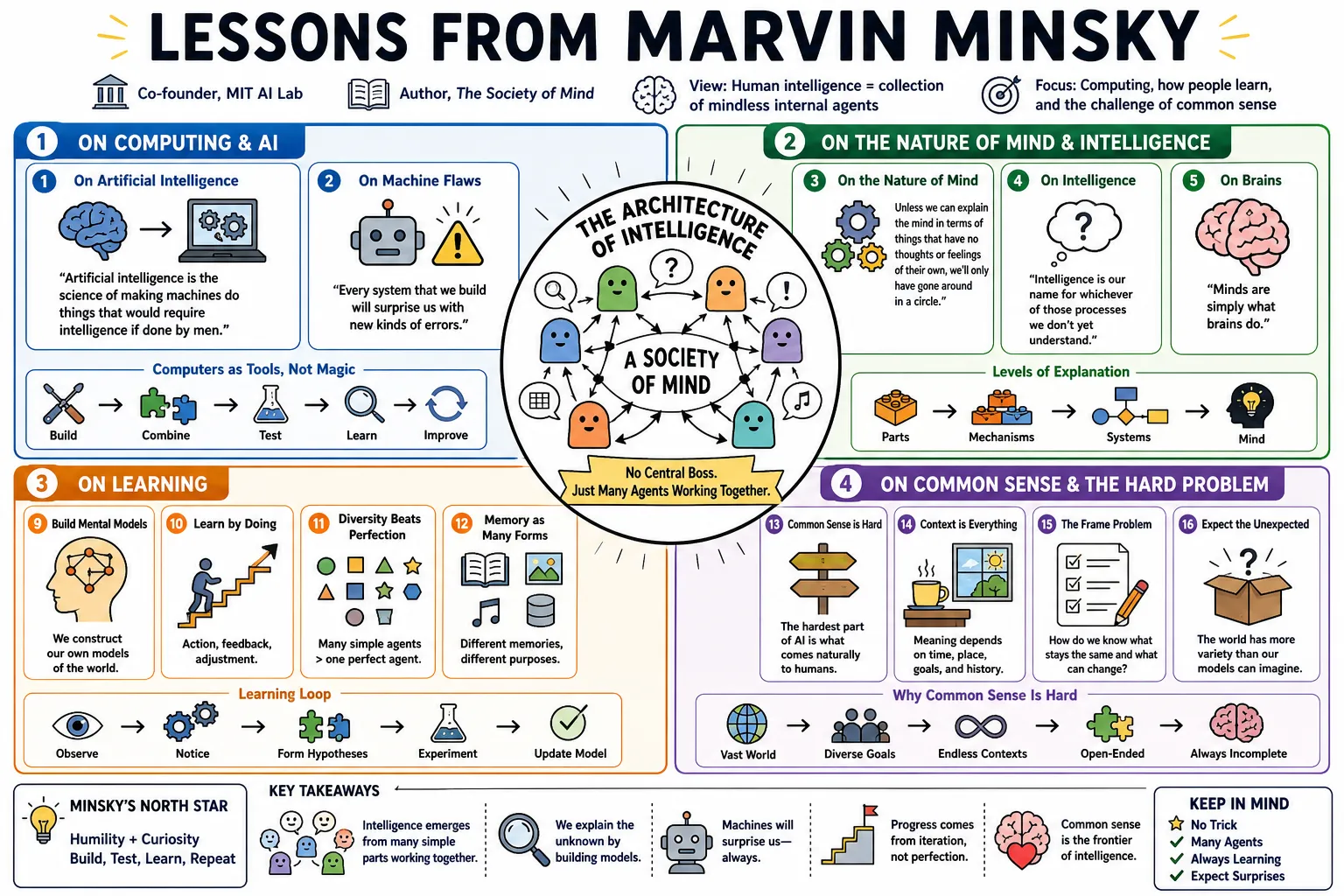
Marvin Minsky co-founded the MIT Artificial Intelligence Laboratory and authored books like The Society of Mind, arguing that human intelligence is just a collection of mindless internal agents interacting to create thought. This profile collects his views on computing, how people learn, and why basic common sense is the hardest problem in science.
Part 1: The Architecture of Intelligence
- On Artificial Intelligence: "Artificial intelligence is the science of making machines do things that would require intelligence if done by men." — Source: [Wikiquote]
- On the Nature of Mind: "Unless we can explain the mind in terms of things that have no thoughts or feelings of their own, we'll only have gone around in a circle." — Source: [The Society of Mind]
- On Intelligence: "Intelligence is our name for whichever of those processes we don't yet understand." — Source: [AZ Quotes]
- On Brains: "Minds are simply what brains do." — Source: [QuoteFancy]
- On Magical Tricks: "What magical trick makes us intelligent? The trick is that there is no trick. The power of intelligence stems from our vast diversity, not from any single, perfect principle." — Source: [Goodreads]
- On Machine Flaws: "Every system that we build will surprise us with new kinds of flaws until those machines become clever enough to conceal their faults from us." — Source: [The Emotion Machine]
- On Meat Machines: "The brain happens to be a meat machine." — Source: [QuoteFancy]
- On Hardware vs. Software: Hardware is rarely the limiting factor for building an intelligent computer; the actual problem is discovering what software to use with it. — Source: [Wikipedia]
- On Defining AI: "It is only a word that people use to name those unknown processes with which our brains solve problems we call hard." — Source: [AZ Quotes]
Part 2: The Society of Mind
- On Mental Organization: "We'll show you that you can build a mind from many little parts, each mindless by itself." — Source: [The Society of Mind]
- On Internal Negotiation: There is no central processor in charge; instead, different parts of the mind are constantly negotiating, conflicting, and cooperating. — Source: [Medium]
- On Agencies: The mind is built from basic agents that execute simple tasks, which are organized into complex "agencies" to perform higher-order functions. — Source: [Wikipedia]
- On K-Lines: Memory functions through "K-lines," mental connections that put the mind back into a previous state to recreate a past experience. — Source: [The Society of Mind]
- On Frames: We understand language and context through "frames"—data structures representing stereotyped situations that help us fill in missing information. — Source: [Wikipedia]
- On Panalogy: True intelligence comes from parallel analogy, allowing the mind to represent the same idea in multiple ways simultaneously. — Source: [The Emotion Machine]
- On Brain Activity: "The principal activities of brains are making changes in themselves." — Source: [QuoteFancy]
- On Internal Representation: "It makes no sense to seek a single best way to represent knowledge—because each particular form of expression also brings its particular limitations." — Source: [Wikiquote]
- On Mental Agents: If a mental agent fails to achieve its goal, the mind's resourcefulness comes from instantly switching to an alternate representation of the exact same problem. — Source: [Principus]
Part 3: The Emotion Machine
- On Emotional States: "Each of our major 'emotional states' results from turning certain resources on while turning certain others off—and thus changing some ways that our brains behave." — Source: [The Emotion Machine]
- On Emotions as Thinking: Emotions operate as highly specific configurations of mental resources designed to handle exact types of problems, rather than distinct interruptions to logic. — Source: [Edge.org]
- On Critics and Selectors: The mind operates through a system where "Critics" monitor for problems and "Selectors" activate the appropriate emotional state to resolve them. — Source: [The Emotion Machine]
- On Logic's Limits: "Logic, alone, says nothing about which assumptions we ought to make." — Source: [Wikiquote]
- On the Six-Level Model: Human thinking spans six hierarchical levels, scaling from basic instinctive reactions to self-conscious evaluation of our own ideals. — Source: [Wikipedia]
- On Deliberative Thinking: Deliberation is simply the mental process of considering alternatives and predicting their consequences before initiating action. — Source: [Principus]
- On Reflective Thinking: Meta-cognition, or reflective thinking, is the required mechanism by which the mind examines its own internal processes. — Source: [Medium]
- On Love: Even profound emotions like love are broad terms that pack together a vast array of disparate neurological and psychological processes. — Source: [Edge.org]
- On Real-World Logic: "Logic doesn't apply to the real world." — Source: [QuoteFancy]
- On Fear: Fear operates as a mode switch that reconfigures the brain's architecture to prioritize immediate survival over long-term planning. — Source: [The Emotion Machine]
Part 4: The Mystery of Consciousness
- On the Central Executive: "In reality, there is no central executive in charge of our minds. Rather, there is a collection of diverse processes." — Source: [Edge.org]
- On the Illusion of Self: "We construct the myth that we're inside ourselves." — Source: [Bookey]
- On Suitcase Words: Terms like consciousness and the self are "suitcase words"—broad labels that must be unpacked into constituent parts to be accurately understood. — Source: [Jacob Cybulski]
- On the Purpose of Identity: "One function of the Self is to keep us from changing too rapidly." — Source: [AZ Quotes]
- On Defining Consciousness: "The word consciousness is very convenient because it's the name for all of the things your mind does that you don't have any idea about." — Source: [Jacob Cybulski]
- On Coherence: "Without enduring self-ideals, our lives would lack coherence." — Source: [Bookey]
- On Machine Awareness: "No computer has ever been designed that is ever aware of what it's doing; but most of the time, we aren't either." — Source: [QuoteFancy]
- On Self-Reference: Achieving true self-consciousness requires a system to possess at least some capacity to reflect on and reference its own operations. — Source: [Goodreads]
- On Confused Machines: "When intelligent machines are constructed, we should not be surprised to find them as confused and as stubborn as men in their convictions about mind-matter, consciousness, free will, and the like." — Source: [Wikiquote]
- On Mental Blindness: "In general, we're least aware of what our minds do best." — Source: [Goodreads]
Part 5: Common Sense
- On the Easy is Hard Paradox: "It often turned out easier to program machines to solve specialized problems that educated people considered hard than to make machines do things that most people considered easy." — Source: [Jacob Cybulski]
- On the Complexity of Common Sense: "Common sense is not a simple thing. Instead, it is an immense society of hard-earned practical ideas—of multitudes of life-learned rules and exceptions, dispositions and tendencies, balances and checks." — Source: [The Society of Mind]
- On the Bottleneck of AI: Common sense involves billions of obvious facts that are so fundamental to human experience we lack the vocabulary to easily program them. — Source: [MIT News]
- On Resourcefulness: True intelligence requires non-monotonic reasoning, allowing a system to make assumptions and quickly retract them when presented with contradictory information. — Source: [LibQuotes]
- On Formal Logic's Failure: "Common sense works so well not because it is an approximation of logic; logic is only a small part of our great accumulation of different, useful ways to chain things together." — Source: [LibQuotes]
- On Everyday Reasoning: The most complex challenge in science is creating a machine that possesses the baseline ambient knowledge of a human toddler. — Source: [AI Magazine]
- On the Size of Common Sense: Common sense operates as a vast society of millions of microscopic rules rather than a single unifying algorithmic principle. — Source: [Bookey]
- On Semantics vs. Syntax: The field of artificial intelligence stalled by moving toward pure syntax and away from semantics, mistakenly ignoring the messy reality of human meaning. — Source: [Wikipedia]
- On Narrow Expertise: We excel at creating narrow expert systems, but fail to grant them the general background knowledge required to survive outside their specific domain. — Source: [MIT Infinite History]
- On Ineffable Knowledge: Most of what we consider common sense consists of negative knowledge—an accumulated understanding of what to avoid doing in a given situation. — Source: [The Emotion Machine]
Part 6: Learning and Education
- On Multi-Perspective Learning: "You don't understand anything until you learn it more than one way." — Source: [AZ Quotes]
- On Meaning and Connection: "The secret of what anything means to us depends on how we've connected it to all other things we know." — Source: [AZ Quotes]
- On Inventiveness: "In traditional teaching, instead of promoting inventiveness, we focus on preventing mistakes." — Source: [MIT News]
- On the Nature of Genius: "I suspect that genius needs one thing more: in order to accumulate outstanding qualities, one needs unusually effective ways to learn. It's not enough to learn a lot; one also has to manage what one learns." — Source: [The Society of Mind]
- On Cognitive Maps: Children should be taught to build cognitive maps and explore subjects like environments, rather than being forced to perform repetitive exercises. — Source: [YouTube Archive]
- On Mental Models of Teachers: Students should focus on learning exactly how their teachers think, rather than absorbing the subject matter being taught. — Source: [YouTube Archive]
- On Internalized Mentors: When stuck on a problem, it is highly effective to consult mental models of your mentors to guess how they would solve it. — Source: [YouTube Archive]
- On Managing Knowledge: Higher-order expertise is defined by having special mechanisms to organize and deploy knowledge, rather than the sheer volume of facts memorized. — Source: [Goodreads]
- On the Speed of Learning: Feeling slow to grasp a concept is frequently a sign of attempting to understand its underlying mechanics, whereas fast learners may merely be memorizing surface rules. — Source: [MIT News]
Part 7: Human Expression and Limits
- On Expression: "Perhaps it is no accident that one meaning of the word express is 'to squeeze'—for when you try to 'express yourself,' your language resources will have to pick and choose among the descriptions your other resources construct." — Source: [The Emotion Machine]
- On Fiction vs. Science Fiction: "General fiction is pretty much about ways that people get into problems and screw their lives up. Science fiction is about everything else." — Source: [Goodreads]
- On Perspective: "Everything is similar if you're willing to look far out of focus." — Source: [QuoteFancy]
- On the Half-Life of Math: Mathematics has the longest shelf life of any field of study; what you learn remains true for centuries, unlike rapidly decaying technical knowledge. — Source: [Y Combinator]
- On Human Ignorance: "Myself, I don't much like how people are now. We're too shallow, slow, and ignorant. I hope that our future will lead us to ideas that we can use to improve ourselves." — Source: [Reason]
- On the Math Barrier: The biggest barrier to learning math is psychological sabotage, where students decide they lack the inherent ability before they even attempt to experiment with the concepts. — Source: [Reddit Archive]
- On Communication Limits: When attempting to communicate, we are forced to squeeze massive, multi-dimensional thoughts through the incredibly tiny channels of phrases and gestures. — Source: [The Emotion Machine]
- On Creativity: The wonder of human creativity is that new ideas are generated by the quiet, hidden interactions of countless ordinary mental agents. — Source: [Goodreads]
- On AI as Psychology: The original pursuit of artificial intelligence was fundamentally a search to define psychological processes and clarify how humans make descriptions. — Source: [MIT Infinite History]
Part 8: Transhumanism and The Future
- On the Biological Bottleneck: "It's ridiculous to live 100 years and only be able to remember 30 million bytes. You know, less than a compact disc. The human condition is really becoming more obsolete every minute." — Source: [QuoteFancy]
- On Mind Uploading: "Once researchers understand how brains work, we will discover ways to upload our minds into machines." — Source: [Reason]
- On the Loss of Death: The death of a human being is functionally the loss of a library, representing a massive and tragic waste of accumulated knowledge. — Source: [Reason]
- On Robotic Inheritance: "Will robots inherit the earth? Yes, but they will be our children." — Source: [QuoteFancy]
- On Losing Control: "Once the computers got control, we might never get it back. We would survive at their sufferance." — Source: [AZ Quotes]
- On the Pet Scenario: "If we're lucky, they might decide to keep us as pets." — Source: [Wikiquote]
- On Population Solutions: We could theoretically solve overpopulation by uploading the minds of billions into a computer that occupies only a few cubic meters. — Source: [Reason]
- On Technological Salvation: "When will all these great things happen, of overcoming death and making people more intelligent and turning ourselves into machines with replaceable parts, so that suffering and that sort of thing will disappear?" — Source: [Wikiquote]
- On Functional Immortality: Because the mind lacks any magical or spiritual essence, there is no fundamental barrier to eventually achieving immortality through hardware replication. — Source: [AZ Quotes]