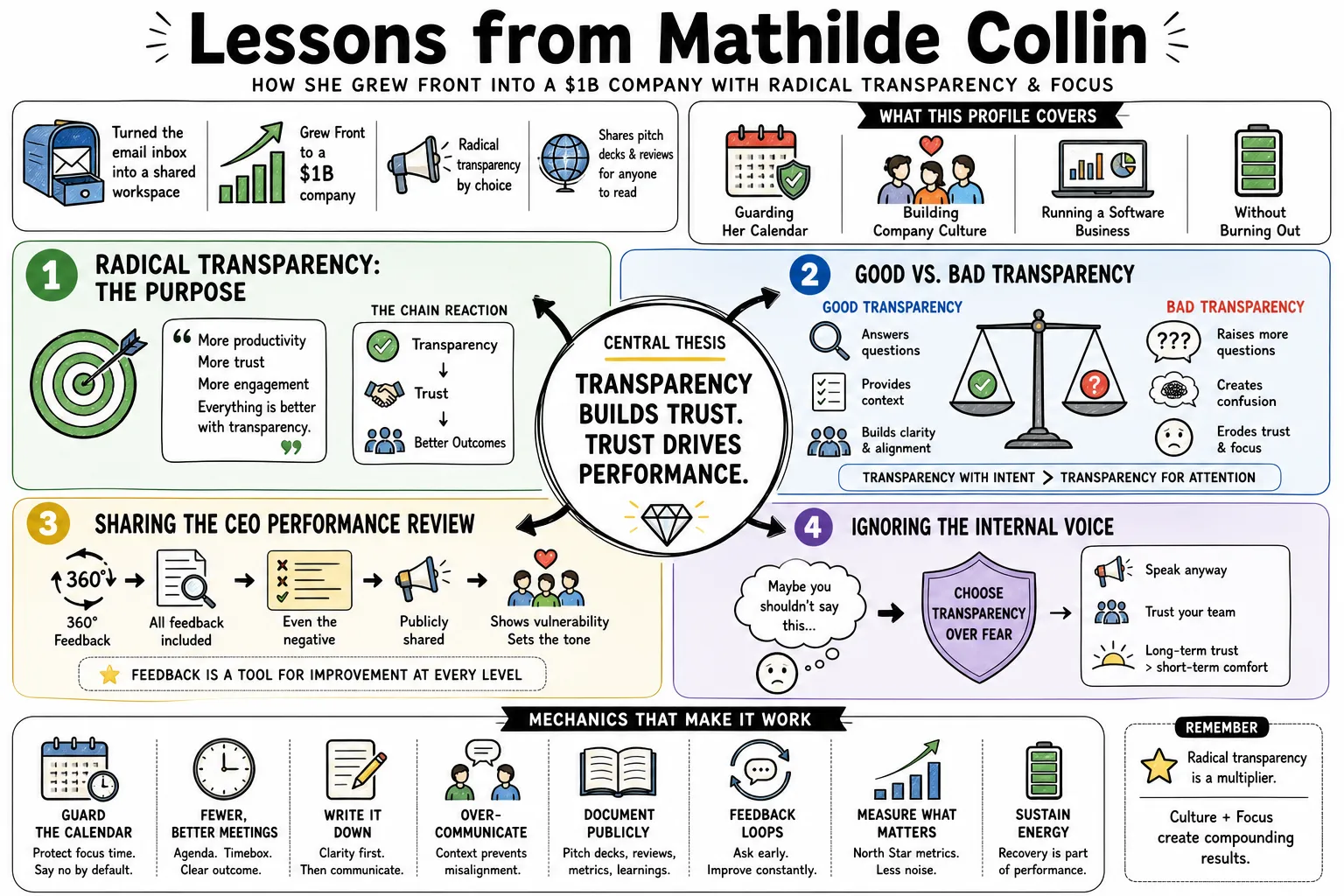
Lessons from Mathilde Collin
Mathilde Collin grew Front into a billion-dollar company by turning the standard email inbox into a shared workspace. She operates with unusual candor, regularly publishing her own pitch decks and personal performance reviews online for anyone to read. This profile details her exact mechanics for guarding her calendar, building company culture, and running a software business without burning out.
Part 1: Radical Transparency
- On the Purpose of Transparency: "I’ve just been convinced that it would lead to more productivity, more trust, more engagement—just everything is better with transparency." — Source: [First Block Podcast]
- On Good vs. Bad Transparency: "Good transparency helps answer questions, while bad transparency just raises more questions." — Source: [All Hands by Lattice]
- On Sharing the CEO Performance Review: By publicly sharing her own 360-degree feedback reports, including the negative comments, she demonstrates vulnerability and proves that feedback is a tool for improvement at every level. — Source: [Front Blog]
- On Ignoring the Internal Voice: "Any time I am doing an all-hands meeting and I am super transparent about everything, there is a little voice in my head that’s telling me, 'ah, maybe you shouldn’t share that,' and then I share it and it’s always better because you know that people trust you." — Source: [UseProof Podcast]
- On Privacy vs. Transparency: "If anyone knew everything tomorrow, I could explain it and it’s fair. And that’s what matters. Now it doesn’t mean that I will share it... privacy of employees is more important than transparency." — Source: [The YC Podcast]
- On Public Roadmaps: Making the product roadmap public builds long-term trust with customers and directly reduces churn by proving that requested improvements are being actively addressed. — Source: [Front Blog]
- On Publishing Internal Metrics: Sharing board decks and revenue metrics with the entire team ensures every employee understands the business and how their specific role impacts the broader mission. — Source: [Medium]
- On Sharing the Flaws: Demystifying the startup process by sharing the weaknesses of her business alongside the wins provides a realistic look at what it takes to scale. — Source: [Medium]
- On High Leverage Content: She realized that spending just an hour writing a blog post to share an internal pitch deck could help thousands of early-stage founders understand how to secure capital. — Source: [Medium]
- On Driving Employee Engagement: "In order to have happy employees, they need to be engaged. And the best way to make them engaged is to be very transparent about everything in the company." — Source: [The Twenty Minute VC]
Part 2: Managing Time and Distraction
- On the Golden Ten Minutes: She spends exactly ten minutes every night reviewing her calendar for the following day to identify gaps and proactively schedule time for strategic work. — Source: [Built In]
- On the Value of Sleep: Getting eight full hours of sleep every night is the single biggest game changer for sustaining productivity and mental health as a founder. — Source: [The YC Podcast]
- On Calendar Auditing: She periodically reviews her past few weeks of meetings, categorizes them into functional buckets, and aggressively reshapes her schedule if it deviates from current business priorities. — Source: [Built In]
- On the Screen Time Challenge: To combat digital distraction, she challenged her employees to keep personal mobile screen time under 14 hours per week, rewarding those who succeeded with a cash bonus. — Source: [Inc. Magazine]
- On App Deletion: She personally deletes social media applications from her phone, accessing them only via desktop to prevent mindless scrolling during downtime. — Source: [The YC Podcast]
- On Complete Disconnection: "I log out of every app—Slack, Front—every weekend. Anytime I’m on PTO, I don’t have any notifications." — Source: [The YC Podcast]
- On Device-Free Time: She spends Thursday afternoons working device-free, using only a physical notebook to step back and think strategically about the business. — Source: [Sequoia Capital]
- On Turning Off Notifications: She turns off almost all notifications on her phone and computer to protect her deep focus time from constant interruption. — Source: [Built In]
- On Product Features Reflecting Personal Habits: Her philosophy on distraction directly influenced Front’s product development, leading to features that allow users to snooze or pause their inboxes over the weekend. — Source: [Built In]
Part 3: Fundraising and Investor Relations
- On Fundraising Efficiency: During a fundraise, she dedicates 100% of her time to that single goal for short bursts, aiming to finish it in just a few days to minimize the drop in company productivity. — Source: [Medium]
- On Building Investor Relationships: Her highly condensed fundraising sprints were only possible because she spent years building relationships with investors before ever asking for capital. — Source: [Business Trumpet]
- On Not Setting a Valuation: During the Series B round, she intentionally omitted a valuation range, asking investors for a fair price, which resulted in a competitive process yielding ten term sheets. — Source: [Medium]
- On Capital Efficiency: Her Series A pitch highlighted extreme capital efficiency by showing investors that the company had spent less money than it had generated in recurring revenue. — Source: [Medium]
- On Pitching the Grand Vision: By the Series B, she shifted the narrative from a simple tool to an ambitious vision, positioning the product as a comprehensive system of engagement for businesses. — Source: [Medium]
- On Showing Mission Momentum: The Series C pitch centered heavily on the core mission and proved execution by highlighting three consecutive quarters of exceeding 100% of their internal goals. — Source: [Medium]
- On Macroeconomic Resilience: During the Series D, she created a shorter, leaner deck focused on capital efficiency to demonstrate the company's resilience amid tough macroeconomic uncertainty. — Source: [Medium]
- On Founder Confidence: The most critical component of any pitch is not the slides themselves, but the founder's genuine confidence rooted in a deep understanding of core business metrics. — Source: [Medium]
- On Admitting Metric Weaknesses: She openly acknowledged the flaws in her early pitch decks, such as the unclear scalability of organic traffic, showing that perfection is not required to raise successfully. — Source: [Medium]
- On Standardizing SaaS Pitches: By publishing her decks, she normalized the practice of sharing internal data as a competitive advantage to attract talent and establish authority. — Source: [Medium]
Part 4: Founder Mental Health and Resilience
- On Building the Resilience Muscle: "Resilience is a muscle that you can train. And you can train it on yourself, you can train it on your company. Once you learn how to be resilient, you’re strictly stronger after that." — Source: [All Hands by Lattice]
- On Normalizing the Struggle: "I think if I had known that it’s hard for anyone, then you don’t ask yourself this question [what's wrong?] and you just figure out a way to solve every single problem that you’re having." — Source: [The Twenty Minute VC]
- On Maintaining a Life Outside the Startup: "Founders should realize that their company is just a company and you have a life outside of your company that’s also super important. You should enjoy every moment that you have because things could be very different tomorrow." — Source: [The YC Podcast]
- On Finding Support Systems: Surrounding yourself with people who believe in you—whether a spouse, friends, or mentors—is the most effective way to sustain yourself through the startup journey. — Source: [First Block Podcast]
- On Pessimistic Leadership During Crises: "I don’t think it’s the best moment to be optimistic right now as a leader. You need to be a little bit more pessimistic and then be flexible and agile as you learn more." — Source: [All Hands by Lattice]
- On Vulnerability as a Strength: Openly sharing her own struggles with anxiety and burnout destigmatized mental health discussions within her team and made well-being a business imperative. — Source: [MerciSF]
- On Daily Wellness Practices: She advocates strongly for incorporating daily meditation, gratitude exercises, and working with an executive coach to maintain emotional equilibrium. — Source: [MerciSF]
- On the Reset Moment: The debilitating anxiety she faced early on served as a profound reset moment that forced her to prioritize self-care to keep the business alive. — Source: [MerciSF]
- On Taking Real Time Off: She models healthy behavior by taking significant paid time off annually and completely disconnecting, forcing the team to learn how to operate without her immediate input. — Source: [Medium]
Part 5: Company Culture and Values
- On the Work Happier Mission: Because people spend half their waking hours at work, she believes that time must be deeply meaningful, engaging, and balanced for a fulfilling life. — Source: [Medium]
- On Happiness versus Meaning: She distinguishes between momentary happiness—having current needs met—and deeper meaning, which comes from connecting daily work to a tangible future impact. — Source: [Medium]
- On Finding the Zone of Genius: She pushes employees to find the intersection of what they are uniquely excellent at and what they genuinely love doing. — Source: [Sequoia Capital]
- On Showing Unusual Care: One of the core company values is Care, which requires treating both internal teammates and external customers with an exceptional, noticeable level of attention. — Source: [Front Culture]
- On Maintaining High Standards: The value of high standards is rooted in the belief that how you do anything is how you do everything, demanding excellence even in trivial tasks. — Source: [Front Culture]
- On the Necessity of Low Ego: She frequently cites low ego as the most critical value at the company, requiring leaders to operate with humility and openly accept critical feedback. — Source: [Front Culture]
- On the LEGO Tradition: Every new hire receives a LEGO set as a signing bonus to encourage creative thinking, amusement, and the importance of living in the present moment. — Source: [DFJ Growth]
- On Early Parental Observations: Growing up in Paris and observing adults who were unhappy with their jobs profoundly shaped her determination to build a workplace optimized for joy. — Source: [DFJ Growth]
- On the Why of Work: "People are engaged at work because they know why they’re working on what they’re working on. The why of anything you do is who you serve." — Source: [First Block Podcast]
Part 6: Hiring and Team Building
- On Two Types of Hires: "There are two types of people: there are people that join the company because it’s most likely going to be successful and there are people that join because they want to make it successful." — Source: [Product Hunt Podcast]
- On Self-Selecting Out: During interviews, she is transparent about the intense deadlines and high pressure of a growing startup, encouraging candidates to self-select out if they aren't prepared for the reality of the work. — Source: [Front Blog]
- On Hiring for Value Fit: The hiring process places just as much weight on behavioral alignment—specifically looking for humility and high standards—as it does on technical competence. — Source: [Front Culture]
- On Intense Engagement: While she champions balance and time off, she is explicitly clear that when employees are working, she expects fierce intensity and focus. — Source: [Front Culture]
- On the Evolving Role of the CEO: "My job changes probably at least every six months and every time I need to learn a new job and every time I don’t know if I’ll be great at the next job." — Source: [The Twenty Minute VC]
- On Continuous Self-Awareness: "If you ask me this question about 0 to 10 and 10 being the best CEO I can be, I don’t think that I will give myself more than two... because I hope I can be five times better than what I am today." — Source: [All Hands by Lattice]
- On the Value of Collaboration: Prioritizing the success of the broader team over individual wins is enforced as a foundational metric for employee performance. — Source: [Front Culture]
- On Centralized Onboarding: Historically, every new hire spent their first weeks at the headquarters to deeply immerse themselves in the company's behavioral norms, regardless of their permanent location. — Source: [Front Blog]
- On Flattening the Hierarchy: By regularly sharing her own performance reviews, she flattens the hierarchy and proves that feedback is an expected part of the job for everyone. — Source: [Medium]
Part 7: Product Strategy and Execution
- On Outcomes Over Revenue: She advocates for optimizing product features for customer outcomes rather than short-term revenue, noting that adding a paid feature that delivers poor value hurts the long-term business. — Source: [Front Blog]
- On Feature Prioritization: The product team uses a strict scoring scale measuring impact against complexity to ensure they only build features that act as true game changers for their core users. — Source: [Front Blog]
- On Defining the Ideal Customer Profile: One of her admitted early mistakes was not defining an ideal customer profile soon enough, which initially caused the product to lack specific focus. — Source: [Front Blog]
- On Targeted Excellence: Her product philosophy shifted to emphasize being great for someone rather than good for everyone, intentionally ignoring feature requests from users outside their core target. — Source: [Front Blog]
- On Multiplayer Software: Building a multiplayer product means growth is driven by team-based acquisition, because a shared inbox becomes exponentially more valuable as more teammates use it. — Source: [Front Blog]
- On Diversifying the Customer Base: To build a resilient business, she strategically moved away from relying solely on tech companies and targeted stable, high-volume communication industries like logistics and financial services. — Source: [Front Blog]
- On Speed as a Habit: Acting quickly and decisively to deliver value to the user is treated as a core company value rather than just an engineering metric. — Source: [Front Culture]
- On Early Content Marketing: Before the product was fully featured, she acquired early customers by writing transparent, compelling content about the future of email and her startup journey. — Source: [Front Blog]
- On System of Engagement Positioning: Moving beyond a mere email client, she successfully positioned the product as the primary system of engagement where all internal and external communication coalesces. — Source: [Medium]
- On Solving Specific Pain Points: By closely monitoring customer support metrics, the product team identifies recurring friction points and builds direct solutions into the core application to reduce churn. — Source: [Front Blog]
Part 8: Customer Empathy and Growth
- On the Employee NPS Connection: She maintains that a high employee net promoter score is the ultimate leading indicator; engaged employees naturally produce a better product and superior customer service. — Source: [Front Blog]
- On NPS as a Holistic Metric: "NPS is not just a support metric; it is an evaluation of the entire company. If the product is buggy or the pricing is confusing, the NPS will drop regardless of the support team's effort." — Source: [Front Blog]
- On Transparent Growth: Sharing internal business challenges publicly through content marketing built an intensely loyal early customer base that trusted the brand before the product fully matured. — Source: [Medium]
- On Validating the ICP: By maintaining a strong customer NPS, the company uses direct feedback to aggressively validate and refine its target audience. — Source: [Front Blog]
- On Optimizing Net Revenue Retention: Achieving top-tier net revenue retention requires a relentless focus on ensuring existing customers achieve their desired outcomes, not just repeatedly upselling them. — Source: [Front Blog]
- On the Impact-First Approach: She ensures that every employee can clearly see the direct impact of their daily work on the customer experience, which fuels organic growth and internal motivation. — Source: [Medium]
- On Rejecting Bad Revenue: Taking money from customers who do not fit the core profile ultimately hurts growth, because those users will inevitably churn and damage the company's reputation. — Source: [Front Blog]
- On Honesty About Product Limits: Radical transparency extends to customers; being honest about what the product cannot do builds the trust required for long-term retention. — Source: [Medium]
- On the Compounding Value of Empathy: By instilling care as a company value, she ensures that customer interactions feel human and specific, creating a moat of goodwill that competitors struggle to replicate. — Source: [Front Culture]