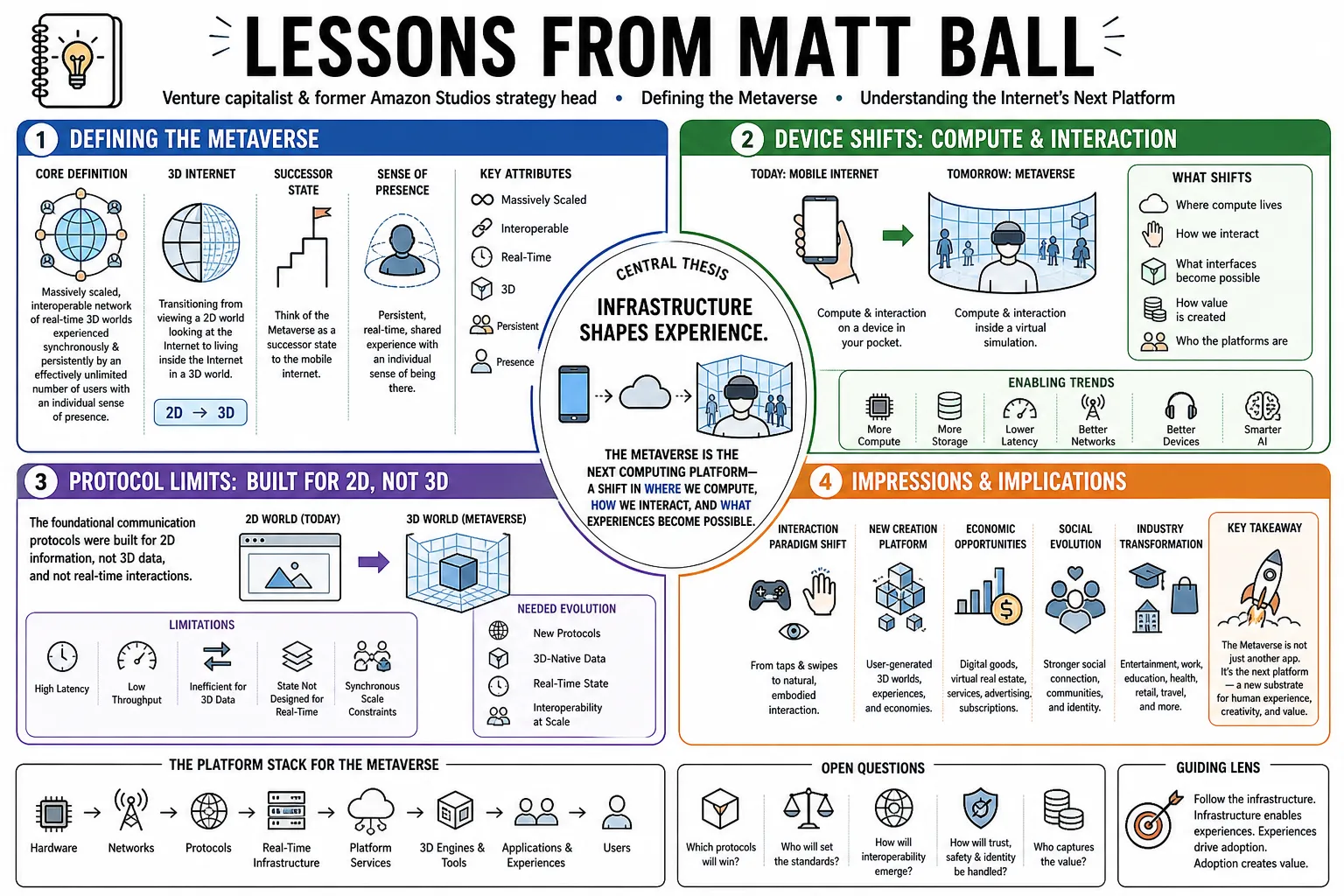
Lessons from Matt Ball
Venture capitalist and former Amazon Studios strategy head Matthew Ball is best known for defining the technical and economic mechanics of the Metaverse. This profile draws from his writing on digital media and the internet to show how underlying computing infrastructure shapes consumer behavior.
Part 1: Defining the Metaverse
- On the Core Definition: "A massively scaled and interoperable network of real-time rendered 3D virtual worlds that can be experienced synchronously and persistently by an effectively unlimited number of users with an individual sense of presence." — Source: [MatthewBall.vc]
- On the 3D Internet: "We are transitioning from viewing a 2D world looking at the Internet to living inside the Internet in a 3D world." — Source: [MatthewBall.vc]
- On Device Shifts: "The metaverse is best understood as the shift of computing and interaction from a device in your pocket into a virtual simulation." — Source: [Supply Chain Today]
- On the Successor State: "We need to think of the Metaverse as a sort of successor state to the mobile internet." — Source: [MatthewBall.vc]
- On Protocol Limits: "The foundational communication protocols were built for 2D information, not 3D data, and not real-time interactions." — Source: [Baillie Gifford]
- On the Sense of Presence: "The Metaverse requires an individual sense of presence, meaning you feel you are actually in a space, not just observing it." — Source: [MatthewBall.vc]
- On Virtual Persistence: "It never 'resets' or 'pauses' or 'ends', but rather continues indefinitely." — Source: [MatthewBall.vc]
- On Synchronicity: "It must be a living experience that exists consistently for everyone and in real time." — Source: [MatthewBall.vc]
- On Asset Interoperability: "The Metaverse will require unprecedented interoperability of data, digital items, and content." — Source: [MatthewBall.vc]
- On Misconceptions: "The Metaverse is not a game, a hardware device, or an online experience. It is a fundamental shift in computing." — Source: [MatthewBall.vc]
Part 2: The Streaming Wars and Media
- On Streaming as a Battleground: "The 'Streaming Wars' are just a battle in the larger war for time, attention, and ecosystem lock-in." — Source: [MatthewBall.vc]
- On Valuing Content: "The shift to direct-to-consumer video fundamentally changes how content is valued, moving from wholesale licensing to subscriber retention." — Source: [MatthewBall.vc]
- On Media as a Strategy: "Major tech companies use OTT video as a strategy to drive other business interests, not strictly as a standalone profit center." — Source: [MatthewBall.vc]
- On the Difficulty of Rebundling: "Rebundling the unbundled streaming landscape is infinitely harder than the original cable bundle because the economics of distribution have fractured." — Source: [MatthewBall.vc]
- On Netflix’s Structural Advantage: "Netflix didn't just build a better product; they built a different business model unconstrained by linear television schedules." — Source: [MatthewBall.vc]
- On Frictionless Churn: "In a world with no friction to cancel, streaming services must constantly prove their value every single month." — Source: [MatthewBall.vc]
- On Audio's Precedent: "On-demand streaming fundamentally changed consumer access in audio long before video, reshaping compensation models in the process." — Source: [MatthewBall.vc]
- On Content Spend Limits: "There is a ceiling on how much money can be rationally spent on content before the marginal return on a new subscriber goes negative." — Source: [MatthewBall.vc]
- On Amazon Prime Video: "Amazon views Prime Video not as a media business, but as a mechanism to reduce Prime churn and increase retail spending." — Source: [MatthewBall.vc]
Part 3: Gaming and Virtual Worlds
- On Learning Through Failure: "Games are the only entertainment category based on learning through failure." — Source: [Baillie Gifford]
- On Motivational Design: "Game developers have greater insight into motivational design than many social giants because they build worlds we actually want to inhabit." — Source: [Baillie Gifford]
- On Epic Games: "Epic Games is not just building a game in Fortnite; they are building a persistent social square and the tools to construct the Metaverse." — Source: [MatthewBall.vc]
- On Roblox’s Model: "Roblox has demonstrated that the future of gaming lies in user-generated worlds where creation tools are democratized." — Source: [MatthewBall.vc]
- On Socializing in Games: "Gaming has evolved from a solitary activity to the primary way younger generations socialize and maintain friendships." — Source: [MatthewBall.vc]
- On Game Engines: "Unreal and Unity are no longer just for games; they are the fundamental rendering engines for architecture, film, and digital twins." — Source: [MatthewBall.vc]
- On Games Becoming Worlds: "When a game becomes a place to simply hang out rather than achieve a specific objective, it transitions into a virtual world." — Source: [MatthewBall.vc]
- On Time Allocation: "The sheer volume of hours logged in virtual worlds dwarfs traditional media consumption among younger demographics." — Source: [MatthewBall.vc]
- On Virtual Economies: "In-game economies are becoming as robust as real-world economies, driven by the desire for digital status and utility." — Source: [MatthewBall.vc]
- On Cross-Play: "The breakdown of walled gardens in gaming through cross-play was the first necessary step toward an interoperable Metaverse." — Source: [MatthewBall.vc]
Part 4: Economics of Abundance and Scarcity
- On the Economy of Infinity: "The economy of infinity is fundamentally different than the real world where there is resource scarcity." — Source: [Mobile Dev Memo]
- On Digital Property: "What does property mean in the metaverse when there's the potential for infinite land?" — Source: [Mobile Dev Memo]
- On Virtual Location: "Location in a digital environment loses its traditional meaning when there is total abundance of land." — Source: [Mobile Dev Memo]
- On Artificial Scarcity: "For virtual economies to have value, creators must intentionally design artificial scarcity into systems of infinite replication." — Source: [MatthewBall.vc]
- On Deriving Value: "Value in digital worlds is derived not from the cost of production, but from social consensus and utility within the network." — Source: [MatthewBall.vc]
- On Digital Goods: "The normalization of spending real money on digital-only clothing and skins represents a massive shift in consumer behavior." — Source: [MatthewBall.vc]
- On Transaction Taxes: "Frictionless digital economies require universally accepted payment layers that do not tax every transaction at thirty percent." — Source: [MatthewBall.vc]
- On Virtual Labor: "We will increasingly see people earning their primary living by providing services, entertainment, or goods entirely within virtual economies." — Source: [MatthewBall.vc]
- On Expanding Economies: "Closed economies limit total market size; interoperable economies expand the pie for all participants." — Source: [MatthewBall.vc]
Part 5: Intellectual Property and Franchises
- On the Marvel Cinematic Universe: "The MCU succeeded because it treated its IP as an interconnected ecosystem rather than a series of isolated films." — Source: [MatthewBall.vc]
- On Disney's Moat: "Disney’s true competitive advantage is its ability to monetize a single piece of IP across theme parks, merchandise, cruise lines, and media." — Source: [MatthewBall.vc]
- On IP Lifespan: "In the modern era, successful intellectual property doesn't age out; it is continuously refreshed and translated across new mediums." — Source: [MatthewBall.vc]
- On Interactive IP: "We are reaching the limits of linear storytelling; the next frontier of IP is interactive and participatory." — Source: [MatthewBall.vc]
- On User-Generated Lore: "The next major franchise is as likely to emerge from a Roblox server as it is from a Hollywood writer's room." — Source: [MatthewBall.vc]
- On Franchise Velocity: "The speed at which a new IP can reach global ubiquity has accelerated drastically due to social media and digital distribution." — Source: [MatthewBall.vc]
- On Nintendo's IP Defense: "Nintendo protects its IP with extraordinary zeal because it understands that brand affinity is its only defense against superior hardware." — Source: [MatthewBall.vc]
- On IP Crossovers: "Fortnite has become the ultimate IP crossover event, proving that consumers want their favorite characters to exist in shared spaces." — Source: [MatthewBall.vc]
- On True Transmedia: "True transmedia is not just putting a movie character in a game; it is allowing the user's actions in the game to affect the broader narrative." — Source: [MatthewBall.vc]
Part 6: Infrastructure and Cloud Computing
- On Compute Constraints: "The Metaverse is constrained by the physical realities of compute power, bandwidth, and latency." — Source: [MatthewBall.vc]
- On Network Architecture: "Rendering a shared, high-fidelity 3D environment for millions of simultaneous users is a computational problem we have not yet solved." — Source: [MatthewBall.vc]
- On the Enemy of Presence: "You can buffer a video, but you cannot buffer a live, interactive 3D simulation; latency is the enemy of presence." — Source: [MatthewBall.vc]
- On Edge Computing: "To achieve the necessary speeds for the Metaverse, computation must move closer to the user through edge computing." — Source: [MatthewBall.vc]
- On Data Protocols: "Our current internet protocols were designed to send packets of static data reliably, not to stream continuous, synchronous spatial coordinates." — Source: [MatthewBall.vc]
- On 5G Networks: "5G is necessary but insufficient; the bandwidth is there, but the routing and continuous connection reliability remain hurdles." — Source: [MatthewBall.vc]
- On Concurrency Limits: "Current game servers max out at roughly 100 simultaneous players in a dense instance; the Metaverse requires this number to scale infinitely." — Source: [MatthewBall.vc]
- On Cloud Gaming: "Cloud gaming is not just about streaming video of a game; it is about offloading the computation to allow for experiences impossible on local hardware." — Source: [MatthewBall.vc]
- On Energy Demands: "The sheer energy and infrastructure requirements to power persistent virtual worlds will demand a massive expansion of global data centers." — Source: [MatthewBall.vc]
- On Universal Standards: "Until we have universal standards for 3D assets, similar to HTML or JPEG, true interoperability will remain impossible." — Source: [MatthewBall.vc]
Part 7: Big Tech and Platform Power
- On the App Store Tax: "Apple's 30% App Store fee is a fundamental tax on the digital economy that restricts the development of metaverse-native business models." — Source: [MatthewBall.vc]
- On Walled Gardens: "The major tech platforms are incentivized to build walled gardens, which is directly opposed to the open nature required for the Metaverse." — Source: [MatthewBall.vc]
- On Meta's Hardware Push: "Meta's massive investment in Reality Labs is a defensive maneuver to ensure they own the hardware platform of the future, rather than renting it from Apple." — Source: [MatthewBall.vc]
- On the Operating System Battle: "The ultimate battle among tech giants is not for software or content, but for the underlying operating system of the next computing paradigm." — Source: [MatthewBall.vc]
- On Open vs Proprietary Systems: "The internet succeeded because it was built on open protocols; the Metaverse is currently being built in proprietary silos." — Source: [MatthewBall.vc]
- On Digital Identity: "Who controls digital identity will control the Metaverse. Currently, our identities are fragmented across a dozen tech monopolies." — Source: [MatthewBall.vc]
- On the Enterprise Metaverse: "Microsoft is quietly building the enterprise Metaverse, understanding that digital twins and B2B applications will monetize long before consumer virtual worlds." — Source: [MatthewBall.vc]
- On Hardware as a Moat: "Owning the hardware layer gives companies like Apple the ultimate veto power over what software can exist and how it can operate." — Source: [MatthewBall.vc]
- On Tech Monopolies: "The sheer scale of capital required to build the Metaverse means only the largest tech companies can compete, inevitably inviting antitrust scrutiny." — Source: [MatthewBall.vc]
Part 8: The Future of Digital Experiences
- On Hardware Adoption: "We cannot fully inhabit a 3D internet until the hardware required becomes lightweight, affordable, and socially acceptable." — Source: [MatthewBall.vc]
- On AR vs VR: "VR takes you out of the world; AR layers the digital onto the physical. The latter has a vastly larger total addressable market." — Source: [MatthewBall.vc]
- On Intuitive Behaviors: "Behaviors that seem alien to older generations, like buying digital real estate, are completely intuitive to children raised on Minecraft and Roblox." — Source: [MatthewBall.vc]
- On Digital Fashion: "Digital fashion will become a larger industry than physical fashion because the constraints of physics and manufacturing no longer apply." — Source: [MatthewBall.vc]
- On the Evolution Timeline: "The Metaverse will not arrive with a flip of a switch; it is a gradual evolution that will take decades to fully mature." — Source: [MatthewBall.vc]
- On Democratized Creation: "When the tools to create 3D worlds become as simple to use as a smartphone camera, we will see an explosion of digital creativity." — Source: [MatthewBall.vc]
- On the Metaverse's Promise: "The promise of the Metaverse is not escaping reality, but enriching it with infinite possibilities for connection and expression." — Source: [MatthewBall.vc]
- On the Physical/Digital Boundary: "The boundary between the offline and online worlds will eventually dissolve, rendering the distinction meaningless." — Source: [MatthewBall.vc]
- On Unpredictable Killer Apps: "We know the direction of travel, but the specific killer apps of the Metaverse are as unpredictable today as Uber was in the dial-up era." — Source: [MatthewBall.vc]