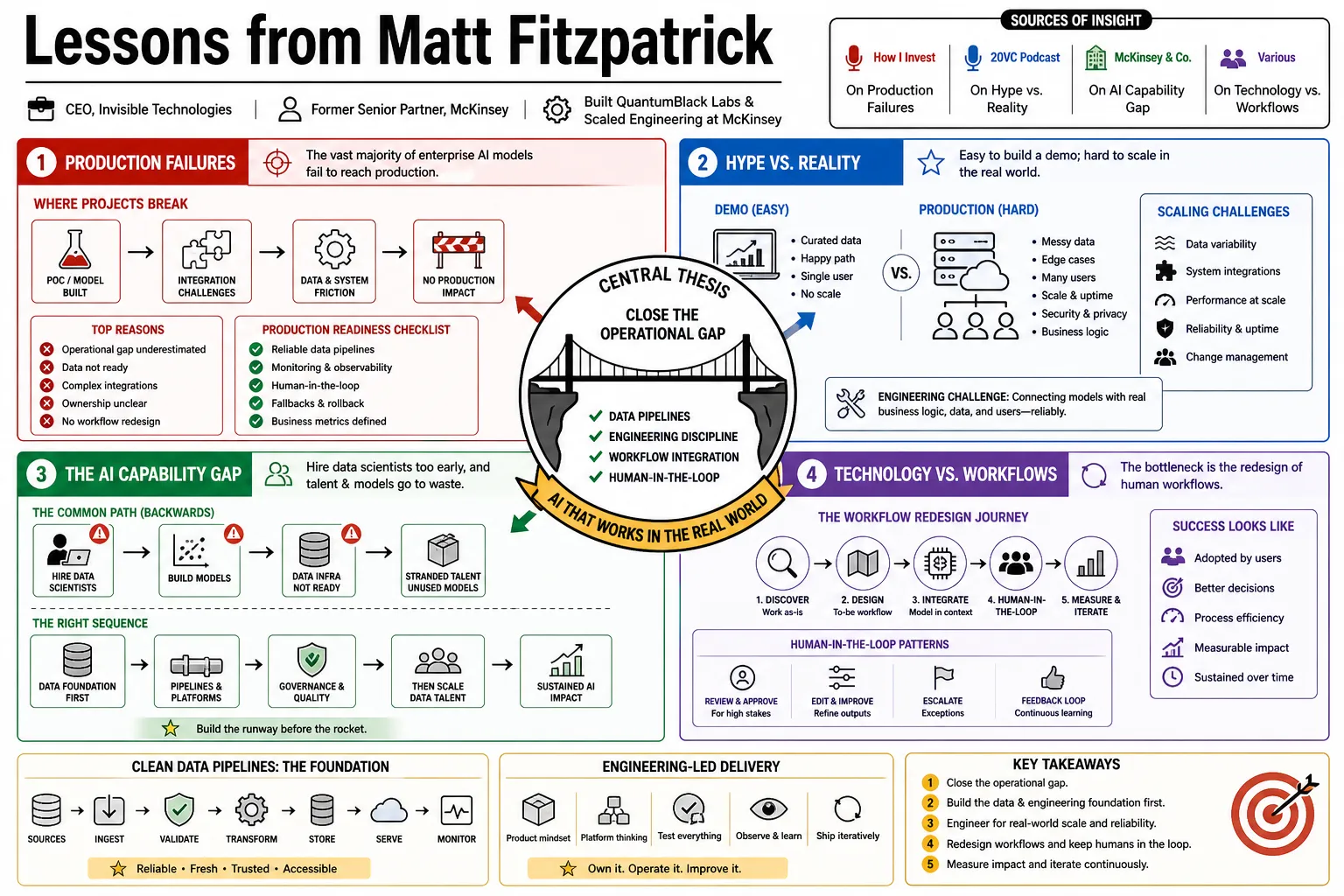
Lessons from Matt Fitzpatrick
Matt Fitzpatrick is the CEO of Invisible Technologies and a former Senior Partner at McKinsey, where he ran QuantumBlack Labs and built out the firm's engineering workforce. This profile covers his views on why enterprise AI projects fail, the mechanics of clean data pipelines, human-in-the-loop systems, and the shift toward engineering-led delivery.
Part 1: The Reality of Enterprise AI
- On Production Failures: Fitzpatrick's How I Invest episode centers on the gap between AI demos and deployed systems, noting that only a small share of enterprise models reach production. — Reference: How I Invest episode on enterprise AI deployment
- On Hype vs. Reality: "It is easy to build a demo, but scaling an application that actually interacts with business logic and customer data is an entirely different engineering challenge." — Source: 20VC Podcast
- On the AI Capability Gap: "Companies often hire data scientists before they have the data engineering infrastructure required to support them, leading to stranded talent and unused models." — Source: McKinsey & Company
- On Technology vs. Workflows: "The bottleneck in AI adoption is rarely the model itself; it is the redesign of human workflows required to integrate the model's outputs." — Source: VivaTech Panel
- On Business Ownership: Fitzpatrick frames enterprise AI as an organizational-change problem, not a standalone IT install; teams need clear KPIs, guardrails, and business ownership before pilots can become production systems. — Reference: AWS Executive Insights transcript with Matt Fitzpatrick
- On Early Adoption: "First movers in generative AI are discovering that off-the-shelf models require significant fine-tuning and context grounding to be reliable." — Source: Business Insider
- On App Proliferation: "If there is an app for everything, we must ask why nothing works seamlessly. The answer is usually a lack of integrated systems." — Source: IVY Podcast
- On Pragmatic AI: "Enterprises do not need Artificial General Intelligence to generate value today; they need targeted, narrow systems that solve specific operational bottlenecks." — Source: McKinsey & Company
- On the Cost of Experimentation: Fitzpatrick argues that companies struggle when they run many pilots without defining what good looks like, because the move to production depends on bounded KPIs, testing, and risk controls. — Reference: AWS Executive Insights transcript on AI adoption hurdles
- On Measuring Success: "An AI project is successful only when it changes a decision-making process or automates a manual task at scale, rather than when the model achieves a high accuracy score in a lab." — Source: 20VC Podcast
Part 2: Human-in-the-Loop Systems
- On Longevity of Human Input: "On the generative AI side, we are going to need humans in the loop for decades to come to ensure cultural context and accuracy." — Source: Business Insider
- On Task Complexity: "There are too many types of tasks in the world for AI to accomplish autonomously; expert human feedback remains the constraint on quality." — Source: 20VC Podcast
- On Synthetic Data Limits: Fitzpatrick told Business Insider that synthetic data will not remove the need for human feedback soon, because real-world tasks require accuracy, language, and cultural context. — Reference: Business Insider article on synthetic data and human feedback
- On Continuous Learning: "Models degrade over time unless they are coupled with a human feedback mechanism that corrects errors and reinforces desired outputs." — Source: McKinsey & Company
- On Quality Control: "You cannot automate quality assurance for generative text without relying on human evaluators who understand the domain's specific constraints." — Source: VivaTech Panel
- On Managing Risk: "Keeping humans involved in high-stakes decisions is a necessary risk management strategy, rather than simply a technical bridge." — Source: IVY Podcast
- On the Labeling Race: "The current AI arms race is fundamentally a data labeling race. The companies that organize human expertise most efficiently will win." — Source: 20VC Podcast
- On Task Routing: "The future of work involves intelligent routing systems that send routine tasks to AI and escalate complex, ambiguous problems to humans." — Source: Invisible Technologies
- On Trust: Fitzpatrick's AWS discussion emphasizes guardrails, auditable decision models, and human training before GenAI systems are pushed live, especially where customers or frontline workers rely on the output. — Reference: AWS Executive Insights transcript on guardrails and testing
Part 3: Scaling Engineering Teams
- On Growth: "When I started on that path, the firm had fewer than a hundred engineers; by the time I left, it had almost seven thousand." — Source: IVY Podcast
- On Hiring Criteria: "We optimize for engineers who understand business logic over those who only want to write algorithms in a vacuum." — Source: 20VC Podcast
- On Engineering Culture: "You cannot bolt an engineering culture onto a traditional consultancy without fundamentally changing how performance is measured and rewarded." — Source: McKinsey & Company
- On Forward-Deployed Engineers: "To make enterprise AI work, you need forward-deployed engineers who sit with the business teams and understand the daily friction points." — Source: Business Insider
- On Forward-Deployed Engineering: The 20VC episode frames Fitzpatrick's enterprise AI thesis around forward-deployed engineers, suggesting that durable AI adoption depends on technical talent working close to business friction. — Reference: 20VC episode with Matt Fitzpatrick
- On Cross-Functional Teams: "The most effective AI squads combine data engineers, ML engineers, domain experts, and product managers working in tight iteration cycles." — Source: McKinsey & Company
- On Technical Debt: Fitzpatrick points to legacy software and old codebases as a major constraint on digital modernization, making AI-assisted refactoring and better engineering systems part of the enterprise AI agenda. — Reference: AWS Executive Insights transcript on legacy-system modernization
- On Developer Productivity: "Investing in internal tooling and continuous integration pipelines pays off exponentially when managing thousands of developers." — Source: VivaTech Panel
- On Specialized Roles: "As the field matures, the role of data scientist is fracturing into more specialized disciplines like MLOps, data engineering, and AI product management." — Source: 20VC Podcast
- On Leadership: "Leading engineers requires clearing roadblocks and providing context, rather than dictating the specific technical implementation." — Source: IVY Podcast
Part 4: The Data Foundation
- On Data Quality: "Your machine learning models will only ever be as good as the underlying data architecture supporting them." — Source: McKinsey & Company
- On Siloed Information: "The biggest barrier to enterprise AI is not algorithm availability, but the fact that required business data is trapped in fragmented, legacy systems." — Source: VivaTech Panel
- On Unstructured Data: "Generative AI has unlocked the value of unstructured data like documents, emails, and chat logs which previously sat dormant in corporate archives." — Source: Business Insider
- On Data Governance: Fitzpatrick's risk-control framing stresses bounded recommendations, transparent machine-learning components, and guardrails so organizations can audit and manage GenAI behavior. — Reference: AWS Executive Insights transcript on AI risk controls
- On Modernization: "Capturing value from generative AI forces companies to accelerate their overall IT modernization and cloud migration efforts." — Source: McKinsey & Company
- On Data Foundations: Fitzpatrick's How I Invest episode highlights poor data quality, domain-specific models, and enterprise fine-tuning as practical constraints that must be solved before AI systems scale. — Reference: How I Invest episode on data quality and enterprise fine-tuning
- On Real-Time Data: "Moving from batch processing to real-time streaming data is necessary for use cases like fraud detection and dynamic pricing." — Source: 20VC Podcast
- On Data Access: "Democratizing data access across an organization accelerates innovation more than buying the latest proprietary model." — Source: IVY Podcast
- On Context Grounding: "Retrieval-augmented generation works only if the retrieval system has access to clean, indexed, and up-to-date knowledge bases." — Source: Invisible Technologies
Part 5: Engineering as a Delivery Model
- On the Future of Services: "The future of technology services relies on engineering as a delivery model, moving away from time-and-materials consulting." — Source: IVY Podcast
- On Outcome-Based Pricing: "Clients want to pay for the operational outcome and the functioning software, rather than the hours spent analyzing the problem." — Source: Business Insider
- On Industrializing AI: "We need to learn from Formula One racing, where rapid iteration and telemetry data drive continuous performance improvements on the track." — Source: McKinsey & Company
- On Managed Services: "As AI becomes more complex, enterprises will increasingly rely on managed services that provide both the model hosting and the human-in-the-loop oversight." — Source: Invisible Technologies
- On Software Assets: "Building reusable software assets allows a services firm to scale its impact without scaling its headcount linearly." — Source: 20VC Podcast
- On Agility: Fitzpatrick contrasts traditional certainty-seeking software programs with AI's test-and-learn motion, where teams must train, test, and iterate before live deployment. — Reference: AWS Executive Insights transcript on test-and-learn adoption
- On Client Capabilities: "The goal of a technology partner should be to leave the client with a working system and the internal capability to maintain it." — Source: VivaTech Panel
- On Product Management: The How I Invest episode presents Invisible's work as an AI-powered enterprise services platform focused on modernizing business operations, which requires product discipline around actual workflows. — Reference: How I Invest episode on Invisible Technologies' enterprise platform
- On Disruption: "Consulting firms that fail to integrate software development into their core offerings will be disrupted by those that can execute on the code." — Source: IVY Podcast
Part 6: Generative AI in the Enterprise
- On Adoption Rates: "We are seeing a massive appetite for generative AI, but a deep hesitation around deploying it in customer-facing scenarios." — Source: McKinsey & Company
- On Multiagent Systems: "The next leap in productivity will come from multiagent systems where different AI models negotiate and complete tasks collaboratively." — Source: 20VC Podcast
- On Proprietary Data: "The true moat for any business in the AI era is its proprietary data; the base models will eventually become commodities." — Source: Business Insider
- On Prompt Engineering: Fitzpatrick's AWS conversation points beyond prompt craft toward better enterprise interfaces, knowledge management, and AI-native applications that translate user needs into working systems. — Reference: AWS Executive Insights transcript on AI-native applications
- On Cost Considerations: "Running large language models at scale is computationally expensive. Enterprises must match the model size to the complexity of the task to manage costs." — Source: VivaTech Panel
- On Internal Use Cases: Fitzpatrick identifies knowledge management, legacy-system modernization, and customer experience as practical enterprise opportunities where GenAI can improve existing workflows. — Reference: AWS Executive Insights transcript on enterprise AI opportunities
- On Hallucinations: "Model hallucinations are a feature of creative systems, but a bug in enterprise applications. Mitigation requires strict grounding and human review." — Source: IVY Podcast
- On Vendor Lock-In: "Organizations should build abstraction layers to avoid being locked into a single foundation model provider as the technology shifts rapidly." — Source: McKinsey & Company
- On Skill Shifts: "Generative AI will not replace developers, but it will raise the baseline, allowing junior engineers to operate with the efficiency of senior staff." — Source: Invisible Technologies
- On Security: "Deploying generative AI safely requires new security paradigms to prevent prompt injection and accidental data exfiltration." — Source: 20VC Podcast
Part 7: Leadership and Strategy
- On Strategic Focus: The How I Invest episode frames enterprise AI value around overcoming friction points and focusing on production-ready use cases, not chasing every possible pilot. — Reference: How I Invest episode on enterprise AI adoption
- On Change Management: "You can deploy the best algorithm in the world, but if the frontline workers refuse to trust it, the investment is zero." — Source: McKinsey & Company
- On Board Visibility: "Boards of directors are asking about AI strategy, but executives often struggle to translate pilot projects into coherent enterprise roadmaps." — Source: VivaTech Panel
- On the AI Divide: "The gap between companies that successfully operationalize AI and those that treat it as an IT experiment is widening into a competitive chasm." — Source: Business Insider
- On Executive Education: "Non-technical leaders need enough fluency in AI to ask the right questions about data privacy, model bias, and operational costs." — Source: IVY Podcast
- On Resource Allocation: "Funding an AI initiative should look more like venture capital investing where you start small, measure the outcome, and double down on what works." — Source: 20VC Podcast
- On Cross-Industry Lessons: 20VC describes Fitzpatrick's work at Invisible as accelerating AI adoption across sports, consumer, and government, supporting a cross-industry view of enterprise AI deployment. — Reference: 20VC profile page for Matt Fitzpatrick
- On Building Trust: "Trust in leadership is required during AI transitions because roles will inevitably change, and employees need to know they will be supported." — Source: Invisible Technologies
- On Long-Term Vision: "We are building systems today that will dictate how our companies operate for the next decade. Short-term thinking leads to fragmented architecture." — Source: McKinsey & Company
Part 8: The Next Decade of Technology
- On Hyper-Automation: "The convergence of robotic process automation and generative AI will allow us to automate entire end-to-end processes, rather than isolated tasks." — Source: VivaTech Panel
- On Continuous Deployment: "The standard for software delivery will shift from monthly updates to continuous, AI-assisted deployment cycles." — Source: IVY Podcast
- On New Interfaces: "Text-based prompts are just the beginning. The future interface for enterprise software will be proactive and multimodal." — Source: Business Insider
- On AI Governance: "As AI takes on more autonomous actions, establishing clear boundaries and audit trails will become the primary focus of compliance teams." — Source: McKinsey & Company
- On Global Talent: "The ability to integrate human-in-the-loop feedback means we can utilize specialized domain expertise from anywhere in the world." — Source: Invisible Technologies
- On Open Source: "Open-source models will continue to apply downward pressure on the pricing of proprietary APIs, benefiting enterprise consumers." — Source: 20VC Podcast
- On Industry Disruption: Fitzpatrick highlights customer service, knowledge management, and legacy-system modernization as areas where AI can change the operating model of established businesses. — Reference: AWS Executive Insights transcript on AI business opportunities
- On Enterprise AI Scope: Fitzpatrick's How I Invest episode concentrates on enterprise AI adoption, fine-tuning, human feedback, and workflow modernization as the practical scope for near-term AI value. — Reference: Apple Podcasts listing for the How I Invest episode
- On Optimism: "Despite the hurdles of deployment, the tools we are building today have the capacity to eliminate administrative drudgery and elevate human creativity." — Source: McKinsey & Company