Lessons from Matt Mullenweg
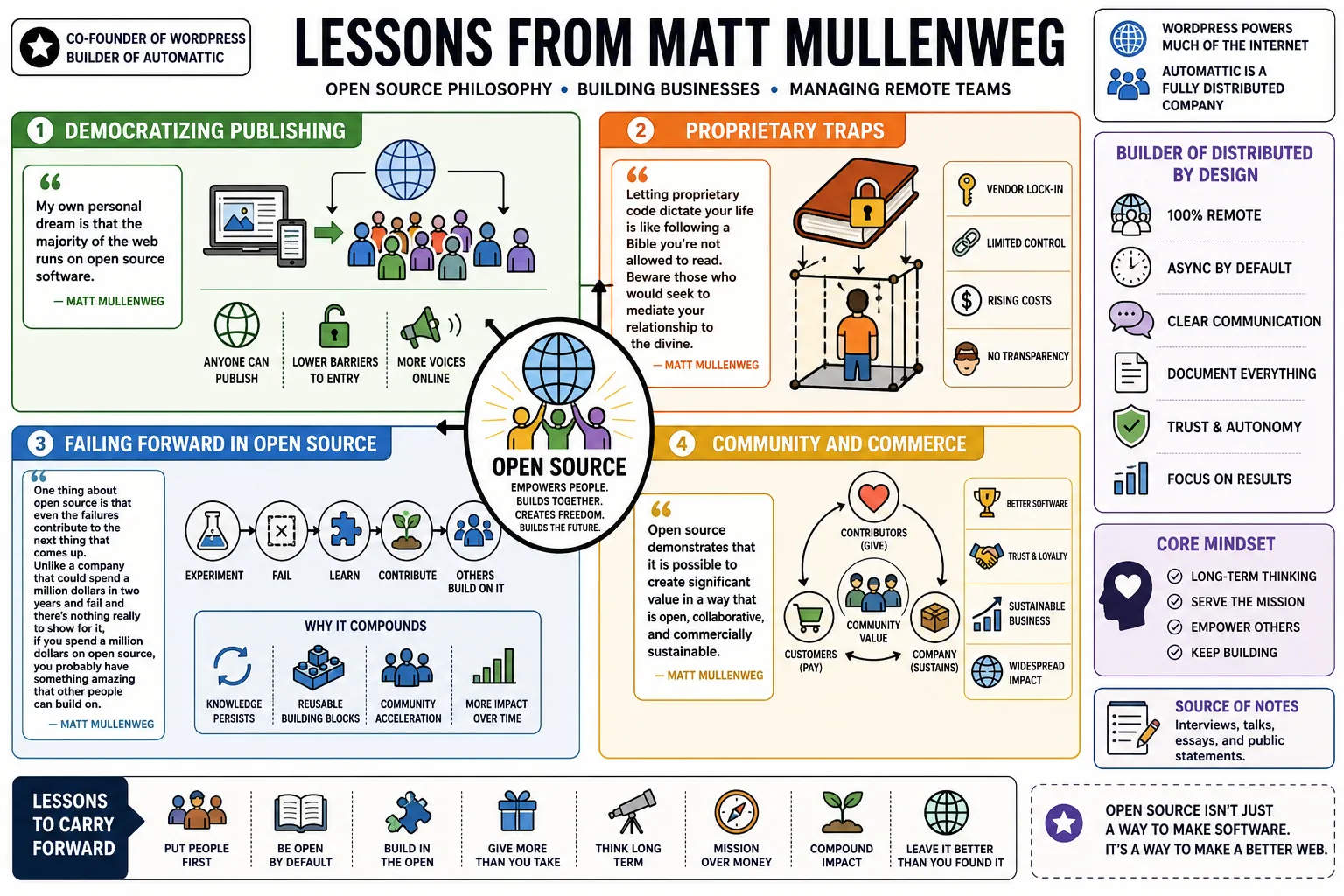
Matt Mullenweg co-founded WordPress, the open-source software running much of the internet, and later built Automattic as a fully distributed company without a physical office. This profile covers his practical approach to software development, building businesses, and managing remote teams.
Part 1: The Philosophy of Open Source
- On Democratizing Publishing: "My own personal dream is that the majority of the web runs on open source software." — Source: [Quote Fancy]
- On the Morality of Code: "For me, open source is a moral thing." — Source: [Activation Quotes]
- On Proprietary Traps: "Letting proprietary code dictate your life is like following a Bible you're not allowed to read. Beware those who would seek to mediate your relationship to the divine." — Source: [ma.tt]
- On Failing Forward in Open Source: "One thing about open source is that even the failures contribute to the next thing that comes up. Unlike a company that could spend a million dollars in two years and fail and there's nothing really to show for it, if you spend a million dollars on open source, you probably have something amazing that other people can build on." — Source: [Activation Quotes]
- On Community and Commerce: Open source demonstrates that it is entirely possible to maintain a highly profitable commercial entity working in harmony alongside a wider free software community. — Source: [Activation Quotes]
- On Standards and Implementations: "I think if you look at the history of the web, all the most successful protocols are often accompanied by reference implementations or great Open Source software to implement them." — Source: [37signals]
- On Development Models: Open-source development typically follows two main methodologies: design by committee, which works well for broad standards, and the benevolent dictator model, which is often more effective for focused consumer products. — Source: [Activation Quotes]
- On Code Ownership: True ownership on the internet means controlling your underlying code and data, ensuring you are never merely renting digital space on someone else's platform. — Source: [ma.tt]
- On Building a Movement: "Don't just build a product; build a movement." — Source: [Lenny's Podcast]
- On Software Longevity: Code built in the open has a far greater chance of outliving its original creators because an active community can carry the torch forward independently. — Source: [The Tim Ferriss Show]
Part 2: Distributed Work and Remote Culture
- On Terminology: "Let's stop calling it telework or working remote. When there's no central place of work and everyone is around the world, the term distributed is more accurate." — Source: [Carrus]
- On Designing the Workspace: You cannot simply tolerate remote employees; you have to intentionally design your entire organizational structure to support distributed work from the ground up. — Source: [Substack]
- On Recreating the Office: The most common mistake companies make is getting stuck at "Level 2," where they simply attempt to replicate physical office habits and rigid synchronous expectations through video calls. — Source: [PMillerd]
- On the Future of Work: "I'd be completely astounded if five, ten years from now... the tech giants that we think of, didn't have distributed work as a major, if not the major, part of the way their employees work together." — Source: [Distributed Blog]
- On the Inevitability of Distribution: Any company with over one hundred people is already operating as a distributed company, even if they share the exact same physical building. — Source: [ma.tt]
- On Judging Work by Output: Reaching high-level distributed work requires abandoning real-time dependence. You have to judge employee performance purely by their actual output rather than their visible time at a desk. — Source: [Substack]
- On Peak Autonomy: A fully mature distributed organization operates autonomously across time zones, breaking the reliance on real-time presence entirely. — Source: [Carrus]
- On Global Talent Pools: When you stop requiring people to commute to a specific building, you unlock the ability to hire the single best person in the world for the job instead of just the best person within a thirty-mile radius. — Source: [Distributed Blog]
- On Observing vs. Surveilling: Managers in a distributed environment must focus on clear deliverables. Monitoring screen time or logging employee hours destroys trust and misses the point entirely. — Source: [Distributed Blog]
- On Travel Budgets: The money a distributed company saves on office real estate should be aggressively spent on bringing teams together physically for focused bonding time a few times a year. — Source: [The Tim Ferriss Show]
Part 3: Leadership and Building Organizations
- On Irreplaceable Traits: When identifying future leaders, look for four characteristics that cannot be taught: strong work ethic, good taste, personal integrity, and deep curiosity. — Source: [The Tim Ferriss Show]
- On Aligning Focus: Managing a large team is about aligning on outcomes and making sure everyone understands the overarching goals, rather than micromanaging individual tasks. — Source: [ma.tt]
- On Audacious Goals: Setting long-term goals that look past immediate financial returns helps attract a higher caliber of talent looking to make a concrete societal impact. — Source: [Learning Leader]
- On Making Unpopular Decisions: Leading an open-source ecosystem forces you to make difficult decisions and defend core principles, even when facing severe public criticism. — Source: [Lenny's Newsletter]
- On the Silent Majority: When dealing with community backlash, leaders have to remember to prioritize the needs of the silent majority of everyday users over the loudest critics in the room. — Source: [Lenny's Newsletter]
- On Optimism: A founder's optimism acts as the primary fuel to guide an organization through periods of deep uncertainty. — Source: [Learning Leader]
- On Executive Coaching: Working with an executive coach provides the necessary external friction to challenge your baseline assumptions and force honest self-reflection. — Source: [Learning Leader]
- On Long-Term Thinking: Building a company that lasts decades requires optimizing for community trust over extracting immediate financial value. — Source: [The Tim Ferriss Show]
- On Public Speaking: Getting comfortable with public speaking acts as a massive multiplier for a leader's ability to communicate ideas clearly across a large organization. — Source: [Learning Leader]
- On Protecting Culture: The actual culture of your company is defined by who gets hired, who gets fired, and who gets promoted. — Source: [The Tim Ferriss Show]
Part 4: Communication and Asynchronous Collaboration
- On Communication as Oxygen: "I will communicate as much as possible because it's the oxygen of a distributed company." — Source: [Podcast Notes]
- On Asynchronous Defaults: Effective distributed teams default to asynchronous text communication and reserve live video meetings exclusively for complex or highly nuanced discussions. — Source: [Forbes]
- On Documentation over Meetings: Forcing people to write things down creates clarity of thought and automatically builds a searchable history of decision-making for new employees. — Source: [Substack]
- On Processing Time: Asynchronous workflows respect attention spans by allowing team members to consume information, process it deeply, and reply on their own schedule. — Source: [Forbes]
- On Transparency: Internal company information should be fully transparent and accessible by default, locked down only when legally required. — Source: [ma.tt]
- On Writing Skills: Because most internal communication happens via text, the ability to write clearly and concisely is the single most critical skill for a new hire. — Source: [The Tim Ferriss Show]
- On Assuming Positive Intent: Text strips away tone and body language. Teams have to actively train themselves to assume positive intent to avoid continuous misunderstandings. — Source: [Automattic Creed]
- On the Real-Time Trap: Using chat applications as a constant, all-day meeting room completely negates the core productivity benefits of working remotely. — Source: [PMillerd]
- On Deliberate Handoffs: True asynchronous communication establishes a system where work is handed off cleanly across time zones, keeping projects moving forward while individuals sleep. — Source: [Carrus]
Part 5: Entrepreneurship and Building WordPress
- On Open Source Business Models: Automattic proved you can build a massive, highly profitable business entirely around an open-source core without locking down the underlying software. — Source: [Activation Quotes]
- On Choosing Your Battles: Startups can only innovate on a few variables at once. Rely on established, boring solutions for everything outside your specific core competency. — Source: [The Tim Ferriss Show]
- On the Value of Plugins: WordPress's decision to embrace a highly flexible plugin architecture allowed a simple blogging tool to expand into an engine capable of running complex applications. — Source: [ma.tt]
- On Building for Users: A product roadmap should be heavily influenced by watching how actual users naturally hack your software to solve problems you never anticipated. — Source: [Lenny's Newsletter]
- On Iteration Speed: Developing in the open creates an incredibly tight feedback loop, giving you bug reports and community patches mere hours after pushing a new release. — Source: [Activation Quotes]
- On Competing with Giants: A dedicated community of thousands of independent developers will continually out-innovate any closed, proprietary team over a long enough timeline. — Source: [ma.tt]
- On Pricing Philosophy: Democratizing software means dropping the barrier to entry to zero and only charging money for premium hosting or conveniences that save businesses time. — Source: [The Tim Ferriss Show]
- On Taking the Long View: Deciding to work on a specific project for the rest of your life completely removes the frantic urgency to force monetization in the first few years. — Source: [The Tim Ferriss Show]
- On Capital Efficiency: Operating without a physical office forces a startup to be highly capital efficient by default, eliminating the massive monthly burn rate associated with physical real estate. — Source: [Distributed Blog]
Part 6: Personal Habits and Productivity
- On Polyphasic Sleep: Experimenting with extreme routines like polyphasic sleep reveals how adaptable human biology is, even if the practice is completely unsustainable long-term. — Source: [The Tim Ferriss Show]
- On Reading as Fuel: Books are the highest return-on-investment activity for gaining new mental models and preserving long-term curiosity. — Source: [The Tim Ferriss Show]
- On Managing Distractions: Guarding your attention requires actively turning off notifications and designing your digital environment specifically for deep, uninterrupted focus. — Source: [The Tim Ferriss Show]
- On Taking Sabbaticals: Fully disconnected sabbaticals give the brain the required downtime to synthesize old information and generate new, long-term ideas. — Source: [The Tim Ferriss Show]
- On Confronting Grief: Processing personal loss forces a stark reevaluation of your daily priorities and clarifies exactly what you want to do with your remaining time. — Source: [The Tim Ferriss Show]
- On Physical Environment: You don't need a corporate office, but you absolutely need a highly curated, ergonomic, and quiet workspace at home to maintain output over decades. — Source: [Distributed Blog]
- On Keyboard Proficiency: Mastering your keyboard, utilizing text expanders, and learning application shortcuts are the most immediate ways a developer can increase their daily output. — Source: [ma.tt]
- On Experiencing the World: Traveling frequently prevents the insular, bubble-like thinking that often plagues tech hubs and homogeneous geographic areas. — Source: [The Tim Ferriss Show]
- On Iterative Improvement: Personal growth operates exactly like software development. You have to ship your current version, accept harsh feedback, and patch your own bugs continuously. — Source: [The Tim Ferriss Show]
Part 7: Managing Talent and Hiring
- On Trial Projects: The single best way to evaluate a candidate is to bypass traditional interviews entirely and pay them to complete a real, bounded project alongside the existing team. — Source: [The Tim Ferriss Show]
- On the Illusion of Resumes: Resumes are largely fictional marketing documents. Actual performance on a specific task is the only reliable metric for predicting future success. — Source: [ma.tt]
- On Diversity of Geography: Hiring from anywhere in the world forces true diversity of thought and background into a company, resulting in much stronger product decisions. — Source: [Distributed Blog]
- On Letting People Go: Keeping an underperforming employee around out of a false sense of politeness ultimately damages the team culture and stalls the individual's career growth elsewhere. — Source: [The Tim Ferriss Show]
- On Intrinsic Motivation: You cannot force someone to care deeply about their output. You have to hire people whose personal values naturally align with the work itself. — Source: [Learning Leader]
- On Trust from Day One: In a distributed company, you must grant absolute trust and autonomy to new hires immediately. You only revoke that trust if they explicitly prove they cannot handle it. — Source: [Distributed Blog]
- On Compensation Equity: Paying standard, competitive rates regardless of local geography honors the objective value of the work being produced rather than exploiting a lower cost of living. — Source: [ma.tt]
- On Promoting from Within: The most effective product leaders often begin their careers in customer support, giving them a raw, unfiltered understanding of user pain points. — Source: [The Tim Ferriss Show]
- On Rejecting the Pedigree: The prestige of the university a candidate attended has zero correlation with their ability to ship excellent code or clearly communicate in a text-based environment. — Source: [ma.tt]
Part 8: The Future of the Web and Technology
- On the Open Web's Survival: The open web is a continuous fight. If developers stop building decentralized alternatives, the internet will fracture completely into closed corporate walled gardens. — Source: [ma.tt]
- On Data Portability: Users only have true digital freedom when they can easily export their personal data and leave a platform without facing deliberate friction. — Source: [ma.tt]
- On the Impact of AI: Artificial intelligence speeds up syntax generation, shifting the developer's role away from writing raw code and toward acting as a high-level systems architect. — Source: [The Tim Ferriss Show]
- On Centralization vs. Decentralization: The tech industry operates on a pendulum. The current state of highly centralized social networks will eventually give way to decentralized, federated alternatives. — Source: [ma.tt]
- On Blogging as Identity: Controlling a personal blog on your own distinct domain remains the most resilient form of digital identity, entirely immune to the changing algorithms of major social networks. — Source: [The Tim Ferriss Show]
- On Security in Open Source: Open-source projects are ultimately more secure because the underlying code is continuously subjected to global scrutiny rather than hidden behind corporate obscurity. — Source: [Activation Quotes]
- On the Role of Interfaces: The most important battles in software development lie in creating radically simpler user interfaces that allow non-technical people to build complex things. — Source: [ma.tt]
- On Commercial Monopolies: When a single corporation controls how information is published and consumed, they hold dangerous power over global culture. Open source provides the necessary counterweight. — Source: [ma.tt]
- On the Next Generation of Creators: The true promise of democratized software is lowering the barrier to entry so drastically that anyone with a cheap laptop can build the next major platform entirely from their bedroom. — Source: [The Tim Ferriss Show]