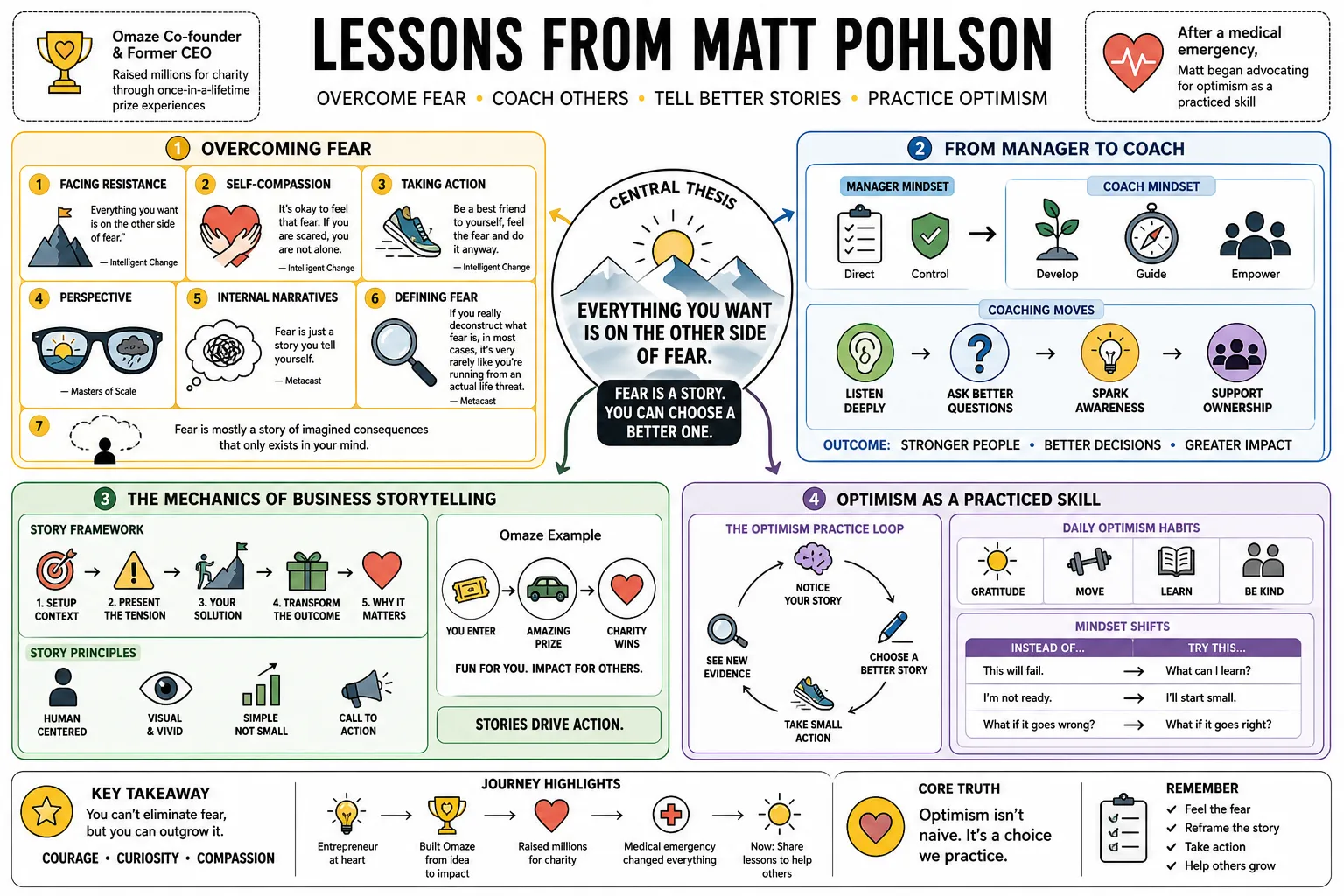
Lessons from Matt Pohlson
Matt Pohlson is the co-founder and former CEO of Omaze, a platform that raised money for charity by offering people the chance to win high-value prizes. After surviving a medical emergency, he began advocating for optimism as a practiced skill rather than a fixed trait. This profile collects his insights on overcoming fear, shifting from a manager to a coach, and the mechanics of business storytelling.
Part 1: Overcoming Fear
- On Facing Resistance: "Everything you want is on the other side of fear." — Source: Intelligent Change
- On Self-Compassion: "It’s okay to feel that fear. If you are scared, you are not alone." — Source: Intelligent Change
- On Taking Action: "Be a best friend to yourself, feel the fear and do it anyway." — Source: Intelligent Change
- On Perspective: "Nothing is as bad as the fear of it." — Source: Masters of Scale
- On Internal Narratives: "Fear is just a story you tell yourself." — Source: Metacast
- On Defining Fear: "If you really deconstruct what fear is, in most cases, it's very rarely like you're running from an actual life threat." — Source: Metacast
- On Illusion: Fear is mostly a story of imagined consequences that only exists in your own brain. — Source: Metacast
- On Love Versus Fear: "The opposite of love is not hate, it's fear." — Source: Business Leader
- On Decision Making: "You can make a decision out of love or fear, but when you are scared, your mind constricts, you are actually dumber." — Source: Business Leader
- On Breaking Through: "When you commit and push through that fear, even though you can't see through to the other side, things start to open up for you." — Source: Next Bridge Consulting
Part 2: The Power of Optimism
- On the Nature of Optimism: "I used to think that optimism was a mindset or maybe even a personality trait. And now I really view optimism as a skill." — Source: Forbes
- On Building Resilience: "Just like a warrior hones her craft in combat, optimism is a skill that is best foraged in adversity." — Source: Forbes
- On Clarity: "Real optimism is about being very clear on what you want, as well as all the obstacles that are in the way." — Source: Intelligent Change
- On Navigating Obstacles: "Optimism can take you to places that you haven't been before." — Source: Intelligent Change
- On Ignoring Naysayers: Real optimism means not falling prey to other people's projections. — Source: Intelligent Change
- On Breaking Barriers: "Just because it hasn't been done before, doesn't mean it can't be done." — Source: Intelligent Change
- On Seeing Possibility: "Real optimism is when you've gone through the difficult times, but yet you still look for possibility where others see impossibility." — Source: Forbes
- On New Paradigms: "I believe that love and optimism are super powers now." — Source: Mishcon
- On Shaping the Future: "You can tap into those frequencies and create a reality in the future through focus and energy in ways that I just did not think was possible." — Source: Mishcon
- On Mindset Shift: Approaching problems with optimism rather than dread is a choice that changes the outcome of a business. — Source: Medium
Part 3: Storytelling as a Skill
- On Business Value: "Storytelling is an undervalued skill in business." — Source: Business Leader
- On Valuations: "Every investment starts with a story. The valuation is just metrics plus storytelling." — Source: Business Leader
- On Scaling: Massive price-to-earnings ratios come from better storytelling. — Source: Business Leader
- On Core Skills: "Storytelling is maybe the most powerful skill a business person can have." — Source: Intelligent Change
- On Structure: "Words are to stories, what noise is to music." — Source: Intelligent Change
- On Resonance: Music is noise until arranged correctly to create emotional resonance. Words must be arranged the same way. — Source: Mishcon
- On Connection: Effective storytelling bridges the gap between a product and an emotional connection with the customer. — Source: Mishcon
- On the Hero's Journey: The key to a brand story is making the customer the hero, rather than focusing entirely on the company itself. — Source: Metacast
- On Beyond Awareness: Awareness alone is incomplete; storytelling is the vehicle to turn awareness into impact. — Source: Medium
Part 4: The Origin & Mission of Omaze
- On the Magic Johnson Auction: "Magic was our childhood hero. There’s nothing we would rather do than play basketball. But it was only available to the really wealthy people in the room." — Source: Foundr
- On Identifying the Problem: The traditional charity auction model was broken because it excluded the vast majority of true fans. — Source: Medium
- On the Solution: "If we made it available to everyone we could have raised so much more money, so much more awareness, and open up a whole new donor base." — Source: LA Times
- On Democratizing Access: Omaze was built to fix the auction model by allowing anyone to participate online with equal opportunity. — Source: Mishcon
- On Frictionless Giving: Goal17's profile of Pohlson describes Omaze as an online fundraising platform built to make giving back feel fun and easy, which matches the company's broader effort to strip friction out of the donation experience. — Reference: Goal17 profile of Matt Pohlson and Omaze
- On the Intersection of Industries: The company found its position at the intersection of entertainment and philanthropy. — Source: Business Insider
- On Pivoting the Model: While celebrity experiences built the brand, scaling required a pivot toward high-value prizes like luxury homes. — Source: Forbes
- On True Scale: "A car can change someone's lifestyle but a house changes someone's life." — Source: Devon Live
- On Business for Good: The mission was to create an industry standard demonstrating that a for-profit business could be a force for good. — Source: Pulse 2
Part 5: Philanthropy & Impact
- On Rethinking Charity: Philanthropy should not be restricted to high-net-worth individuals at gala dinners. — Source: Mishcon
- On Donor Passion: People who cannot afford a high auction bid often care far more about the cause than the wealthy bidders who win. — Source: Foundr
- On Win-Win Scenarios: A successful impact model creates overlapping value for the charitable cause and the donor. — Source: Metacast
- On Sustainable Impact: Relying on guilt for donations is less sustainable than relying on excitement and entertainment. — Source: Business Insider
- On the Power of Small Donations: Opening fundraising to a global audience with small entry fees outperforms traditional large-donor models. — Source: LA Times
- On Purpose-Driven Work: Building a company that aligns profit with purpose allows for a more motivated team. — Source: Holly & Co
- On Cause Content: Creating compelling content around a cause is the difference between a forgotten campaign and a movement. — Source: Medium
- On Amplifying Good: The mechanics of business and marketing should be utilized to scale charitable impact. — Source: Forbes
- On Maximizing Returns: Combining luxury prizes with a charitable mission generates unprecedented funding for non-profits. — Source: Devon Live
Part 6: Leadership & Team Building
- On the Role of a Leader: "Realizing that our team members are the heroes, and I am just one of their guides, fundamentally changed the way I look at leadership." — Source: Medium
- On Shifting Styles: "I had been a manager, when what my team needed was a coach." — Source: Medium
- On Seeing Potential: "Leadership is about recognizing that there's greatness in everyone." — Source: Medium
- On Creating Environments: A leader's primary job is to create an environment where the greatness of their team members can emerge. — Source: Medium
- On Micromanagement: Stepping into the trenches to fix every problem for your team can hinder their execution. — Source: Medium
- On Hiring Early: In the formative years of a startup, the people you hire dictate the trajectory of the company. — Source: Stack Commerce
- On Trusting Intuition with People: If a new hire doesn't feel right in your gut, trust that instinct, because it is almost always correct. — Source: Stack Commerce
- On Stillness in Leadership: "When you don't know what to do, do nothing." — Source: Foundr
- On Inner Voice: Leaders must not let the volume of outside opinions drown out their own intuition. — Source: Foundr
Part 7: Resilience & Crisis
- On Near-Death Perspectives: Facing a medical emergency can reframe how a leader approaches daily business stress. — Source: Inc. Magazine
- On the Illusion of Business Stress: Once you have faced death, the fear of an investor saying no loses its power. — Source: Masters of Scale
- On Choosing Your Energy: A crisis forces a choice between operating from a place of dread, or a place of expansive love. — Source: City AM
- On the Gift of Adversity: The hardest moments in life and business are the necessary crucible for developing optimism. — Source: Forbes
- On Letting Go of Ego: Surviving a crisis strips away the ego-driven fears of not being liked or not looking successful. — Source: Metacast
- On True Courage: Courage is the decision that the mission is more important than the fear. — Source: Intelligent Change
- On Re-evaluating Priorities: A brush with death clarifies what matters, allowing a founder to cut through the noise of running a startup. — Source: Inc. Magazine
- On Physical and Mental Connection: Overcoming severe health challenges underscores the connection between mental resilience and physical recovery. — Source: City AM
- On Carrying the Lesson Forward: The test of a crisis is whether you maintain the fearlessness it grants you after you return to normal life. — Source: Masters of Scale
Part 8: Growth & Building a Business
- On Capital and Risk: "Venture capital money kills more companies than it saves." — Source: Medium
- On Experimentation: In the early days, you must experiment across multiple platforms to discover what resonates. — Source: Stack Commerce
- On Knowing Your Audience: Different demographics require different engagement strategies; a gamer responds to different cues than a luxury home buyer. — Source: Stack Commerce
- On Strategic Pivots: A business model must be willing to abandon its original hook if a more scalable path presents itself. — Source: Forbes
- On Consistency in Inventory: Scaling a platform requires moving away from unpredictable inventory toward reliable assets. — Source: Forbes
- On Metric Reality: While storytelling drives valuation, it must be backed by sustainable unit economics. — Source: Business Leader
- On the Gritty Reality of Startups: The 20VC episode notes both Omaze's tiny early campaign results and later moments when the company nearly went out of business, which supports the broader lesson that startup building demands persistence through repeated failures and resets. — Reference: 20VC episode with Matt Pohlson
- On Customer Centricity: The most effective marketing focuses on how great the customer can be, rather than how great the company is. — Source: Metacast
- On Initial Failures: Early campaigns may flop, but these failures are necessary data points for finding product-market fit. — Source: Stack Commerce
- On Long-Term Vision: Building a company requires holding onto the original vision while remaining flexible on the execution. — Source: Forbes