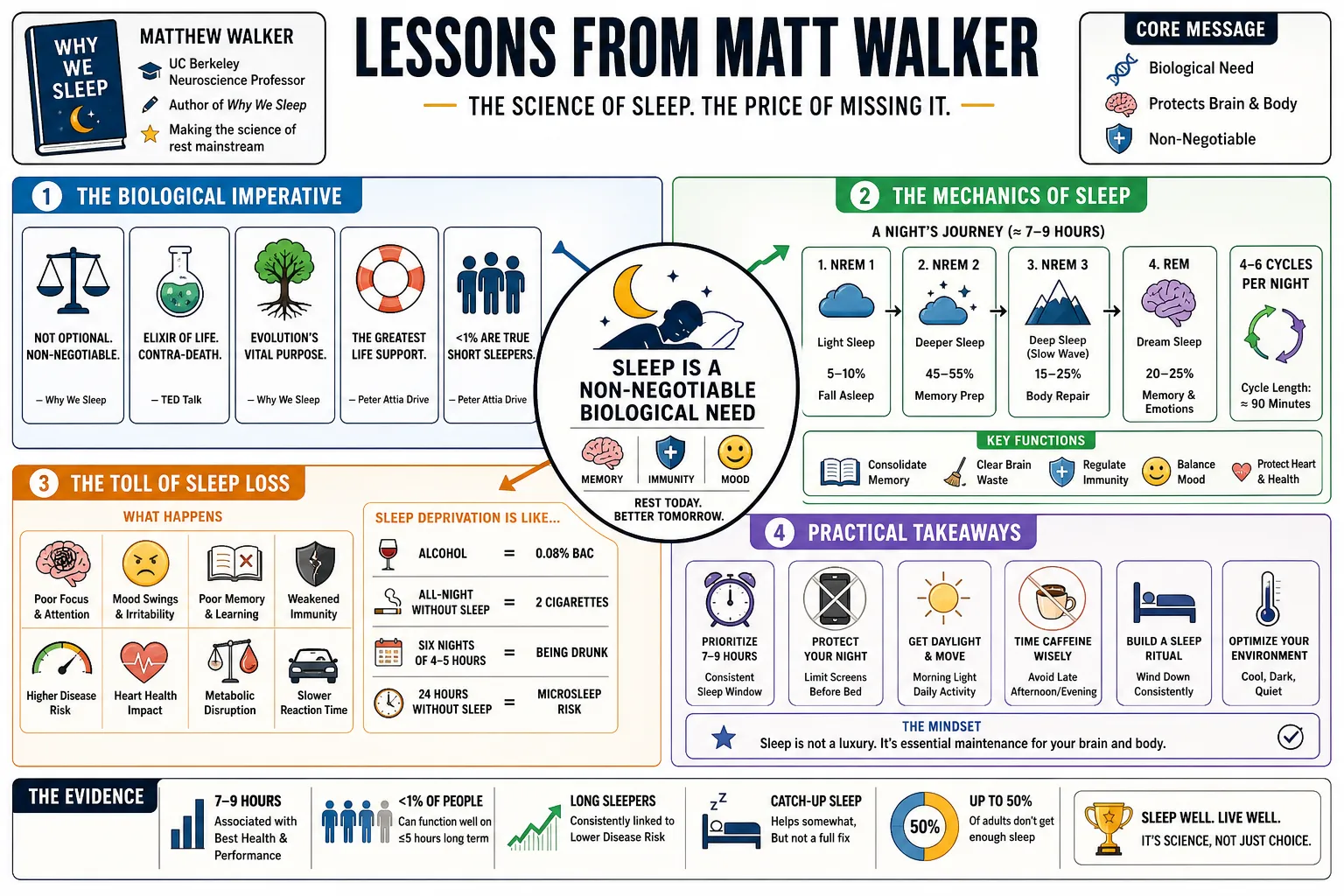
Lessons from Matt Walker
Matthew Walker is a UC Berkeley neuroscience professor whose book Why We Sleep made the science of rest mainstream. His research frames sleep as a non-negotiable biological need that regulates memory, immunity, and mood. This profile outlines his findings on the mechanics of sleep and the physical toll of missing it.
Part 1: The Biological Imperative of Sleep
- On non-negotiability: "Sleep is not an optional lifestyle luxury. Sleep is a non-negotiable biological necessity." — Source: Why We Sleep
- On the elixir of life: "Sleep is the single most effective thing we can do to reset our brain and body health each day—Mother Nature's best effort yet at contra-death." — Source: TED Talk
- On evolutionary purpose: "If sleep does not serve an absolutely vital function, then it is the biggest mistake the evolutionary process has ever made." — Source: Why We Sleep
- On sleep as life support: "Sleep is the greatest life support system you could ever wish for. It's a remarkable health insurance policy; it's democratic, free, and painless." — Source: The Peter Attia Drive
- On short sleepers: "The number of people who can survive on five hours of sleep or less without any impairment, expressed as a percent of the population, and rounded to a whole number, is zero." — Source: Why We Sleep
- On societal neglect: "The silent sleep loss epidemic is the greatest public health challenge we face in the twenty-first century in developed nations." — Source: Why We Sleep
- On performance enhancement: "Sleep is the greatest legal performance-enhancing drug that most people are probably neglecting." — Source: The Rich Roll Podcast
- On sleep banking: "Sleep is not like the bank. You cannot accumulate a debt and then hope to pay it off at a later point in time." — Source: Huberman Lab
- On biological reset: "There is no biological function that does not benefit from a good night's sleep." — Source: MasterClass
Part 2: Sleep and Memory Consolidation
- On preparing the brain: "Sleep before learning refreshes our ability to initially make new memories. It acts like hitting the 'save' button on those new files." — Source: TED Talk
- On the brain as a sponge: "Without adequate sleep, the memory circuits within the brain essentially become waterlogged, and you can't absorb new information." — Source: TED Talk
- On memory cement: "Sleep after learning is essential to take those new memories and cement them into the neural architecture of the brain." — Source: The Tim Ferriss Show
- On forgetting: "Sleep also helps us forget what we don't need, pruning away the neural connections that are no longer useful to make room for new ones." — Source: Why We Sleep
- On all-nighters: "Pulling an all-nighter cuts your ability to learn new facts by 40 percent, the difference between acing an exam and failing it miserably." — Source: Why We Sleep
- On physical memory: "Practice does not make perfect. It is practice, followed by a night of sleep, that leads to perfection." — Source: MasterClass
- On information transfer: "During deep sleep, memories are moved from a short-term vulnerability reservoir to a more permanent, safe storage site in the cortex." — Source: Huberman Lab
- On creativity: "REM sleep takes newly minted information and collides it with the back catalog of your life's experiences, sparking creative insights." — Source: The Joe Rogan Experience
- On problem solving: "We never say, 'Stay awake on a problem.' We say, 'Sleep on it,' because sleep fosters creative problem-solving." — Source: Why We Sleep
- On cognitive impairment: "Ten days of six hours of sleep a night was all it took to become as impaired in performance as going without sleep for twenty-four hours straight." — Source: Why We Sleep
Part 3: Emotional Regulation and Mental Health
- On emotional recovery: "The best bridge between despair and hope is a good night's sleep." — Source: Why We Sleep
- On psychiatric disorders: "There is no major psychiatric disorder we can find in which sleep is normal." — Source: The Peter Attia Drive
- On emotional reactivity: "When you are sleep-deprived, the emotional centers of your brain become up to 60 percent more reactive." — Source: TED Talk
- On overnight therapy: "REM sleep is the only time during the 24-hour period when your brain is completely devoid of the anxiety-triggering molecule noradrenaline." — Source: The Tim Ferriss Show
- On trauma processing: "Dreaming takes the sting out of a difficult, even traumatic, emotional episode experienced during the day." — Source: Why We Sleep
- On emotional brake pads: "A lack of sleep severs the connection between the prefrontal cortex—the CEO of the brain—and the amygdala, stripping away our emotional brakes." — Source: Huberman Lab
- On social interaction: "Sleep-deprived individuals feel more lonely and socially isolated, and they actively avoid close proximity to others." — Source: Why We Sleep
- On anxiety: "Sleep disruption is a symptom of anxiety, but it is also an instigator that fuels it." — Source: MasterClass
- On reading faces: "Without sufficient sleep, your brain loses its ability to accurately read subtle social and emotional facial expressions." — Source: The Joe Rogan Experience
- On mood stabilization: "We treat sleep as a passive state, but it is an active, demanding process of emotional recalibration." — Source: Feel Better, Live More
Part 4: The Physical Toll of Sleep Deprivation
- On lifespan: "The shorter your sleep, the shorter your life span." — Source: Why We Sleep
- On immunity: "Routinely sleeping less than six or seven hours a night demolishes your immune system, more than doubling your risk of cancer." — Source: Why We Sleep
- On natural killer cells: "Just one night of four hours of sleep sweeps away 70 percent of your natural killer cells, which are your body's immune assassins." — Source: TED Talk
- On cardiovascular risk: "Adults aged 45 years or older who sleep fewer than six hours a night are 200 percent more likely to have a heart attack or stroke in their lifetime." — Source: Why We Sleep
- On daylight saving time: "In the spring, when we lose one hour of sleep, we see a subsequent 24 percent increase in heart attacks the following day." — Source: TED Talk
- On weight gain: "Sleep loss disrupts the hormones that regulate appetite, making you crave sugary, heavy-carbohydrate foods." — Source: The Tim Ferriss Show
- On physical exertion: "Time to physical exhaustion drops by 10 to 30 percent when you operate on fewer than eight hours of sleep." — Source: The Rich Roll Podcast
- On insulin resistance: "A week of short sleep alters your body so significantly that your blood sugar levels would classify you as pre-diabetic." — Source: Huberman Lab
- On DNA damage: "Lack of sleep erodes the very fabric of biological life, altering the expression of over 700 genes." — Source: Why We Sleep
Part 5: Sleep and Longevity
- On Alzheimer's disease: "Inadequate sleep across the lifespan significantly raises your risk of developing Alzheimer's disease." — Source: The Peter Attia Drive
- On the brain's sewage system: "During deep sleep, the brain's glymphatic system kicks into high gear, clearing out metabolic toxins like amyloid beta." — Source: TED Talk
- On compounding damage: "The amyloid plaques that cause Alzheimer's specifically attack the regions of the brain that generate deep sleep, creating a vicious cycle." — Source: Why We Sleep
- On chronological aging: "You can measure the biological age of someone's brain simply by looking at the electrical quality of their deep sleep." — Source: Huberman Lab
- On midlife preservation: "Optimizing your sleep in midlife is one of the most effective preventative measures you can take against neurodegeneration later in life." — Source: The Tim Ferriss Show
- On reproductive health: "Men who routinely sleep five hours a night have testicles that are significantly smaller than those who sleep seven hours or more." — Source: TED Talk
- On testosterone: "Routine short sleeping ages a man by over a decade in terms of his testosterone levels." — Source: TED Talk
- On women's reproductive health: "Follicular-releasing hormone drops by 20 percent in women who sleep less than six hours a night, impacting fertility." — Source: Why We Sleep
- On the illusion of resilience: "We are biologically wired to be terrible judges of our own sleep deprivation." — Source: The Knowledge Project
- On biological reach: "No aspect of our biology is left unscathed by sleep deprivation. It sinks down into every possible nook and cranny." — Source: Why We Sleep
Part 6: The Mechanics of Sleep
- On sleep architecture: "Sleep is a complex, orchestrated cycle of deep non-REM and REM stages, each serving a distinct evolutionary purpose." — Source: MasterClass
- On sleep cycles: "Your brain cycles through 90-minute periods of non-REM and REM sleep, but the ratio shifts dramatically across the night." — Source: Huberman Lab
- On waking up early: "If you wake up at 6:00 a.m. instead of 8:00 a.m., you lose 25 percent of your total sleep, but you might lose 60 to 90 percent of your REM sleep." — Source: Why We Sleep
- On circadian rhythms: "Your circadian rhythm is an internal 24-hour clock that dictates your wakefulness and sleepiness, regardless of whether you actually sleep." — Source: Why We Sleep
- On chronotypes: "Night owls are naturally bound to a delayed schedule, an evolutionary trait that historically kept the tribe safe." — Source: The Joe Rogan Experience
- On adenosine: "Adenosine builds up in your brain every waking minute, creating sleep pressure that eventually forces you into slumber." — Source: Why We Sleep
- On deep sleep: "Deep non-REM sleep acts as the brain's data transfer mechanism, slowing down brainwaves to a steady, synchronized rhythm." — Source: The Peter Attia Drive
- On dreaming: "REM sleep is characterized by brain activity that looks almost identical to being awake, which is why dreams feel so real." — Source: MasterClass
- On muscle paralysis: "During REM sleep, your brain paralyzes your voluntary muscles to prevent you from physically acting out your dreams." — Source: Why We Sleep
Part 7: Disruptors
- On caffeine's deception: "Caffeine does not give you energy; it blocks the adenosine receptors in your brain, masking your true level of exhaustion." — Source: Why We Sleep
- On the half-life of caffeine: "Caffeine has a half-life of about six hours, meaning a quarter of that afternoon coffee is still circulating in your brain at midnight." — Source: TED Talk
- On alcohol as a sedative: "Alcohol is one of the most misunderstood sleep aids. It is no sleep aid at all; it is a class of drugs called sedatives." — Source: The Tim Ferriss Show
- On alcohol and REM: "Alcohol is one of the most potent suppressors of REM sleep that we know of, fragmenting your sleep architecture." — Source: Huberman Lab
- On memory blocking: "If you study all week and then get drunk on the weekend, you selectively erase the memories you spent the week trying to build." — Source: Why We Sleep
- On LED lights: "Exposure to LED screens before bed delays the release of melatonin by up to three hours, tricking your brain into thinking the sun hasn't set." — Source: The Rich Roll Podcast
- On sleeping pills: "Prescription sleep medications do not produce natural sleep; they act like a chemical blunt instrument that knocks out the higher cortex." — Source: Why We Sleep
- On marijuana: "While THC can reduce the time it takes to fall asleep, it significantly blocks REM sleep, leading to a state of emotional withdrawal over time." — Source: The Joe Rogan Experience
- On temperature: "Your body needs to drop its core temperature by about two to three degrees Fahrenheit to initiate and stay in deep sleep." — Source: TED Talk
Part 8: Actionable Protocols and Hygiene
- On the golden rule: "If there is one piece of advice I can offer, it is regularity: go to bed at the same time and wake up at the same time, no matter what." — Source: TED Talk
- On bedroom temperature: "Keep your bedroom cool. A target temperature of around 65 degrees Fahrenheit is optimal for the sleep of most people." — Source: Why We Sleep
- On darkness: "We are a dark-deprived society. Dim the lights in your home an hour before bed to signal to your brain that it is time to sleep." — Source: Feel Better, Live More
- On tossing and turning: "If you can't sleep for twenty minutes, get out of bed and do something relaxing until you feel sleepy. Don't let your brain associate the bed with wakefulness." — Source: Huberman Lab
- On winding down: "Sleep is not a light switch. It is more like landing a plane—your brain needs a runway to gradually descend into slumber." — Source: The Tim Ferriss Show
- On tracking sleep: "The best sleep tracker is the one that you use consistently without it causing you orthosomnia—anxiety about getting perfect sleep." — Source: The Peter Attia Drive
- On morning light: "Get natural sunlight in your eyes first thing in the morning. It anchors your circadian clock and sets you up for better sleep that night." — Source: The Knowledge Project
- On napping: "Naps can be fantastic for cognitive restoration, but avoid napping late in the afternoon, or it will act like a snack before a main meal." — Source: MasterClass
- On shifting perspective: "We need to stop seeing sleep as a cost of being awake, and start seeing it as the ultimate investment in our waking lives." — Source: The Rich Roll Podcast