Matthew Yglesias is a journalist, blogger, and author who focuses on economic policy, housing, and political strategy. He co-founded Vox and now writes the newsletter Slow Boring, where he argues that the United States should prioritize increasing the supply of housing, energy, and infrastructure to drive economic growth. This profile collects his specific insights on demographics, popularist messaging, and the mechanics of building a more abundant society.
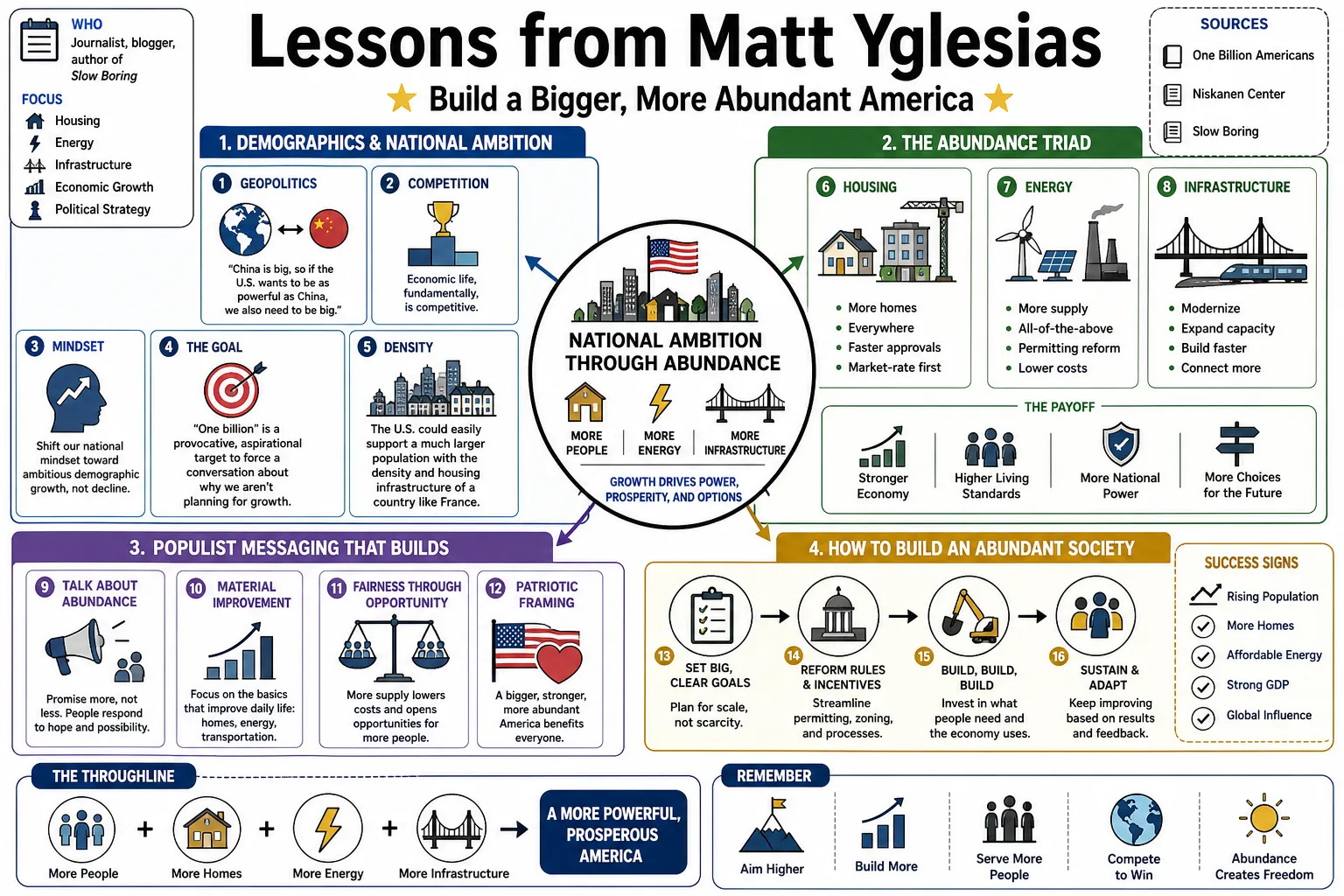
Part 1: Demographics and National Ambition
- On Geopolitics: "China is big, so if the U.S. wants to be as powerful as China, we also need to be big." — Source: One Billion Americans
- On Competition: "Economic life, fundamentally, is competitive." — Source: One Billion Americans
- On Mindset: The US needs to shift its national mindset toward ambitious demographic growth rather than managing decline. — Source: Niskanen Center
- On The Goal: The "one billion" figure is a provocative, aspirational target meant to force a conversation about why the US isn't planning for growth. — Source: Slow Boring
- On Density: The US could easily support a much larger population if it achieved the density and housing infrastructure of a country like France. — Source: One Billion Americans
- On Families: Making it easier and more affordable for Americans to have the number of children they actually want is a critical lever for national growth. — Source: Slow Boring
- On Immigration: High levels of immigration are a strategic asset that allows the United States to continually replenish its labor force and maintain global dominance. — Source: Vox
- On Brain Drain: Attracting the smartest and most ambitious people from around the world to study and work in the US is a massive, structural advantage. — Source: Slow Boring
- On Stagnation: Stagnation is a choice; the winner in the future world is going to have more ideas, more ambition, and more people. — Source: One Billion Americans
- On Infrastructure: A growing population requires committing to build the housing, transit, and educational infrastructure necessary to support it. — Source: The Atlantic
Part 2: Housing, Zoning, and YIMBYism
- On The Solution: "Housing policy isn't that complicated. If you want more affordable homes, make it legal to build more. If you don't, then don't." — Source: Slow Boring
- On Single-Family Zoning: "Single-family houses are great, single-family zoning is not. We need a world of choices." — Source: Slow Boring
- On Development Rights: Cities should establish by-right rules so that anyone can build a garage or an accessory dwelling unit without discretionary approval. — Source: Slow Boring
- On Economic Bottlenecks: Restrictive land-use regulations are a primary cause of housing shortages and a massive bottleneck on general economic prosperity. — Source: The Rent Is Too Damn High
- On Local Control: Local zoning authority is routinely weaponized by incumbent homeowners to block necessary housing supply. — Source: Slow Boring
- On Aesthetic Objections: While aesthetic complaints about new apartment buildings are often pretexts, they remain a significant political hurdle that reformers must navigate. — Source: The Argument
- On State Intervention: State-level governments must intervene to preempt restrictive local housing policies because municipalities fail to coordinate regional needs. — Source: Slow Boring
- On Planners: City planning departments often ignore basic supply and demand in favor of overly cautious mapping processes. — Source: Slow Boring
- On Vacancy: A well-functioning market requires a healthy inventory of housing, including a decent amount of vacancy, to keep costs in check. — Source: Slow Boring
- On Historic Preservation: Overly broad historic preservation laws often act as a backdoor method to freeze neighborhoods in amber and prevent new housing. — Source: Vox
Part 3: The Abundance Agenda and Supply-Side Progressivism
- On The Frame: The "abundance agenda" has real value as a conceptual frame to focus progressives on production rather than just redistribution. — Source: Niskanen Center
- On Environmental Review: Outdated environmental review processes often delay or kill the green energy projects necessary to combat climate change. — Source: Slow Boring
- On Building: The left has hit a dead end by focusing too much on legislative processes and not enough on the messy work of actual implementation and building. — Source: Slow Boring
- On Regulation: Progressives must shift from a default stance of blocking development to actively encouraging it through targeted deregulation. — Source: The Atlantic
- On Zero-Sum Thinking: Political debates too often assume a zero-sum economy, whereas an abundance mindset focuses on increasing the total amount of goods and services available. — Source: Slow Boring
- On Public Investment: Expanding the supply side of the economy requires serious public investment in areas like housing, energy, and transportation infrastructure. — Source: Vox
- On Implementation: The abundance community sometimes lacks fully sorted details on how to actually execute and implement its goals at the local level. — Source: Grant Mulligan
- On Energy: True energy abundance requires leaning into a mix of nuclear, solar, and wind, rather than just trying to curtail consumption. — Source: Slow Boring
- On Healthcare: Increasing the sheer supply of doctors and medical facilities is a more durable fix to healthcare costs than simply tweaking insurance subsidies. — Source: Slow Boring
- On Nuance: Abundance is not a one-size-fits-all solution; making housing abundant makes sense, but the same logic does not apply to harmful goods like alcohol or tobacco. — Source: Slow Boring
Part 4: Popularism and Political Strategy
- On Popularism: Political parties must prioritize policy positions and messaging that are broadly popular with the median voter rather than catering to ideological activists. — Source: Slow Boring
- On Tactics: While political tactics have a real impact, the effect size of any single campaign tactic is small, so candidates must constantly weigh if the juice is worth the squeeze. — Source: Slow Boring
- On Moderation: Democrats need more than just moderate candidates; they need a fundamentally more moderate ideology to win in the Electoral College. — Source: Boston Review
- On Activism: Catering to the demands of the online activist class often forces politicians into taking stances that alienate working-class and swing voters. — Source: Slow Boring
- On Persuasion: You cannot build a durable governing majority without actively trying to persuade people who currently disagree with you. — Source: Vox
- On Defunding the Police: Slogans that alienate the median voter on issues of public safety are politically disastrous and undermine broader progressive goals. — Source: Slow Boring
- On Pragmatism: Popularism is not a miracle solution for winning, but rather a framework for smarter, more conscious decision-making. — Source: Slow Boring
- On Asymmetry: Because of the structural biases of the US Senate and Electoral College, Democrats cannot afford to simply rely on turning out their base. — Source: Vox
- On Cultural Issues: Leaning heavily into niche cultural issues is a losing strategy compared to focusing on popular economic policies like minimum wage increases. — Source: Slow Boring
- On The Status Quo: Critics who view popularism as merely a defense of the status quo misunderstand that you have to win elections first before you can enact any structural change. — Source: The Nation
Part 5: Macroeconomics and Inflation
- On Voter Psychology: "Even if a wonk might say that 4 percent income growth and 2 percent inflation is the same as 10 percent income growth and 8 percent inflation, most people have a strong preference for the former." — Source: Slow Boring
- On Nominal Prices: Voters are highly sensitive to high nominal prices, which drives negative assessments of economic conditions regardless of real wage gains. — Source: Slow Boring
- On Greedflation: Inflation surged because of excess demand that outpaced the country's productive capacity, not primarily because of corporate price gouging. — Source: Slow Boring
- On Stimulus Constraints: Democrats were right to run the economy hot, but erred by imposing cost-inflating mandates that constricted the supply side as a condition for subsidies. — Source: Slow Boring
- On Deficits: Running large budget deficits during times of economic expansion carries real inflationary risks that many center-left economists were too quick to dismiss. — Source: Slow Boring
- On Central Banks: Relying solely on central banks to crush demand via high interest rates is a painful and inefficient way to manage inflation compared to expanding supply. — Source: Vox
- On Unemployment: The hydraulic view of monetary policy, where the Fed must raise unemployment to curb demand, often ignores the role of forward-looking expectations. — Source: Slow Boring
- On Minimum Wage: Raising the minimum wage is good policy, but it is not a substitute for robust macroeconomic management that ensures a tight labor market. — Source: Slow Boring
- On Free Trade: Tariffs and trade wars act as a tax on consumers and introduce unnecessary inflationary pressure into the domestic economy. — Source: Vox
Part 6: Blogging and the Internet Media
- On Consistency: The key to success in online content creation is regularity, rather than relying solely on novelty or viral hits. — Source: Slow Boring
- On The Internet's Appetite: The internet creates an insatiable demand for content, heavily rewarding writers who can produce pretty good articles in a short span of time. — Source: Substack
- On Negativity: The internet's demand for engagement has contributed to a rise in media negativity because outrage drives clicks more reliably than sober analysis. — Source: Slow Boring
- On Tech Platforms: The shift to newsletter models allows writers to create content that is not strictly driven by algorithms or tech-platform fads. — Source: Slow Boring
- On Politics Online: The internet has fundamentally altered politics by warping political perceptions through extremely online discourse that does not reflect the broader public. — Source: Marginal Revolution
- On Making Mistakes: The modern policy blogger must be willing to navigate intense criticism, publicly track their own predictions, and openly acknowledge when they are wrong. — Source: Noahpinion
- On Writing Style: A direct, plain-spoken style is vastly superior to academic jargon when the goal is to reach and persuade a broad audience. — Source: Vox
- On Media Economics: While technology has made the distribution of journalism cheaper, it has simultaneously made it harder to monetize at scale. — Source: Slow Boring
- On AI: While a long-time proponent of the web, the broken promises of social media require a more skeptical approach to the current technological trajectory of artificial intelligence. — Source: Slow Boring
Part 7: The Philosophy of Journalism and "Slow Boring"
- On Slow Boring: Politics and policy work is a "slow boring of hard boards" that requires steadfastness of heart rather than just performative outrage. — Source: Slow Boring
- On Real Progress: True political progress is often incremental and difficult, demanding passion and perspective in equal measure. — Source: Slow Boring
- On Audience Capture: A major flaw in modern journalism is the tendency to write articles that primarily serve to flatter the reader's existing prejudices. — Source: Slow Boring
- On Independence: Newsletter platforms offer a space to write independently without the pressures of a traditional newsroom or the constraints of virality-driven media. — Source: Slow Boring
- On Granularity: Effective policy journalism must be deeply engaged with the mundane, workaday aspects of public administration rather than just high-level ideology. — Source: Washington Post
- On Punditry: Good punditry requires placing specific policy debates into a broader, synthesized framework of how the world actually works. — Source: Vox
- On Contrarianism: Taking a contrarian stance is only valuable if it is rooted in data and a genuine attempt to find the truth, not just for the sake of being different. — Source: Slow Boring
- On Expertise: Journalists should defer to empirical evidence while remaining skeptical of experts who stray beyond their domain into subjective political judgments. — Source: Slow Boring
- On the Media Bubble: Mainstream newsrooms often suffer from a severe ideological bubble that blinds them to how policies are received by the general public. — Source: Slow Boring
Part 8: Pragmatism and Institutional Reform
- On the Filibuster: The Senate filibuster is an anti-democratic relic that paralyzes the legislative process and prevents the party in power from governing. — Source: Vox
- On Democratic Institutions: The US Constitution's design often leads to gridlock, making it exceptionally difficult to enact sweeping changes even with a mandate. — Source: Vox
- On Federalism: While federalism allows for local experimentation, it often creates a race to the bottom or allows local vetoes to block national priorities. — Source: Slow Boring
- On State Capacity: The decline of state capacity in the US makes it harder for the government to execute basic infrastructure projects efficiently. — Source: Slow Boring
- On the Supreme Court: Relying on the judiciary to achieve policy victories is a fragile strategy compared to building durable legislative majorities. — Source: Slow Boring
- On the Presidency: The American political system places too much emphasis on the presidency, ignoring the reality that most day-to-day governance happens at the state and local level. — Source: Vox
- On Public Unions: Public sector unions often negotiate rules that protect low performers and make it impossible for governments to manage their own agencies effectively. — Source: Slow Boring
- On Incrementalism: Refusing to accept half-loaves in politics is a recipe for starvation; pragmatic, incremental gains are how society actually moves forward. — Source: Slow Boring