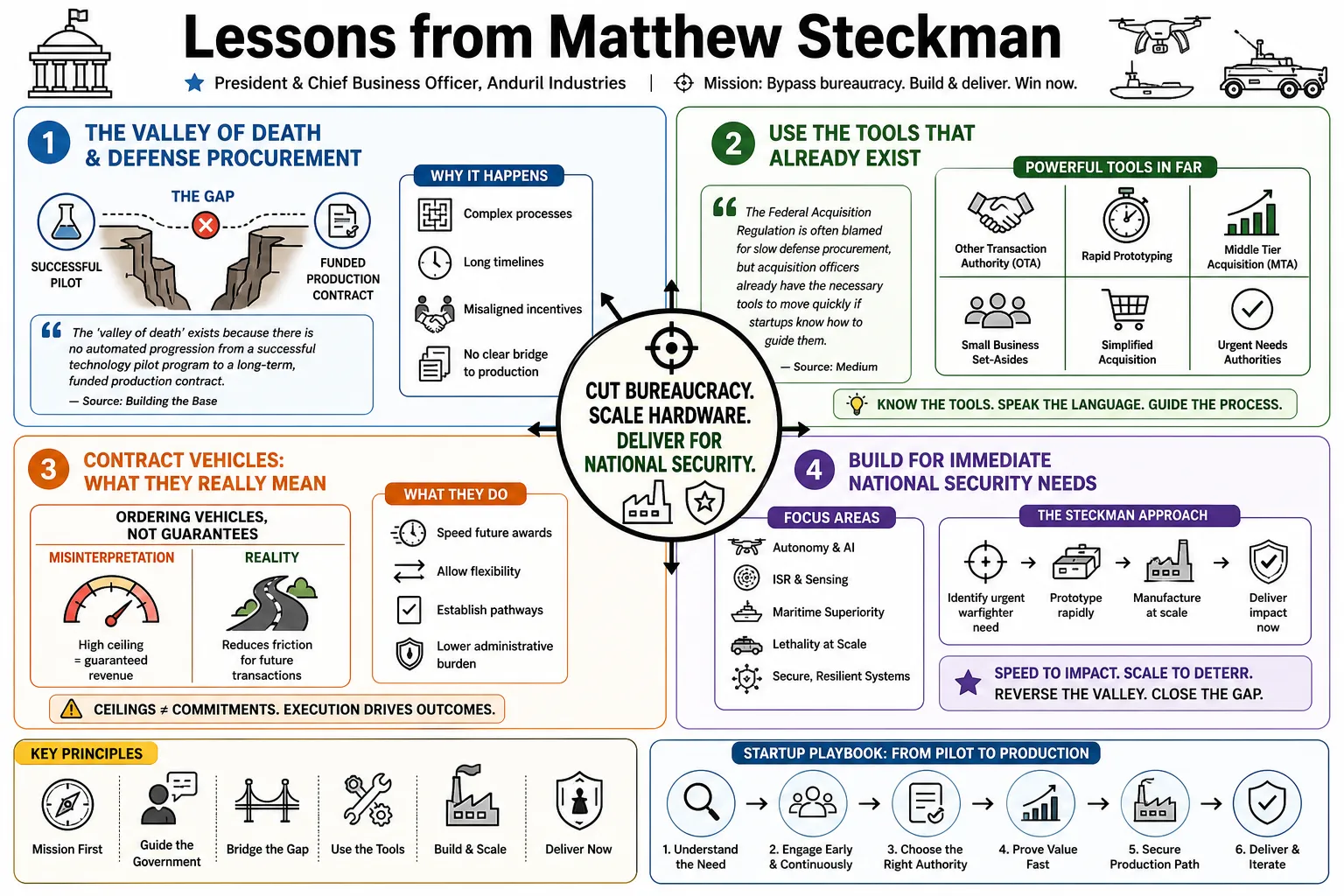
Lessons from Matthew Steckman
Matthew Steckman is the President and Chief Business Officer of Anduril Industries, where he helped scale a defense startup into a major prime contractor. After managing revenue at Palantir and Zipline, he now focuses on bypassing slow procurement cycles to manufacture hardware at scale. The insights below outline his approach to cutting through government bureaucracy, securing contracts, and building technology for immediate national security needs.
Part 1: The Valley of Death and Defense Procurement
- On the procurement gap: "The 'valley of death' exists because there is no automated progression from a successful technology pilot program to a long-term, funded production contract." — Source: Building the Base
- On government acquisition tools: "The Federal Acquisition Regulation is often blamed for slow defense procurement, but acquisition officers already have the necessary tools to move quickly if startups know how to guide them." — Source: Medium
- On contract vehicle misunderstandings: "Large top-line contract ceilings are often misinterpreted as guaranteed revenue; they are actually ordering vehicles that simply reduce the friction of future transactions." — Source: Business Insider
- On solving the right problem: "Startups must identify specific capability gaps that the government desperately needs to solve but cannot address through its traditional defense contractors." — Source: Tectonic Defense
- On recompeting contracts: "The Department of Defense could drastically improve access for new entrants by recompeting existing programs more frequently rather than defaulting to legacy providers." — Source: Acquisition Talk
- On funding flexibility: "A major barrier to rapid technology adoption is the inability of defense agencies to move large sums of money dynamically within the same fiscal year." — Source: Acquisition Talk
- On guiding the buyer: Steckman’s government-market lesson is that great technology still has to be packaged so the buyer can buy it; defense startups need buyer fit as much as product fit. — Reference: Building the Base transcript on buyer fit in government markets
- On pilot purgatory: Steckman’s pattern is to bring enough self-funded product to prove fit, then work with creative government counterparts to turn a promising capability into a buyable program. — Reference: Building the Base transcript on self-funded product development
- On winning categories: "Within specific defense categories, there might only be one or two major programs of record; capturing them is essential for the survival of a defense startup." — Source: Business Insider
- On shifting the burden: "The traditional defense model shifts R&D costs to the taxpayer, whereas a commercially viable defense sector requires the company to bear the development cost." — Source: Anduril News
Part 2: Scaling Operations and Manufacturing
- On manufacturing bottlenecks: "The primary constraint in modern defense technology is not software development, but the ability to rapidly manufacture high-mix hardware at scale." — Source: Building the Base
- On commercial components: Anduril’s manufacturing approach leans on commercial components and flexible production lines so defense hardware can scale despite uneven demand forecasts. — Reference: Building the Base notes on commercial components and manufacturing flexibility
- On centralized production: "Managing demand unpredictability requires centralizing manufacturing facilities, which allows a company to shift resources between product lines as government orders fluctuate." — Source: Building the Base
- On speed as a metric: In defense hardware, speed shows up as integration velocity: how quickly a company can replace components and keep a system useful as threats and requirements move. — Reference: Defense Mavericks notes on integration and replacement velocity
- On capital intensity: "Scaling hardware production for military use requires massive upfront capital expenditure before a single system is delivered to the government." — Source: Tectonic Defense
- On continuous iteration: "Manufacturing lines must be designed to accept constant software and hardware updates, avoiding the lock-in of decade-old designs typical of legacy systems." — Source: Anduril News
- On supply chain resilience: Steckman’s manufacturing lesson is to design for variable demand and component flexibility, because defense production has to absorb uncertainty without freezing the roadmap. — Reference: Building the Base notes on manufacturing strategy
- On managing growth: "Rapid growth in a manufacturing environment is dangerous without strict operational discipline; success requires controlling dozens of variables simultaneously." — Source: Medium
- On the Arsenal strategy: "Building large, modular manufacturing plants allows a defense company to adapt to sudden surges in military demand without needing to build new infrastructure from scratch." — Source: Tectonic Defense
Part 3: Private Capital and Risk Tolerance
- On internal R&D: "Putting private capital into developing defense systems before any formal competition exists is highly risky, but betting correctly gives the company an insurmountable head start." — Source: Business Insider
- On anticipating budgets: "A successful defense tech company acts like a commercial tech company, taking financial risks to build products roughly two years before government budgets explicitly call for them." — Source: Tectonic Defense
- On cost-plus contracts: Steckman’s broader contracting point is that defense companies often have to invent business models around unit cost, sustainment, and software updates so the government can buy modern products cleanly. — Reference: Building the Base transcript on defense business-model invention
- On venture capital in defense: Anduril began when many venture firms still avoided defense; Steckman frames the later shift in capital as part of a broader strategic change, not a substitute for execution. — Reference: Building the Base transcript on the shift in defense venture capital
- On risk sharing: "Matching government funding with private capital on joint development projects proves to the customer that the company has genuine skin in the game." — Source: Anduril News
- On capital as a weapon: "Having access to a large balance sheet allows a startup to survive long procurement cycles that would normally starve a smaller, undercapitalized firm." — Source: Business Insider
- On early failure: "If a privately funded prototype fails early, the company absorbs the cost and pivots quickly, rather than wasting years of taxpayer money on a doomed program." — Source: Acquisition Talk
- On valuing speed over perfection: "The government often pays traditional contractors to eliminate all risk; private capital allows startups to deliver an 80% solution immediately and improve it iteratively in the field." — Source: Building the Base
- On acquisition strategy: "Utilizing private capital to acquire adjacent technology companies allows a prime to integrate new capabilities faster than developing them internally." — Source: Tectonic Defense
- On founder mentality: Defense founders need more than technical confidence; Steckman’s framing emphasizes grit, risk tolerance, and the ability to operate through chaos with very high stakes. — Reference: Defense Mavericks notes on grit and defense-startup risk
Part 4: Go-to-Market Strategy in Defense
- On the wide-not-deep strategy: "Rather than relying on a single niche software application, a defense prime must build a broad product portfolio to address multiple segments of the market simultaneously." — Source: Building the Base
- On selling to users vs. buyers: In federal markets, the operator and the buyer are often different people, so the company has to win user relevance and procurement reality at the same time. — Reference: Building the Base transcript on product fit and buyer fit
- On establishing monopolies: "In specific defense hardware categories, there are only a handful of viable contracts; companies must strategize to win those categories outright rather than settling for minor market share." — Source: Business Insider
- On pricing for adoption: Steckman’s adoption lesson is to make the offer understandable: unit cost, sustainment, and ongoing upgrades need to be clear enough for government buyers to act. — Reference: Building the Base transcript on unit-cost hardware and sustainment
- On the first major contract: "Securing the first true program of record is the hardest milestone for a defense startup, but it serves as the ultimate validation that unlocks adjacent market opportunities." — Source: Acquisition Talk
- On geographic expansion: Steckman’s role points to defense growth as a portfolio and market-access problem: domestic programs matter, but international and security-services expansion require careful strategic direction. — Reference: GovCon Wire on Steckman’s Anduril role and strategic direction
- On product demonstrations: "Powerpoint presentations do not sell defense technology; getting physical hardware into a realistic operational environment is the only way to build customer trust." — Source: Tectonic Defense
- On finding the right champion: New defense technology often needs a creative government counterpart who understands the mission value and can help translate it into a workable acquisition path. — Reference: Building the Base transcript on creative government counterparts
- On pacing the market: "A company can build the best technology in the world, but if they cannot time their sales motion to align with the government's budget cycle, they will run out of cash." — Source: Medium
Part 5: Hardware and Software Integration
- On software-defined hardware: "The future of defense relies on hardware that serves primarily as a vessel for continuously updated, intelligent software, rather than hardware that degrades in utility over time." — Source: Anduril News
- On the integration tax: Steckman warns that underestimating service integration destroys trust; defense products have to fit into the customer’s operational system, not just work in isolation. — Reference: Building the Base transcript on integration into the service
- On edge computing: "Autonomous defense systems require heavy compute power at the tactical edge, because bandwidth in contested environments is too constrained to rely on cloud processing." — Source: Building the Base
- On open architectures: "Building systems with open software architectures ensures that third-party applications and sensors can be rapidly integrated without needing permission from the original manufacturer." — Source: Tectonic Defense
- On modularity: The defensible modularity lesson is speed of replacement: defense systems need architectures and manufacturing practices that let components change as requirements shift. — Reference: Defense Mavericks notes on replacing system components
- On testing environments: Steckman’s testing lesson is that modeling and simulation matter because defense systems must be evaluated at scale before they can be trusted in battlefield conditions. — Reference: Defense Mavericks notes on modeling and simulation for battlefield readiness
- On hardware obsolescence: "Traditional defense hardware is obsolete the day it is fielded; software-defined systems become more capable every time they connect to a network." — Source: Medium
- On data dominance: "The true value of a defense hardware network is the aggregated data it collects, processes, and pushes to commanders in real-time to close the kill chain." — Source: Acquisition Talk
- On user interfaces: The product has to be legible to the buyer and operator: Steckman describes selling systems that do an understandable job, with clear sustainment and continued software improvement. — Reference: Building the Base transcript on understandable defense products
- On autonomous teaming: "The most complex integration challenge is not making one drone fly autonomously, but making dozens of distinct hardware assets communicate and act as a unified swarm." — Source: Building the Base
Part 6: Navigating Bureaucracy and Culture
- On facility clearances: "Obtaining facility security clearances is a circular problem for startups; you need a clearance to win a contract, but you need a contract to get the clearance." — Source: Medium
- On bureaucratic risk aversion: "The DoD culture inherently punishes failure much more severely than it rewards success, making it entirely rational for acquisition officers to stick with legacy primes." — Source: Acquisition Talk
- On urgency: "The most successful defense startups operate with an extreme sense of urgency, recognizing that national security timelines cannot accommodate standard corporate lethargy." — Source: Anduril News
- On regulatory capture: Steckman’s more grounded point is about acquisition friction: reforms rarely remove every obstacle, but each cycle can make it easier for program managers to use new authorities. — Reference: Building the Base notes on acquisition reform reducing friction
- On hiring talent: "Bringing commercial tech talent into the defense sector requires convincing them that building systems for national security is a more meaningful mission than optimizing ad clicks." — Source: Tectonic Defense
- On bridging the divide: Steckman’s career sits at the boundary between technology and government; the operator has to understand both the technical system and the institutional path to deployment. — Reference: Building the Base transcript on technology-government translation
- On managing expectations: "Every day involves reacting to a new interpretation of how the government wants to move fast, requiring constant adaptation from the startup's operational team." — Source: Acquisition Talk
- On the compliance burden: "Security and compliance are not optional in defense tech; startups must build robust internal controls from day one or they will be locked out of the market entirely." — Source: Building the Base
- On persistence: "There is no magic bullet for breaking into the defense market; it requires relentless, grinding execution across dozens of distinct problem sets simultaneously." — Source: Medium
Part 7: Lessons from Palantir and Zipline
- On enterprise deployments: Steckman’s Palantir-to-Anduril background reinforces a deployment lesson: complex government software work requires integration discipline, not just a strong product demo. — Reference: 20VC notes and Building the Base transcript on Palantir background and software integration
- On demonstrating reliability: "Zipline proved that autonomous drone delivery could operate at massive scale with high reliability, a standard of execution that directly translates to defense logistics." — Source: Building the Base
- On regulatory navigation: Steckman’s path through Zipline, Palantir, and Anduril gives him a repeat pattern: hard regulated markets reward operators who can connect product, operations, and institutional constraints. — Reference: GovCon Wire on Steckman’s Zipline, Palantir, and Anduril roles
- On the limits of software: "Selling data analytics software teaches a company that software alone cannot solve physical world problems without the right hardware to collect and act on the data." — Source: Tectonic Defense
- On customer operations: Customer operations in defense start with service reality: the company has to understand how the technology fits into the mission, or the buyer will not trust the solution. — Reference: Building the Base transcript on understanding the service problem
- On scaling physical operations: "Expanding hardware operations globally requires a deep understanding of local logistics, maintenance, and supply chain constraints, lessons highly applicable to military deployments." — Source: Building the Base
- On building trust: Trust comes from demonstrating that you understand the mission and integration burden; otherwise the buyer sees a vendor outside the problem rather than a partner solving it. — Reference: Building the Base transcript on trust and service integration
- On revenue predictability: "Transitioning from volatile pilot revenue to predictable enterprise contracts requires a fundamental shift in how a sales organization is structured and incentivized." — Source: Acquisition Talk
- On mission alignment: "Startups that succeed in government contracting are those where the entire employee base genuinely believes in the mission impact of the technology they are building." — Source: Medium
Part 8: The Future of Autonomous Systems
- On asymmetric warfare: Steckman’s 20VC discussion frames defense competition around the changing future of war, drones, and the scale required to win major military programs. — Reference: 20VC episode notes on drones and the future of war
- On counter-UAS capabilities: Counter-drone capability is a system problem: the harder work is integrating detection, decisioning, and response into a kill chain that can operate at defense speed. — Reference: Defense Mavericks notes on kill-chain integration
- On the role of the operator: "The goal of autonomy is to remove humans from the loop of mundane tasks so they can focus on high-level command and control." — Source: Building the Base
- On underwater autonomy: "Developing autonomous systems for the maritime domain presents unique engineering challenges regarding communication, pressure, and endurance that software alone cannot solve." — Source: Anduril News
- On scaling autonomy: "True military advantage will come from the ability to manufacture and deploy thousands of low-cost autonomous systems rapidly, rather than relying on a handful of specialized assets." — Source: Tectonic Defense
- On ethical deployment: The supported takeaway is that Steckman treats the ethics of Anduril’s products as a serious defense-policy question, tied to how the company thinks about war, mission, and customer use. — Reference: 20VC episode notes on ethics and Anduril product use
- On attritable assets: "The military must adopt the concept of attritable hardware—systems that are cheap enough to lose in combat without devastating the broader operational budget." — Source: Acquisition Talk
- On sensor fusion: The stronger sourced lesson is system integration: autonomous defense systems become useful when sensing, interpretation, and response are connected into one operational picture. — Reference: Defense Mavericks notes on system-level kill-chain integration
- On the software arms race: "The future of global security will not be decided by who has the most steel, but by who can deploy the most capable, adaptable artificial intelligence to the tactical edge." — Source: Medium