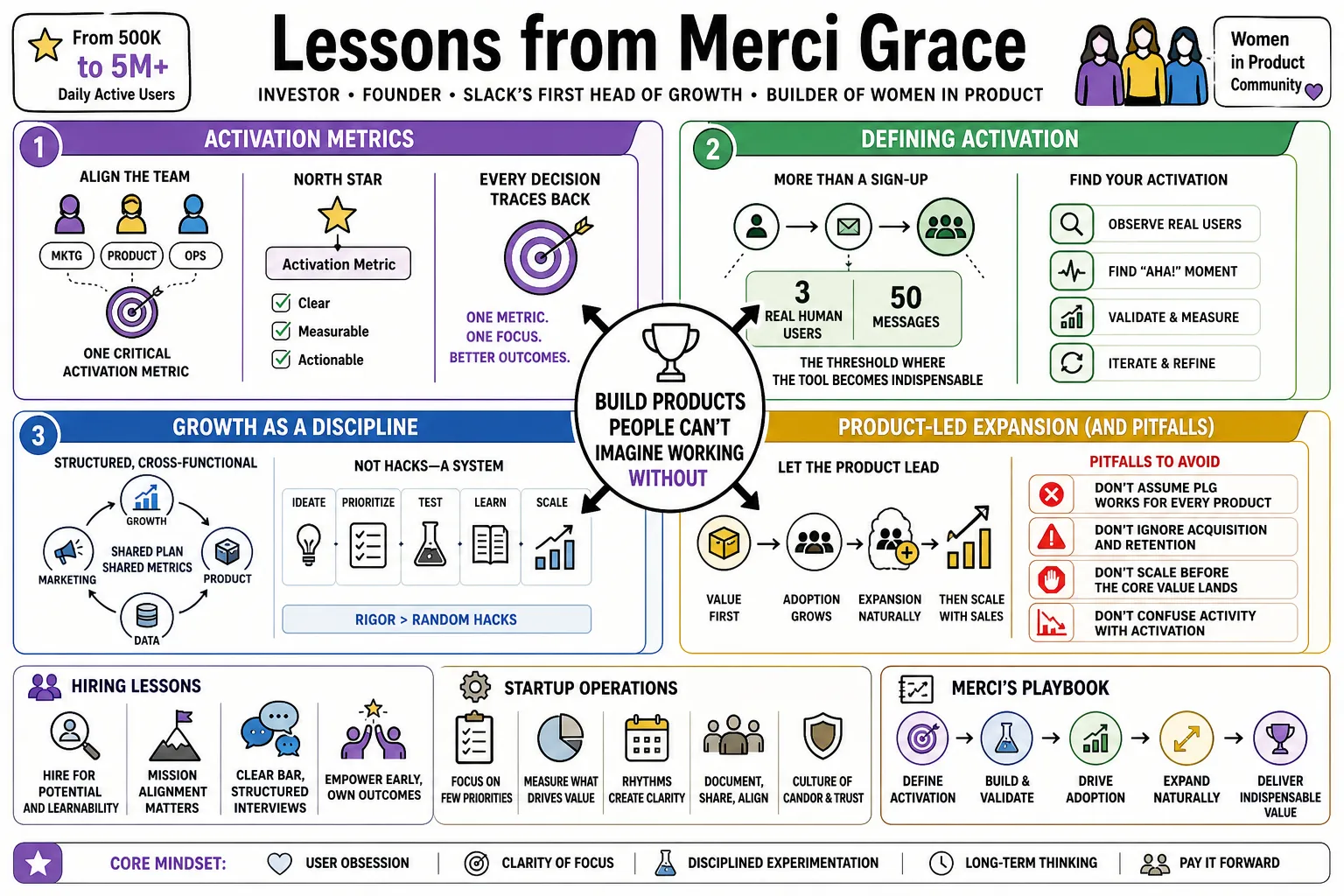
Lessons from Merci Grace
Merci Grace is an investor and founder best known as Slack’s first Head of Growth, where she grew the user base from 500,000 to over five million daily active users. She helped establish early standards for product-led growth and activation, and later created the Women in Product community for female operators. This collection gathers her straightforward advice on hiring, startup operations, and building software companies.
Part 1: Product-Led Growth and Activation
- On Activation Metrics: "Align the entire team, including marketing and product, around a single, critical activation metric rather than isolated goals." — Source: [Daytona]
- On Defining Activation: "Activation is more than a sign-up; for Slack, it was three real human users and 50 messages, the exact threshold where a dedicated tool becomes indispensable over email." — Source: [Liminary]
- On Growth as a Discipline: "Growth should be a structured, cross-functional effort instead of a disorganized set of hacks." — Source: [It Shipped That Way]
- On Product-Led Expansion: "Allow the product to drive its own adoption and expansion before relying heavily on traditional sales motions at early stages." — Source: [Lenny's Newsletter]
- On the Pitfalls of PLG: "Do not assume PLG means zero sales; it means your product creates the pipeline that your sales team ultimately closes." — Source: [Lenny's Newsletter]
- On Finding the North Star: "Focus on activation and deep engagement metrics rather than vanity numbers like total top-of-funnel sign-ups." — Source: [OpenView Partners]
- On Evaluating Growth Teams: "A successful growth team operates like a scientific organization, testing hypotheses rigorously rather than throwing spaghetti at the wall." — Source: [Lenny's Newsletter]
- On Growth Stages: "The growth strategy that works for a 25-person startup will not be the same one you need when you reach 500 employees." — Source: [It Shipped That Way]
- On Cross-Functional Alignment: "You cannot unlock exponential growth if product and marketing are fighting over who gets credit for a user." — Source: [Daytona]
- On Product Value: "Growth tactics only amplify what is already there; if the core product lacks value, no amount of optimization will save it." — Source: [Maven]
Part 2: Team Building and Hiring
- On Early Hires: "When building a young team, promoting from within, particularly someone who already deeply understands the customer, is often more effective than hiring specialized PMs from outside." — Source: [It Shipped That Way]
- On Big Tech Transfers: "Hiring a PM from a massive tech company can be a mistake for early startups, as they are used to turning small knobs on mature products, whereas early stages require building from scratch." — Source: [It Shipped That Way]
- On Assessing Motivation: "Look for deep intrinsic motivation in builders. They shouldn't be motivated by sounding like a CEO, but by a genuine desire to solve problems for users." — Source: [Her Story Created]
- On Hiring Sales: "When integrating sales into a product-led motion, hire people who are comfortable navigating ambiguity and collaborating deeply with product." — Source: [Lenny's Newsletter]
- On the People-to-Problems Ratio: "Optimize your career for situations where there are many problems to solve but too few people to solve them, as this offers the highest learning potential." — Source: [Statsig]
- On Building Diversity: "Maintaining a balanced gender ratio on a large growth team requires absolute intentionality from the very first hire." — Source: [Medium]
- On Interviewing PMs: "Ask candidates to explain something complicated they recently learned, because it reveals their ability to distill information and communicate clearly." — Source: [Lenny's Newsletter]
- On Team Composition: "A great growth team is a carefully balanced mix of analytical minds, creative problem solvers, and empathetic researchers." — Source: [Lenny's Newsletter]
- On Internal Talent: "The person answering support tickets often has a better grasp of the product's gaps than a newly hired executive." — Source: [It Shipped That Way]
- On Founder Resilience: "Everyone gets knocked down, but the winners are simply those who get up one more time than they are knocked down." — Source: [Her Story Created]
Part 3: Product Management Philosophy
- On The PM Role: "The role of a product manager or designer is similar to that of a thoughtful host anticipating the needs of their guests." — Source: [Medium]
- On Avoiding Fads: "Be wary of blindly copying competitor features; what works for their specific user base may not translate to yours." — Source: [UX Design]
- On Product Operations: "Product Ops is essentially product management for product managers, creating shared systems so PMs can spend less time on coordination." — Source: [Liminary]
- On Managing Complexity: "As a product scales, the PM's job shifts from adding features to rigorously defending the product against unnecessary complexity." — Source: [Productboard]
- On Storytelling: "A product manager must be an exceptional storyteller, because if you cannot articulate the narrative of why a feature matters, the team will not build it well." — Source: [Lenny's Newsletter]
- On Zero-to-One: "When thinking through product fundamentals, rigidly focus on four pillars: core product, business model, positioning, and first customers." — Source: [Notion]
- On Empathy: "Product management is an exercise in applied empathy where you have to literally feel the friction your user feels." — Source: [Medium]
- On Prioritization: "Saying no is the default state of a strong product manager; you only say yes when the evidence is overwhelming." — Source: [Lenny's Newsletter]
- On Feedback Loops: "Tighten the loop between shipping a feature and hearing directly from the person who uses it." — Source: [Productboard]
- On Continuous Delivery: "Shipping isn't the end of the process; it is merely the beginning of learning what you actually built." — Source: [It Shipped That Way]
Part 4: Leadership and Company Culture
- On Vulnerability: "Foster honesty and improve team dynamics by using personal user manuals to help teammates understand how best to work with you." — Source: [Sebastien Phlix]
- On Managing Up: "Strong PMs are self-aware and capable of managing up by actively cultivating a growth mindset within their teams." — Source: [Medium]
- On Building Culture: "Culture is not what you write on the wall; it is strictly defined by the behaviors you reward and the behaviors you tolerate." — Source: [Her Story Created]
- On Cross-Functional Trust: "You cannot mandate trust across engineering, product, and design; you have to build it manually through shared wins and transparent post-mortems." — Source: [CPO Club]
- On Leadership Transitions: "Moving from an individual contributor to a leader requires you to stop trying to solve the problem yourself and start building the machine that solves it." — Source: First Round Review
- On Transparent Communication: "When things are broken, explicitly say they are broken, because obscuring failure denies the team the opportunity to learn from it." — Source: [Medium]
- On Psychological Safety: "People will not propose bold ideas if they feel they will be professionally punished for being wrong." — Source: [Medium]
- On Setting Vision: "A leader's most vital job is repeating the vision so often that they are genuinely sick of hearing themselves say it." — Source: [Lenny's Newsletter]
- On Navigating Ambiguity: "Early-stage leadership is fundamentally about making high-conviction decisions with low-quality data." — Source: [Intro]
Part 5: Understanding the Customer
- On Real vs. Mythical Personas: "Stop designing for abstract profiles. True product insight comes from obsessing over real customers and observing their actual behaviors." — Source: [OpenView Partners]
- On Non-Users: "Seek insights from non-users to understand the real barriers to adoption, as the people who churned hold the answers you need." — Source: [Daytona]
- On Customer Interviews: "Do not ask customers what they want; ask them to walk you through how they currently solve their problem." — Source: [Growth Mentor]
- On Behavioral Data: "What customers say they do and what the analytics show they do are often two entirely different things, so always trust the behavior." — Source: [Daytona]
- On Uncovering Needs: "The best insights come from the edge cases, specifically the users who are hacking your product to do something it wasn't designed for." — Source: [Maven]
- On the Value of Support Tickets: "Read support tickets religiously because they are the unfiltered truth about where your product falls short." — Source: [It Shipped That Way]
- On Market Context: "Understand the specific environment in which your customer is using the product, because mobile behavior differs wildly from desktop behavior." — Source: [Medium]
- On Customer Pain: "If the pain isn't acute enough, your solution will not be adopted, no matter how elegant the interface is." — Source: [OpenView Partners]
- On Continuous Discovery: "Customer research is not a project phase you complete; it is a continuous habit you must maintain indefinitely." — Source: [Growth Mentor]
Part 6: Venture Capital and Investing
- On Evaluating Founders: "I look for founders who possess a deep, almost irrational need to see their specific solution exist in the world." — Source: [Her Story Created]
- On The Pitfalls of Fundraising: "Do not treat a funding round as a finish line; it is merely the starting gun for higher expectations." — Source: [It Shipped That Way]
- On Market Timing: "You can be completely right about the product and the market, but if you are wrong about the timing, you still fail." — Source: [Podnews]
- On Assessing Pitch Decks: "The best pitches avoid merely selling a vision; they clearly articulate the structural advantage that makes the vision inevitable." — Source: [Substack]
- On Cap Table Hygiene: "Founders need to be ruthlessly protective of their equity in the early days, as giving away too much early on restricts future flexibility." — Source: [It Shipped That Way]
- On Investor-Founder Fit: "Choose investors based on how they behave when things are going poorly, rather than how they act during the honeymoon phase." — Source: First Round Review
- On Operational Experience: "Having been an operator gives an investor a visceral understanding of the daily operational drag that founders face." — Source: [Podscripts]
- On Market Size: "Venture scale requires a market massive enough to forgive the inevitable early execution mistakes." — Source: [Podnews]
- On Mentorship vs. Meddling: "A good board member inherently knows the difference between asking probing questions and trying to run the company themselves." — Source: [Substack]
Part 7: Onboarding and Early Stage Strategy
- On Day Zero Value: "Avoid relying on heavy UI elements like carousels. Instead, strive for day zero value where the product teaches itself through native, high-value experiences." — Source: [Liminary]
- On Reducing Friction: "Every extra step in your onboarding flow halves your conversion rate, so be brutal about cutting non-essential friction." — Source: [Lenny's Newsletter]
- On First Impressions: "The first five minutes of a user's experience determine whether they will give you a second chance at all." — Source: [Productboard]
- On Willingness to Pay: "Test your willingness-to-pay frameworks early; if you wait until the product is fully built to figure out pricing, you are flying blind." — Source: [Maven]
- On Blank States: "An empty dashboard is intimidating. You must provide templates, populated data, or immediate actionable steps to guide new users." — Source: [Liminary]
- On Progressive Disclosure: "Do not overwhelm the user with every feature at once; reveal complexity only as they demonstrate mastery of the basics." — Source: [UX Design]
- On Aha Moments: "Identify the exact action that correlates with long-term retention, and engineer your entire onboarding flow to get users to that moment as quickly as possible." — Source: [Daytona]
- On Early Stage Scrappiness: "In the early days, do things that don't scale by manually onboarding your first hundred users to deeply understand their friction points." — Source: [Intro]
- On Copywriting: "Microcopy in onboarding is often more impactful than macro design changes, so use clear, human language over technical jargon." — Source: [Lenny's Newsletter]
Part 8: Diversity and Community Building
- On Creating Spaces: "Women in product management were rarely included in broader conversations about women in technology, which is why creating a dedicated community was essential." — Source: [Productboard]
- On Exclusionary Cultures: "We have to actively counteract industry cultures that default to exclusivity by building intentional, supportive spaces." — Source: [Girl Going West]
- On Mentorship Networks: "A community thrives when it shifts from a top-down broadcast model to a network of peer-to-peer mentorship and support." — Source: [HelpDocs]
- On Diversity as a Strength: "A team that looks the same and thinks the same will build a product with massive blind spots." — Source: [Poddtoppen]
- On Intersectionality: "True inclusion requires acknowledging that the challenges faced by women in tech are not a monolith, but are compounded by race, background, and orientation." — Source: [All American Speakers]
- On Pipeline Excuses: "The 'pipeline problem' is often a convenient excuse for companies unwilling to change their fundamentally flawed recruiting networks." — Source: [Medium]
- On Empowering Voices: "Community building is about giving the microphone to those who have historically been talked over." — Source: [Mind the Product]
- On Retention over Recruitment: "Hiring diverse talent means absolutely nothing if your internal culture is so toxic that they leave within a year." — Source: First Round Review
- On Leading by Example: "If leadership does not actively participate in and defend the community guidelines, the community will inevitably degrade." — Source: [HelpDocs]