Meredith Kopit Levien is the president and chief executive officer of The New York Times Company. She drove the transition of the Times from a traditional newspaper heavily reliant on advertising into a subscription-first digital powerhouse, expanding its offerings beyond news into games, cooking, sports, and shopping. This collection curates her perspectives on modern media, the mechanics of the subscription bundle, and why human-led journalism remains a durable business in an era of artificial intelligence.
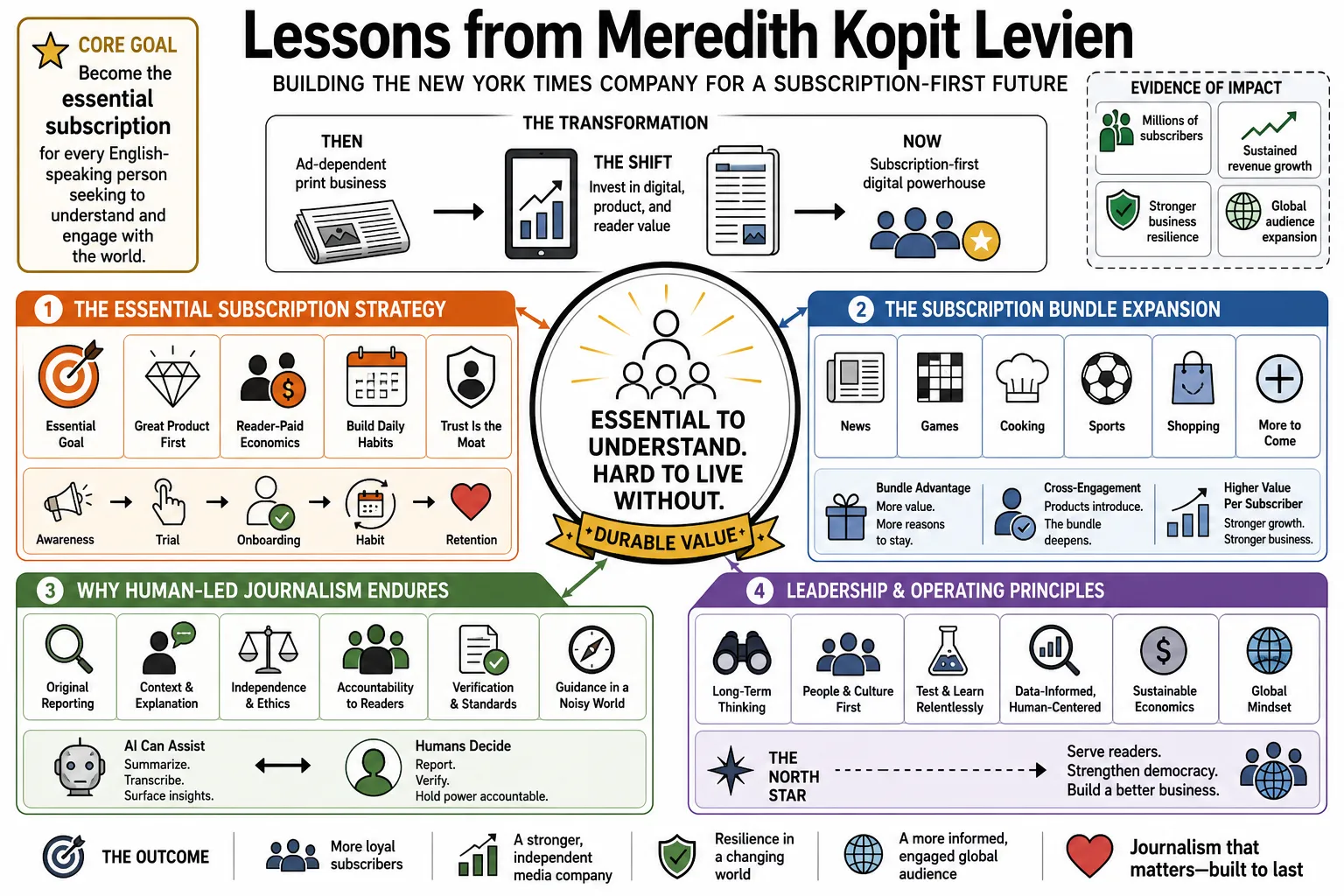
Part 1: The Essential Subscription Strategy
- On the core goal: "We want to become the essential subscription for every English-speaking person seeking to understand and engage with the world." — Source: [Q4 2025 Earnings Call]
- On product necessity: "There are no substitutes for a really great product, and you have to take care of that first." — Source: [Wikiquote]
- On shifting economics: "We successfully changed the fundamental economics of our business, relying primarily on millions of people paying directly for the journalism they read." — Source: [The New York Times Company Press Release]
- On building habits: "The goal of a digital subscription is to build a daily habit that the user finds so valuable they cannot imagine going without it." — Source: [Stratechery]
- On the scale of ambition: "We believe there is an addressable market of at least 135 million people who are willing to pay for English-language journalism, and our job is to capture the largest possible share of that." — Source: [Aspen Institute: Trust, Truth, and Technology]
- On retention over acquisition: "Acquiring a subscriber is only the first step; the real metric of success is how deeply they engage with the product in month two, month six, and year two." — Source: [Code Conference 2022]
- On pricing power: "When you provide something that helps people navigate their lives better, you earn the right to ask them to pay for it, and you earn pricing power over time." — Source: [Prof G Conversations]
- On transitioning revenue: "The hardest part of moving from an ad-supported model to a consumer-supported model is changing the internal culture to prioritize the reader above all else." — Source: [Columbia Business School]
- On the primary metric: "Subscriber engagement is our North Star. Everything we build is designed to increase the number of days a week a user interacts with our brand." — Source: [Q1 2026 Earnings Call]
- On long-term value: "We are not managing for the quarter; we are managing to build a generational digital consumer business." — Source: [The Grill Room Podcast]
Part 2: The Logic of the Bundle
- On diversification: "The bundle is how we move from being a news organization to a broader lifestyle brand that touches multiple aspects of a subscriber's day." — Source: [Stratechery]
- On unit economics: "Subscribers who take the bundle are more engaged, they retain at higher rates, and they ultimately yield higher lifetime value." — Source: [Q4 2025 Earnings Call]
- On cross-pollination: "Somebody might come to us to play Wordle, but our job is to introduce them to Cooking, to Wirecutter, and eventually to our core news report." — Source: [Prof G Conversations]
- On value perception: "A bundled subscription feels like a much better deal to the consumer because it solves multiple needs for a single price." — Source: [Stratechery]
- On competitive moats: "The more interconnected our products become, the harder it is for a competitor to replicate the specific value proposition of The New York Times." — Source: [Aspen Institute: Trust, Truth, and Technology]
- On daily utility: "We want to be the place you go to understand the world, decide what to make for dinner, see which headphones to buy, and take a quick mental break with a game." — Source: [The Grill Room Podcast]
- On mitigating news fatigue: "When the news cycle is heavy and people want to pull away, having a portfolio of non-news products keeps them engaging with our brand." — Source: [Code Conference 2022]
- On frictionless access: "The magic of the bundle is removing the friction of separate paywalls so the user can flow seamlessly across all our distinct properties." — Source: [Stratechery]
- On the Athletic acquisition: "Adding sports through The Athletic was a massive acceleration of our bundle strategy, capturing a highly passionate audience with strong daily habits." — Source: [Q1 2026 Earnings Call]
Part 3: Navigating the AI Landscape
- On generative AI: "AI is going to change how information is distributed, but high-quality journalism is still a fundamentally human business." — Source: [Prof G Conversations]
- On intellectual property: "We will aggressively protect our intellectual property. It is not acceptable for AI companies to train their models on our journalism without permission or compensation." — Source: [The New York Times Company Press Release]
- On commoditization: "As AI makes generic content infinite and cheap, the premium on verified, deeply reported, expert human journalism will only increase." — Source: [Stratechery]
- On internal efficiency: "We are exploring how AI can make our journalists more effective—helping them parse large datasets or translate documents—but the final output is always human-led." — Source: [Columbia Business School]
- On trust: "In a world flooded with synthetic media, the trust people place in our brand is the most valuable asset we have." — Source: [Aspen Institute: Trust, Truth, and Technology]
- On search traffic: "We recognize that search interfaces will evolve with AI, which is why our strategy has always been to build direct relationships with our readers rather than relying on intermediaries." — Source: [Q4 2025 Earnings Call]
- On differentiation: "You cannot use a language model to go to a war zone and report on what is happening on the ground." — Source: [Prof G Conversations]
- On fair use: "The scraping of our archives to build commercial products that compete with us goes far beyond the boundaries of fair use." — Source: [The Grill Room Podcast]
- On reader expectations: "Our readers pay us because they want to know that a smart, capable human being did the hard work of finding the facts." — Source: [Code Conference 2022]
- On long-term media survival: "The media companies that survive the AI transition will be those that offer something software cannot replicate: human judgment and on-the-ground reporting." — Source: [Stratechery]
Part 4: The Digital Transformation
- On shifting mediums: "We stopped treating digital as a secondary platform and realized it had to be the absolute center of everything we do." — Source: [Columbia Business School]
- On structural change: "Transforming a legacy media company isn't just about launching an app; it requires rebuilding the engineering, product, and data functions from the ground up." — Source: [The Grill Room Podcast]
- On the print legacy: "Print remains a profitable and beautiful product for those who love it, but our growth narrative and resource allocation are overwhelmingly digital." — Source: [Q1 2026 Earnings Call]
- On continuous iteration: "Digital products are never finished. You have to build a culture that is comfortable with constant shipping and testing." — Source: [Code Conference 2022]
- On data utilization: "We use data not to tell our editors what to write, but to understand how our audience interacts with the journalism so we can present it better." — Source: [Stratechery]
- On visual storytelling: "The phone is a visual medium. We had to evolve from being a text-first organization to one that tells stories through graphics, video, and audio." — Source: [Aspen Institute: Trust, Truth, and Technology]
- On hiring engineering talent: "To compete for attention, we had to become a technology company capable of attracting top-tier engineering and product talent." — Source: [Columbia Business School]
- On the speed of delivery: "The digital environment demands speed, but speed without accuracy destroys the brand. Balancing those two is the daily challenge." — Source: [Prof G Conversations]
- On audio expansion: "Podcasting allowed us to translate the depth of Times journalism into a highly intimate, daily digital habit." — Source: [Q4 2025 Earnings Call]
Part 5: Leadership and Culture
- On mindset shifts: "When this job that I'd been moving up the ladder for became available … I will never again play not to lose — I had to learn how to be someone who played to win." — Source: [Wikiquote]
- On the institutional mission: "The mission is the most important thing in the place: how do we help people to seek the truth and understand the world?" — Source: [Wikiquote]
- On managing talent: "You have to create an environment where the best journalists in the world feel they have the resources and backing to do their life's work." — Source: [Columbia Business School]
- On making hard choices: "Leadership in media right now means constantly deciding what not to do so you can properly fund what actually matters." — Source: [The Grill Room Podcast]
- On internal alignment: "The business side and the newsroom used to sit on opposite sides of the building. We had to bridge that gap without compromising editorial independence." — Source: [Aspen Institute: Trust, Truth, and Technology]
- On organizational agility: "A legacy company naturally wants to move slowly. My job is to continually push the metabolism of the organization to match the pace of the internet." — Source: [Stratechery]
- On feedback loops: "You have to be willing to look at the numbers and admit when a widely championed initiative isn't working with the audience." — Source: [Code Conference 2022]
- On diversity: "We cannot cover a complex world accurately if our newsroom and leadership do not reflect the diversity of the audiences we are trying to reach." — Source: [The New York Times Company Press Release]
- On resilience: "We are in the business of covering crises, which means the organization itself has to be incredibly resilient and steady under pressure." — Source: [Prof G Conversations]
Part 6: Modernizing the Advertising Business
- On advertising's role: "Advertising is no longer the primary engine of our business, but it remains a highly profitable and important secondary revenue stream." — Source: [Q1 2026 Earnings Call]
- On premium environments: "Advertisers are willing to pay a premium to be adjacent to high-quality, trusted content in a brand-safe environment." — Source: [Stratechery]
- On first-party data: "By transitioning to a logged-in subscriber base, we built a robust first-party data business that doesn't rely on third-party cookies." — Source: [The Grill Room Podcast]
- On bespoke campaigns: "Standard display ads are a commodity. We shifted our focus to custom content, podcasts, and high-impact sponsorships that deliver real value." — Source: [Columbia Business School]
- On podcast advertising: "Audio is one of the most intimate advertising environments available, and it has been a massive growth area for our ad business." — Source: [Q4 2025 Earnings Call]
- On user experience: "We will never sacrifice the subscriber's reading experience to jam in another ad unit. The subscription economics are too important." — Source: [Aspen Institute: Trust, Truth, and Technology]
- On brand alignment: "Brands want to associate themselves with truth-seeking and cultural relevance, which gives us a unique pitch in the marketplace." — Source: [Code Conference 2022]
- On native advertising: "T Brand Studio showed the market that publisher-created custom content could rival the quality of traditional agency creative." — Source: [Prof G Conversations]
- On the attention economy: "We aren't competing for ad dollars just against other newspapers; we are competing against social platforms for the limited attention of the consumer." — Source: [Stratechery]
Part 7: Expanding Beyond Hard News
- On Games as a funnel: "Games like Wordle and Spelling Bee bring in millions of people daily, acting as a massive, joyful funnel into the wider Times ecosystem." — Source: [Q4 2025 Earnings Call]
- On utility journalism: "Products like Wirecutter prove that we can apply the rigorous reporting standards of the newsroom to help people make everyday purchasing decisions." — Source: [Stratechery]
- On NYT Cooking: "Cooking solves a daily problem for millions of people, and the community around the comments section has become a product feature in itself." — Source: [The Grill Room Podcast]
- On sports coverage: "The Athletic gave us a way to cover sports with the same depth and obsession that we cover politics or foreign affairs." — Source: [Columbia Business School]
- On standalone subscriptions: "While the bundle is the ultimate goal, giving users the option to subscribe only to Games or Cooking allows us to capture specialized audiences." — Source: [Q1 2026 Earnings Call]
- On the daily routine: "We want to be the puzzle you do with your coffee, the podcast you listen to on your commute, and the recipe you use for dinner." — Source: [Prof G Conversations]
- On lifestyle branding: "We are shifting the perception of the Times from just a heavy news obligation to a brand that provides daily delight and utility." — Source: [Aspen Institute: Trust, Truth, and Technology]
- On Wordle's impact: "Acquiring Wordle was a singular event that vastly expanded our reach and brought an unprecedented number of new users into our funnel." — Source: [Code Conference 2022]
- On investing in adjacencies: "We only build or buy adjacent products if we believe we can bring the distinct quality of The New York Times to that category." — Source: [Stratechery]
- On continuous engagement: "If you only read the news, you might churn when the news cycle slows down. If you also cook and play our games, you stay." — Source: [The Grill Room Podcast]
Part 8: The Value of Human Expertise
- On original reporting: "The core value of our business is sending reporters out into the world to find out what is true. There is no algorithm for that." — Source: [Stratechery]
- On the cost of truth: "Independent journalism is incredibly expensive to produce. The subscription model is the only way to fund it at the scale it deserves." — Source: [Aspen Institute: Trust, Truth, and Technology]
- On editorial judgment: "In a world of infinite information, the value shifts from volume to curation—knowing what matters and why." — Source: [Columbia Business School]
- On long-form investigations: "The pieces that take six months to report and edit are often the ones that drive the most profound loyalty among our subscribers." — Source: [Prof G Conversations]
- On defending the moat: "Our competitive advantage is the collective expertise, sourcing, and courage of our newsroom." — Source: [Q4 2025 Earnings Call]
- On voice and personality: "Readers don't just want facts; they want to read writers they trust, who have a distinct voice and deep domain expertise." — Source: [The Grill Room Podcast]
- On the Daily podcast: "The Daily succeeded because it leaned into the human element of reporting—letting you hear the emotion and the process behind the story." — Source: [Code Conference 2022]
- On specialized beats: "Whether it's tech, health, or fashion, our strategy relies on having reporters who know their subjects better than anyone else in the industry." — Source: [Stratechery]
- On the ultimate product: "At the end of the day, we are selling clarity. And clarity requires human intelligence." — Source: [Q1 2026 Earnings Call]