Lessons from Michael Easter
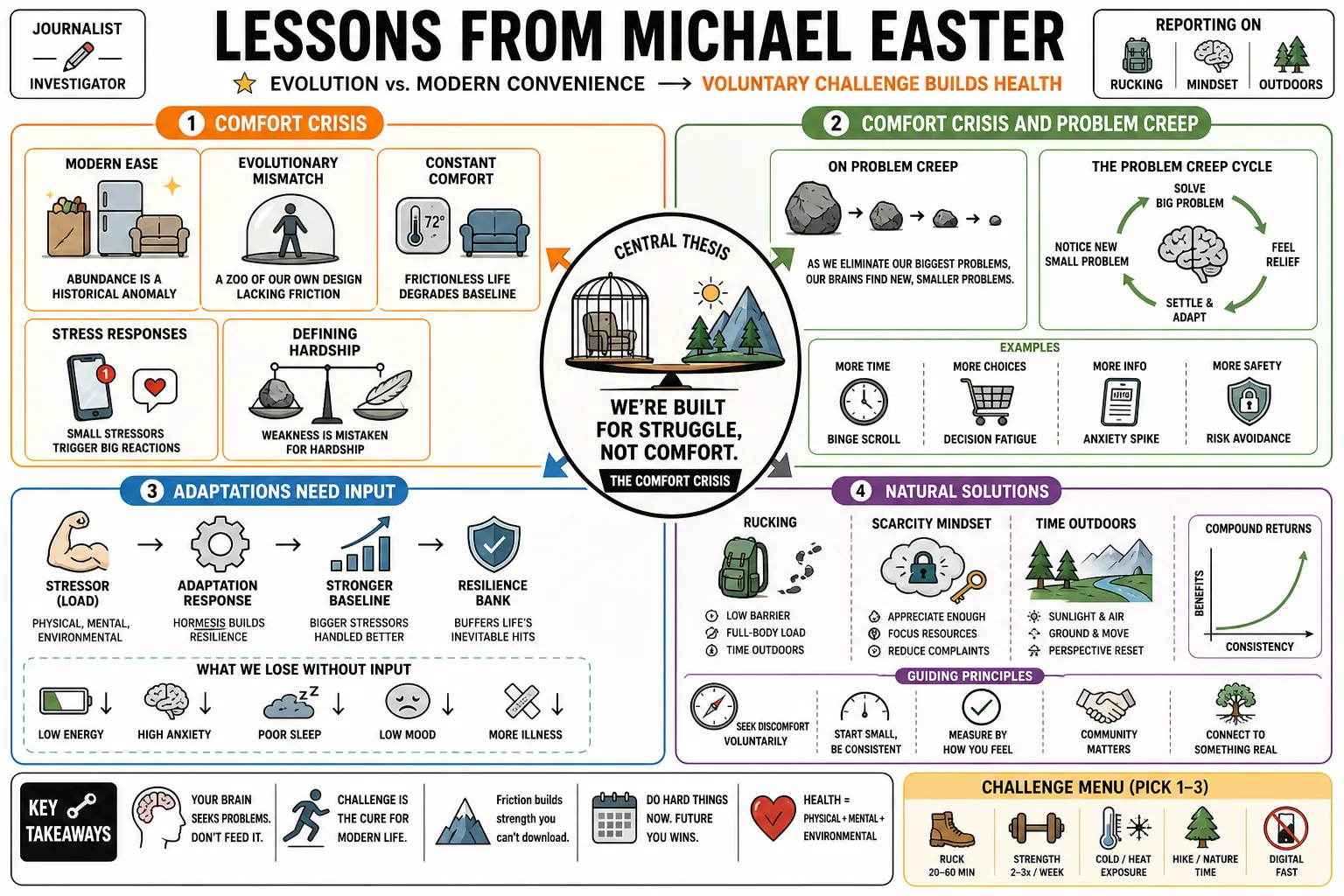
Journalist and professor Michael Easter investigates the clash between evolutionary biology and modern convenience. He popularized the "comfort crisis," arguing that voluntary physical and mental challenges improve human health. This collection distills his reporting on rucking, the scarcity mindset, and time outdoors into practical takeaways.
Part 1: The Comfort Crisis and Problem Creep
- On Problem Creep: "As we eliminate our biggest problems, we do not become satisfied. Instead, our brains simply find new, smaller problems to fix." — Source: [The Comfort Crisis]
- On Modern Ease: "Our environment of abundance is a historical anomaly, and our bodies are still waiting for the struggle." — Source: [Two Percent Podcast]
- On Evolutionary Mismatch: "We are living in a zoo of our own design, protected from the elements but suffering from the lack of friction." — Source: [Men's Health]
- On Constant Comfort: "The pursuit of a perfectly temperature-controlled, frictionless life is actively degrading our physical and mental baseline." — Source: [The Comfort Crisis]
- On Stress Responses: "Without real physical threats, our bodies interpret a delayed email or a social media comment as a life-or-death scenario." — Source: [Outside Magazine]
- On Defining Hardship: "What we consider difficult today would look like a vacation to our ancestors." — Source: [The Joe Rogan Experience]
- On Artificial Environments: "We spend the vast majority of our lives indoors, missing out on the physical adaptations that only come from environmental stress." — Source: [The Ready State]
- On Emotional Fragility: "When you remove all physical discomfort, emotional discomfort takes its place and expands to fill the void." — Source: [The Comfort Crisis]
- On the Value of Cold: "Brief exposure to cold water forces the body to remember it is alive and capable of adaptation." — Source: [Two Percent Newsletter]
- On Historical Perspective: "Life in a state of nature was hard, but it built a human chassis that breaks down when left entirely idle." — Source: [Goodreads]
Part 2: The Scarcity Brain and Craving Loops
- On the Scarcity Loop: "The cycle of opportunity, unpredictable rewards, and quick repeatability is what drives our modern addictions." — Source: [Scarcity Brain]
- On Human Wiring: "Our scarcity brain is built to acquire more food, status, and information, a system that backfires in an age of abundance." — Source: [EconTalk]
- On Information Consumption: "We scroll endlessly because our brains treat novel information the same way a hunter-gatherer treated finding a high-calorie food source." — Source: [IN-DEPTH with Cal Newport]
- On the Gambling Mechanism: "Slot machines and social media feeds use the exact same variable reward schedules to keep human attention trapped." — Source: [Scarcity Brain]
- On Short-term Rewards: "Behaviors that are fun and rewarding in the short term often destroy our capacity for long-term satisfaction." — Source: [Order of Man]
- On Uncertainty: "Humans hate uncertainty to the point that many would choose a guaranteed electric shock over the suspense of maybe getting one." — Source: [Goodreads]
- On Status Seeking: "We chase online clout because our ancestors needed group approval to avoid being exiled from the tribe and dying." — Source: [Two Percent Podcast]
- On Material Goods: "The drive to accumulate things was a survival advantage for thousands of years; now it just fills storage units." — Source: [Scarcity Brain]
- On Breaking the Loop: "To escape the scarcity loop, you have to deliberately introduce friction between the impulse and the behavior." — Source: [The Joe Rogan Experience]
- On Choice Architecture: "If you want to consume less, stop relying on willpower and start changing your physical environment to make consumption harder." — Source: [Rich Roll Podcast]
Part 3: The Philosophy and Mechanics of Rucking
- On Basic Movement: "Walking with weight is the most fundamental human exercise; it is how we migrated out of Africa." — Source: [Huckberry]
- On Accessibility: "Rucking is cardio for people who hate running and weightlifting for people who hate the gym." — Source: [Walk with Weight]
- On Bone Density: "Carrying a load forces your skeletal structure to adapt, building denser bones and stronger connective tissues." — Source: [The Ready State]
- On Posture: "A heavy pack pulls your shoulders back and forces your torso upright, counteracting the effects of sitting at a desk all day." — Source: [Men's Health]
- On Caloric Burn: "Adding just a little bit of weight turns a normal walk into an activity that burns nearly as much energy as a slow jog." — Source: [Two Percent Newsletter]
- On Injury Prevention: "Unlike running, which creates massive impact spikes with every step, rucking keeps one foot on the ground and spares your knees." — Source: [Outside Magazine]
- On Practical Fitness: "If you can comfortably carry thirty pounds for a few miles, you are physically prepared for most of the random tasks life throws at you." — Source: [The Prairie Homestead]
- On Mental Toughness: "There is no technique to hide behind when rucking; it is just you, the weight, and gravity." — Source: [The Comfort Crisis]
- On Starting Out: "You do not need tactical gear; you just need a sturdy backpack and some books or wrapped bricks." — Source: [Reddit AMA]
- On Community: "Because it allows you to talk while exercising, rucking naturally builds social bonds in a way that sprinting cannot." — Source: [Walk with Weight]
Part 4: Misogi and the Necessity of Hard Challenges
- On Defining Misogi: "A proper Misogi is an artificial challenge that is so difficult it has a fifty percent chance of failure." — Source: [The Comfort Crisis]
- On Keeping Quiet: "You cannot post about your Misogi on social media; the psychological benefit evaporates when it becomes a performance for others." — Source: [Being Well Podcast]
- On Expanding Limits: "When you survive something you genuinely thought might break you, your daily annoyances shrink to their proper size." — Source: [The Joe Rogan Experience]
- On Frequency: "Doing something insanely hard once a year is enough to reset your perspective for the other 364 days." — Source: [Rich Roll Podcast]
- On Creativity: "A Misogi should be weird and specific to you; running a structured, organized marathon usually does not count." — Source: [The Comfort Crisis]
- On Managing Fear: "The dread leading up to the challenge is a feature, not a bug; overcoming that dread is where the growth happens." — Source: [Two Percent Newsletter]
- On the Failure Rate: "If you know for a fact you can finish the task, you set the bar too low." — Source: [The Ready State]
- On Self-Reliance: "In a real Misogi, no one is coming to save you if you quit. You have to handle the logistics of your own exit." — Source: [Outside Magazine]
- On Translating to Life: "The physical suffering of a hard outdoor challenge directly translates to mental stamina in a corporate office." — Source: [Men's Health]
Part 5: Boredom, Silence, and Digital Noise
- On the Loss of Boredom: "We have eradicated boredom, and in the process, we have eradicated our primary trigger for creative thinking." — Source: [Scarcity Brain]
- On the Default Mode Network: "When you stare out a window doing nothing, your brain enters a mode that solves background problems and generates new ideas." — Source: [The Comfort Crisis]
- On Phone Addiction: "The smartphone is an unfailing boredom killer that robs us of the discomfort required to start difficult, meaningful work." — Source: [IN-DEPTH with Cal Newport]
- On Mental Rest: "Listening to a podcast while walking is still consuming information; real mental rest requires total silence." — Source: [Two Percent Podcast]
- On Internal Monologue: "People avoid silence because it forces them to listen to their own thoughts, which can be deeply uncomfortable." — Source: [Being Well Podcast]
- On Scheduled Idleness: "You have to actively block off time to do nothing, otherwise the modern world will fill every second with input." — Source: [EconTalk]
- On Attention Spans: "Our inability to focus on a single book or conversation is a direct result of training our brains to expect a new stimulus every ten seconds." — Source: [Scarcity Brain]
- On Productivity: "Constant input does not make you more productive; it just makes you more frantic and less capable of deep thought." — Source: [Rich Roll Podcast]
- On Walking Without Tech: "Leaving your phone at home during a 45-minute walk is one of the hardest and most beneficial things a modern person can do." — Source: [The Comfort Crisis]
Part 6: Nature, Environment, and The 20-5-3 Rule
- On the 20-5-3 Rule: "Spend 20 minutes a day in a local park, 5 hours a month in a wilder state park, and 3 days a year completely off the grid." — Source: [The Comfort Crisis]
- On Microbes: "Exposure to dirt and outdoor environments provides a continuous dose of microbes that strengthen our immune systems and lower inflammation." — Source: [Goodreads]
- On Fractal Patterns: "Looking at the complex, repeating patterns of trees and rivers physically lowers human heart rates and reduces cortisol." — Source: [The Prairie Homestead]
- On Urban Environments: "City streets demand sharp, directed attention to avoid cars and navigate crowds, which exhausts our cognitive reserves." — Source: [Outside Magazine]
- On Soft Fascination: "Nature requires soft fascination—a state where your attention is held gently by your surroundings, allowing your brain to recover." — Source: [The Comfort Crisis]
- On Physical Space: "Being in vast, open spaces reminds humans of their physical smallness, which is an excellent cure for a bloated ego." — Source: [Two Percent Newsletter]
- On Artificial Light: "Blocking out natural sunlight and staring at fluorescent bulbs disrupts our circadian rhythms on a cellular level." — Source: [Men's Health]
- On Senses in the Wild: "When you are deep in the backcountry, you start hearing and seeing things you would normally filter out." — Source: [The Joe Rogan Experience]
- On Children and Nature: "Kids who grow up playing in the dirt have fundamentally different immune baselines than kids raised in sterile, indoor environments." — Source: [Being Well Podcast]
Part 7: Nutrition, Fasting, and Evolutionary Hunger
- On True Hunger: "Most of us have never felt actual hunger; we have only felt the scheduled, habitual urge to eat at noon." — Source: [The Comfort Crisis]
- On Ultra-Processed Foods: "Food scientists have engineered snacks to hit the exact mathematical bliss points that override our natural satiety signals." — Source: [Scarcity Brain]
- On Fasting as a Tool: "Going 24 hours without food teaches you that hunger is a passing sensation, not a medical emergency." — Source: [The Ready State]
- On Caloric Scarcity: "For 99 percent of human history, calories were hard to find and easy to burn; now the exact opposite is true." — Source: [Two Percent Podcast]
- On Emotional Eating: "We use food to self-medicate boredom and anxiety because eating triggers a reliable, immediate dopamine release." — Source: [Scarcity Brain]
- On Dietary Tribalism: "People treat their diets like religion, but the actual human digestive system is remarkably adaptable to almost any whole-food regimen." — Source: [Order of Man]
- On Chewing: "Modern food is so soft that we barely use our jaw muscles, which changes our facial structure and breathing patterns." — Source: [The Comfort Crisis]
- On the Buffet Effect: "When presented with endless variety, the scarcity brain demands that we try everything, leading to massive overconsumption." — Source: [EconTalk]
- On Earning Food: "There is a profound psychological difference between eating after a grueling physical effort and eating after sitting on a couch." — Source: [Rich Roll Podcast]
Part 8: Agency, Sobriety, and Mental Resilience
- On Taking Ownership: "The moment you stop blaming external circumstances for your situation is the exact moment you regain your agency." — Source: [Two Percent Newsletter]
- On Sobriety: "Quitting drinking forces you to actually process your negative emotions instead of drowning them in a socially acceptable depressant." — Source: [The Joe Rogan Experience]
- On Action vs. Anxiety: "Anxiety is a physical energy meant to prepare you for action; if you just sit there, it turns inward and tears you apart." — Source: [The Comfort Crisis]
- On Daily Choices: "Resilience is not a trait you are born with; it is a habit built through tiny, annoying daily choices to not take the easy way out." — Source: [Being Well Podcast]
- On the Victim Trap: "Cultivating a victim mindset is the ultimate comfort mechanism because it absolves you of any responsibility to change." — Source: [Scarcity Brain]
- On Reframing Discomfort: "If you view pain as a signal of growth rather than a signal of damage, your entire physical capability changes." — Source: [Outside Magazine]
- On Consistency: "The magic is in doing the boring, hard work on the days when your motivation is completely gone." — Source: [Men's Health]
- On Modern Coddling: "We are raising a generation terrified of failure because we intervene before they ever experience the consequences of their actions." — Source: [Order of Man]
- On Finding Meaning: "A meaningful life requires friction. If you remove all the friction, you slide smoothly into a state of total apathy." — Source: [The Comfort Crisis]