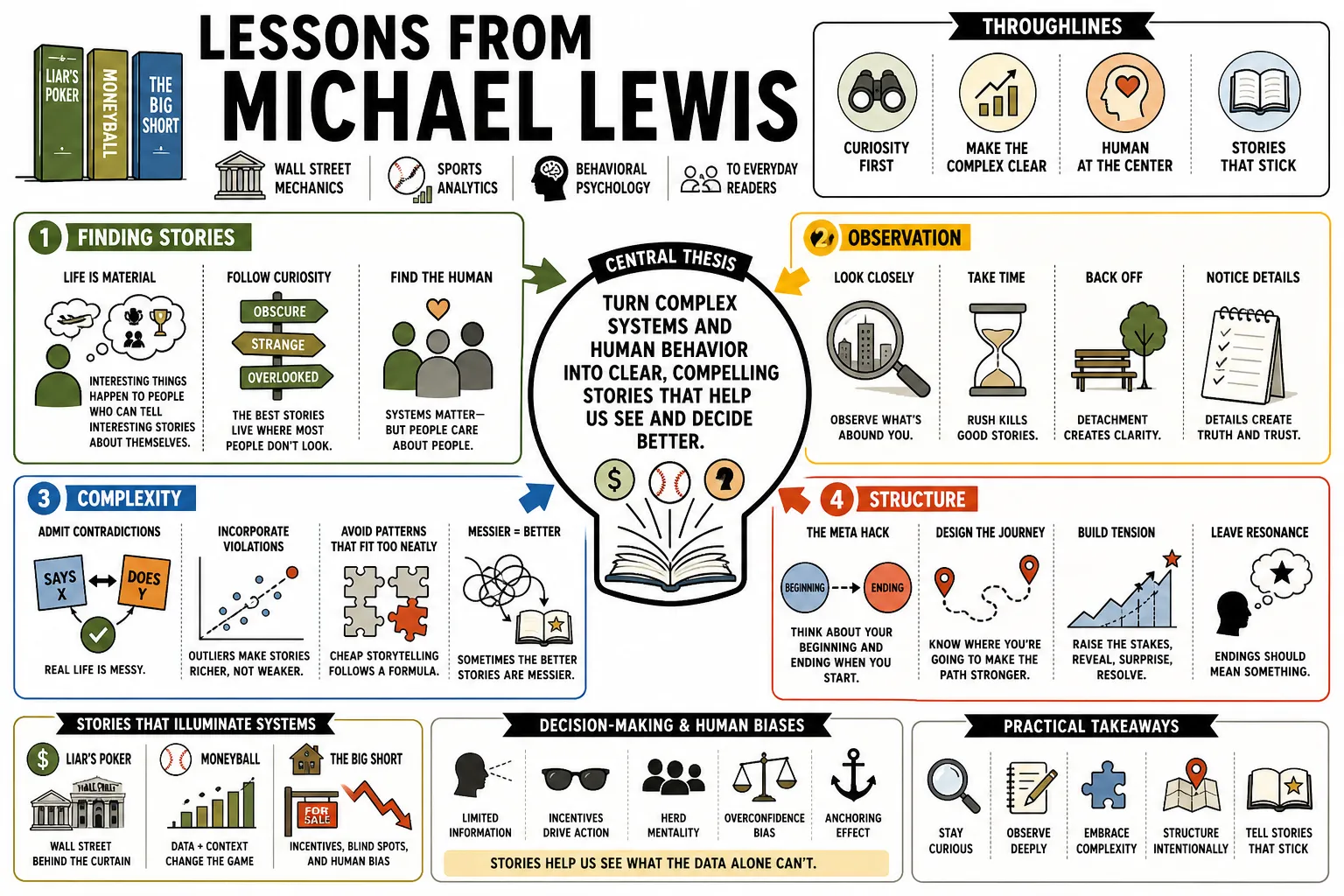
Lessons from Michael Lewis
Michael Lewis turns obscure systems into popular narratives. In books like Liar's Poker, Moneyball, and The Big Short, he explains the mechanics of Wall Street, sports analytics, and behavioral psychology to everyday readers. This profile collects his insights on writing, decision-making, and the human biases that shape the world.
Part 1: The Craft of Storytelling
- On Finding Stories: "Interesting things happen to people who can tell interesting stories about themselves. Developing a narrative impulse about your own life is incredibly enriching." — Source: [Next Big Idea Club]
- On Observation: "If you want to tell good stories about just your own life, observe it. Observe what's around you, take time. Back off it a little bit. Have some detachment about it." — Source: [Next Big Idea Club]
- On Complexity: "Admit contradictory evidence. Cheap storytelling is a cheap pattern writing machine. If there's something that violates the pattern, if you incorporate it into the story, often it makes the story even richer. Sometimes the better stories are messier." — Source: [Next Big Idea Club]
- On Structure: "The broad meta hack is that if you think about your beginning and your ending when you start, it's amazing how a lot of this stuff starts to tell you how to lay the story out." — Source: [Radio Station Consultant]
- On Brevity: "Verbosity gets in the way of connection. Say less, mean more." — Source: [Medium]
- On Audience: "Imagine you are writing to someone who loves you... to shift the perspective from fearing critics to connecting with an ally." — Source: [Medium]
- On Expression: "I learned to write because I am one of those people who somehow cannot manage the common communications of smiles and gestures, but must use words to get across things that other people would never need to say." — Source: [Goodreads]
- On Curiosity: "If a topic is tedious for the writer to investigate, it will surely be tedious for the reader, so a writer must follow their own natural curiosity to maintain engagement." — Source: [Barry Ritholtz Interview]
- On Historical Rhymes: "Placing events side by side forces the mind to see recurring human patterns like mass speculation and the dangerous escalation of financial debt." — Source: [Wave]
Part 2: The Writing Process
- On Immersion: "I noticed very quickly that writing was the only way for me to lose track of the time." — Source: [Reddit]
- On Environment: "I unplug the phones. I pull down the blinds. I put my headset on and play the same soundtrack of twenty songs over and over and I don't hear them. It shuts everything else out." — Source: [The Marginalian]
- On Emotional Experience: "I'm writing and laughing and talking to myself. I'm not even aware I'm making noise. I'm having a physical reaction to a very engaging experience. It is not a detached process." — Source: [Medium]
- On Preparation: "What is hard for me is figuring out in the beginning what I want to say. I spend a lot of time gathering material and organizing the material before I sit down to write." — Source: [Bennett Ink]
- On Unintended Consequences: "When I sat down to write my first book, I had no great agenda, apart from telling what I took to be a remarkable tale." — Source: [LitCharts]
- On Salesmanship in Writing: "A bond salesman and a writer both rely heavily on the same fundamental skill of telling a compelling story to an audience." — Source: [Business Insider]
- On Subject Matter: "Silicon Valley is a hard place to write about because it is a cold place with a lack of emotional content." — Source: [Bloomberg]
- On Exploring Reality: "The goal of narrative non-fiction is to press people’s noses up against what is actually happening rather than relying on standard and superficial narratives." — Source: [Constitution Center]
- On Cheap Narrative: "Avoid cheap storytelling in your own life by resisting the urge to constantly cast yourself as the victim or the hero." — Source: [Next Big Idea Club]
Part 3: Wall Street and Finance
- On Incentives: "What are the odds that people will make smart decisions about money if they don't need to make smart decisions, if they can get rich making dumb decisions? The incentives on Wall Street were all wrong; they're still all wrong." — Source: [Goodreads]
- On Ignorance: "The men on the trading floor may not have been to school, but they have Ph.D.'s in man's ignorance." — Source: [Shortform]
- On Secrecy: "Those who know don't tell and those who tell don't know." — Source: [Goodreads]
- On Cynicism: "The cynical view of the financial world says that Wall Street is run by a special breed of traders who exploit investors' collective fear and greed to enrich themselves however they can, without any care for the havoc they might wreak." — Source: [Shortform]
- On True Risk: "Real risk was not volatility; real risk was stupid investment decisions." — Source: [Ivanhoff]
- On Overvaluation: "The first thing you learn on the trading floor is that when large numbers of people are after the same commodity, be it a stock, a bond, or a job, the commodity quickly becomes overvalued." — Source: [Medium]
- On Asymmetric Accountability: "You can be positive and wrong on the sell side. But if you are negative and wrong, you get fired." — Source: [Ivanhoff]
- On Lenders vs. Borrowers: "What you want to watch are the lenders, not the borrowers. The borrowers will always be willing to take a great deal for themselves. It's up to the lenders to show restraint, and when they lose it, watch out." — Source: [Ivanhoff]
- On Wall Street Survival: "Never agree to anything proposed on someone else's boat or you'll regret it in the morning." — Source: [Goodreads]
- On Illusion of Complexity: "Wall Street deliberately obscures its operations in complex jargon to keep outsiders confused and reliant on its services while masking the simple truth of what is actually happening." — Source: [Business Insider]
Part 4: Sports and Analytics
- On Challenging the Status Quo: "If you challenge conventional wisdom, you will find ways to do things much better than they are currently done." — Source: [Goodreads]
- On Bias vs. Data: "People in both fields operate with beliefs and biases. To the extent you can eliminate both and replace them with data, you gain a clear advantage." — Source: [Goodreads]
- On the Naked Eye: "Some coaches believed they could judge a player's performance simply by watching it. In this they were deeply mistaken. The naked eye was an inadequate tool for learning what you needed to know to evaluate baseball players and baseball games." — Source: [AZQuotes]
- On General Value: "If gross miscalculations of a person's value could occur on a baseball field, before a live audience of thirty thousand, and a television audience of millions more, what did that say about the measurement of performance in other lines of work? If professional baseball players could be over- or under-valued, who couldn't?" — Source: [AZQuotes]
- On Defensive Management: "Managers tend to pick a strategy that is the least likely to fail, rather than to pick a strategy that is most efficient. The pain of looking bad is worse than the gain of making the best move." — Source: [Goodreads]
- On Strategy Evolution: "In 1978, NFL teams passed 42 percent of the time and ran the ball 58 percent of the time... in 1995, NFL teams passed 59 percent of the time and ran 41 percent of the time. It's not hard to see why; the passing game was improving, and the running game was stagnant." — Source: [LitCharts]
- On Quantifying Impact: "In Lawrence Taylor's first season in the NFL, no official records were kept of quarterback sacks. In 1982, after Taylor had transformed the quarterback sack into the turning point of a football game, a new official NFL statistic was born." — Source: [Weebly]
- On Subjectivity and Labels: "Michael Oher had a measured IQ of 80... The numbers looked like misprints... People rank him by his IQ and other tests of 'intelligence' but that does not stop him from trying, and showing that he can do something." — Source: [Weebly]
- On the Cost of Prejudice: "What begins as a failure of the imagination ends as a market inefficiency: when you rule out an entire class of people from doing a job simply by their appearance, you are less likely to find the best person for the job." — Source: [Goodreads]
- On Inefficiency as Opportunity: "People often fail to see talent or solutions because of their own biases. This inability to envision someone succeeding is a market inefficiency that creates opportunities for those willing to look closer." — Source: [Goodreads]
Part 5: Technology and Silicon Valley
- On Disruption: "For a technology company to succeed, he argued, it needed always to be looking to destroy itself. If it didn't, someone else would." — Source: [Goodreads]
- On Progress: "Progress crawls on its belly like a guerrilla." — Source: [Goodreads]
- On Commitment: "The chicken is interested, the pig is committed. If you are going to do anything worth doing, you need a lot of pigs." — Source: [Goodreads]
- On the New Thing: "The new new thing is a notion that is poised to be taken seriously in the marketplace. It's the idea that is a tiny push away from general acceptance and, when it gets that push, will change the world." — Source: [Goodreads]
- On Technologists: "The markets were now run by technology, but the technologists were still treated like tools." — Source: [Goodreads]
- On Crypto Delusion: "The blockchain! The blockchain is going to change . . . everything, they'd say, and hope that would suffice." — Source: [Goodreads]
- On Crypto Narratives: "In a crypto landscape ridden with scams, hedonism, and greed, Bankman-Fried offers a kinder and more impactful vision brought forth by the nascent technology." — Source: [Goodreads]
- On Management in Tech: "There's a functional religion around the CFO. I'll ask them, 'Why do I need one?' Some people cannot articulate a single thing the CFO is supposed to do." — Source: [Goodreads]
- On Silicon Valley's Artificiality: "People in the tech industry often get artificially excited about technology, manifesting a drive and detachment that can feel devoid of deep emotional warmth." — Source: [Bloomberg]
Part 6: Psychology and Decision-Making
- On Randomness of Choice: "The big choices we make are practically random. The small choices probably tell us more about who we are. Which field we go into may depend on which high school teacher we happen to meet... On the other hand, the small decisions are very systematic." — Source: [Goodreads]
- On Motivation: "When they made decisions, people did not seek to maximize utility. They sought to minimize regret." — Source: [Goodreads]
- On Self-Awareness: "He suggested a new definition of the nerd: a person who knows his own mind well enough to mistrust it." — Source: [Goodreads]
- On Narrative Preference: "Nobody ever made a decision based on a number, they needed a story." — Source: [Matthew Cleek]
- On Studying Error: "The only way to understand a mechanism such as the eye, Danny thought, was studying the mistakes that it made. Error wasn't merely instructive; it was the key that might unlock the deep nature of the mechanism. 'How do you understand memory?' he asked. 'You don't study memory. You study forgetting.'" — Source: [Big Ben Comedy]
- On Evaluating Claims: "When someone says something, don't ask yourself if it is true. Ask what it might be true of." — Source: [Matthew Cleek]
- On Uncertainty: "Doubt is not a pleasant condition, but uncertainty is an absurd one." — Source: [Matthew Cleek]
- On Knowledge and Prediction: "Knowledge is essentially the act of prediction. Humans are constantly attempting to predict outcomes in a world governed by chance." — Source: [Goodreads]
- On Heuristics: "Mental shortcuts lead to systematic errors in judgment. This demonstrates that human cognitive processes are deeply influenced by emotion and context rather than pure rationality." — Source: [GradeSaver]
- On Trust: "The erosion of public trust in institutions has made it increasingly difficult for society to agree on what constitutes fairness." — Source: [Musixmatch]
Part 7: Government, Institutions, and Risk
- On the Fifth Risk: "Fifth risk: the risk a society runs when it falls into the habit of responding to long-term risks with short-term solutions." — Source: [Goodreads]
- On Unseen Dangers: "The risk we should most fear is not the risk we easily imagine. It is the risk that we don't." — Source: [Goodreads]
- On Imagination and Risk: "Human imagination is a poor tool for judging risk. People are really good at responding to the crisis that just happened... They are less good at imagining a crisis before it happens." — Source: [Goodreads]
- On Public Service Motivation: "There was a rift in American life that was now coursing through American government. It wasn't between Democrats and Republicans. It was between the people who were in it for the mission, and the people who were in it for the money." — Source: [Goodreads]
- On Bureaucratic Silos: "Inside the United States government were all these little boxes... Each box became its own small, frozen world, with little ability to adapt and little interest in whatever might be going on inside the other boxes." — Source: [GovExec]
- On Near Misses: "You can keep mistakes from happening if you can identify the almost mistakes. This kind of changes how I view everything." — Source: [Goodreads]
- On Government Purpose: "The primary role of the federal government is to mitigate long-term and catastrophic risks that the private sector cannot or will not handle." — Source: [Instaread]
- On Civil Servants: "There is a stark contrast between the mission-driven civil servants who quietly manage essential systems and political appointees who may be indifferent to or ignorant of those systems." — Source: [Berkeleyside]
- On Public Ignorance of Government: "The public often has a poor understanding of what the government actually does. This leads to the dangerous assumption that it can be ignored or dismantled without consequence." — Source: [Books of Titans]
Part 8: Career and Life Choices
- On Luck: "Successful people often ignore the role of luck in their achievements. Instead of eating your own fortune cookie, you should recognize that your position is partially a result of circumstance and that you have a debt to the unlucky." — Source: [Business Insider]
- On Unconventional Paths: "Do not follow the conventional path simply because it is expected. Choosing a prestigious path like finance or law without true interest is a mistake." — Source: [Money]
- On Good Management: "The best way to manage people, he thought, was to convince them that you were good for their careers. He further believed that the only way to get people to believe that you were good for their careers was actually to be good for their careers." — Source: [QuoteFancy]
- On Authenticity: "Refuse to phony it up. Pursuing a career just to project an image of success is a fast track to a hollow life." — Source: [Medium]
- On Statistics in Democracy: "Honest and accurate statistics are the beating heart of democracy. They are incredibly difficult to maintain and are often drowned out by idiotic conversations." — Source: [Constitution Center]
- On Mentorship: "A good coach or mentor is someone who pushes you into places you wouldn't go yourself and helps you overcome the limits of your own imagination." — Source: [Tim Ferriss Show]
- On Fairness: "In a society that is rapidly stratifying, the concept of fairness is eroding. This makes it imperative for individuals to actively question and seek out what is just in their own spheres of influence." — Source: [Pushkin Industries]
- On Navigating Career: "You must step back, observe your surroundings, and develop a narrative impulse about your life rather than just being busy for the sake of being busy." — Source: [Next Big Idea Club]
- On True Value: "Do not let a job title or salary define your sense of worth. Recognize that market value does not necessarily equal human value." — Source: [Michael Lewis at Talks at Google]