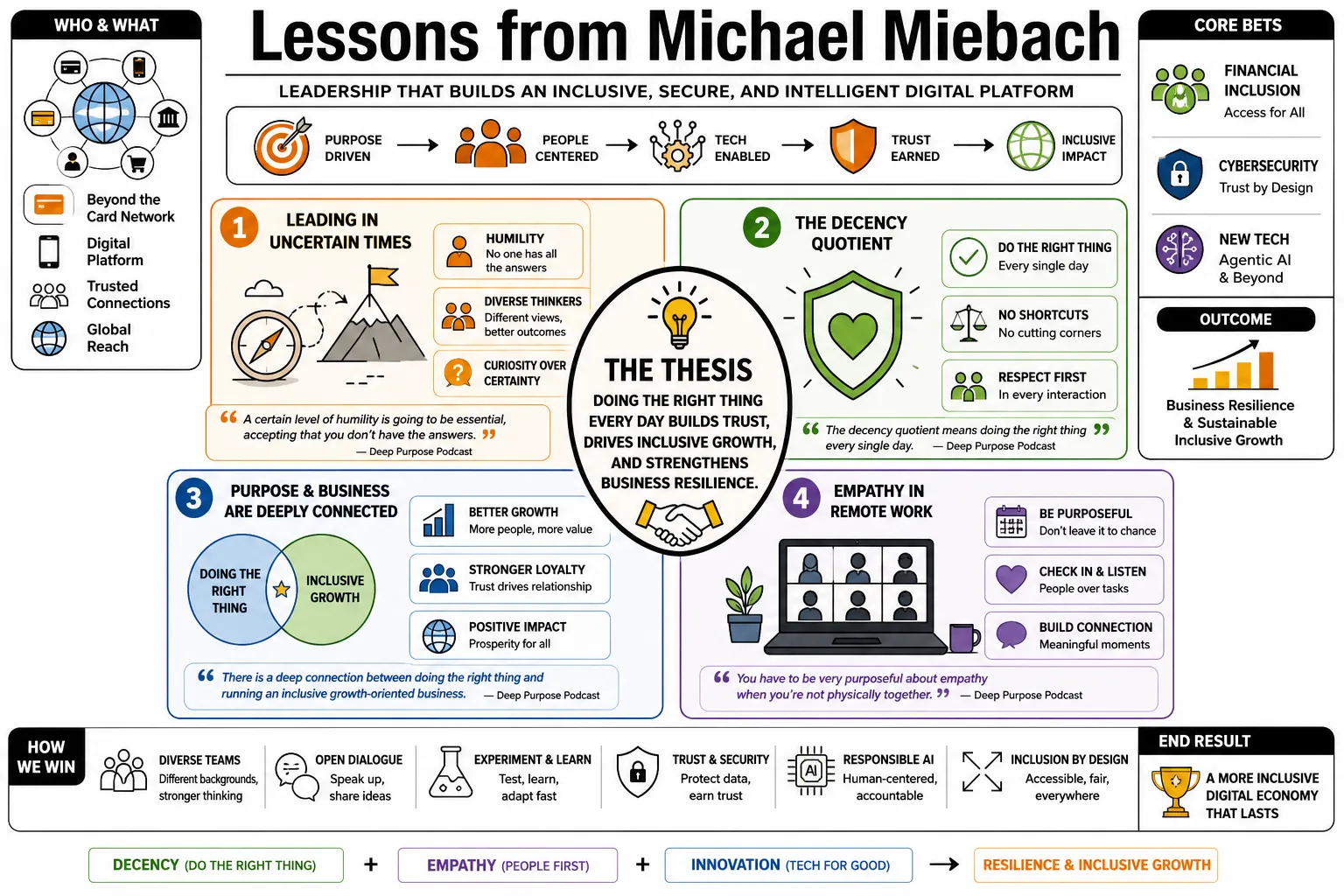
Lessons from Michael Miebach
As CEO of Mastercard, Michael Miebach has pushed the company beyond its traditional card network roots to become a broader digital platform. He treats financial inclusion, cybersecurity, and new tech like agentic AI not as side projects, but as core to the company's business resilience. The insights below outline his approach to leadership and managing technological change.
Part 1: Leadership and Culture
- On Leading in Uncertain Times: "I think a certain level of humility is going to be essential, accepting that you don't have the answers. This puts you in a position to get a diverse set of thinkers and experiences around a table." — Source: Deep Purpose Podcast
- On the Decency Quotient: "The decency quotient means doing the right thing every single day. It prevents cutting corners and ensures that respect remains a fundamental part of our daily operations." — Source: Deep Purpose Podcast
- On Purpose and Business: "There is a deep connection between doing the right thing and running an inclusive growth-oriented business. They are, for us, very closely related." — Source: Deep Purpose Podcast
- On Empathy in Remote Work: "You have to be very purposeful about wanting to understand and wanting to be empathetic. Recognizing the person on the other side of the screen makes a huge difference." — Source: Deep Purpose Podcast
- On Inclusive Leadership: "Emerging markets serve as a daily, constant reminder that we won't win unless everybody wins." — Source: McKinsey & Company
- On Building a Team: "Surround yourself with people who challenge your assumptions. A leadership team in an era of disruption cannot rely on consensus at the expense of debate." — Source: Leadership Next
- On Navigating Disruption: "As a leader, my role is to act as a steward through geopolitical, economic, and technological shifts without losing sight of our core mission." — Source: Washington Post Live
- On Continuous Learning: "The pace of change means that what you learned five years ago might no longer apply. Leaders must remain relentlessly curious." — Source: Fast Company
- On Corporate Responsibility: "We cannot look at our social impact as a side project. It has to be embedded in how we generate revenue and build products." — Source: Mastercard Newsroom
- On Future-Proofing: "While the fundamental business of enabling a value exchange is timeless, the methods must be constantly reimagined to prepare the organization for the next generation." — Source: Deep Purpose Podcast
Part 2: Strategy and Diversification
- On Strategic Pillars: "Our strategy is based on three central pillars: Expand in payments, extend our services, and embrace new networks." — Source: Mastercard Strategy
- On the Virtuous Cycle: "Payments generate data. More data strengthens our services. Better services attract more payments to our network, and the cycle spins on." — Source: Mastercard Newsroom
- On Business Resilience: "Our business model, strategically diversified across geographies, product capabilities and spend categories, further amplifies our resilience and enduring relevance." — Source: Mastercard Investor Relations
- On Evolving from Plastic: "We are no longer just a consumer card-centric business; we are a digital payments platform supporting all types of payment flows." — Source: Business Roundtable
- On Agility in Roadmaps: "Businesses must stay agile and adapt their technology roadmaps continuously to keep pace with rapid shifts in consumer behavior." — Source: MLQ.ai
- On Global Market Reach: "Diversifying our geographic footprint ensures that local downturns are balanced by growth in emerging digital economies." — Source: Mastercard Earnings
- On Value-Added Services: "Services like fraud prevention and data analytics are not just add-ons; they are becoming the core reason partners choose our network." — Source: The Motley Fool
- On Open Banking: "Embracing open banking allows us to facilitate payments directly from accounts, expanding our relevance beyond traditional card rails." — Source: Mastercard Strategy
- On the Competitive Landscape: Mastercard's 2025 shareholder letter says the company builds relationships across an extensive ecosystem of partners and uses those connections to amplify growth and impact. That supports the safer lesson that Mastercard treats fintechs and digital partners as important extensions of its network, not only as competitors. — Reference: Mastercard 2025 annual letter on partner ecosystem expansion
- On Long-Term Thinking: "Short-term market fluctuations shouldn't dictate your fundamental strategy. We build capabilities for where commerce will be in a decade." — Source: Bernstein Strategic Decisions Conference
Part 3: Financial Inclusion and Resilience
- On the Business Case for Inclusion: "Addressing financial inclusion is smart for our business and the right thing to do for society. It brings a farmer's crops to a wider digital marketplace." — Source: Mastercard Newsroom
- On Empowering Small Businesses: "When small businesses thrive, our local communities thrive. They need partners who listen and develop innovative solutions to help them grow." — Source: Business Wire
- On Digital Public Infrastructure: "Advancements where local governments set up systems that reach previously unbanked consumers lift everybody's boat and benefit the overall payments industry." — Source: Mastercard Earnings
- On Market Building: "Financial inclusion is not philanthropy; it is long-term market building. As emerging consumers graduate into the digital ecosystem, they expand the addressable economy." — Source: Seeking Alpha
- On Shifting to Resilience: "Access to a digital account is only step one. The next phase of inclusion must focus on financial resilience—ensuring people can weather economic shocks." — Source: Deep Purpose Podcast
- On Emerging Market Innovation: "Countries like India and Brazil prove that when you combine digital public infrastructure with agile fintech ecosystems, millions can be brought into the formal economy rapidly." — Source: The Finanser
- On Tangible Impact: "Visiting registration centers in places like Soweto shows firsthand how a digital identity and payment solution can materially change a person's life." — Source: Deep Purpose Podcast
- On Eliminating Cash: "Cash remains the biggest competitor to inclusion. Moving away from paper money reduces the friction and costs that disproportionately hurt the poor." — Source: Global Inclusive Growth Summit
- On Agricultural Supply Chains: "Digitizing payments for smallholder farmers not only secures their income but provides the data footprint necessary to access microcredit." — Source: Mastercard Newsroom
- On Women in the Economy: "Targeting financial tools specifically toward women entrepreneurs has an outsized multiplier effect on local community wealth and stability." — Source: Inclusive Capitalism
Part 4: Artificial Intelligence and Innovation
- On Agentic AI: "We are moving toward a world of agentic commerce, where smart agents can seamlessly complete complex, multi-step tasks on behalf of consumers." — Source: Semafor
- On the Foundation of AI: In Mastercard's 2024 annual letter, Miebach says the company's AI approach starts with trust, security, and consumer protections, with updated responsibility principles used as guardrails. That supports the narrower lesson that AI in payments only scales when trust and protections are designed in from the start. — Reference: Mastercard 2024 annual letter on AI guardrails
- On AI Governance: "As AI acts more autonomously across value chains, the interaction and oversight models between humans and AI represent a significant risk that must be managed." — Source: Washington Post Live
- On Fostering Innovation: Mastercard's 2025 shareholder letter says more than 39,000 employees add their own insight and experience to move the company forward, and that Mastercard aims to innovate with purpose and foresight. That supports the safer lesson that innovation is treated as a broad organizational responsibility rather than a siloed function. — Reference: Mastercard 2025 annual letter on company-wide innovation
- On Fraud Prevention: "We have utilized AI for decades to identify anomalies. Today, generative AI allows us to process vast data sets to stay ahead of increasingly sophisticated fraud." — Source: Payments Dive
- On Evaluating AI Agents: "In an era of autonomous finance, we must continuously ask: What happens if something goes wrong, and is the agent actually who it claims to be?" — Source: TheStreet
- On Technological Adoption: "You cannot wait for a technology to mature perfectly before experimenting. You have to build use cases that provide immediate value while managing the long-term risks." — Source: Northeastern Global Leadership Summit
- On Data as Fuel: "AI is only as effective as the data feeding it. Maintaining pristine, secure, and privacy-compliant data architectures is a prerequisite for intelligent systems." — Source: Mastercard Newsroom
- On the U.S. Innovation Ecosystem: "The American innovation ecosystem—fueled by top-tier universities, open markets, and deep risk capital—provides a distinct advantage in the global AI race." — Source: Washington Post Live
Part 5: Cybersecurity and Digital Trust
- On the Necessity of Cyber Defenses: "Cybersecurity is the foundation for our digital world. It is at the heart of trust and will allow society to fully benefit from new technologies like quantum computing." — Source: Cybersecurity Ventures
- On Collective Intelligence: "Cybersecurity is not something one can do on their own. We have to come together, share intelligence globally, and develop skills equal to the emerging risks." — Source: Cybersecurity Ventures
- On Predictive Security: "If a participant is attacked and then shares, it's already too late. We've got to get in the business of predicting and picking up threat signals earlier." — Source: Mastercard Newsroom
- On the Economics of Trust: "People don't use what they don't trust. That makes cybersecurity foundational to driving economic resilience and growth." — Source: Morningstar
- On Public-Private Partnerships: "By connecting public and private sector efforts and sharing best practices, we strengthen collective defense and secure a more confident digital economy." — Source: Morningstar
- On Zero Trust Architecture: "The perimeter has vanished. Building systems with a zero-trust mindset ensures that security checks happen at the data level, not just at the network boundary." — Source: Fast Company
- On AI-Driven Threats: "While AI scales our defenses, we must acknowledge that criminals are using the same generative tools to craft highly sophisticated social engineering attacks." — Source: Washington Post Live
- On Digital Identity: "Securing a transaction is no longer about encrypting a card number; it is about confidently authenticating the digital identity of the person on the other end." — Source: Mastercard Innovation Forum
- On the Cost of Failure: "Society knows what's at stake if we get cybersecurity wrong. A systemic failure doesn't just cost money; it erodes the fundamental trust required for digital life." — Source: Cybersecurity Ventures
Part 6: The Future of Payments
- On Biometrics: In his CNBC-TV18 interview, Miebach describes passkeys and biometric authentication for online commerce as a way to make something complex feel easy and safe. That supports the lesson that biometrics can enable more personalized payments while improving security and reducing checkout friction. — Reference: CNBC-TV18 interview on biometric authentication for commerce
- On Invisible Transactions: Mastercard's 2024 earnings review says tokenization and biometrics are making tap-to-pay, contactless, and Click to Pay simple and secure by embedding payments into the devices people already use. That supports the safer lesson that good payment technology fades into the background while lowering friction. — Reference: Mastercard earnings review on embedded, low-friction payments
- On Tokenization: In Fortune's Leadership Next transcript, Miebach says Mastercard's tokenization standard keeps sensitive data in a secure vault and issues one-time-use transaction information instead of exposing account details directly. That supports the lesson that tokenization is central to moving payments beyond physical cards without weakening security. — Reference: Fortune Leadership Next transcript on tokenization
- On the Convergence of Systems: Mastercard's 2024 annual letter says consumers are gaining more payment choices across cards, account-to-account flows, buy now pay later, and other rails, and that Mastercard is building to serve all of them. That supports the safer lesson that payments are evolving toward a multi-rail environment rather than a single dominant format. — Reference: Mastercard 2024 annual letter on multi-rail payments
- On Real-Time Payments: "Consumers and businesses increasingly expect money to move as fast as data. Real-time account-to-account flows are a fundamental part of a modern economy." — Source: Mastercard Investor Relations
- On Central Bank Digital Currencies: "As central banks explore digital currencies, our role is to provide the testing grounds and interoperability needed to ensure these new assets can flow safely." — Source: Seeking Alpha
- On Cross-Border Friction: "Global trade is hindered by slow, opaque cross-border payments. Digitizing these B2B flows represents one of the largest growth opportunities in the industry." — Source: Mastercard Earnings
- On Consumer Choice: "The future isn't about forcing one payment method over another; it's about providing a multi-rail platform where the consumer chooses how they want to pay." — Source: Mastercard Newsroom
- On Smart Contracts: "Embedding programmable logic into payments can automate compliance and escrow, fundamentally changing how trust operates in complex transactions." — Source: TheStreet
Part 7: Collaboration and Partnerships
- On Achieving the Impossible: "There's nothing we can't achieve when we work together and have a clear mission." — Source: Mastercard Newsroom
- On Systemic Challenges: "Challenges like climate change and financial exclusion are too massive for any single entity. They require coalitions across governments, NGOs, and the private sector." — Source: McKinsey & Company
- On Fintech Partnerships: Mastercard's 2024 earnings review says its partnership approach has helped more than 80% of CNBC's top digital payment and neobank fintechs choose to work with the company. That supports the lesson that partnering with startups helps Mastercard reach new verticals while giving those firms scale and infrastructure. — Reference: Mastercard earnings review on fintech partnership reach
- On Government Relations: "Operating a global network requires moving from a transactional relationship with regulators to a collaborative one, helping them draft the rules for the digital economy." — Source: Washington Post Live
- On Telco Synergies: "Mobile network operators have the consumer reach in emerging markets; we have the payment rails. Together, we can bank the unbanked at an unprecedented pace." — Source: The Finanser
- On Shared Value: "A successful partnership must be rooted in shared value, where every participant—from the merchant to the issuing bank—sees tangible economic benefits." — Source: Deep Purpose Podcast
- On Academic Collaboration: "Engaging with universities and research institutions is vital for staying ahead of theoretical advancements in cryptography and quantum computing." — Source: Northeastern Global Leadership Summit
- On Open Source: "Contributing to open standards in digital identity and security lifts the baseline for the entire industry, making the ecosystem safer for everyone." — Source: Cybersecurity Ventures
- On Listening to Clients: "Innovation shouldn't happen in a vacuum. It happens when we sit down with a local bank or a massive retailer and map out their specific pain points." — Source: Fast Company
Part 8: Global Economics and Market Dynamics
- On Consumer Spending Data: "Our transaction network serves as a real-time pulse on the economy, allowing us to see shifts in consumer confidence before they appear in official statistics." — Source: Fast Company
- On Experiential Spending: "We continue to see a structural shift where consumers prioritize spending on travel, dining, and experiences over physical goods." — Source: Mastercard Earnings
- On Inflationary Pressures: "While inflation impacts wallet size, the ongoing secular shift from cash to digital payments provides a consistent tailwind for our business." — Source: Mastercard Earnings
- On Geopolitical Fragmentation: "In a fragmenting global economy, maintaining a secure, interoperable network that bridges different regulatory regimes becomes a strategic imperative." — Source: Washington Post Live
- On Regional Resilience: "Economic recovery is rarely uniform. A resilient business relies on the ability to pivot resources to regions experiencing accelerated digital adoption." — Source: Bernstein Strategic Decisions Conference
- On the E-commerce Baseline: Mastercard's 2024 earnings review says commerce has shifted more online and in-app over the last several years and that the acceleration now reflects changing preferences for digital experiences. That supports the safer lesson that the pandemic pulled e-commerce forward and left the digital baseline structurally higher than before. — Reference: Mastercard earnings review on durable online and in-app commerce
- On Small Business Health: "Monitoring the health of small and medium enterprises is the most accurate leading indicator of macroeconomic stability in emerging markets." — Source: Business Wire
- On Regulatory Tailwinds: "When governments mandate digital tax collection or subsidy distribution, it acts as a massive accelerant for formalizing the shadow economy." — Source: The Finanser
- On the Value of Trust in Markets: "Ultimately, the currency that drives the global economy is not the dollar or the euro; it is trust in the systems that move them." — Source: Inclusive Capitalism