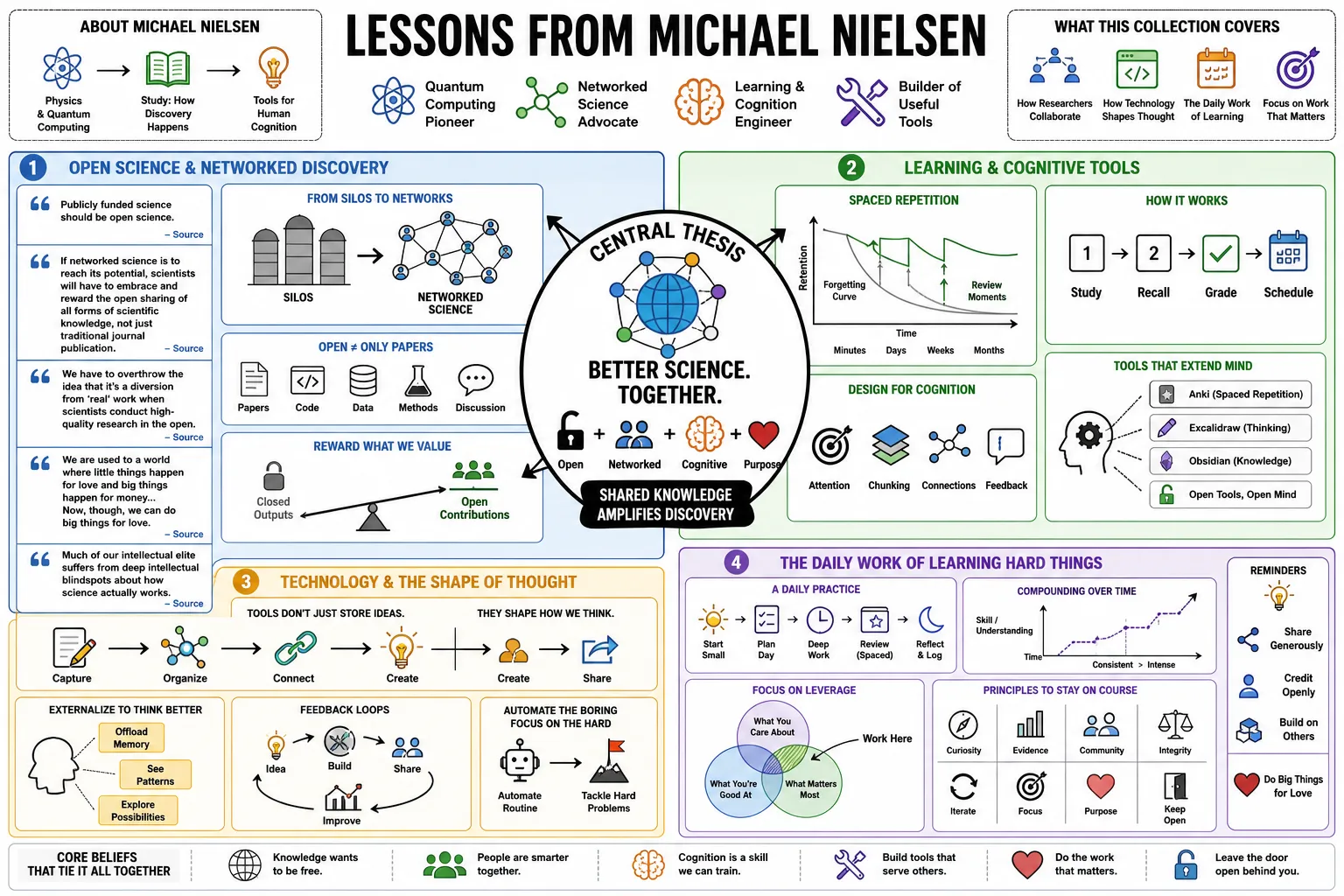
Lessons from Michael Nielsen
Michael Nielsen helped establish the field of quantum computing before leaving physics to study how scientific discovery actually happens. He is known for his work on networked science, spaced repetition, and building tools that improve human cognition. This collection gathers his writing on how researchers collaborate, how technology shapes thought, and the daily work of learning hard subjects.
Part 1: Open Science and Networked Discovery
- On the open science mandate: "Publicly funded science should be open science." — Source: [Quotesgram]
- On breaking academic silos: "If networked science is to reach its potential, scientists will have to embrace and reward the open sharing of all forms of scientific knowledge, not just traditional journal publication." — Source: [MichaelNielsen.org]
- On true scientific diversion: "We have to overthrow the idea that it's a diversion from 'real' work when scientists conduct high-quality research in the open." — Source: [Wikiquote]
- On doing big things for love: "We are used to a world where little things happen for love and big things happen for money... Now, though, we can do big things for love." — Source: [Inside Story]
- On intellectual blindspots: "Much of our intellectual elite who think they have 'the solutions' have actually cut themselves off from understanding the basis for much of the most important human progress." — Source: [Substack]
- On collective intelligence: "Networked science won't just speed up discovery, but will actually amplify our collective intelligence, expanding the range of scientific problems which can be attacked at all." — Source: [MichaelNielsen.org]
- On designed serendipity: Modern networked tools can systematically connect researchers with the exact expertise they need, replacing the historical reliance on sheer coincidence. — Source: [Dominic Cummings's Blog]
- On collective problem-solving: Initiatives like the Polymath Project show that massive online collaboration can crack mathematical problems that isolated experts could never solve alone. — Source: [Carnegie Council]
- On cultural blockers: The primary obstacles preventing a revolution in scientific discovery are deeply entrenched cultural norms within academia rather than technological limitations. — Source: [MichaelNielsen.org]
Part 2: Tools for Thought and the Medium of Cognition
- On transformative media: "Such a medium creates a powerful immersive context, a context in which the user can have new kinds of thought, thoughts that were formerly impossible for them." — Source: [Andy Matuschak's Blog]
- On domain expertise in tool building: "Unless you are deeply involved in practicing that subject, it's going to be extremely difficult to build good tools." — Source: [Andy Matuschak's Blog]
- On the limitations of tech industry cycles: "That practice has been astoundingly successful at its purpose: creating great businesses. But it's also what Alan Kay has dubbed a pop culture, not a research culture." — Source: [MDubakov]
- On thought as a technology: Interfaces and media, from the printing press to software, fundamentally reshape how humans think rather than merely transmitting information. — Source: [Cognitive Medium]
- On the difficulty of genuine innovation: To build truly transformative tools for thought, software developers must move beyond the rapid product cycles of consumer tech and engage in long-term foundational research. — Source: [Numinous Productions]
- On mnemonic media: A properly designed reading environment embeds memory practices directly into the text, changing the act of reading from passive consumption into guaranteed retention. — Source: [Michael's Notebook]
- On building tools for specific subjects: Generic tools often fail to transform thought; the most powerful cognitive software is built by practitioners trying to solve hard problems in their specific field. — Source: [Maggie Appleton's Digital Garden]
- On expanding cognitive boundaries: A real tool for thought introduces concepts and mental motions that the user couldn't previously conceptualize, rather than merely making an existing task faster. — Source: [Substack]
- On the broader metascience context: Developing better tools for thought is inherently a metascientific project, as it aims to improve the underlying cognitive infrastructure of discovery itself. — Source: [Science Plus Plus]
Part 3: Spaced Repetition and the Choice to Remember
- On memory as an active choice: "Anki makes memory a choice, rather than a haphazard event, to be left to chance." — Source: [Augmenting Cognition]
- On perfect memory: "Memory is fundamental to our thinking, and the notion of having a perfect memory is seductive." — Source: [Augmenting Cognition]
- On the foundation of cognition: "But I now believe memory is at the foundation of our cognition." — Source: [GitHub Pages]
- On the goal of repetition: "The point here isn't really to memorize. It's to be changed—to metabolize an experience so that I feel or act differently in the future." — Source: [Andy Matuschak's Blog]
- On exponential returns: "This is the big, counterintuitive advantage of spaced repetition: you get exponential returns for increased effort. On average, every extra minute of effort spent in review provides more and more benefit." — Source: [Numinous Productions]
- On memory system framing: The term "memory system" is a far more accurate framing than "spaced repetition system," which overly fixates on the underlying mechanism. — Source: [Andy Matuschak's Blog]
- On mathematical understanding: Spaced repetition systems can be used to break down and completely internalize complex mathematical proofs, making previously impenetrable subjects feel fluent. — Source: [Cognitive Medium]
- On overcoming forgetfulness: Relying on natural memory alone guarantees that much of what we read and learn will evaporate, whereas memory systems enforce durable retention. — Source: [Dominic Cummings's Blog]
- On the cost of adoption: The biggest barrier to using memory systems effectively is the upfront effort of making flashcards and the daily discipline of review, which deters most potential users. — Source: [Better Humans]
Part 4: Artificial Intelligence and Neural Networks
- On defining neural networks: "Neural networks, a beautiful biologically-inspired programming paradigm which enables a computer to learn from observational data." — Source: [Goodreads]
- On defining deep learning: "Deep learning, a powerful set of techniques for learning in neural networks." — Source: [NeuralNetworksAndDeepLearning.com]
- On the utility of deep networks: "Empirical evidence suggests that deep networks are the networks best adapted to learn the functions useful in solving many real-world problems." — Source: [NC State University]
- On the pedagogical approach to AI: To truly understand deep learning, one must build the underlying algorithms from scratch rather than relying exclusively on black-box libraries. — Source: [Michael's Notebook]
- On the shift in programming paradigms: Traditional programming requires explicit instructions, while neural networks represent a shift to systems that derive rules implicitly from massive datasets. — Source: [GitHub]
- On understanding AI fundamentals: Grasping the mathematics of backpropagation and gradient descent is essential before moving on to complex modern architectures. — Source: [NeuralNetworksAndDeepLearning.com]
- On intuition in machine learning: Developing a mathematical intuition for how simple neural layers interact is more valuable than memorizing the structure of the latest state-of-the-art model. — Source: [Cross Validate]
- On AI governance and dual-use: As AI agents become more capable than simple tools, the world must navigate the profound philosophical and governance challenges of dual-use technologies. — Source: [Future of Life Institute]
- On breaking fragile worlds: The rapid scaling of artificial intelligence poses severe questions about whether our current civilizational structures are strong enough to survive incoming technological shocks. — Source: [iHeart Podcasts]
- On the nature of AI agents: There is a fundamental difference in risk profile between AI deployed as an obedient tool versus AI designed to act as an autonomous agent pursuing its own goals. — Source: [Future of Life Institute]
Part 5: Quantum Computing and the Physics of Information
- On computation as a physical process: "Computers are physical objects, and computations are physical processes. What computers can or cannot compute is determined by the laws of physics alone, and not by pure mathematics." — Source: [Reddit Discussions]
- On the baseline for quantum study: Attempting to study quantum computing without a rigorous grounding in linear algebra and basic quantum mechanics is futile. — Source: [Y Combinator Hacker News]
- On the philosophical stakes of physics: Quantum mechanics introduces faster computation while fundamentally challenging classical intuitions about information, reality, and determinism. — Source: [Caltech Heritage Project]
- On Einstein and quantum mechanics: Early skepticism toward quantum theory often framed it as "Real Black Magic Calculus," a sentiment reflecting the deep counter-intuitiveness of quantum phenomena. — Source: [Physics Stack Exchange]
- On standardizing the field: The transition of quantum information from a niche theoretical curiosity into an established scientific discipline required the creation of rigorous standard textbooks to unify the language of physicists and computer scientists. — Source: [Wikipedia]
- On the ultimate machine: The quantum computer is frequently viewed as the ultimate device of modern science, capable of solving specific classes of problems that classical hardware never could. — Source: [WordPress Science Blogs]
- On the limitations of classical computing: Classical Turing machines fail to capture the physical reality that some quantum processes can be simulated efficiently only by quantum systems. — Source: [Preprints.org]
- On stepping away from physics: Transitioning from mainstream quantum physics to open science advocacy was driven by the belief that improving the mechanisms of scientific collaboration could have a wider impact than isolated physics research. — Source: [Caltech Heritage Project]
- On the physical limits of information: Information is never purely abstract; it is always instantiated in physical systems, meaning the ultimate limits of communication and processing are bound by quantum theory. — Source: [Caltech Heritage Project]
- On foundational texts: Writing a comprehensive textbook in a rapidly evolving field forces researchers to clarify hazy concepts and separate enduring principles from temporary hype. — Source: [Conversations with Tyler]
Part 6: Metascience and the Ecosystem of Progress
- On the pace of change: "The process of scientific discovery – how we do science – will change more over the next 20 years than in the past 300 years." — Source: [MichaelNielsen.org]
- On the necessity of metascience: "Metascience plays a key role: it deepens our understanding of which social processes best support discovery; that understanding can then help drive change." — Source: [Science Plus Plus]
- On evaluating universities: "Systems like the university or peer review are immensely deep inventions... But I believed a radically better discovery system must be possible." — Source: [Michael's Notebook]
- On latent scientific potential: "I believe far better social processes are possible in science, and that these could activate great latent potential for discovery." — Source: [Notion.so Essays]
- On scientific verification loops: The speed and reliability of scientific progress depend heavily on how tightly a field can close its feedback loops between theory and experimental verification. — Source: [Dwarkesh Podcast]
- On the fragility of civilization: We cannot assume continuous upward scientific progress; history shows that institutions and civilizations can stagnate or collapse if they fail to maintain their intellectual infrastructure. — Source: [Conversations with Tyler]
- On alien technology trees: If extraterrestrial civilizations exist, their scientific progress would likely follow a completely different "tech stack" based on different early discoveries and environmental constraints. — Source: [Dwarkesh Podcast]
- On wise optimism: True optimism in science avoids the naive belief that technology solves everything. It focuses instead on the active construction of better institutions to manage the power of new discoveries. — Source: [Into the Bytecode]
- On institutional design: Much of the friction in modern scientific output stems from legacy funding models and publication incentives that punish high-risk exploration. — Source: [Marginal Revolution]
- On reinventing discovery: The internet was initially built by researchers for researchers, yet the scientific establishment has been one of the slowest sectors to fully utilize the web for collaborative discovery. — Source: TEDxWaterloo
Part 7: Principles of Effective Research
- On tests as gifts: "Tests are a gift. And great tests are a great gift. To fail the test is a misfortune. But to refuse the test is to refuse the gift, and something worse, more irrevocable, than misfortune." — Source: [MichaelNielsen.org]
- On discovery fiction: "To help me understand a scientific result, I often find it helpful to write what I call discovery fiction. By this I mean: a plausible story of how I could have discovered that result." — Source: [Michael's Notebook]
- On spontaneous discovery: "If you keep your mind open while engaging in exploration, and are working at the edge of what is known, you'll often see huge opportunities open wide in front of you, provided you keep developing your range of skills." — Source: [MichaelNielsen.org]
- On Isaac Newton and eras: "Newton was not the first of the age of reason. He was the last of the magicians, the last great mind which looked out on the visible and intellectual world with the same eyes as those who began to build our intellectual inheritance." — Source: [Dwarkesh Podcast]
- On reading technical papers: Approaching a difficult scientific paper requires multiple passes. First to understand the structure and claims, and only later to interrogate the mathematics and methodology. — Source: [JHU Research Guides]
- On the nature of human endeavor: "All great human deeds both consume and transform their doers. Consider an athlete, or a scientist, or an artist... In the service of their goals they lay down time and energy." — Source: [MichaelNielsen.org]
- On psychological momentum: Success in research relies heavily on choosing the right problems, managing psychological momentum, and knowing when to abandon a dead end. — Source: [GitHub Pages]
- On the value of false starts: Reconstructing the dead ends and incremental steps of a famous discovery often yields far more insight into the scientific method than reading the final polished paper. — Source: [Michael's Notebook]
- On building a research career: Developing a strong personal vision for what questions matter is the most difficult and necessary step for transitioning from a student to an independent researcher. — Source: [MichaelNielsen.org]
Part 8: Philosophy, Morality, and Excellence
- On moral imagination: Atheism and scientific materialism do not preclude deep engagement with moral questions. They demand a rigorous application of moral imagination to navigate life's big questions. — Source: [Michael's Substack]
- On the influence of Simone Weil: The concept of attention, as framed by philosophers like Simone Weil, is deeply relevant to how we choose to direct our cognitive resources in an age of distraction. — Source: [Conversations with Tyler]
- On optimism in technology: Maintaining a positive outlook on technological progress requires acknowledging severe risks while actively working to build systems that elevate human potential. — Source: [Into the Bytecode]
- On the transformation of the doer: Engaging in extreme excellence inevitably alters the person doing the work, making the pursuit of mastery as much about self-transformation as external achievement. — Source: [MichaelNielsen.org]
- On effective altruism and progress: Long-term human progress requires funding immediate charitable causes alongside building the foundational knowledge necessary to solve future unforeseen problems. — Source: [Future of Life Institute]
- On writing as thinking: Writing is an arena where confused ideas are stress-tested and refined into clarity, rather than simply a medium for recording fully formed thoughts. — Source: [Michael's Notebook]
- On intellectual honesty: A scientist's first obligation is to an unyielding honesty about what the data actually reveals, rather than to their initial hypothesis or career advancement. — Source: [MichaelNielsen.org]
- On the aesthetics of science: There is a profound beauty in a well-constructed theory or a perfectly executed experiment that mirrors the aesthetic satisfaction found in high art. — Source: [Michael's Notebook]
- On legacy and contribution: The most enduring contributions to human knowledge often come from individuals who prioritize the collaborative advancement of the field over their personal accolades. — Source: [Caltech Heritage Project]