Michael Platt is a neuroscientist at the University of Pennsylvania where he serves as the director of the Wharton Neuroscience Initiative. He studies the biological mechanisms of decision-making and social interaction to understand how the physical brain shapes leadership and business performance. This profile outlines his findings on how ancient evolutionary hardware dictates modern organizational behavior.
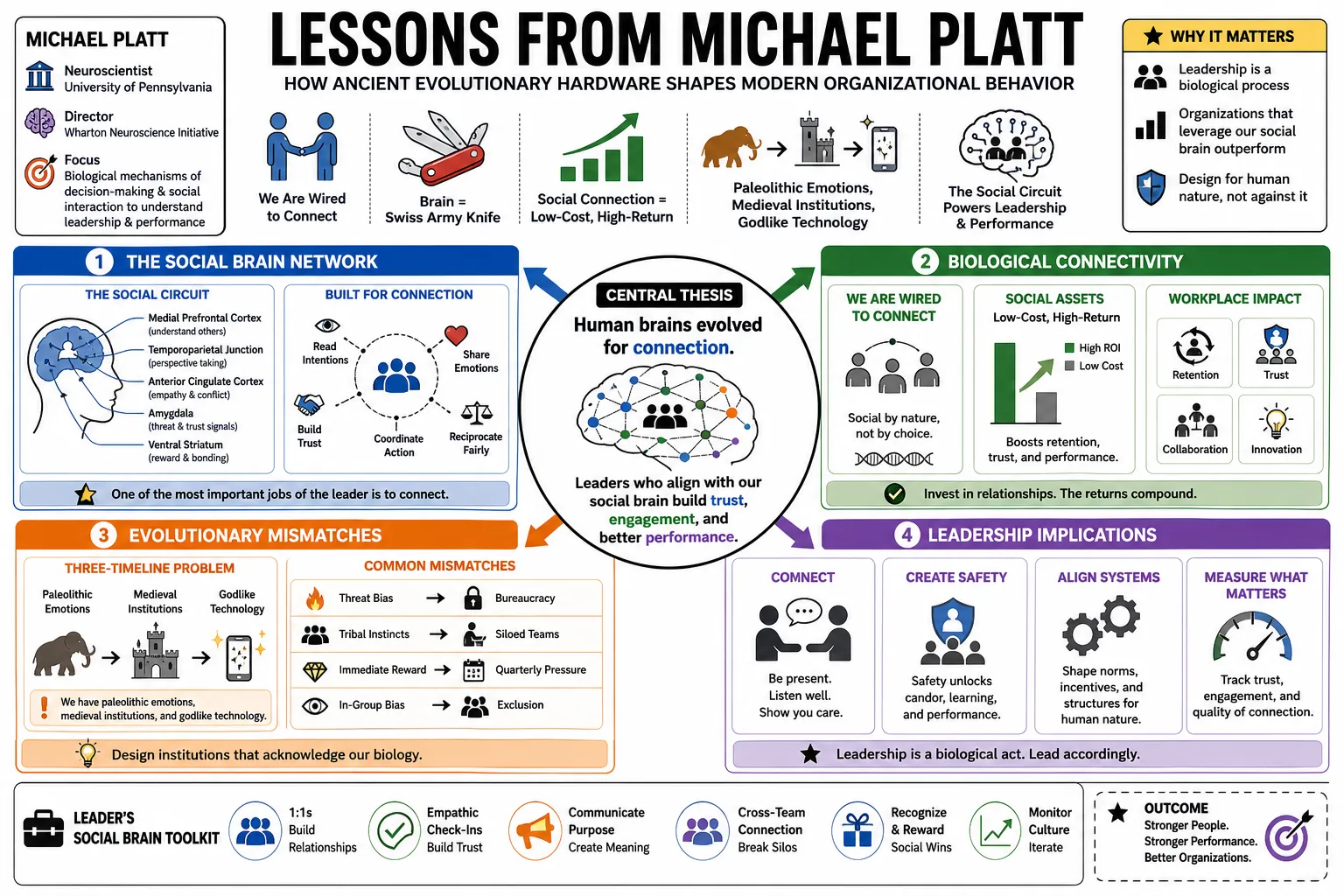
Part 1: The Social Brain Network
- On Biological Connectivity: "We are human beings, and we are social creatures by nature. We are wired that way. One of the most important jobs of the leader is to connect with the people that they manage." — Source: Wharton School
- On the "Swiss Army Knife" Brain: "Your brain is not an all-purpose computer; it's much more like a Swiss Army knife equipped with specific tools." — Source: Wharton Neuroscience Initiative
- On Social Assets: "Social connection is a 'low-cost, high-return' investment with workplace relationships proven to boost retention and trust." — Source: Dr. Michael Platt
- On Evolutionary Mismatches: "We have paleolithic emotions, medieval institutions, and godlike technology." — Source: Microsoft WorkLab
- On the Social Circuit: "The social brain network is a specialized circuit evolved to navigate human interactions, originally designed for small groups of 20 to 100 people." — Source: Knowledge at Wharton
- On Brain Plasticity: "The social brain is like a muscle—the more it is exercised the stronger it becomes." — Source: IEDP Developing Leaders
- On Biological Survival: "One of the first things brains learned to do on this planet was to repeat things that made the world a little bit better for you." — Source: Dokumen
- On Social Information: "Our brains prioritize social information above almost everything else because, for our ancestors, being part of a group was a matter of life or death." — Source: Marketing Today Podcast
- On the Leader's Mindset: "The 'leader's brain' is a mindset that seeks to use neuroscience insights to develop our skills as managers and leaders." — Source: Wharton School Press
Part 2: Leadership as a Biological Skill
- On Developing Talent: "Leadership is a set of abilities with which a lucky few are born... The good news for the rest of us is that those abilities can be developed." — Source: University of Pennsylvania
- On Practice: "The brain is plastic; these 'leadership muscles' can be strengthened through intentional practice." — Source: IEDP
- On Cognitive Readiness: "AI can analyze behavioral cues like response latency to detect a person's cognitive readiness for leadership tasks." — Source: Microsoft
- On Relationship Building: "Authentic dialogue and active curiosity physically strengthen the neural pathways responsible for social intelligence." — Source: Dr. Michael Platt
- On Resilience: "In times of crisis, the individuals who thrive are those who expand their social circles and become more cooperative." — Source: Wharton Neuroscience
- On Training the Brain: "Through use, you can make the tools in your 'Swiss Army knife' brain a little sharper." — Source: Knowledge at Wharton
- On Natural Leaders: "While some have natural relationship-building skills, these are biological tools that can be 'dialed up' through neuro-enhancement techniques." — Source: Penn Today
- On Management: "Business runs on brains. The more we understand about the people we manage, the better we can do." — Source: Wharton School
- On Emotional Safety: "The brain learns best when it is curious and joyful, not when it is under the pressure of a ticking clock." — Source: Microsoft WorkLab
Part 3: Decision Science and the Evidence Accumulator
- On Evidence Accumulation: "The brain makes decisions by accumulating evidence for different options until a threshold is reached." — Source: Wharton Neuroscience Initiative
- On the Speed-Accuracy Trade-off: "The faster you make a decision, the less evidence your brain has gathered, leading to more mistakes." — Source: Dr. Michael Platt
- On Attention Filters: "Attention acts as a filter that 'turns up the volume' on specific information while suppressing distractions." — Source: Marketing Today Podcast
- On Strategic Slowing: "If accuracy is critical, you must consciously slow down to allow the 'noisy' biological data in your brain to settle into a clear signal." — Source: Knowledge at Wharton
- On Choice Overload: "Divisive normalization is the mathematical way the brain scales the value of an option relative to other available choices, which explains choice overload." — Source: Wharton Business Daily
- On Irrationality: "Irrational decisions are often the result of brain processes that were adaptive 200,000 years ago but are mismatched for the modern world." — Source: Wharton Neuroscience
- On Choice Architecture: "Instead of trying to 'think' your way out of bias, use choice architecture—designing environments that nudge the brain toward better decisions." — Source: Microsoft
- On Learning from the Unchosen: "We learn not just from what we did, but by imagining what might have happened if we chose differently." — Source: ITOL
- On Internal Biases: "Cognitive biases are not 'errors' but deeply baked-in evolutionary processes." — Source: Wharton School Press
- On Brain Utility: "By shifting your focus, you can physically change how your brain calculates the 'utility' or value of a choice." — Source: Knowledge at Wharton
Part 4: Interpersonal Synchrony and Team Flow
- On Group Flow: "Interpersonal physiological synchrony is the glue that sustains harmony, trust, cooperation, and teamwork." — Source: University of Pennsylvania
- On Neural Synchrony: "High-performing teams exhibit 'brain-to-brain coupling' where their brainwaves and heart rates align." — Source: Wharton Neuroscience Initiative
- On Team Chemistry: "Physiological synchrony is the chemistry underlying group flow and is a measurable biological state." — Source: Dr. Michael Platt
- On Communication Efficiency: "When people communicate effectively, their brain waves literally synchronize." — Source: Knowledge at Wharton
- On Establishing Trust: "Eye contact released oxytocin in both parties, initiating neural synchrony and signaling rapport." — Source: Microsoft WorkLab
- On Tribal Identities: "Leaders can facilitate neural synchrony by Establishing shared 'tribal' identities through common goals." — Source: Wharton School Press
- On Mirroring: "Trigger synchrony through 'mirroring'—subtly imitating gestures—which signals safety to the other person's brain." — Source: Penn Today
- On Face-to-Face Advantage: "Face-to-face interaction is more effective than video calls for eye contact and brain-to-brain synchrony." — Source: Knowledge at Wharton
- On Team Coordination: "Social coordination has biological foundations that can be measured through wearable technology." — Source: Wharton Neuroscience Initiative
Part 5: Innovation and the Explorer Brain
- On the Focus vs. Explore Trade-off: "The brain has two mutually opposed networks: one for focus (routine tasks) and one for exploration (creativity)." — Source: Wharton School Press
- On Creative Downtime: "Leaders must intentionally create 'downtime' to allow the exploration network to engage, as the focus network suppresses it." — Source: Knowledge at Wharton
- On Foraging Logic: "The brain uses the same logic for finding new ideas that our ancestors used for foraging for food in the wild." — Source: Dr. Michael Platt
- On Innovation Stifling: "If you are constantly under high stress, your brain stays in the focus network, effectively killing your ability to innovate." — Source: Microsoft WorkLab
- On Curiosity: "Joy and curiosity are the biological drivers that allow the brain to switch into 'exploration mode'." — Source: Wharton Neuroscience Initiative
- On Breaking Routine: "Walking meetings disengage the brain from routine, which helps spark innovation." — Source: Knowledge at Wharton
- On Exploration Incentives: "To foster innovation, leaders must reward exploration even when it doesn't immediately lead to exploitation of a resource." — Source: Wharton School Press
- On Mental Exhaustion: "Innovation requires high metabolic costs; you cannot expect a brain to be creative when it is cognitively depleted." — Source: Dr. Michael Platt
- On Strategic Curiosity: "Successful innovators have brain circuits that are highly sensitive to information that contradicts their current model of the world." — Source: Penn Today
Part 6: Trust, Oxytocin, and Influence
- On the Gaze Technique: "Making people feel 'bathed in your gaze' triggers oxytocin and synchronizes their brain activity with yours." — Source: Knowledge at Wharton
- On Biological Trust: "Oxytocin can increase 'giving' behavior and social coordination, providing the biological foundation for team chemistry." — Source: Dr. Michael Platt
- On Eye Contact Priority: "Prioritize eye contact; it is the primary trigger for the social brain network and fosters immediate trust." — Source: IEDP
- On Perspective-Taking: "Move beyond empathy (feeling what others feel) to active perspective-taking (thinking what others think) to improve coaching." — Source: Wharton Neuroscience Initiative
- On Influence: "Leaders influence others by effectively 'tuning' their own social brains to match the state of their audience." — Source: Wharton School Press
- On Rapport Cues: "Pupil dilation and true eye contact are essential cues our social brains require to build trust, which are often lost in digital formats." — Source: Microsoft WorkLab
- On Social Signaling: "Making eye contact signals that the other person is the 'most important thing right now' to their biological hardware." — Source: Knowledge at Wharton
- On Brand Growth: "Neuroscience provides a better ROI for brands because the brain tells the truth while self-reported survey data often lies." — Source: Marketing Today Podcast
- On Marketing Biology: "Cracking the code on brand growth requires understanding how products activate the brain's reward and social circuitry." — Source: Dr. Michael Platt
- On Non-Verbal Trust: "Trust is built through thousands of tiny, non-verbal signals that the social brain processes sub-consciously." — Source: Penn Today
Part 7: The Biology of Power and Isolation
- On the Power Paradox: "One of the most critical findings for leadership is that power 'turns down' the social brain." — Source: Knowledge at Wharton
- On Empathy Decline: "As people gain status, they often become less attentive to others' cues and less capable of perspective-taking." — Source: Dr. Michael Platt
- On the Loneliness Delta: "Loneliness is the painful delta between the social connections you have and the ones you actually want." — Source: Wharton Neuroscience Initiative
- On Loneliness Damage: "Loneliness is biologically damaging, with research suggesting it can be as harmful to health as smoking 15 cigarettes a day." — Source: University of Pennsylvania
- On the Power Trap: "Leaders must consciously work to 'turn back on' their social brain to avoid the blind spots created by power." — Source: Wharton School Press
- On Social Exercise: "Social engagement is the ultimate treadmill for the brain, having twice the impact on staving off decline as physical exercise." — Source: Knowledge at Wharton
- On Digital Isolation: "Tools like Zoom create fatigue because they lack the 3D cues our social brains require to feel connected." — Source: Microsoft WorkLab
- On the Epidemic of Despair: "Isolation causes an 'epidemic of despair' because it denies the brain the social synchrony it needs to regulate stress." — Source: Dr. Michael Platt
- On Power Blind Spots: "High-power individuals show less activation in the mirror neuron system, making them literally less sensitive to the actions of others." — Source: Penn Today
Part 8: Future Frontiers: AI and Human Potential
- On AI Harmony: "The future of leadership involves harmonizing human biological limitations with the potential of Generative AI." — Source: Wharton School Press
- On the Stone Age Brain: "No matter how enthusiastic you are about AI, you’re still using it with the same Stone Age brain, with all its quirks and constraints." — Source: Microsoft WorkLab
- On AI as a Neural Mirror: "AI can act as a tool to reveal 'neural secrets' of leadership by analyzing cues like facial affect or response latency." — Source: Wharton Neuroscience Initiative
- On Collaborative AI: "In the future, AI won't just automate tasks; it will help leaders understand when their team is 'overloaded' or 'in the zone'." — Source: Microsoft
- On Cognitive Unloading: "The brain prioritizes speed under stress; AI can help by handling routine tasks to keep the brain in an 'accurate' state." — Source: Knowledge at Wharton
- On Wearable Tech: "Using wearable technology and AI to measure performance in real-time allows leaders to provide more empathetic management." — Source: Dr. Michael Platt
- On Digital Signal Degradation: "Remote work feels draining because the brain has to work harder to decode degraded social signals." — Source: Wharton Neuroscience Initiative
- On Future Leadership: "Neuroscience can help illuminate a more enlightened path forward for leaders in a world dominated by digital interactions." — Source: Wharton School Press
- On Brain Augmentation: "Understanding the metabolic costs of decision-making allows us to schedule high-stakes tasks when cognitive resources are at their peak." — Source: IEDP
- On Human-AI Interaction: "Effective leadership in the AI era requires leveraging the social brain to maintain trust while utilizing machine accuracy for data." — Source: Penn Today