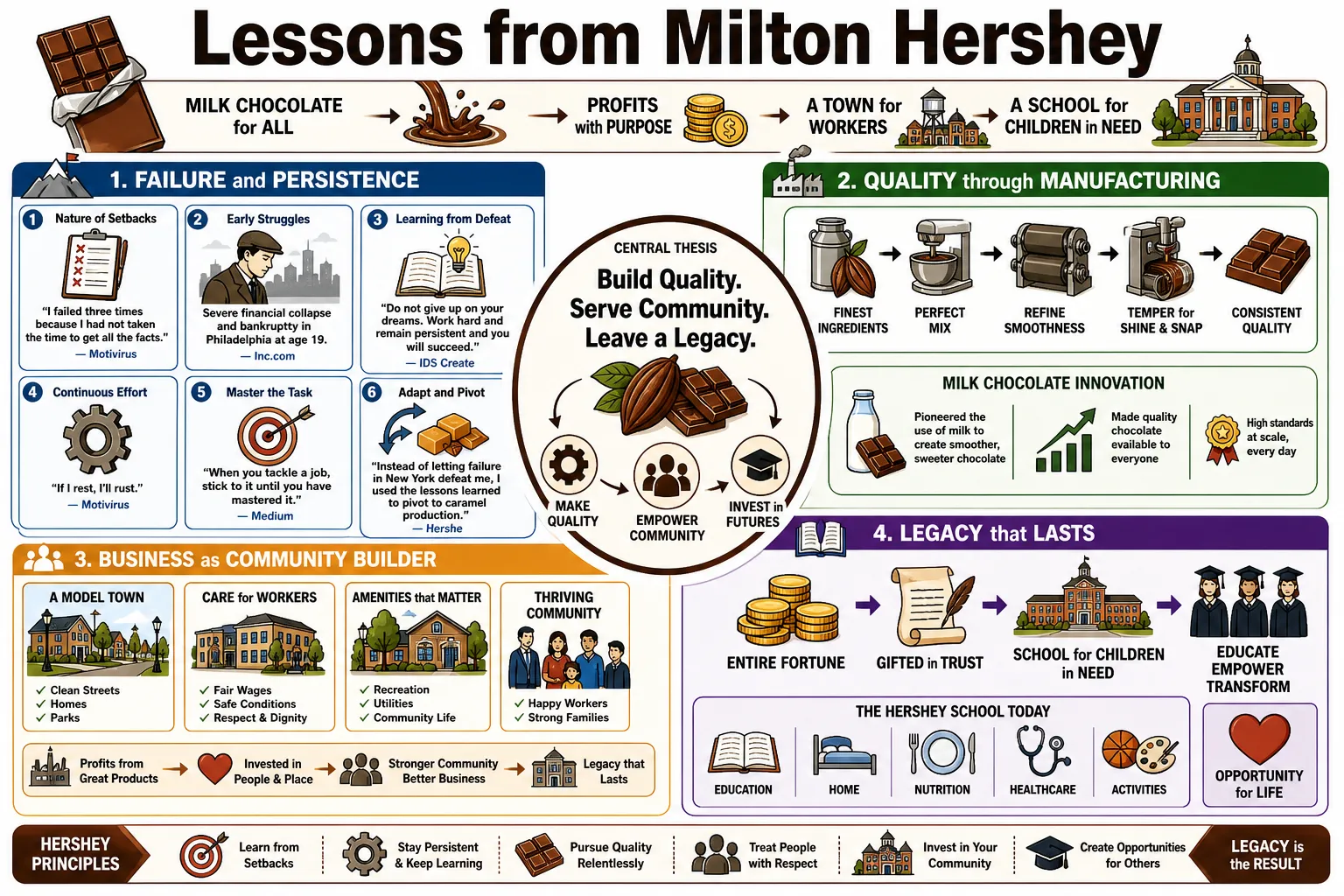
Lessons from Milton Hershey
Milton Hershey figured out how to mass-produce milk chocolate, turning a rare luxury into an everyday staple. He used the profits to build a town for his workers and later gave his entire fortune to a school for children in need. The lessons below cover his early bankruptcies, his approach to manufacturing quality, and his conviction that a business should serve its community.
Part 1: Failure and Persistence
- On the nature of setbacks: "I failed three times because I had not taken the time to get all the facts. After that I learned my lesson well." — Source: Motivirus
- On early struggles: "Before achieving success, I faced severe financial collapse and bankruptcy in Philadelphia at age 19." — Source: Inc.com
- On learning from defeat: "Do not give up on your dreams. Work hard and remain persistent and you will succeed." — Source: IDS Create
- On continuous effort: "If I rest, I'll rust." — Source: Motivirus
- On mastering a task: "When you tackle a job, stick to it until you have mastered it." — Source: Medium
- On adapting after failure: "Instead of letting failure in New York defeat me, I used the lessons learned to pivot to caramel production." — Source: Hershey Archives
- On the value of persistence: "My early ventures in candy-making taught me that success requires treating each failure as a crucial learning opportunity." — Source: Inc.com
- On defying expectations: "While my father was an eternal dreamer who never achieved financial stability, I used persistence to ground my dreams in reality." — Source: FEE
- On maintaining optimism: "Even when my equipment was confiscated due to unpaid debts, I remained focused on the future of confectionery." — Source: Penn State University
- On long-term vision: "The caramel business is a fad. The chocolate market will be a permanent one. I’ll stake everything on chocolate." — Source: Quoteswise
Part 2: Focus and Mastering the Craft
- On curiosity: "My experience has shown me that the people who are exceptionally good in business aren't so because of what they know, but because of their insatiable need to know more." — Source: Logomaker
- On practical knowledge: "I am a doer, not a theorist. Success is built on applying practical lessons." — Source: Hershey Story
- On ingredients: "Fresh milk makes good candy." — Source: Hershey Story
- On absolute commitment: "I started with the ambition and intention of making the best chocolate that money or skill could make, regardless of the cost of manufacture." — Source: Quoteswise
- On simplicity: "By focusing entirely on what we do best, we achieve operational efficiency and market dominance." — Source: Anspach Media
- On the scientific method in business: "I approached candy-making like a scientist in an apron, constantly experimenting until the formula was right." — Source: Medium
- On decisiveness: "After discovering the potential of milk chocolate at the 1893 World’s Columbian Exposition, I immediately purchased the German machinery needed to produce it." — Source: Philanthropy Roundtable
- On focusing resources: "Selling the Lancaster Caramel Company for one million dollars allowed me to focus all my capital on mass-producing milk chocolate." — Source: Hershey Story
- On Embracing Mass Production: Hershey's 1905 chocolate plant was designed to manufacture chocolate using the latest mass-production techniques, helping turn milk chocolate from a Swiss luxury into a nationally marketed product. — Reference: Hershey, PA history of Milton Hershey
Part 3: Quality Over Promotion
- On advertising: "Give them quality. That's the best kind of advertising in the world." — Source: Hersheyland
- On word-of-mouth: "A superior product speaks for itself, turning satisfied customers into the most effective brand advocates." — Source: Hershey Archives
- On the foundation of trust: "While marketing has its place, a non-negotiable focus on quality is the essential foundation for long-term customer trust." — Source: Medium
- On product excellence: "I was determined to make a chocolate bar better than any competitor's, relying on the product itself rather than paid campaigns." — Source: Hershey Archives
- On traditional marketing: "For decades, the Hershey Chocolate Company abstained from traditional paid advertising, proving that quality creates its own demand." — Source: Hershey Archives
- On mass appeal: "By dedicating resources to perfecting manufacturing processes and ingredients, we built a reputation that sustained our growth without a formal advertising budget." — Source: Hershey Archives
- On the consumer's palate: "The public will always recognize and return to genuine quality." — Source: The Hershey Company
- On building a lasting brand: "True brand identity is built on delivering a consistently excellent product, day after day." — Source: Anspach Media
- On prioritizing resources: "I invested in better ingredients and better machinery rather than spending money to convince people to buy an inferior product." — Source: Hershey Archives
Part 4: Building the Model Town
- On urban planning: "A model town should not be a faceless company town; it must provide a thriving environment with homes, schools, and parks." — Source: Hershey, PA
- On the connection between work and life: "The success of a company is deeply tied to the health and happiness of the people who build it and the community that sustains it." — Source: Hershey Archives
- On investing in infrastructure: "I invested my fortune into creating an environment where my employees could thrive, including cultural institutions." — Source: Hershey Story
- On integrated branding: "By naming the town Hershey, Pennsylvania, I created a powerful brand identity that linked our product directly to our values." — Source: Anspach Media
- On community well-being: "A business cannot truly succeed if the town surrounding it is failing." — Source: Hershey Archives
- On providing amenities: "Workers need more than just a paycheck; they need access to recreation, education, and decent housing." — Source: Hershey Story
- On corporate responsibility: "Building a community is an investment in the stability and loyalty of the workforce." — Source: The Hershey Company
- On creating a utopia: "My goal was to build a place where people could live well, work hard, and enjoy the fruits of their labor." — Source: Archive.org
- On long-term community value: "The town of Hershey was designed to outlast me, providing a permanent home for the industry and its workers." — Source: Hershey Archives
Part 5: Valuing Employees and Community
- On human relations: "We should deal with one another not as classes but as persons, as brothers." — Source: Logomaker
- On business as service: "Business is a matter of human service." — Source: Huxley Media
- On happiness: "One is only happy in proportion as he makes others feel happy and only useful as he contributes his influences for the finer callings in life." — Source: MHS Kids
- On togetherness: "We must value the collective well-being of our employees, consumers, and communities." — Source: The Hershey Company
- On integrity: "Maintaining high ethical standards in all business dealings is essential to long-term success." — Source: Corporate IR
- On fair treatment: "A loyal workforce is built on mutual respect and genuine care for their overall well-being." — Source: The Hershey Company
- On shared prosperity: "Financial success and social good are not mutually exclusive; they must go hand in hand." — Source: Hershey Archives
- On the purpose of wealth: "Wealth is only useful if it is used to benefit the community and humanity at large." — Source: Hershey Story
- On recognizing contributions: "Every individual in the factory plays a vital role in the quality of the final product." — Source: The Hershey Company
- On the social contract of business: "A business owes a debt to the community that allows it to operate." — Source: Hershey Archives
Part 6: Innovation and Mass Production
- On democratization of luxury: "I recognized that milk chocolate, then a luxury Swiss product, could be mass-produced to be affordable for everyone." — Source: Anspach Media
- On scale: "By applying mass-production techniques to milk chocolate, we transformed it from a rare treat for the wealthy into an everyday joy." — Source: The Hershey Company
- On technological foresight: "Seeing the German machinery in 1893 made me realize that the future of confectionery lay in automation and scale." — Source: Hershey, PA
- On continuous improvement: "Innovation is not a one-time event, but a constant process of refining the manufacturing process." — Source: Hersheyland
- On supply chain integration: "Securing fresh milk from local farms directly was critical to scaling up production without sacrificing taste." — Source: Hershey Story
- On the limits of the caramel business: "Caramels were a stepping stone; chocolate offered a universal appeal that could be scaled infinitely." — Source: Biography.com
- On efficiency: "Mass production requires simplifying the product line to focus on what can be done efficiently and excellently." — Source: Anspach Media
- On meeting demand: "Our goal was to make enough chocolate so that no one was priced out of enjoying it." — Source: Hersheyland
- On adapting to the market: "You must be willing to abandon a successful business model if a vastly superior opportunity presents itself." — Source: Medium
Part 7: Philanthropy and The Hershey School
- On his core motivation: "I was a poor boy myself once." — Source: Hershey Story
- On the genesis of the school: "It was Kitty's idea." — Source: Hershey Archives
- On the ultimate purpose of his fortune: "I endowed the Hershey Industrial School with my entire fortune to ensure its permanent operation and success." — Source: Philanthropy Roundtable
- On providing opportunity: "We sought to create a home and school to provide children with a stable life, education, and vocational training." — Source: The Hershey Company
- On measuring good: "The value of our good is not measured by what it does, but by the amount of good it does to the one concerned." — Source: Logomaker
- On legacy over lineage: "Having no children of our own, we decided to make the orphan boys of the United States our heirs." — Source: MHS Kids
- On structural philanthropy: "A trust was established to ensure that the chocolate company would perpetually fund the school's mission." — Source: Hershey, PA
- On the nature of charity: "True philanthropy goes beyond giving money; it requires building institutions that change lives." — Source: MHS Kids
- On protecting the mission: "The philanthropic structure we created was designed to resist corporate takeovers and protect our social mission forever." — Source: CMG Partners
- On evolving needs: "While founded for orphans, the institution's purpose is to provide high-quality education to any child facing significant social or financial need." — Source: Wikipedia
Part 8: Personal Philosophy and Legacy
- On overcoming adversity: "The unconquerable, unselfish spirit can bring fulfillment of even the most fantastic dreams. It can be done." — Source: Hershey Archives
- On a lifetime of work: "Reflecting on sixty years in the candy business, I realize that success is built on sustained effort and unyielding optimism." — Source: Archive.org
- On defining a life well-lived: "A life is measured by the permanent institutions it leaves behind for the betterment of others." — Source: Hershey Archives
- On quiet leadership: "I preferred to remain private and unassuming, letting the work and the community speak for my values." — Source: Hershey Story
- On practical utopias: "My utopian dreams were grounded in the reality of commerce; I wanted to prove that a profitable business could also be humane." — Source: Archive.org
- On the ultimate test of business: "A business is only truly successful if it continues to serve its community long after its founder is gone." — Source: MHS Kids
- On finding fulfillment: "Fulfillment comes not from accumulating wealth, but from finding a way to give it all away constructively." — Source: Focus on the Family
- On the journey vs. the destination: "The failures along the way were just as important as the successes, for they taught me what not to do." — Source: Medium
- On enduring principles: "My actions established a distinct approach that permanently blended commercial innovation with social responsibility." — Source: Hershey Archives