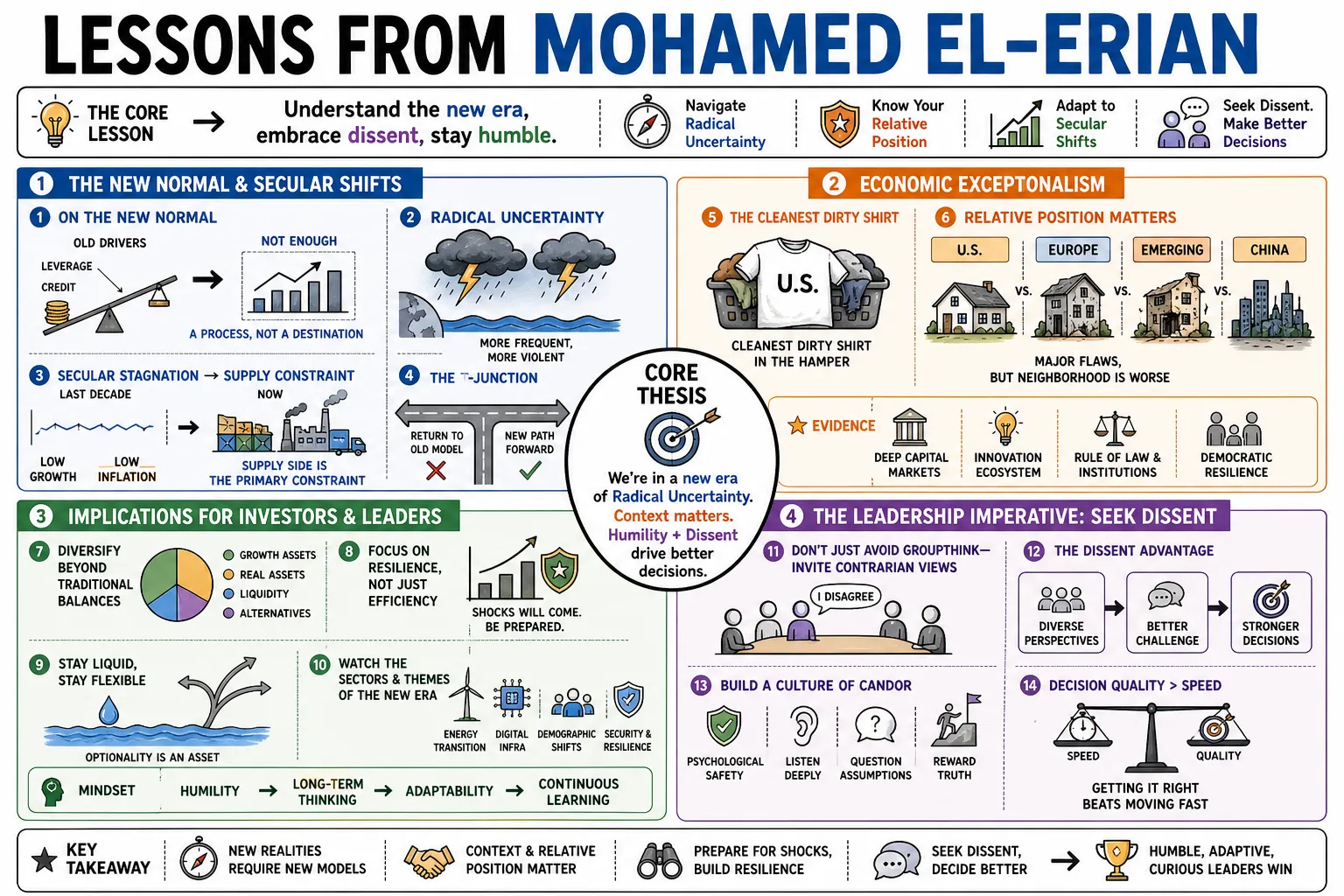
Lessons from Mohamed El-Erian
Mohamed El-Erian ran PIMCO through the 2008 crash and famously coined the "New Normal" to describe the era that followed. Now at Cambridge, his work focuses on why central banks can’t solve every economic problem and why the best leaders actively seek out dissenting perspectives.
Part 1: The New Normal and Secular Shifts
- On the New Normal: "The 'New Normal' was not a destination but a process where the old drivers of growth—leverage and credit—were no longer sufficient to sustain the global economy." — Source: PIMCO
- On Radical Uncertainty: "We have moved from a world of predictable massive liquidity to one of radical uncertainty where shocks are more frequent and more violent." — Source: Bloomberg TV
- On Economic Exceptionalism: "The U.S. remains the 'cleanest dirty shirt' in the hamper—it has major flaws, but its neighborhood is in much worse shape than its own house." — Source: CNBC Squawk Box
- On Secular Stagnation: "Low growth and low inflation were the hallmarks of the last decade, but we are now entering a period where the supply side of the economy is the primary constraint." — Source: Financial Times
- On the T-Junction: "The global economy is at a T-junction: one road leads to higher, inclusive growth, while the other leads to financial instability and social fragmentation." — Source: The Only Game in Town (Book)
- On Global Liquidity: "Liquidity is like oxygen; you only notice it when it is gone, and when it disappears, it does so suddenly and violently." — Source: Project Syndicate
- On Structural Change: "Investors often mistake structural changes for cyclical fluctuations, leading them to apply old solutions to brand new problems." — Source: When Markets Collide (Book)
- On the End of Low Volatility: "The era of repressed volatility is over; the central bank 'put' is no longer a guaranteed floor for market prices." — Source: Allianz Global Investors
- On the 2% Inflation Target: "The 2% inflation target is an arbitrary anchor from a bygone era; sticking to it too rigidly in a supply-constrained world risks unnecessary economic damage." — Source: Bloomberg Opinion
Part 2: Central Banking and The Fed's Dilemma
- On the Fed's 2021 Mistake: "Labeling inflation as 'transitory' was the biggest Fed policy mistake in several decades, causing them to fall significantly behind the curve." — Source: CNBC
- On Data Dependency: "Being 'data dependent' is a trap if it makes you backward-looking; central banks must have a forward-looking strategic vision to lead the market." — Source: Financial Times
- On the Policy Put: "The 'Fed Put'—the idea that the central bank will always rescue the market—has been diluted by the need to fight persistent inflation." — Source: Bloomberg
- On Central Banks as 'The Only Game in Town': "Central banks have been forced to do too much for too long because political institutions have failed to enact necessary structural reforms." — Source: The Only Game in Town (Book)
- On Quantitative Easing: "QE was a successful emergency measure that became a dangerous habit, distorting price signals and encouraging excessive risk-taking." — Source: Project Syndicate
- On Communications: "Central bank forward guidance has lost its potency because the gap between what they say and what they do has grown too wide." — Source: Financial Times
- On Financial Stability: "The Fed has a dual mandate of employment and price stability, but it often ignores its 'third mandate'—financial stability—until it is too late." — Source: Bloomberg TV
- On Interest Rate Hikes: "The danger of 'long and variable lags' means that by the time you see the full effect of rate hikes, you may have already pushed the economy over the cliff." — Source: CNBC
- On Monetary Policy Limits: "You cannot use a hammer (interest rates) to fix a broken supply chain or a labor mismatch; monetary policy is a blunt instrument." — Source: Allianz
Part 3: Investment Strategy and The Barbell Approach
- On Resilient Portfolios: "In a world of wider dispersion, you need a barbell strategy: deep resilience on one side and high-conviction agility on the other." — Source: Masters in Business Podcast
- On Cash as a Strategic Asset: "Cash is not just a drag on returns; in a volatile environment, it is an option to buy at lower prices when others are forced to sell." — Source: Financial Times
- On the 60/40 Split: "The traditional 60/40 portfolio is no longer a 'set and forget' strategy because the correlation between stocks and bonds has turned positive." — Source: CNBC
- On Emerging Markets: "Emerging markets are no longer a monolith; you must distinguish between the 'creditor' nations and the 'debtor' nations to find true value." — Source: When Markets Collide (Book)
- On Risk Management: "Risk is not just the probability of a loss; it is the inability to withstand a series of losses that occur simultaneously." — Source: PIMCO Viewpoints
- On Real Assets: "In an inflationary world, real assets like infrastructure and commodities provide a necessary hedge that financial assets cannot match." — Source: Allianz Global Investors
- On Selection over Momentum: "The era of the 'rising tide lifts all boats' is over; performance is now driven by idiosyncratic selection rather than broad market momentum." — Source: Bloomberg Opinion
- On Gold: "Gold's recent rise is a signal of the 'rest of the world' looking for alternatives to the dollar-based financial system." — Source: CNBC Squawk Box
- On Private Credit: "The migration of risk from the banking system to private credit is a structural shift that offers higher yields but comes with hidden liquidity traps." — Source: Financial Times
Part 4: Geopolitics and The Fragmenting Global Order
- On Fragmentation: "Global trade is shifting from 'just-in-time' efficiency to 'just-in-case' resilience, leading to higher costs and more localized supply chains." — Source: Project Syndicate
- On the Dollar's Hegemony: "The dollar's role as the global reserve currency is being tested not by a superior competitor, but by a world that is building 'pipes' to bypass it." — Source: Odd Lots Podcast
- On China's Transition: "China is attempting a difficult transition from an export-led economy to one driven by domestic consumption while managing a massive debt overhang." — Source: Financial Times
- On Weaponizing Finance: "Using the financial system as a weapon of war increases short-term pressure on adversaries but risks long-term fragmentation of the global order." — Source: Bloomberg Opinion
- On the Fifth World Order: "We are moving into a 'Fifth World Order' where there is no single hegemon and the rules of the game are constantly being renegotiated." — Source: Project Syndicate
- On G7 vs. BRICS: "The growing divide between the G7 and the expanded BRICS is not just about trade; it is about a competition for the narrative of the future." — Source: CNBC
- On Supply Chain Autonomy: "National security is increasingly defined by economic security—access to chips, energy, and medicine is the new front line of geopolitics." — Source: Allianz Research
- On the Middle East: "Geopolitical tensions in the Middle East act as a stagflationary wind, simultaneously slowing growth and pushing up energy-driven inflation." — Source: Bloomberg TV
- On Multilateralism: "The IMF and World Bank were designed for a different era; without reform, they will become irrelevant in a multi-polar world." — Source: Project Syndicate
- On Global Coordination: "The world has moved from a cooperative game to a zero-sum game, making it nearly impossible to solve global challenges like climate change." — Source: Financial Times
Part 5: Technology, AI, and Future Productivity
- On the AI Safe Speed Limit: "AI is the only factor today that could significantly increase the 'safe speed limit' of the U.S. economy without triggering inflation." — Source: Bloomberg TV
- On the Rational Bubble: "The AI boom is a 'rational bubble'—rational because the productivity gains are real, but a bubble because most firms will fail to capture them." — Source: ThinkAdvisor
- On Vertical Integration in Tech: "In the next phase of tech, the winners will be those who control the entire stack, from hardware to proprietary data sets." — Source: CNBC Squawk Box
- On Jobless Growth: "The great risk of the mid-2020s is a decoupling of GDP growth from job creation as automation replaces middle-skill roles." — Source: Odd Lots Podcast
- On Crypto and Trust: "Bitcoin is a 'distrust asset'—it gains value when people lose faith in traditional institutions and currencies." — Source: CNBC
- On CBDCs: "Central Bank Digital Currencies are inevitable, but the challenge is ensuring they don't stifle private innovation or compromise privacy." — Source: Financial Times
- On the Digital Divide: "Technological progress without inclusive education only deepens social inequality and fuels political populism." — Source: Queens' College Cambridge
- On Innovation vs. Regulation: "Regulation almost always lags behind innovation, creating a period of 'lawless growth' followed by a disruptive crackdown." — Source: Project Syndicate
- On Energy Transition: "The green transition is a structural supply shock that will be inflationary in the short term but essential for stability in the long term." — Source: Allianz Global Investors
- On Human Capital: "In an AI world, the most valuable skills are not coding or calculation, but critical thinking, empathy, and the ability to ask the right questions." — Source: Financial Times
Part 6: Market Behavioralism and Signal Processing
- On Signal vs. Noise: "Successful investing requires a 'healthy paranoia' that allows you to distinguish between temporary market noise and a permanent structural signal." — Source: When Markets Collide (Book)
- On Active Inertia: "Successful companies often fail because they respond to change by doing more of what made them successful in the past, even when it's no longer relevant." — Source: Wharton School
- On Cognitive Diversity: "A diverse group of thinkers will almost always outperform a group of like-minded experts because they cover each other's blind spots." — Source: Financial Times
- On Groupthink: "The greatest danger in policy-making is an echo chamber where everyone agrees because they all went to the same schools and worked at the same firms." — Source: The Only Game in Town (Book)
- On Overconfidence: "In markets, the moment you feel certain is the moment you are most vulnerable to a tail risk." — Source: PIMCO Viewpoints
- On Anchoring: "We are naturally anchored to the past; we expect the 'old normal' to return even when all the data says the world has changed." — Source: Project Syndicate
- On Market Malfunctioning: "A market that is volatile is healthy; a market that is malfunctioning, where liquidity dries up and prices stop moving, is a systemic crisis." — Source: Odd Lots Podcast
- On the 'Lemons' Problem: "Information asymmetry can freeze a market overnight; if buyers think they are buying 'lemons,' they will stop buying altogether." — Source: When Markets Collide (Book)
- On Narrative Following: "Markets don't follow data; they follow narratives that are occasionally interrupted by data." — Source: Bloomberg Opinion
- On Dissent: "Dissent should be formalized in the investment process; if nobody is arguing against the house view, the house view is probably wrong." — Source: Allianz
Part 7: Crisis Management and Financial Resilience
- On Plan B: "In a crisis, the most important thing is not your prediction, but your ability to execute 'Plan B' when your prediction fails." — Source: Wharton School
- On Compounding Negatives: "In finance, negative factors don't just add up; they compound, leading to a sudden 'tipping point' that few see coming." — Source: Financial Times
- On Banking Resilience: "Banks are safer today than in 2008, but the risk has simply migrated to the 'shadow banking' sector where there is less oversight." — Source: CNBC
- On Moral Hazard: "Every time a central bank rescues a market, it plants the seeds of the next crisis by encouraging even more reckless behavior." — Source: Project Syndicate
- On the Lehman Moment: "The mistake with Lehman wasn't letting it fail; it was failing to prepare the rest of the system for the consequences of its failure." — Source: Bloomberg TV
- On Debt Sustainability: "High debt is manageable as long as growth is higher than interest rates; the moment that flips, the math of solvency becomes brutal." — Source: Allianz Research
- On Tailing Risks: "Tail risks are now 'fat-tailed'—events that were once considered 1-in-100-year occurrences are now happening every decade." — Source: PIMCO
- On Inclusive Growth: "Economic growth that is not inclusive is inherently unstable; you cannot have a flourishing economy in a fracturing society." — Source: The Only Game in Town (Book)
- On Staying Calm: "In a market panic, your first job is to preserve your capital, and your second job is to preserve your ability to think clearly." — Source: RealVision Interview
Part 8: Leadership, Cognitive Diversity, and Career Mastery
- On the 22-Point List: "Work-life balance is a unicorn; what you must master is 'work-life fit,' ensuring you don't miss the 22 milestones that actually matter." — Source: Worth Magazine
- On Being an Outsider: "Feeling like an imposter is a superpower if it drives you to work harder and question the status quo more than the insiders." — Source: The National News
- On Reading Opposing Views: "My father taught me to read five newspapers every morning, specifically those I disagreed with, to ensure I wasn't trapped in my own bias." — Source: Business Insider
- On Midcourse Corrections: "Changing your mind in the face of new data is a sign of intellectual integrity, not a sign of weakness." — Source: Queens' College Cambridge
- On Organizational Agility: "The goal of a leader is to build a structure that makes people better than they would be on their own." — Source: Wharton School
- On Education as a Passport: "Education is the only asset that cannot be taken away from you; it is your permanent passport to any opportunity." — Source: Arab America
- On the Portfolio Career: "Success in the future isn't a single job for 40 years; it is a portfolio of experiences that allow you to adapt to a changing world." — Source: Financial Times
- On Mentorship: "A great mentor doesn't tell you what to do; they tell you how they thought through a similar problem so you can develop your own judgment." — Source: Allianz Leadership Blog
- On the Responsibility of Success: "The more successful you are, the greater your obligation to ensure that the ladder you climbed remains available for others." — Source: Queens' College Cambridge