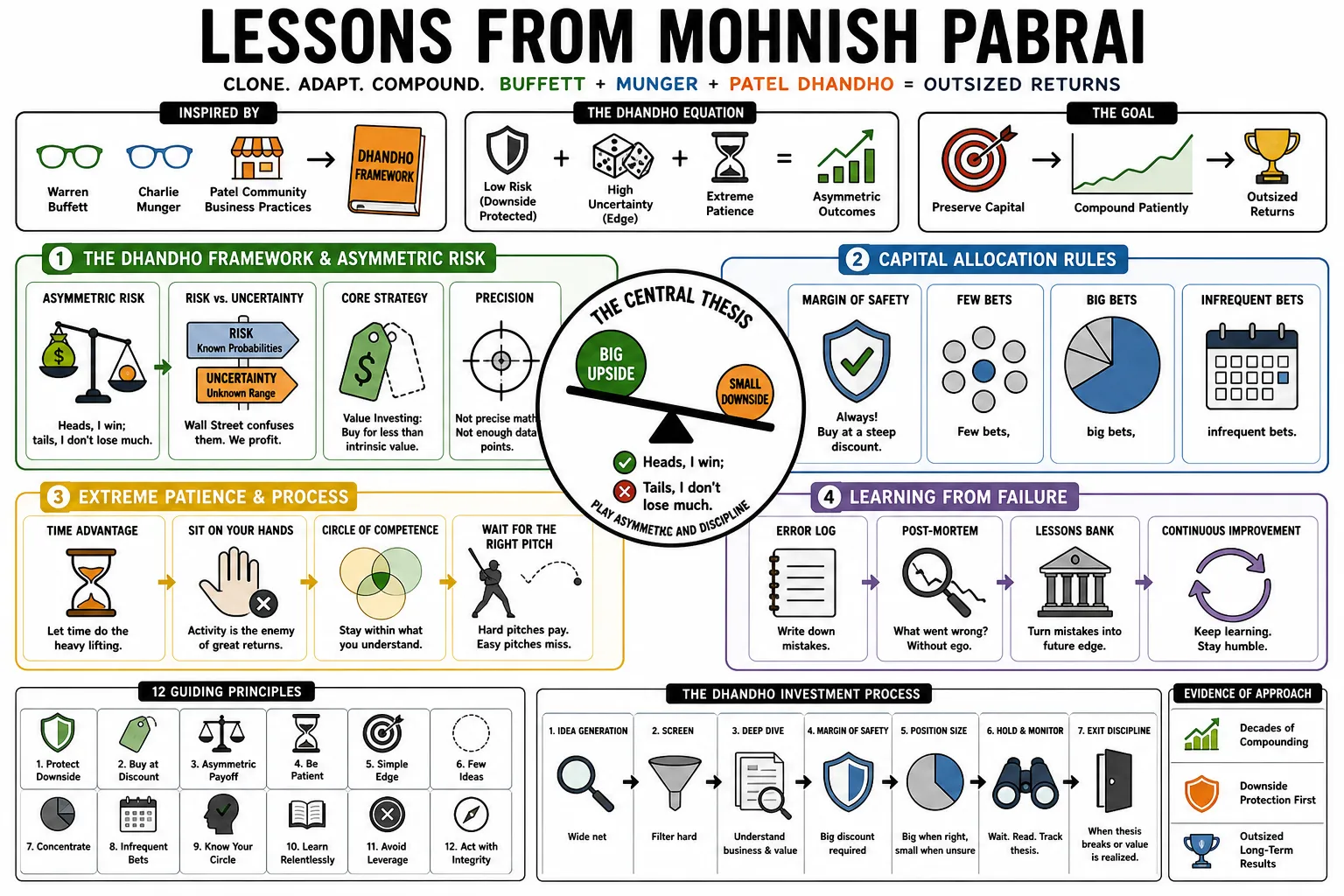
Investor Mohnish Pabrai built his career by openly cloning Warren Buffett and Charlie Munger, and adapting the Patel community's business practices into his "Dhandho" framework of low-risk, high-uncertainty bets. This collection outlines how he spent decades turning those borrowed strategies into outsized returns, detailing his specific rules for capital allocation, extreme patience, and learning from failure.
Part 1: The Dhandho Framework and Asymmetric Risk
- On Asymmetric Risk: "Heads, I win; tails, I don't lose much." — Source: [The Dhandho Investor]
- On Risk vs. Uncertainty: "Wall Street sometimes gets confused between risk and uncertainty, and you can profit handsomely from that confusion." — Source: [The Dhandho Investor]
- On Core Strategy: "All intelligent investing is value investing—buying assets for less than their intrinsic value." — Source: [The Dhandho Investor]
- On Precision: "Investing is not a discipline based on absolutes or precise mathematics. There simply aren't enough data points available to work out the exact odds." — Source: [The Dhandho Investor]
- On Downside Protection: "Margin of Safety – Always! Buy at a steep discount to intrinsic value." — Source: [The Dhandho Investor]
- On Portfolio Concentration: "Few bets, big bets, infrequent bets." — Source: [The Dhandho Investor]
- On Existing Operations: "Invest in existing businesses: Buying stocks is safer than starting a new venture." — Source: [The Dhandho Investor]
- On Finding Free Lunches: "Fixate on arbitrage: Look for free lunches or low-risk spreads." — Source: [The Dhandho Investor]
- On Fear in the Market: "Invest in distressed businesses in distressed industries. Look where others are fearful." — Source: [The Dhandho Investor]
- On Recognizing Opportunities: "When I see someone doing something smart, I will do it. I will adapt." — Source: [The Dhandho Investor]
Part 2: Patience, Inactivity, and Compounding
- On Creating Wealth: "You don't make money when you buy stocks. And you don't make money when you sell stocks. You make money by waiting." — Source: [The Dhandho Investor]
- On the Investor's Edge: "The single biggest advantage a value investor has is not IQ. It’s patience and waiting." — Source: [The Dhandho Investor]
- On Awaiting Opportunities: "Waiting for the right pitch, and waiting for many years for the right pitch." — Source: [The Dhandho Investor]
- On Market Inefficiency: "Most of the time, assets trade hands at or above their intrinsic value. The key, however, is to wait patiently for that super-fast pitch down the center." — Source: [The Dhandho Investor]
- On Sitting Still: "The good news in investing is there are no HR problems. If there are no humans, there are no problems!" — Source: [The Dhandho Investor]
- On Long-term Horizon: "The wonderful compounders we own in India have legs. Many of them are easy doubles from here. I just hope I am smart enough to hold on to some of our India bets for a long time." — Source: [The Dhandho Investor]
- On Temptation: "The mistress always appears to look better than the wife, but she may not be better. Appearances can be deceiving." — Source: [Chai with Pabrai]
- On Inaction as Action: "The real wealth is created in the sitting and letting the investment thesis play out over years." — Source: [The Dhandho Investor]
- On the Thirty-Year Game: "I describe my career as a Thirty-Year Game of cloning Warren Buffett." — Source: [The Dhandho Investor]
- On Daily Rest: "I have a hard time getting past the day without the nap, so the nap is a must." — Source: [Chai with Pabrai]
Part 3: The Circle of Competence
- On Staying Within Bounds: "The only way one should buy stocks is if you understand the underlying business. You stay within the circle of competence." — Source: [The Dhandho Investor]
- On Identifying the Edges: "If you find yourself asking yourself the question, 'Is this within my circle of competence?', I can just make it very quick for you. It is not." — Source: [The Dhandho Investor]
- On Complex Valuations: "If you find yourself asking the question, 'What is this business worth?', again, it’s not within your circle of competence." — Source: [The Dhandho Investor]
- On Staying Dead Center: "It is very important to stay dead center in your circle of competence. Usually, there is not a clear boundary between competence and incompetence." — Source: [The Dhandho Investor]
- On The Risks of the Edge: "As you move away from the center, the degree of confidence goes down and the risk factors of investing in those businesses go up." — Source: [The Dhandho Investor]
- On Recognizing Key Drivers: "If a company falls inside an investor’s circle of competence, you would know the two or three variables that would drive most of the outcome in the long term." — Source: [The Dhandho Investor]
- On Expanding Knowledge: "Circle of competence grows very slowly. Be patient about it." — Source: [The Dhandho Investor]
- On Self-Awareness: "One of the things I’ve learned over the years is there’s some miswiring in my brain that makes me miss the issues with levered institutions. So try to avoid going there." — Source: [The Dhandho Investor]
- On Humility: "Admitting what one does not know is a sign of wisdom, not weakness." — Source: [The Dhandho Investor]
Part 4: Economic Moats and "Spawners"
- On Focusing on Fundamentals: "Don't focus on macro forecasts, or short-term noise. Focus on the business, its moat, and its intrinsic value." — Source: [The Dhandho Investor]
- On Rare Longevity: "There's a very small scale of businesses that survive for several decades and thrive for several decades. They have to have some kind of a moat that is enduring and durable." — Source: [The Dhandho Investor]
- On the Scarcity of Durability: "Enduring and durable moats are very rare in capitalism." — Source: [The Dhandho Investor]
- On Expanding Opportunities: "I want growing pies, and I want that pie to be a 10x in 5 years... life becomes really simple because most things don't make the cut." — Source: [The Dhandho Investor]
- On Concealed Value: "I look for hidden moats, where very few humans can understand it." — Source: [The Dhandho Investor]
- On Internal Innovation: "Spawners lead to new businesses spawning from the original... the prowess to redeploy cash is rare." — Source: [The Dhandho Investor]
- On Identifying Spawners: "If you do not obviously see spawning in the DNA of the business... it doesn't need to be a 30-year-old business, it can be obvious in 10 years." — Source: [Chai with Pabrai]
- On the Quality of Growth: "We are not so much looking for growth. We want growth. But we want the durability of that growth." — Source: [The Dhandho Investor]
- On Finding the Slivers: "What we are looking for is strong durability with strong growth that becomes a narrow sliver of capitalism." — Source: [The Dhandho Investor]
- On Moats as Protection: "Channeling Warren Buffett, it is a very nice castle with a decent moat and a couple of good knights in charge of the place." — Source: [The Dhandho Investor]
Part 5: Shameless Cloning and Learning from Others
- On the Absence of Originality: "I’m a shameless copycat. Everything in my life is cloned… I have no original ideas." — Source: [The Dhandho Investor]
- On Why Cloning Works: "We Americans love original ideas. But truly, there are already plenty of good ones out there, ours for the taking." — Source: [The Dhandho Investor]
- On Acknowledging Sources: "If I were too proud to copy the ideas of others, I likely wouldn't have even a fraction of my current success." — Source: [The Dhandho Investor]
- On Ego and Investing: "They’re not as shameless as me. They have more ego. To be a great cloner, you have to check your ego at the door." — Source: [The Dhandho Investor]
- On Building Wealth through Observation: "The power of cloning significantly increased my wealth. Even if you don’t know much about investing, you can buy what the great investors have bought and you should do well." — Source: [The Dhandho Investor]
- On Listening: "We don’t learn when we speak, we learn when we listen." — Source: [The Dhandho Investor]
- On Absorbing Lessons: "If we could only absorb the lessons of others and shorten our learning curve, we’d get so much further." — Source: [The Dhandho Investor]
- On Corporate Strategy: "No innovation in business could be a good thing. Companies like Walmart, Microsoft, and Burger King are successful because they are good at cloning ideas from other companies." — Source: [The Dhandho Investor]
- On Replicating Ideas: "Over time I have realized it's better to be a cloner than to think of original investment ideas." — Source: [The Dhandho Investor]
Part 6: Mistakes, Failure, and The Checklist
- On Recognizing Errors: "There is no such thing as a value trap. There are investing mistakes." — Source: [Pabrai Investment Lecture]
- On the Value of Failure: "Mistakes are the best teachers. One does not learn from success." — Source: [The Dhandho Investor]
- On Internalizing Lessons: "It is desirable to learn vicariously from other people's failures, but it gets much more firmly seared in when they are your own." — Source: [The Dhandho Investor]
- On Taking the Hit: "It's easier to learn the lessons when you don't take the hits in your own portfolio. But when you take the hits in your own portfolio, those lessons stay with you for a long time." — Source: [The Dhandho Investor]
- On Cutting Losses: "Don't hesitate to take a realized loss once three years have passed. Such losses are your best teachers to becoming a better investor." — Source: [The Dhandho Investor]
- On Preventing Catastrophes: "A checklist helps investors avoid big mistakes, which is far more important than making frequent brilliant decisions." — Source: [Pabrai Investment Lecture]
- On the Checklist's Utility: "The checklist is a wonderful tool and I think that every investor should use it. The main reason is that it carries significant weight, in terms of how much it helps you, versus the time it takes to go through it." — Source: [Pabrai Investment Lecture]
- On Identifying Blind Spots: "The big value the checklist adds is that the first time I run it, it’ll pop up maybe 10 or 20 questions where I don’t know the answer. And what that says to me is: 'Listen dummy, you are not done with the work.'" — Source: [Pabrai Investment Lecture]
- On Building the Tool Kit: "The only antidote for being an absolute klutz... is to have a full kit of tools... and you’ve got to use those tools checklist-style." — Source: [Pabrai Investment Lecture]
Part 7: Simplicity and Business Quality
- On the Value of Simplicity: "Einstein noted that the five ascending levels of intellect were: Smart, Intelligent, Brilliant, Genius, Simple. For Einstein, simplicity was simply the highest level of intellect." — Source: [The Dhandho Investor]
- On Change as an Enemy: "Industries with rapid change are the enemy of the investor." — Source: [The Dhandho Investor]
- On Copying the Proven: "Invest in the copycats rather than the innovators: It is often safer to invest in a proven business model that is being scaled than a brand-new invention." — Source: [The Dhandho Investor]
- On Protecting Capital First: "The checklist has done its job when it highlights things that are likely possible failure points in the investment... The upside will take care of itself; the question is how do you protect the downside." — Source: [Pabrai Investment Lecture]
- On Basic Comprehension: "If you cannot explain a business to a 10-year-old in two minutes, it's not a business you should own." — Source: [The Dhandho Investor]
- On Avoiding Biases: "Using a checklist before making an investment keeps me safe from biases and overconfidence." — Source: [Pabrai Investment Lecture]
- On Post-mortem Analysis: "I looked at the mistakes either I made or other great investors made and I asked if it was obvious before the investment was made that it would not work. In many cases, it was obvious." — Source: [Pabrai Investment Lecture]
- On Asking the Right Questions: "Then I asked: 'What is the question that should have been asked before this investment was made?'" — Source: [The Dhandho Investor]
- On Trusting Management: "I have never made a phone call to any management of any of the companies I am an investor in. The way I see it, if they need my help, there is a problem." — Source: [Chai with Pabrai]
Part 8: Life, Wealth, and Entrepreneurship
- On the Limits of Wealth: "There are very few things that money can do that can make you happier, and there are many things money can do that can make you unhappy." — Source: [Chai with Pabrai]
- On Alignment of Interests: "When you win, I win. I am very bullish on the long-term future of Pabrai Funds – as demonstrated by my being the second largest investor in the funds." — Source: [The Dhandho Investor]
- On Entrepreneurial Skill: "Entrepreneurs are great at dealing with uncertainty and also very good at minimizing risk. That’s the classic great entrepreneur." — Source: [The Dhandho Investor]
- On Market Capacity: "The world will very easily accept three of the same thing or five of the same thing." — Source: [The Dhandho Investor]
- On Executing an Existing Model: "You don't always need a disruptive new idea; you can succeed by executing an existing model better." — Source: [The Dhandho Investor]
- On Investing Simplicity: "Invest in simple businesses: Stick to your circle of competence." — Source: [The Dhandho Investor]
- On Avoiding the Novel: "If you look at the track record of the innovators, it is relatively poor compared to the track record of the people who scaled the innovations." — Source: [The Dhandho Investor]
- On Building Moats: "Durable competitive advantages are built on doing simple things exceptionally well, for a very long time." — Source: [The Dhandho Investor]
- On Personal Conviction: "The upside of making a few big bets is that it forces you to do your homework and only swing at the best pitches." — Source: [The Dhandho Investor]