Molly White is a software engineer, Wikipedia administrator, and technology researcher known for her meticulous documentation of the cryptocurrency industry's failures. Through her project Web3 Is Going Just Great and her newsletter Citation Needed, she tracks the gap between the promises of tech companies and their real-world consequences. This profile catalogs her specific observations on financial speculation, lobbying, platform decay, and the preservation of the open web.
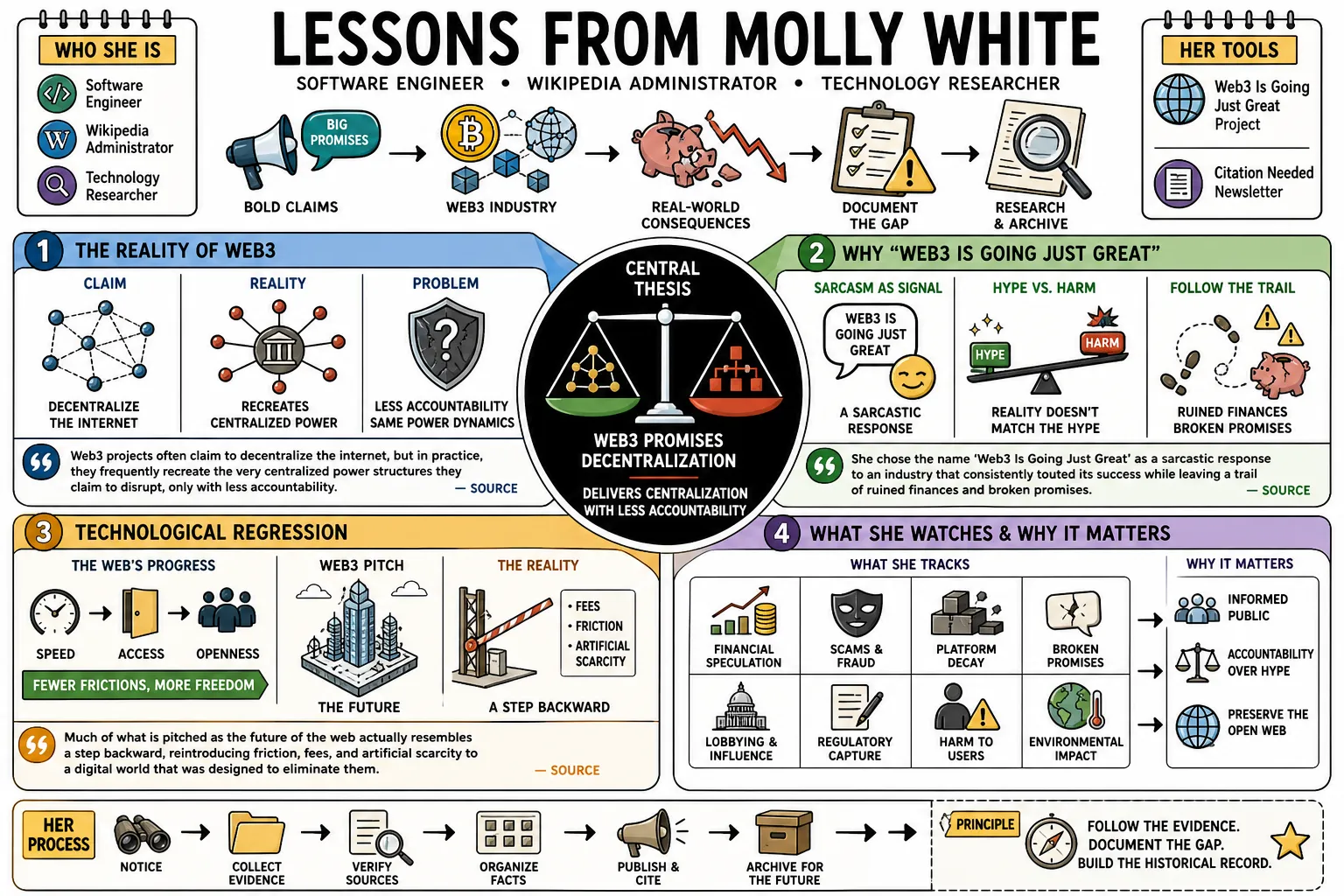
Part 1: The Reality of Web3
- On the core premise of Web3: "Web3 projects often claim to decentralize the internet, but in practice, they frequently recreate the very centralized power structures they claim to disrupt, only with less accountability." — Source: [Web3 Is Going Just Great]
- On the title of her famous project: "She chose the name 'Web3 Is Going Just Great' as a sarcastic response to an industry that consistently touted its success while leaving a trail of ruined finances and broken promises." — Source: [Citation Needed]
- On technological regression: "Much of what is pitched as the future of the web actually resembles a step backward, reintroducing friction, fees, and artificial scarcity to a digital world that was designed to eliminate them." — Source: [mollywhite.net]
- On decentralization theater: "Many supposedly decentralized platforms rely entirely on centralized points of failure, such as standard web hosting, private APIs, and small groups of core developers holding administrative keys." — Source: [University of Texas Lecture]
- On the financialization of everything: "Web3 seeks to attach a price tag and a speculative token to every human interaction online, fundamentally altering the way people socialize and share information." — Source: [Citation Needed]
- On user experience: "The user experience in Web3 is notoriously hostile, requiring everyday users to manage complex cryptographic keys and navigate environments where a single misclick can result in total financial ruin." — Source: [Web3 Is Going Just Great]
- On the gap between marketing and engineering: "There is a vast chasm between the marketing copy of Web3 startups, which promises revolutionary societal change, and the underlying code, which is often cobbled together and highly vulnerable to exploits." — Source: [mollywhite.net]
- On the definition of Web3: "The term Web3 is less of a coherent technological movement and more of a rebranding effort by venture capitalists looking to distance their investments from the toxicity of the word crypto." — Source: [Citation Needed]
- On the cost of participation: "Participating in the Web3 ecosystem often requires paying exorbitant transaction fees, which prices out the marginalized communities that the technology claims to empower." — Source: [University of Texas Lecture]
- On the underlying motivation: "When examining the trajectory of most Web3 projects, the primary driving force is rarely technological innovation; it is almost always the creation of new mechanisms for regulatory arbitrage and financial speculation." — Source: [mollywhite.net]
Part 2: Cryptocurrency and Financial Risk
- On crypto as an investment: "Crypto is not an investment, it's this total Wild West." — Source: [Silicon Republic Interview]
- On the nature of the market: "The cryptocurrency market operates more like a casino than a traditional financial market, with retail investors essentially putting money on the roulette wheel." — Source: [Silicon Republic Interview]
- On consumer protection: "The crypto industry actively fights against the implementation of basic consumer protections, arguing that regulation stifles innovation while everyday people lose their life savings." — Source: [The Perfect Scam Podcast]
- On the volatility of tokens: "The extreme price volatility of cryptocurrencies makes them entirely unsuitable for use as an actual currency for purchasing everyday goods and services." — Source: [Citation Needed]
- On the concept of yield: "In the crypto ecosystem, outsized yields are almost never generated by actual economic activity; they are usually paid out from the deposits of newer investors, closely mimicking a Ponzi structure." — Source: [Web3 Is Going Just Great]
- On predatory marketing: "Crypto companies frequently use celebrity endorsements and aggressive advertising to target vulnerable populations, promising financial freedom while obscuring the massive risks." — Source: [Congressional Statement]
- On the myth of banking the unbanked: "The promise that crypto will help the unbanked is a hollow marketing talking point; the fees, complexity, and lack of safeguards make it a highly dangerous environment for the financially vulnerable." — Source: [Citation Needed]
- On algorithmic stablecoins: "Algorithmic stablecoins are inherently fragile and prone to catastrophic failure, as demonstrated by the collapse of Terra/Luna, which wiped out billions of dollars in retail wealth overnight." — Source: [Web3 Is Going Just Great]
- On the role of venture capital: "Venture capital firms often dump their heavily discounted, early-access tokens onto retail investors as soon as a project is listed on a public exchange." — Source: [mollywhite.net]
- On irreversible transactions: "The irreversibility of crypto transactions is framed as a feature, but for the average consumer, it is a massive liability that eliminates any recourse in cases of theft or simple human error." — Source: [The Perfect Scam Podcast]
Part 3: The Crypto Industry and Fraud
- On illicit finance: "Crypto has become the choice for criminals doing any sort of cybercrime essentially. It has, because of its traceability challenges for law enforcement and others, because of the irreversibility of transactions, it's a perfect asset for criminals." — Source: [The Perfect Scam Podcast]
- On the frequency of hacks: "The grift counter on her website illustrates that multi-million dollar hacks and exploits are not rare anomalies, but a daily occurrence in the crypto industry." — Source: [Web3 Is Going Just Great]
- On rug pulls: "The barrier to entry for creating a new token is so low that anonymous developers routinely spin up projects, build hype, and then drain the liquidity pool, disappearing with investors' money." — Source: [Citation Needed]
- On wash trading: "A significant portion of the trading volume on crypto exchanges, particularly for NFTs, is wash trading, where individuals trade assets back and forth between their own wallets to create the illusion of demand." — Source: [mollywhite.net]
- On smart contract vulnerabilities: "Code is law is a disastrous philosophy when the code is written hastily, unaudited, and deployed to an immutable ledger where bugs can be instantly exploited for millions." — Source: [University of Texas Lecture]
- On industry self-regulation: "The industry's attempts at self-regulation are entirely ineffective, largely because the ecosystem's anonymity and lack of boundaries reward bad actors and penalize compliance." — Source: [Congressional Statement]
- On the normalization of scams: "The crypto community has developed a culture where getting scammed is often treated as a rite of passage or a tax on learning, rather than an unacceptable failure of the technology." — Source: [Web3 Is Going Just Great]
- On the collapse of major exchanges: "The implosion of platforms like FTX revealed that even the most celebrated and seemingly reputable institutions in crypto were built on commingled funds, non-existent risk management, and outright fraud." — Source: [Citation Needed]
- On the speed of grift: "The pace at which new scams are invented and deployed outstrips the ability of regulators and law enforcement to track them, leaving the public to fend for themselves." — Source: [mollywhite.net]
Part 4: Blockchain Technology and Solutionism
- On blockchain as a concept: "Blockchain technology is fundamentally a solution in search of a problem, offering a highly inefficient database architecture for use cases that are better served by traditional technologies." — Source: [University of Texas Lecture]
- On forced application: "She looked for projects that actually needed a blockchain and were credibly changing the paradigm, but more often than not, found projects that were rowing in the completely opposite direction." — Source: [mollywhite.net]
- On the inefficiency of consensus: "The mechanisms required to achieve distributed consensus, whether proof-of-work or proof-of-stake, introduce massive computational overhead that scales incredibly poorly compared to centralized databases." — Source: [Citation Needed]
- On append-only ledgers: "An immutable, append-only ledger is fundamentally incompatible with data privacy laws like GDPR, specifically the right to be forgotten." — Source: [Congressional Statement]
- On the oracle problem: "Blockchains cannot verify the truth of data originating outside their own network; they rely on oracles, which reintroduce the exact trust and centralization issues the blockchain was supposed to solve." — Source: [University of Texas Lecture]
- On digital ownership: "NFTs do not confer actual legal ownership or copyright of an image; they merely point to a hyperlink on a standard web server that can be altered or taken offline at any time." — Source: [Web3 Is Going Just Great]
- On supply chain tracking: "Putting a supply chain on a blockchain does not prevent someone from entering fraudulent data at the source; it just makes that fraudulent data permanent." — Source: [Citation Needed]
- On voting via blockchain: "Using blockchain for political voting is a dangerous idea that introduces extreme security risks, destroys voter anonymity, and solves none of the actual logistical challenges of running an election." — Source: [mollywhite.net]
- On tech exceptionalism: "The tech industry suffers from a persistent belief that complex social and political problems can be solved simply by applying a new layer of code, completely ignoring human behavior and institutional realities." — Source: [University of Texas Lecture]
Part 5: Crypto Lobbying and Politics
- On campaign spending: "The crypto industry has weaponized its immense capital to flood U.S. elections with dark money, attempting to unseat skeptical lawmakers and install industry-friendly politicians." — Source: [Follow the Crypto]
- On single-issue voting: "Crypto PACs try to manufacture the appearance of a massive, single-issue voting bloc of crypto enthusiasts, when in reality, the vast majority of the public does not care about or actively dislikes the industry." — Source: [Citation Needed]
- On the purpose of lobbying: "The primary goal of crypto lobbying is not to seek clarity, but to carve out special exemptions that allow them to bypass existing securities laws and financial regulations." — Source: [Blood in the Machine Podcast]
- On the revolving door: "The industry actively recruits former regulators and politicians, using their credibility to legitimize an ecosystem that operates largely outside the bounds of traditional finance." — Source: [Citation Needed]
- On legislative capture: "The scale of crypto lobbying threatens to capture the legislative process, allowing a niche, highly speculative industry to write its own rules at the expense of consumer protection." — Source: [Follow the Crypto]
- On astroturfing: "Much of the perceived grassroots support for pro-crypto legislation is actually astroturfed, funded and coordinated by large crypto exchanges and venture capital firms." — Source: [mollywhite.net]
- On the framing of innovation: "Lobbyists intentionally conflate cryptocurrency with broader technological innovation, threatening that the U.S. will fall behind if it attempts to regulate digital assets." — Source: [Congressional Statement]
- On bipartisan influence: "Crypto money does not respect party lines; the industry aggressively funds candidates across the political spectrum to ensure a favorable regulatory environment regardless of who is in power." — Source: [Follow the Crypto]
- On media manipulation: "The industry funds favorable research and sponsors media outlets to create a persistent, positive narrative that counteracts the daily reality of scams and market crashes." — Source: [Citation Needed]
Part 6: Wikipedia and the Open Web
- On the value of Wikipedia: "Wikipedia stands as one of the last major outposts of the old, open web, serving as a platform driven by collaboration, consensus, and the sharing of knowledge rather than profit extraction." — Source: [Wikipedia)]
- On fighting misinformation: "As an editor heavily involved in covering right-wing extremism and online harassment, she has seen firsthand the intense effort required to protect an open platform from bad faith actors and organized disinformation campaigns." — Source: [mollywhite.net]
- On crypto donations to Wikimedia: "She successfully campaigned for the Wikimedia Foundation to stop accepting cryptocurrency donations, arguing that endorsing the technology was incompatible with the foundation's commitment to environmental sustainability and open knowledge." — Source: [Wikipedia)]
- On community governance: "Wikipedia's model of community governance and dispute resolution, though imperfect and often bureaucratic, is vastly superior to the plutocratic governance token models proposed by Web3 DAOs." — Source: [Citation Needed]
- On preserving internet history: "The internet used to feel like magic before the era of hyper-financialization, and there is immense value in fighting to preserve spaces that are not commodified." — Source: [mollywhite.net]
- On volunteer labor: "The open web relies heavily on the invisible, uncompensated labor of volunteers who maintain infrastructure, moderate content, and combat spam out of a sense of civic duty." — Source: [mollywhite.net]
- On structural bias: "Wikipedia, like all open projects, struggles with systemic biases and representation gaps, requiring active, intentional effort by editors to document marginalized groups and historically overlooked figures." — Source: [Wikipedia)]
- On the monetization of data: "The modern web's reliance on surveillance advertising and data extraction has eroded user trust and fundamentally degraded the quality of information online." — Source: [Citation Needed]
- On platform decay: "Enshittification is a natural consequence of the venture capital model, which demands endless growth and eventual rent-seeking behavior from platforms that once served their users well." — Source: [Citation Needed]
Part 7: Technology Criticism and Journalism
- On her motivation to write: "She shifted from apathy to active criticism because she came to believe these technologies are so harmful that I cannot ethically continue to ignore them, and must instead do my best to educate and advocate against their wider adoption." — Source: [mollywhite.net]
- On tech journalism's failings: "Mainstream tech journalism often acts as a stenographer for venture capitalists, repeating press releases and hyping unproven technologies without applying basic skepticism or technical scrutiny." — Source: [Citation Needed]
- On following the money: "To truly understand the trajectory of a technology trend, critics must ignore the stated mission and instead meticulously follow the flow of venture capital and lobbying dollars." — Source: [Follow the Crypto]
- On the independent web: "Her decision to self-publish Citation Needed without paywalls reflects a commitment to the independent web and the belief that critical public interest reporting should be accessible to everyone." — Source: [Citation Needed]
- On engaging with hype: "Critics often face intense harassment and bad-faith arguments from highly invested communities, requiring a thick skin and a commitment to meticulous, unassailable documentation." — Source: [mollywhite.net]
- On the role of a software engineer: "Engineers have an ethical obligation to speak out when they see their industry building products that are structurally designed to exploit the public." — Source: [University of Texas Lecture]
- On primary sources: "Effective criticism relies heavily on reading the primary sources, such as the actual smart contracts, court filings, and whitepapers, rather than relying on industry summaries." — Source: [Web3 Is Going Just Great]
- On independent funding: "By relying on reader support rather than venture capital or advertising, independent researchers can maintain the editorial freedom necessary to sharply criticize powerful tech monopolies." — Source: [Citation Needed]
- On the normalization of failure: "Tech media has normalized the idea that breaking things and causing societal harm is an acceptable, inevitable byproduct of moving fast and innovating." — Source: [mollywhite.net]
- On holding platforms accountable: "Researchers and journalists must constantly apply pressure to tech companies to force transparency regarding their algorithms, moderation practices, and data sharing." — Source: [Citation Needed]
Part 8: AI Hype and the Tech Industry
- On the pivot to AI: "Following the collapse of the crypto market, the exact same venture capitalists, founders, and hype mechanisms immediately pivoted to generative AI, using identical rhetoric to attract funding." — Source: [Citation Needed]
- On AI solutionism: "Similar to blockchain, generative AI is currently being aggressively jammed into products and services where it adds no actual value, solely to appease investors and generate press." — Source: [mollywhite.net]
- On copyright and data scraping: "The generative AI industry is built on the massive, unconsented scraping of human-created data, effectively laundering copyrighted work into statistical models." — Source: [Citation Needed]
- On environmental impact: "The immense energy consumption and water usage required to train and run large language models directly contradicts the tech industry's stated climate goals." — Source: [Citation Needed]
- On the degradation of search: "The integration of AI-generated summaries into search engines actively degrades the quality of information, surfaces hallucinations as facts, and starves original creators of traffic." — Source: [mollywhite.net]
- On the existential risk narrative: "Tech CEOs frequently hype the existential, sci-fi risks of AI to distract regulators from the very real, immediate harms of the technology, such as bias, labor exploitation, and copyright infringement." — Source: [Citation Needed]
- On replacing human labor: "The primary enterprise use case for generative AI is not to augment human creativity, but to deskill labor and replace workers with cheaper, inferior automated outputs." — Source: [Blood in the Machine Podcast]
- On the centralization of power: "Despite claims of democratizing technology, the massive computational resources required for AI ensure that power and infrastructure remain concentrated in the hands of a few dominant tech monopolies." — Source: [Citation Needed]
- On the inevitability of tech: "We must reject the narrative that specific technological trajectories are inevitable; humans build technology, and humans have the power to decide what gets built, how it is regulated, and who it serves." — Source: [University of Texas Lecture]