Lessons from Nadia Asparouhova
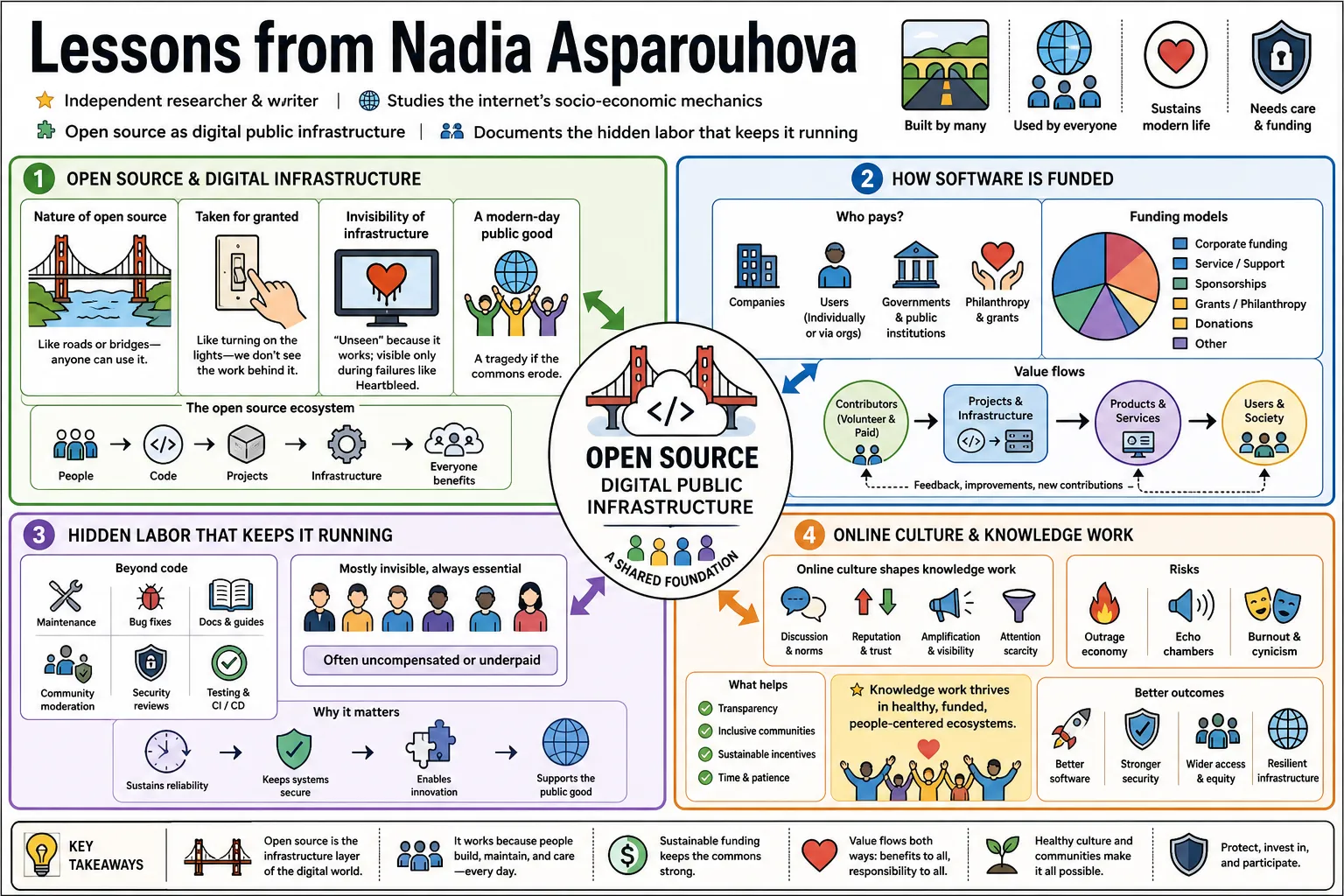
Nadia Asparouhova is an independent researcher and writer studying the internet's socio-economic mechanics. She is known for treating open-source software as digital public infrastructure and documenting the hidden labor that keeps it running. This profile gathers her writing on how software is funded and how online culture shapes knowledge work.
Part 1: Open Source and Digital Infrastructure
- On the nature of open source: "Much like roads or bridges, which anyone can walk or drive on, open source code can be used by anyone—from companies to individuals—to build software." — Source: Roads and Bridges
- On taking software for granted: "Most of us take opening a software application for granted, the way we take turning on the lights for granted; we don't think about the human capital necessary to make that happen." — Source: Roads and Bridges
- On infrastructure invisibility: "Digital infrastructure is 'unseen' precisely because it works; it only becomes visible to the public during a catastrophic failure like the Heartbleed bug." — Source: Roads and Bridges
- On the open source public good: "The story of open source software is one of the great modern-day triumphs of the public good, achieved not by altruism but by people solving their own problems." — Source: Roads and Bridges
- On the fragility of code: The mystery of software maintenance is not that a few overworked volunteers occasionally miss a critical security vulnerability, but that catastrophic failures do not happen far more frequently given how much modern commerce relies on them. — Source: Roads and Bridges
- On funding models: The open source ecosystem lacks a reliable mechanism to convert the massive commercial value it generates back into financial support for the individuals who actually write and manage the code. — Source: Working in Public
- On corporate reliance: Large tech companies often treat open source projects as a free resource to be extracted, rather than a shared environment that requires active, reciprocal investment to survive. — Source: Roads and Bridges
- On the tragedy of the commons: Digital public goods suffer from a unique form of exhaustion where the code itself does not degrade from use, but the attention and energy of the maintainers are rapidly depleted by a growing user base. — Source: Working in Public
- On infrastructure funding: Providing grants for new software features is easy for institutions, but finding capital to pay for the unglamorous, continuous work of maintaining existing dependencies remains a structural challenge. — Source: Roads and Bridges
- On shifting focus: To secure the future of software, the technology industry must shift its focus away from solely celebrating code creation and begin formally recognizing and compensating the labor of code preservation. — Source: Roads and Bridges
Part 2: The Maintenance and Labor of Software
- On community architecture: Many open source projects operate less like collaborative commons and more like auditoriums, characterized by a stark asymmetry between a small handful of maintainers on stage and a massive audience of passive consumers. — Source: Working in Public
- On the burden of maintainers: When a software project becomes popular, the primary challenge for the creator shifts from writing new code to managing an overwhelming influx of user requests, bug reports, and unhelpful contributions. — Source: Working in Public
- On the myth of the community: The idea that open source projects are maintained by a large, egalitarian community of casual contributors is often a fiction; the reality is that the vast majority of critical work is done by a very small group of core maintainers. — Source: Working in Public
- On contribution quality: In modern software repositories, the problem is rarely a lack of contributors, but rather a high volume of low-quality contributions that require more time to review and fix than they save. — Source: Working in Public
- On the cost of attention: The most scarce resource in an open source project is not money or hosting space, but the focused attention of the lead developer. — Source: Working in Public
- On burnout: Maintainer burnout happens when the intrinsic joy of building software is replaced by the administrative burden of managing people and expectations for free. — Source: Working in Public
- On casual contributions: A platform like GitHub lowers the barrier to entry so much that casual users can easily suggest changes without understanding the project's long-term roadmap, creating a persistent tax on the maintainer's time. — Source: Working in Public
- On managing user expectations: Open source maintainers frequently find themselves acting as unpaid customer support agents for highly profitable corporations that use their software. — Source: Working in Public
- On project forks: "Forking is a technical right. Socially, it's much harder to execute." — Source: Working in Public
- On redefining open source: We need to update our mental model of open source from a chaotic bazaar of equal participants to a structure that resembles online video creators managing a demanding audience. — Source: Working in Public
Part 3: The Creator Economy and Internet Culture
- On creator burnout: The constant pressure to produce content and remain relevant transforms what begins as a creative endeavor into a demanding industrial process. — Source: Spicy Takes
- On audience capture: Creators who rely entirely on audience feedback for direction risk becoming constrained by the very people they serve, slowly losing the original perspective that made their work interesting. — Source: Spicy Takes
- On the Creator Industrial Complex: The creator economy is increasingly adopting the structures of traditional industry, where individual creators function more like small factories optimizing for algorithmic distribution rather than artistic expression. — Source: Spicy Takes
- On internet evolution: Early internet culture was driven by a sense of optimism and connection, but it has gradually evolved through stages of context collapse toward a more hostile landscape of attention-seeking. — Source: Working in Public
- On platform leverage: When creators build their businesses on centralized platforms, they operate as tenant farmers; the platform ultimately controls the relationship with the audience and can change the rules at any time. — Source: Working in Public
- On digital identity: Online spaces often force individuals to flatten their personalities into easily recognizable brands, stripping away nuance in favor of algorithmic legibility. — Source: Nadia.xyz
- On the pressure to scale: The internet defaults to treating every creative project as a startup that must scale infinitely, leaving little room for sustainable, small-scale creative practices. — Source: Nadia.xyz
- On shifting community models: Online communities have moved from synchronous, deeply connected forums to asynchronous broadcast platforms where interaction is shallow and performative. — Source: Working in Public
- On the attention economy: The fundamental currency of the modern internet is attention, and the architecture of our digital tools is explicitly designed to harvest it as efficiently as possible. — Source: Nadia.xyz
- On creative autonomy: Maintaining creative independence online requires deliberately ignoring the metrics and feedback loops that platforms provide to encourage continuous engagement. — Source: Spicy Takes
Part 4: Independent Research and Career Paths
- On alternative institutions: "I feel like if someone asks me at a cocktail party what I do for work, I try to keep it simple. I'll just say I'm a writer or a researcher. Then they'll ask, 'What university do you work for?' and I'm like, 'Well, I'm independently funded.' I start to realize that this isn't a concept people are super familiar with." — Source: Interview with Sina Habibian
- On the motivation for research: "For the truly obsessed person, the need for validation isn't about ego; it's about sanity." — Source: The Independent Researcher
- On creating your own PhD: Independent research allows a person to unintentionally construct their own version of a PhD program through self-directed phases of discovery, testing, and public writing. — Source: The Independent Researcher
- On the definition of research: Research, writing, and teaching are not entirely separate career paths, but rather different configurations of the exact same underlying skills applied to different audiences. — Source: The Independent Researcher
- On institutional constraints: Working outside of academia removes the pressure to conform to specific methodological dogmas, freeing the researcher to ask strange questions that cross traditional disciplinary boundaries. — Source: The Independent Researcher
- On zero to one research: The most valuable independent work often involves exploring unanswered questions that lack a formal descriptive framework, requiring the researcher to invent the vocabulary before they can explain the phenomenon. — Source: Nadia.xyz
- On public thinking: Publishing unfinished thoughts and working in public accelerates the research process by inviting immediate peer review and serendipitous connections from across the internet. — Source: The Independent Researcher
- On funding independent work: Securing patronage for independent research requires translating abstract intellectual curiosity into tangible value for a specific group of people who are willing to underwrite the exploration. — Source: The Independent Researcher
- On building a track record: An independent researcher's credibility is established entirely through their public body of work, rather than through institutional affiliations or traditional credentials. — Source: The Independent Researcher
Part 5: Philanthropy and Science Funding
- On the role of philanthropy: "If venture capital is risk capital for private goods, philanthropy is risk capital for public goods." — Source: Idea Machines Podcast
- On tech wealth: The current generation of technology billionaires is experimenting with new methods of deploying capital, attempting to apply the mechanics of venture capital to the funding of scientific discovery and social institutions. — Source: Nadia.xyz
- On funding structures: Traditional philanthropy often moves too slowly and requires too much administrative overhead to effectively support the rapid, experimental nature of early-stage scientific research. — Source: Nadia.xyz
- On Effective Altruism: While analytical frameworks like Effective Altruism provide a rigorous way to evaluate impact, they can sometimes discount the value of hard-to-measure, foundational research that lacks immediate, quantifiable outcomes. — Source: Dwarkesh Podcast
- On the talent bottleneck: The limiting factor in scientific progress is rarely just money; it is often the difficulty of identifying and supporting extremely talented individuals before they have established traditional credentials. — Source: Idea Machines Podcast
- On decentralized funding: New models of science funding are emerging that bypass traditional grant committees, utilizing distributed networks of experts to identify promising researchers and allocate capital faster. — Source: Nadia.xyz
- On measuring success: Philanthropists funding public goods must accept a higher rate of failure and longer time horizons than investors funding software startups, as the metrics of success for a new scientific paradigm are not immediately obvious. — Source: Idea Machines Podcast
- On the cost of grants: The time and energy researchers spend applying for traditional academic grants is a massive deadweight loss to scientific progress that alternative philanthropic models can eliminate. — Source: Nadia.xyz
- On risk tolerance: Science funding needs more institutions willing to act like early-stage angel investors, writing small, high-risk checks based entirely on the conviction of the researcher rather than the safety of the proposal. — Source: Dwarkesh Podcast
Part 6: Idea Machines and Institutional Design
- On idea machines: Society needs more "idea machines"—specific organizational structures designed to take abstract concepts, fund their exploration, and systematically turn them into tangible outcomes. — Source: Idea Machines Podcast
- On the formal deficit: The technology industry suffers from a lack of organizational imagination; the venture-backed startup is currently the only shape of institution the sector knows how to build and fund. — Source: Idea Machines Podcast
- On institutional evolution: Just as software architectures evolve to handle greater scale, the social design of our institutions must evolve to coordinate people and ideas over much longer time horizons. — Source: Nadia.xyz
- On decentralized organizations: DAOs and other experimental governance structures represent early, clumsy attempts to solve the fundamental problem of coordinating strangers on the internet without a centralized corporate authority. — Source: Idea Machines Podcast
- On the limits of democracy in tech: Applying pure democratic participation to open source software maintenance often fails because building coherent software requires opinionated technical leadership, not consensus. — Source: Dwarkesh Podcast
- On building new shapes: We must invent new legal and social containers for collective action that sit somewhere between a non-profit organization and a hyper-growth tech startup. — Source: Idea Machines Podcast
- On network maintenance: Maintaining a network of smart, capable people requires as much deliberate architectural design as maintaining a large-scale software system. — Source: Nadia.xyz
- On the life cycle of institutions: Institutions are born from a specific ideological movement, formalize into rigid structures to survive, and eventually become obstacles to the very ideas they were created to protect. — Source: Nadia.xyz
- On designing for trust: The core challenge of modern institutional design is figuring out how to manufacture high-trust environments in a digital ecosystem that structurally incentivizes low-trust behavior. — Source: Idea Machines Podcast
Part 7: Antimemetics and Information Spread
- On the definition of antimemes: "Creative self-expression is the only way we will continue to make our mark as humans in times of uncertainty, and it doesn't come from doing what you think will sell to other people. It comes from wanting to express something deep in your soul. Sometimes those ideas are trite and 'cringe,' and most of them fail to find an audience. But we can't let this fear of failure keep us from trying to produce things that feel truly original to us." — Source: Antimemetics: Why Some Ideas Resist Spreading
- On the shadow ecosystem: The internet contains a massive hidden layer of high-consequence ideas that fail to spread because they lack the simple, easily digestible shape required by algorithmic distribution networks. — Source: Antimemetics: Why Some Ideas Resist Spreading
- On the limits of virality: Memes are optimized for transmission, but antimemes are optimized for depth; the ideas that matter most are often the hardest to explain in a short format. — Source: Infinite Loops Podcast
- On self-censoring concepts: Certain subjects act as antimemes because they are socially taboo, structurally complex, or require too much prerequisite context, causing them to naturally resist propagation. — Source: Antimemetics: Why Some Ideas Resist Spreading
- On retreating to private spaces: As public internet discourse becomes increasingly combative and performative, the most valuable intellectual exchanges are retreating into closed group chats and private networks. — Source: Spicy Takes
- On the cost of legibility: When a complex idea is forced into a highly shareable format, it inevitably loses the nuance that made it accurate, replacing understanding with mere recognition. — Source: Antimemetics: Why Some Ideas Resist Spreading
- On resisting algorithms: Discovering new and meaningful concepts requires deliberately seeking out unoptimized information that algorithms actively ignore or suppress due to low engagement metrics. — Source: Infinite Loops Podcast
- On the antimemetic era: We are entering a phase of internet culture where the sheer volume of viral noise is forcing individuals to develop filters that prioritize obscure, high-signal information over mass-market narratives. — Source: Antimemetics: Why Some Ideas Resist Spreading
- On protecting ideas: Some intellectual communities intentionally adopt opaque language and difficult concepts to protect their work from being flattened and consumed by the broader internet. — Source: Infinite Loops Podcast
Part 8: Attention, Consciousness, and Mental Space
- On the scarcity of attention: The modern environment treats human attention as an infinite resource to be mined, when in reality it is a delicate, easily depleted capacity that requires rigorous defense. — Source: Nadia.xyz
- On internal quiet: Producing original research demands a disciplined withdrawal from the daily cycle of online discourse to cultivate the prolonged mental silence necessary for deep work. — Source: Nadia.xyz
- On meditation practice: Practices like the Jhanas offer a systematic technology for observing and managing the mechanics of consciousness, allowing individuals to exert more control over their own attention. — Source: Infinite Loops Podcast
- On the geometry of thought: Exploring the states of mind accessed through rigorous meditation provides a different vocabulary for understanding how ideas form and dissolve before they are ever articulated. — Source: Nadia.xyz
- On defending mental space: Treating one's mental environment as a physical territory that must be aggressively guarded from commercial interruption is a necessary survival skill in the digital age. — Source: Nadia.xyz
- On the exhaustion of context switching: The brain is not designed to process the rapid, continuous context collapse of a social media feed, and doing so fundamentally degrades our capacity for sustained, linear thought. — Source: Spicy Takes
- On boredom: Boredom is not a problem to be solved by a screen, but a necessary resting state where the mind synthesizes disparate information into new conceptual models. — Source: Nadia.xyz
- On cognitive sovereignty: True independence as a researcher begins with reclaiming cognitive sovereignty from the platforms that profit from keeping users in a state of continuous distraction. — Source: Infinite Loops Podcast
- On the value of the obscure: Finding clarity often involves ignoring the most visible debates of the day to focus on the quiet, obscure questions that will quietly shape the architecture of the future. — Source: Nadia.xyz