Lessons from Nadia Eghbal
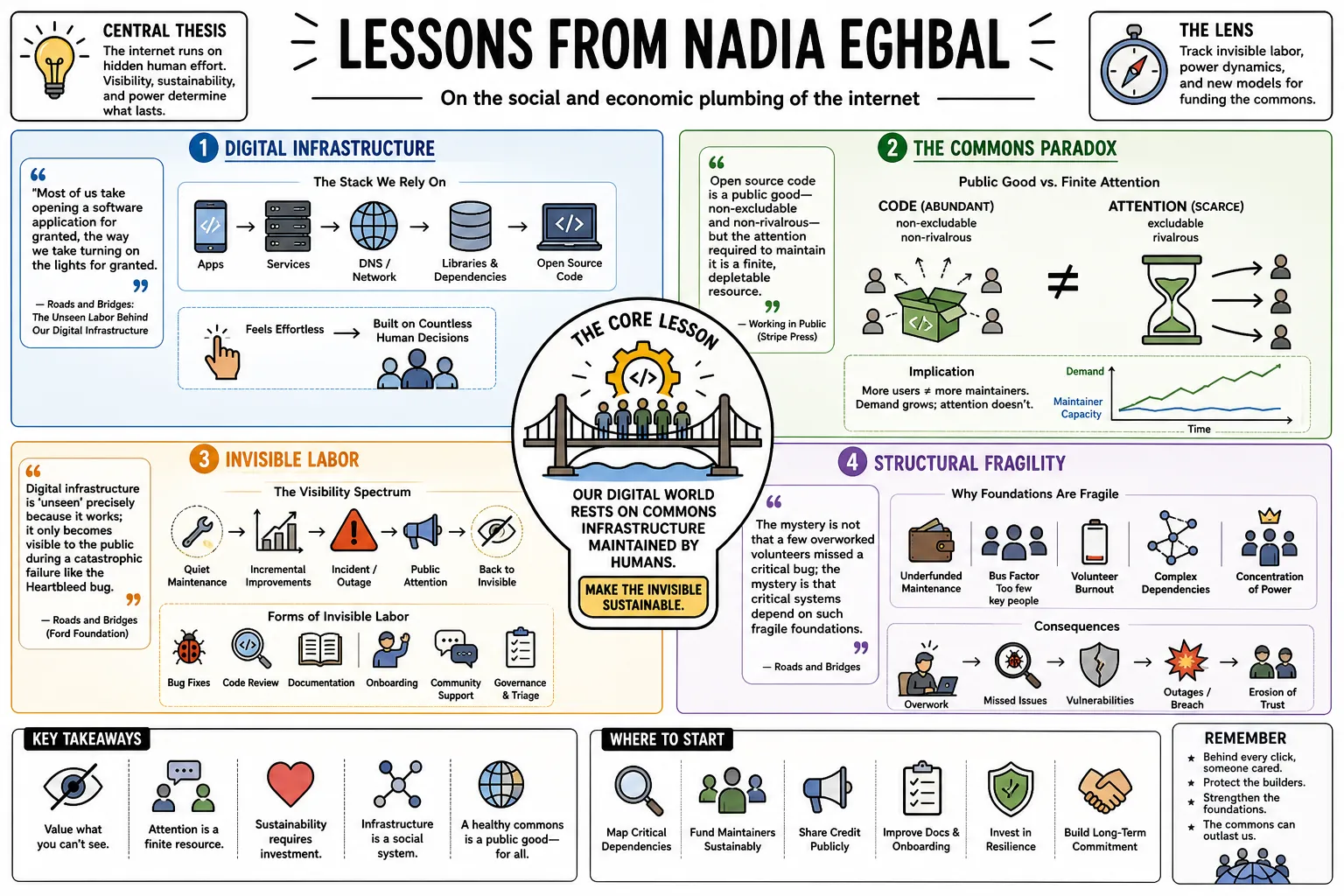
Nadia Eghbal writes about the social and economic plumbing of the internet, specifically the invisible labor that keeps open-source software running. Her work tracks how individuals navigate power and find funding in a digital landscape that is constantly rewriting its own rules.
Part 1: Digital Infrastructure and the Commons
- On Digital Infrastructure: "Most of us take opening a software application for granted, the way we take turning on the lights for granted; we don’t think about the human capital necessary to make that happen." — Source: Roads and Bridges: The Unseen Labor Behind Our Digital Infrastructure
- On the Commons Paradox: "Open source code is a public good—non-excludable and non-rivalrous—but the attention required to maintain it is a finite, depletable resource." — Source: Working in Public (Stripe Press)
- On Invisible Labor: "Digital infrastructure is 'unseen' precisely because it works; it only becomes visible to the public during a catastrophic failure like the Heartbleed bug." — Source: Roads and Bridges (Ford Foundation)
- On Structural Fragility: "The mystery is not that a few overworked volunteers missed a critical bug; the mystery is that it doesn’t happen more often given how much we rely on them." — Source: Roads and Bridges (Ford Foundation)
- On the Cost of Sharing: "Sharing code turned out to be cheaper and more efficient than building proprietary silos, but this efficiency shifted the burden from companies to individual maintainers." — Source: Roads and Bridges (Ford Foundation)
- On Public Goods: "The story of open source software is one of the great modern-day triumphs of the public good, achieved not by altruism but by people solving their own problems." — Source: Roads and Bridges (Ford Foundation)
- On Institutional Neglect: "Governments and corporations often fail to recognize open source as infrastructure, leaving the foundation of the global economy to be supported by hobbyists." — Source: Roads and Bridges (Ford Foundation)
- On Global Dependencies: "Open up your phone—your social media, your news, your bank—they are all using free and public code that requires constant upkeep." — Source: Roads and Bridges (Ford Foundation)
- On the Foundation Gap: "The cracks in our digital foundation are not obvious right now, but they are widening as startup speed outpaces infrastructure support." — Source: Roads and Bridges (Ford Foundation)
Part 2: The Evolution of Open Source Models
- On the Stadium Model: "Most modern open source projects look like a stadium: a few players on the field performing for millions of fans in the stands who don't actually help." — Source: Working in Public (Stripe Press)
- On the Club Model: "The original vision of open source was a 'club' where every user was also a potential contributor, but this model doesn't scale to projects with millions of users." — Source: a16z Podcast
- On Transaction Costs: "GitHub transformed open source by lowering the transaction costs of contribution so much that code became as easy to 'retweet' as a thought." — Source: Working in Public (Stripe Press)
- On Federations: "Projects like Linux or Rails are 'Federations'—rare ecosystems where high user growth is actually matched by high contributor growth." — Source: Working in Public (Stripe Press)
- On Participatory Myths: "Open source code is public, but it doesn’t have to be participatory; maintainers often buckle under excess demand for their attention." — Source: Working in Public (Stripe Press)
- On the 95/5 Rule: "In over 85% of projects, less than 5% of developers are responsible for over 95% of the code and social interactions." — Source: Working in Public (Stripe Press)
- On the Shift to Consumerism: "We have moved from a world where software was built by its users to a world where software is consumed by users who expect professional support for free." — Source: Software Engineering Daily
- On Code as Content: "Code is increasingly treated like content; it is copied and pasted without the user ever knowing or caring who the creator was." — Source: Working in Public (Stripe Press)
- On the One-Way Mirror: "Open source is moving toward a 'one-way mirror' model: the code is public for everyone to see, but the development process is becoming private." — Source: Working in Public (Stripe Press)
- On Project Toys: "Many projects start as 'toys'—personal experiments that accidentally become critical infrastructure, trapping the creator in a role they didn't want." — Source: Working in Public (Stripe Press)
Part 3: The Economy of Attention and Burnout
- On Attention Scarcity: "The real cost of open source isn't the code—which has zero marginal cost to distribute—it's the maintainer's finite attention." — Source: Working in Public (Stripe Press)
- On the Parasocial Burden: "Maintainers have a parasocial relationship with their users; thousands of people feel they 'know' the creator and are entitled to their time." — Source: The North Star Podcast
- On the Christmas Lights Analogy: "The problem with your Christmas lights isn't people driving by to see them; it's when they knock on your door to ask how you wired them." — Source: Working in Public (Stripe Press)
- On Extractive Contributions: "A bug report or a low-quality pull request is often an 'extractive' contribution that costs the maintainer more energy to review than it adds in value." — Source: Working in Public (Stripe Press)
- On Reputation as a Battery: "Reputation is like a battery for creators; they charge it by shipping work and drain it by dealing with the noise of an audience." — Source: Working in Public (Stripe Press)
- On the Maintainer’s Dilemma: "In the absence of financial benefits, maintaining code for the general public quickly becomes an unpaid job you can’t quit." — Source: Roads and Bridges (Ford Foundation)
- On Boundaries: "Communities are meaningful only when we make boundaries around them; if everyone is a member, the sense of identity and shared responsibility vanishes." — Source: Means of Creation
- On User Entitlement: "Users often treat open-source maintainers like they are a service provider, despite never having paid a cent for the software." — Source: Working in Public (Stripe Press)
- On the Bystander Effect: "In large projects, the 'stadium' audience assumes someone else will fix the bug, leading to a total lack of help despite massive usage." — Source: Working in Public (Stripe Press)
Part 4: Digital Labor and the Craft of Maintenance
- On Puppies vs. Dogs: "Creation is like getting a puppy—it's fun and exciting. Maintenance is like taking care of the dog for the next fifteen years; it's a daily responsibility." — Source: Working in Public (Stripe Press)
- On Goodwill Hunting in Reverse: "Running a successful open source project is like Goodwill Hunting in reverse: you start as a respected genius and end as a janitor fighting with strangers." — Source: The North Star Podcast
- On the Tourist Analogy: "Casual contributors are like tourists visiting a city; we shouldn't expect them to participate in governance just because they are passing through." — Source: Software Engineering Daily
- On the Status of Creation: "Society rewards 'first-copy' creation with high status, while systematically undervaluing the 'janitorial' work of maintenance." — Source: Working in Public (Stripe Press)
- On Software as a Living Object: "Software is not a static object like a book; it is a living thing that requires constant refactoring to stay relevant in a changing environment." — Source: Working in Public (Stripe Press)
- On Keystone Species: "Maintainers are the keystone species of the digital ecosystem; they are small in number but their removal would cause the entire system to collapse." — Source: Roads and Bridges (Ford Foundation)
- On Creator Attention as Currency: "In the age of information abundance, the most valuable currency is no longer the content itself, but the attention of the person who curates it." — Source: a16z Podcast
- On the Freedom from People: "Freedom of code includes freedom from the people who made it, yet modern users are increasingly dependent on the specific maintainer's whim." — Source: Working in Public (Stripe Press)
- On High-Stakes Volunteering: "If you're a volunteer maintainer and a critical system goes down, everyone expects you to fix it immediately, making the 'hobby' higher stakes than a job." — Source: Software Engineering Daily
- On the Labor of Refactoring: "The most important work in software is often the invisible work of deleting code and simplifying systems, which earns no public applause." — Source: Working in Public (Stripe Press)
Part 5: Independent Research and Idea Machines
- On Idea Machines: "An Idea Machine is a self-sustaining organism containing all the parts needed to turn abstract ideologies into real-world outcomes." — Source: nadia.xyz - Idea Machines
- On the Anatomy of Action: "The flow of an Idea Machine is: Ideology → Community → Agenda → Funding → Outcomes." — Source: nadia.xyz - Idea Machines
- On Effective Altruism: "Effective Altruism is the blueprint for a modern Idea Machine because it successfully coupled a rigorous ideology with a massive funding apparatus." — Source: nadia.xyz - Idea Machines
- On Arming the Rebels: "Idea Machines are community-centric; they succeed by distributing capital to a decentralized network of people already aligned with the mission." — Source: nadia.xyz - Idea Machines
- On Philanthropic Pluralism: "If you are pro-pluralism in startups, you should be pro-pluralism in philanthropy; we need a competition of many different 'Idea Machines'." — Source: Dwarkesh Podcast
- On Funding as a Catalyst: "Without the presence of a funder, a community is just a community; capital is the energy that turns a social group into a machine." — Source: nadia.xyz - Idea Machines
- On Instrumental vs. Expressive Giving: "The tension in philanthropy is between 'instrumental' giving (focused on efficiency) and 'expressive' giving (focused on a donor's vision for the world)." — Source: Dwarkesh Podcast
- On Spend-Down Foundations: "The new tech elite prefers to 'spend down' their fortunes within their lifetimes to avoid the institutional capture and drift of perpetual foundations." — Source: Dwarkesh Podcast
Part 6: Software as a Cultural Force
- On Tech as Culture: "Tech is better defined as a culture or a way of thinking than as a business industry." — Source: nadia.xyz - The New Tech Elite
- On the Meritocratic Elite: "The tech elite are meritocratic—gaining wealth through talent—but all meritocratic elites eventually face the challenge of turning into aristocratic ones." — Source: nadia.xyz - The New Tech Elite
- On Being Basic as a Virtue: "In an environment of constant intellectual extraction, 'being basic' becomes a status symbol that signals you haven't had to think for a day." — Source: nadia.xyz - Being basic as a virtue
- On Shamelessness as a Strategy: "Shamelessness has become a dominant strategy in public life; blatantly defying social norms often backfires on critics by amplifying the transgressor’s signal." — Source: nadia.xyz - Shamelessness as a strategy
- On the Idea Coal Mine: "Silicon Valley is a coal mine for ideas; developers have their faces smeared with coal dust from the effort of constant extraction." — Source: nadia.xyz - Being basic as a virtue
- On the "God-Drug" Effect: "Successful ideas act like a 'god-drug' on their creators; once an idea takes off, the creator is forced to keep delivering it to the audience." — Source: nadia.xyz - The Tyranny of Ideas
- On Humans as Hosts: "We are not the masters of our ideas; we are just the hosts that ideas infect and use to play around in the world." — Source: nadia.xyz - The Tyranny of Ideas
- On the Geeks Winning: "The geeks won—software is now the infrastructure of the world—but we haven't yet figured out the social structures to support that victory." — Source: The North Star Podcast
- On Reputation as a List of Afflictions: "Reputation is just the aggregation of ideas that have swarmed your body; it is a list of your chronic afflictions." — Source: nadia.xyz - The Tyranny of Ideas
- On the Global Democracy Myth: "I don't want to be part of a faceless global democracy; human interest comes from the boundaries that make us different." — Source: Means of Creation
Part 7: Antimemetics and Information Dynamics
- On Antimemetics: "An antimeme is a self-censoring idea—something that is deeply consequential but people feel an intuitive resistance to sharing." — Source: nadia.xyz - Antimemetics
- On the Dark Forest Internet: "The public internet has become a funhouse mirror of shallow virality, driving the most important intellectual labor into private 'whisper networks'." — Source: nadia.xyz - Antimemetics
- On Intellectual High Fiber: "Antimemes are 'high-fiber' ideas—dense and difficult to digest—compared to the 'simple sugars' of viral memes." — Source: nadia.xyz - Antimemetics
- On the Cost of Social Exposure: "We suppress important truths because we fear they will harm our network; sharing a taboo truth is socially expensive." — Source: nadia.xyz - Antimemetics
- On Whisper Networks: "Group chats and DMs are the new 'neighborhoods' where high-trust conversations happen away from the noise of the feed." — Source: nadia.xyz - Antimemetics
- On Transmissibility vs. Impact: "Existential risks spread instantly because they allow tribal signaling, but deep truths about human nature die because they are 'antimemetic'." — Source: nadia.xyz - Antimemetics
- On the Shadow Ecosystem: "We are surrounded by 'dark matter'—important ideas that exist but are never discussed in public because the tools are optimized for clicks." — Source: nadia.xyz - Antimemetics
- On Idea Virality: "A meme is designed to be shared; an antimeme is an idea that people find compelling but feel they shouldn't repeat." — Source: nadia.xyz - Antimemetics
- On Cognitive Biases as Antimemes: "Deep understanding of our own biases is an antimeme because it’s uncomfortable to admit we aren’t the rational actors we claim to be." — Source: nadia.xyz - Antimemetics
Part 8: Individual Agency and the Future of Work
- On the Era of Maintenance: "In the age of information abundance, we’re all maintainers now." — Source: Working in Public (Stripe Press)
- On the Locus of Value: "You aren't subscribing to a single thing; you are subscribing to the flow of ongoing things and the creator's pattern of thinking." — Source: Substack Blog
- On Arbitrage of Knowledge: "Publishing your thoughts is an arbitrage of knowledge; you radically underestimate how much you know that is obvious to you but revolutionary to others." — Source: The North Star Podcast
- On Creative Self-Expression: "Creative self-expression is the only way we continue to make our mark as humans; it comes from wanting to express something deep in the soul." — Source: Means of Creation
- On Subscription Security: "Subscription models afford creators the security to focus on making things for their fans rather than chasing the broadest possible audience." — Source: Substack Blog
- On Growing a Reputation: "You can't go paid overnight; growing a free list is the essential first step to proving you have a flow of value worth paying for." — Source: Substack Blog
- On the Future of Independence: "The individual is becoming the new institution; we are seeing a shift from working for a company to building a personal ecosystem of ideas." — Source: nadia.xyz - About
- On Knowledge Work as Craft: "We need to transition away from thinking of code as an object to be sold and toward relationship-based ways of thinking about content." — Source: The North Star Podcast
- On Making a Mark: "In times of uncertainty, the only thing that remains is what we have built and the ideas we have shared with others." — Source: Means of Creation