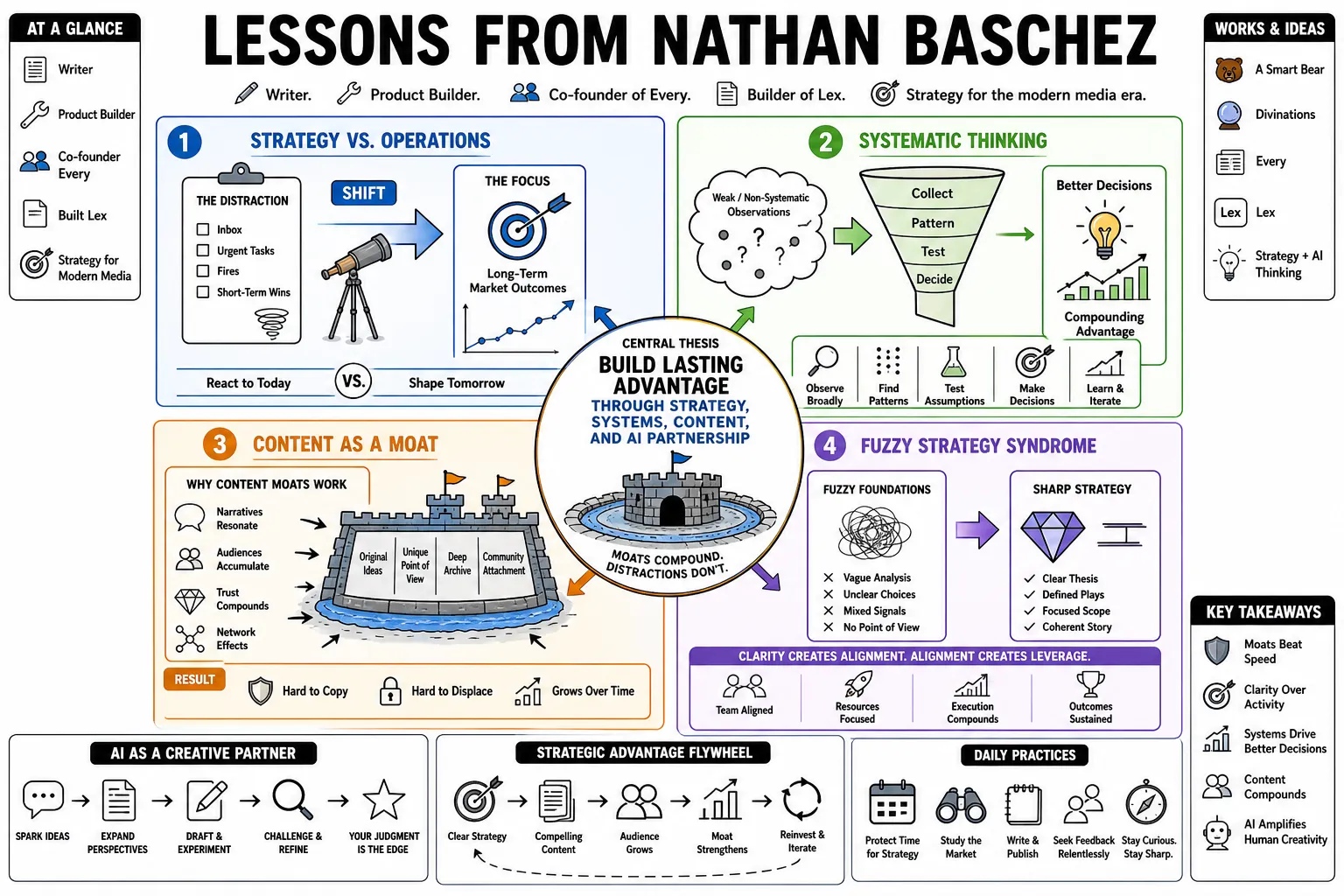
Lessons from Nathan Baschez
Nathan Baschez is a writer and product builder who co-founded the business newsletter collective Every and built the AI word processor Lex. He frequently applies traditional business strategy to modern media and the creator economy. This profile gathers his thoughts on building a competitive advantage and using AI as a creative partner.
Part 1: Strategy and Moats
- On Strategy vs. Operations: "People often get distracted by immediate tactical needs, but true strategy requires a focus on long-term market outcomes." — Source: A Smart Bear
- On Systematic Thinking: "If you have weak or non-systematic observations about the market driving your decision making process, you can make bad decisions despite getting the strategy concepts right." — Source: Divinations
- On Content as a Moat: "I've come to believe that content can create incredibly strong moats. There are properties inherent to narratives and ideas that make them naturally powerful, similar to how social networks and marketplaces naturally accumulate power." — Source: Every
- On Fuzzy Strategy Syndrome: "Too many businesses suffer from 'Fuzzy Strategy Syndrome,' where a lack of sharp foundational analysis leads to executing the wrong playbook entirely." — Source: Divinations
- On Applying Classic Frameworks: "By applying classic frameworks like the Five Forces to modern tech and media, we can reveal structural realities that are often ignored by the hype cycle." — Source: Divinations
- On Finding Actual Competition: "You have to look beyond direct rivals; your actual competition is often whatever alternative solution a consumer uses when your product isn't available." — Source: Every
- On The Value of Attention: "In the internet economy, capturing attention is only the first step; building a defensible moat requires converting that attention into trust and a recurring habit." — Source: Divinations
- On Christensen’s Modularity: "The Law of Conservation of Modularity applies perfectly to media: as one layer of the stack becomes commoditized, the adjacent layer captures the value." — Source: Divinations
- On the Economics of Newsletters: "A newsletter business requires understanding the intersection of distribution economics and the deeply personal nature of a writer's brand." — Source: Indie Hackers
- On Strategic Patience: "True strategic advantages compound over years; they cannot be rushed or hacked into existence through short-term marketing stunts." — Source: Every
Part 2: The Creator Economy and Substack
- On The Power of the Pitch: "Creators and platforms often neglect the pitch; they need to find elegant ways to invite fans to support them directly without feeling overly transactional." — Source: Future
- On Creator Revenue: "Once creators and creator platforms stop neglecting the pitch and lean into the sell, it's inevitable that dollars will flow more freely." — Source: Future
- On Substack's Magic Dust: "The core of the Substack model is 'magic dust' that empowers creators through absolute ownership of their communities and direct subscription revenue." — Source: Substack
- On Aligned Incentives: "A platform truly serves creators when it only makes money when the writers do, creating a deeply aligned business model." — Source: Substack
- On The Future of Creator Media: "As creator platforms mature, they will increasingly resemble traditional media like books and magazines, featuring higher production values and established genres." — Source: Future
- On Audience Ownership: "The most significant shift in the creator economy is the move away from algorithmic rent-cropping toward direct, portable audience ownership." — Source: Every
- On Evaluating Writers: "You can measure a creator's potential by looking beyond follower count to examine the depth of engagement and community resonance they generate online." — Source: Columbia Journalism Review
- On The Niche Advantage: "In the creator economy, being intensely relevant to a specific group of people is infinitely more valuable than being mildly interesting to millions." — Source: Divinations
- On Platform Churn: "Creators eventually realize they are subsidizing platform growth; the logical endpoint is for successful writers to seek direct relationships with their readers." — Source: Every
- On Media Professionalization: "The passion economy is professionalizing; what started as side hustles will evolve into full-fledged media empires built around solo personalities." — Source: Indie Hackers
Part 3: Writing with AI and Lex
- On The Writing Process: "I'm not trying to avoid writing by using AI in my writing process. I'm trying to have a more satisfying writing process. I want to come up with something that I feel really proud of personally." — Source: Animalz
- On AI as a Personal Trainer: "Using an AI writing tool is like having a personal trainer or a spotter in the writing gym; it helps unblock creativity without doing the heavy lifting for you." — Source: Podcast Notes
- On Creation and Choice: On Infinite Loops, Baschez argues that AI does not turn writers from creators into mere curators; creation is still about the choices a writer makes, and AI can add options the writer may not have considered. — Reference: Infinite Loops transcript where Baschez says creation is fundamentally about writer choices and AI adds options
- On Collaboration-as-a-Service: "AI for writers isn't 'thinking-as-a-service'; it's 'collaboration-as-a-service,' where the value lies in tinkering to allow novel patterns to emerge." — Source: OSV
- On Overcoming Writer's Block: "The blank page is the hardest part of writing; AI excels at providing a starting point to react to, drastically reducing the agony of beginning." — Source: Fast Company
- On The Middle Path of AI: In the Animalz conversation, Baschez frames AI for writers as neither outright rejection nor complete surrender: the more useful posture is to treat AI like a personal trainer for the writing process rather than a replacement. — Reference: Animalz interview summary on Baschez using AI as a personal trainer for writers rather than rejecting or surrendering to it
- On The AI Adoption Curve: "Writers are at the very bottom of the S-curve of AI adoption, contrasting heavily with how quickly programmers integrated similar tools into their workflows." — Source: Animalz
- On Preserving Voice: "The goal of AI in writing isn't to mimic your voice perfectly. Instead, it acts as a sparring partner that sharpens your own arguments." — Source: Buttondown
- On Tool Design: "An AI word processor should feel like a natural extension of the writing experience, seamlessly integrated rather than feeling like a disruptive, external application." — Source: Build Fast With AI
- On Thought Design: "Writing is fundamentally thought design; AI is simply a new interface for exploring and arranging the architecture of our ideas." — Source: Animalz
Part 4: Product Development and Side Projects
- On Learning by Doing: "I love to jump in and make things without planning too much in advance. Ever since college I've done on average probably four side projects a year. It's how I've learned everything I know." — Source: Medium
- On Hacking Together Products: "The best way to understand a market is to hack together a prototype and see how real people interact with it in the wild." — Source: Medium
- On The Disposable MVP: "A minimum viable product should be disposable; if you are too attached to the first version of your code, you will hesitate to pivot when the market demands it." — Source: Medium
- On Product Hunt's Origins: "Product Hunt started as an email list and a side project; the most vibrant communities often begin with simple, unpolished experiments." — Source: Readsom
- On Designing for Engineers: "When a designer learns to code, or an engineer learns to design, the resulting product velocity increases dramatically because the translation layer is removed." — Source: Medium
- On Speed of Iteration: "Your ability to iterate quickly and absorb feedback is a much better predictor of product success than the perfection of your initial launch." — Source: Every
- On Building for Utility: "A successful product solves a persistent, painful problem reliably enough to become an invisible part of a user's workflow, prioritizing utility over pure aesthetics." — Source: Medium
- On Scope Creep: "The hardest part of product management is saying no to good ideas in order to execute a few exceptional ones flawlessly." — Source: Every
- On Side Project ROI: "Even if a side project fails to make money, the skills acquired and the network built during its creation almost always generate a positive return on investment." — Source: Indie Hackers
Part 5: Bundling and Media Businesses
- On The Logic of Bundling: "The economic logic of bundling is real. By bundling, writers can earn more and readers gain access to a better variety of content, which helps reduce deadweight loss." — Source: Substack
- On Collective Media: "A collective approach allows writers to reach a broader audience and build a more sustainable media business than they ever could completely on their own." — Source: Business Insider
- On The Everything Bundle: "We started Every because we realized that business readers want a comprehensive package of insights, avoiding fragmented subscriptions across multiple silos." — Source: Every
- On Subscription Fatigue: "Consumers have a hard limit on the number of individual media subscriptions they will manage; the bundle is the natural market correction to subscription fatigue." — Source: Indie Hackers
- On Media Margins: "The best media businesses operate with software-like margins while building a depth of brand loyalty that software companies often struggle to achieve." — Source: Every
- On Collaborative Growth: "When writers share an audience through a bundle, they transform competition for inbox space into a cooperative engine for mutual discovery." — Source: Every
- On Utility over Hype: "A successful business newsletter must provide concrete utility to its readers, helping them make better decisions rather than merely summarizing the news." — Source: Listen Up
- On B2B Media Models: "The most lucrative media markets are those where reading the content is viewed as a necessary professional investment rather than an entertainment expense." — Source: Divinations
- On Unbundling and Rebundling: "The internet constantly oscillates between unbundling and rebundling; recognizing which phase a market is in dictates your optimal business strategy." — Source: Every
Part 6: Storytelling and Narratives
- On Mediums and Messages: "When we get a new technology, the first thing we do is use it to recreate the previous thing. However, new mediums require entirely new storytelling formats." — Source: OSV
- On Visual Storytelling: "Reading on mobile demands an immersive, visual experience designed specifically for how we hold our phones, rather than scaled-down desktop text." — Source: Medium
- On Audio Narratives: "Podcasts are powerful because audio is deeply intimate; it creates a parasocial bond between the host and the listener that text struggles to match." — Source: Animalz
- On Narrative Structure: "A good product narrative is like a good story: it needs a hook and a resolution that leaves the user feeling empowered." — Source: Every
- On The Open Podcast Ecosystem: "The open podcast ecosystem is under threat from platform consolidation, which alters how audio creators can monetize and distribute their work." — Source: Divinations
- On Hardbound's Lessons: "Sometimes you build a beautiful product that people love, but if the distribution mechanics aren't aligned with platform incentives, the business model breaks." — Source: Medium
- On Evolving Formats: "Just as movies proved they were more than filmed stage plays, mobile content must prove it is a distinct format beyond digitized print pages." — Source: OSV
- On Creating Habits: "The best storytelling apps entertain while fitting seamlessly into the micro-moments of a user's day, turning casual consumption into a daily habit." — Source: Medium
- On Audio Advertising: "The effectiveness of podcast advertising comes from the authentic host read; it is a recommendation from a trusted friend rather than a sterile corporate interruption." — Source: Divinations
Part 7: Decision Making and Mental Models
- On Applying Economics: "You don't need an economics degree to make good business decisions, but understanding concepts like supply and switching costs is mandatory." — Source: Divinations
- On Recognizing Leverage: "The most effective founders are those who recognize where they have asymmetric advantage and apply all their focus to that single point of pressure." — Source: Every
- On Analyzing the Market: "A rigorous market analysis forces you to confront the reality of how hard it is to change consumer behavior, preventing you from drinking your own startup kool-aid." — Source: Every
- On Framework Flexibility: "Mental models are tools, not religions; if a framework isn't helping you clarify a specific decision, discard it and find one that does." — Source: Divinations
- On Pricing Power: "If you cannot raise your prices without losing your customer base, you don't actually have a moat despite good branding." — Source: Divinations
- On Opportunity Cost: "Every feature you build carries the invisible opportunity cost of what you could have built instead; strategy is deciding what not to do." — Source: Every
- On Navigating Uncertainty: "In high-uncertainty environments, the goal is to lower the cost of being wrong rather than aiming for perfection on the first try." — Source: Every
- On The Danger of Averages: "Optimizing a product for the average user often results in an experience that nobody actively loves; it's better to be essential to a few than mildly useful to many." — Source: Divinations
- On Feedback Loops: "The speed at which a company learns is directly correlated to the tightness of the feedback loop between its builders and its actual customers." — Source: Medium
Part 8: Solo Foundership and Career Building
- On the Co-Founder Myth: "I used to have romantic notions about co-founder relationships, waiting for the perfect match before starting a company." — Source: Substack
- On Just Going: "Eventually, you realize that waiting for the ideal co-founder is an excuse; sometimes you just need to launch as a solo founder and figure it out on the way." — Source: Substack
- On Career Trajectories: "A career in tech is rarely a straight ladder; it's more like a portfolio of bets and side projects that compound unexpectedly over time." — Source: Indie Hackers
- On Taking Risks: "The biggest career risk is staying in a comfortable role where your rate of learning plateaus, rather than joining a startup that might fail." — Source: Medium
- On Authentic Networking: "The best networking happens by publicly sharing your work and attracting a tribe of people who care about the same niche problems." — Source: Demand Curve
- On Building in Public: "Sharing your process, your failures and your unfinished thoughts online acts as a magnet for future opportunities and serendipity." — Source: Twitter
- On Continuous Learning: "The moment you stop building things for fun on the weekends is the moment your skills begin a slow, invisible decline." — Source: Every
- On Redefining Success: "Success often means building a sustainable, quiet business that affords you the freedom to write and think." — Source: Indie Hackers
- On Intellectual Curiosity: "The unifying thread of a fulfilling career is relentless intellectual curiosity; if a problem fascinates you, pursuing it is rarely a waste of time." — Source: Every