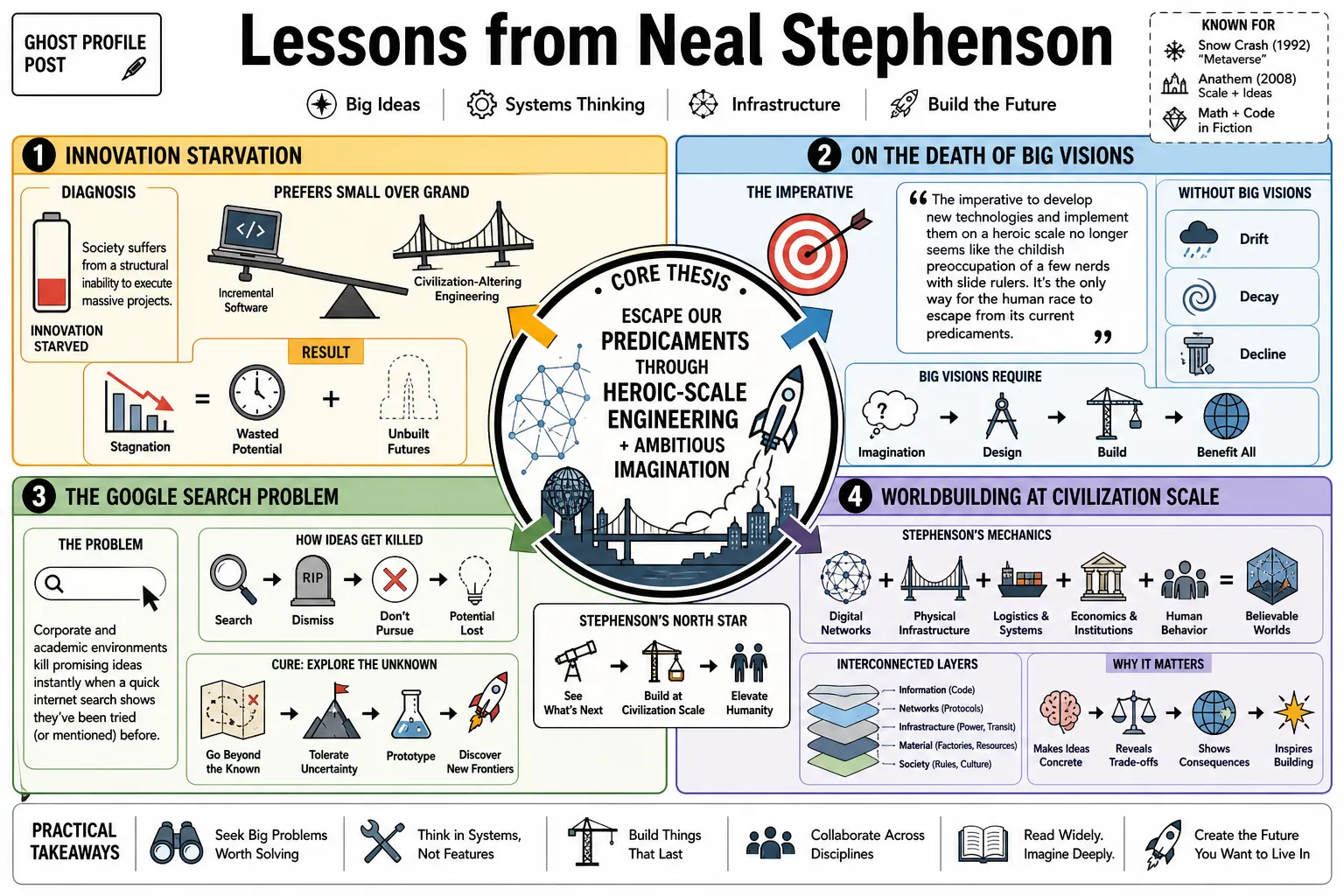
Lessons from Neal Stephenson
Neal Stephenson writes massive, mathematically dense novels that forecast the physical shape of the internet and virtual reality. Beyond coining the "Metaverse" in Snow Crash, he diagnoses our era's "innovation starvation" and our structural inability to execute civilization-scale engineering. This profile breaks down his mechanics for large-scale worldbuilding, exploring how digital networks interact with physical infrastructure and why ambitious science fiction is a hard requirement for human progress.
Part 1: Innovation and Technological Stagnation
- On the Death of Big Visions: "The imperative to develop new technologies and implement them on a heroic scale no longer seems like the childish preoccupation of a few nerds with slide rulers. It’s the only way for the human race to escape from its current predicaments." — Source: [Some Remarks]
- On Innovation Starvation: Contemporary society suffers from a structural inability to execute massive projects. It prefers incremental improvements in software over civilization-altering engineering. — Source: [World Policy Journal]
- On the Google Search Problem: Corporate and academic environments kill promising ideas instantly when a quick internet search reveals a similar, previously tried concept. This creates a risk-averse culture. — Source: [Wired]
- On the Role of Science Fiction: Modern science fiction has abandoned its duty to provide clear, inspiring symbols of a better future. The genre has chosen instead to dwell on dystopian anxieties. — Source: [Project Hieroglyph]
- On Crossing the Valley: "Any strategy that involves crossing a valley, accepting short-term losses to reach a higher hill in the distance, will soon be brought to a halt by the demands of a system that celebrates short-term gains." — Source: [Wikiquote]
- On Hacking the Physical World: The golden age of innovation involved hacking physical matter to build rockets and nuclear reactors, rather than rearranging bits on a screen. — Source: [MIT Technology Review]
- On Institutional Paralysis: Large institutions have evolved to produce predictable returns and minimize liability. This actively selects against the erratic, high-risk nature of true breakthrough discoveries. — Source: [Conversations with Tyler]
- On Inspiring Engineers: Science fiction does more than predict the future. It provides the psychological permission and imaginative blueprint for scientists to spend their careers building those technologies. — Source: [Slate]
- On the Fear of Unintended Consequences: We have become so paralyzed by the potential negative side effects of new technologies that we have chosen stagnation, forgetting that stagnation itself carries fatal risks. — Source: [Reason Magazine]
- On Technological Nostalgia: We look back at the Apollo program with admiration and a creeping sense of inadequacy, realizing we have lost the cultural machinery that made such efforts possible. — Source: [Lex Fridman Podcast]
Part 2: Virtual Worlds and the Metaverse
- On the Origin of the Metaverse: The concept of the Metaverse was born out of a practical need in Snow Crash to find a visually interesting way to depict the internet, as staring at text on a screen was not cinematic. — Source: [Vanity Fair]
- On Digital Real Estate: Virtual worlds will inevitably develop their own economies and real estate markets. These will be driven by the human desire for status and prime location. — Source: [Snow Crash]
- On Avatars: The term "avatar" was popularized in Snow Crash to describe the audiovisual bodies that people use to communicate with each other in a computer-generated universe. — Source: [The New York Times]
- On the Limits of VR: The fundamental physical constraint of virtual reality is the vestibular system. Until we can trick the inner ear into feeling movement, immersive VR will always cause motion sickness for many. — Source: [UploadVR]
- On Corporate Control of the Metaverse: A decentralized metaverse is preferable. A privately owned, centralized virtual world would amount to a corporate dictatorship controlling the fundamental reality of its users. — Source: [Wired]
- On Generative AI in Virtual Worlds: AI tools will be necessary for populating virtual spaces with infinite, dynamically generated content. Hand-crafting every 3D asset is economically and temporally impossible. — Source: [Tim Boucher Blog]
- On the Convergence of Gaming and Reality: The boundary between massive multiplayer online games and the broader economy will blur. This will lead to situations where people earn their real-world living entirely inside game engines. — Source: [Reamde]
- On the Metaverse as a Standard: For the Metaverse to function, it requires a universal, open-source protocol for 3D graphics and physics. This would be much like how HTML serves as the foundational protocol for the web. — Source: [Lamina1]
- On Escapism: As the physical world faces climate degradation and economic inequality, the appeal of a highly rendered virtual environment will transition from entertainment to a psychological necessity. — Source: [Fall; or, Dodge in Hell]
- On Digital Afterlives: The logical endpoint of brain-computer interfaces and massive computing power is the uploading of human consciousness into simulated environments, which creates a secular digital afterlife. — Source: [The Guardian]
Part 3: Cryptography and Information Security
- On Information as Power: In the digital age, the ability to encrypt and decrypt information is the ultimate arbiter of power. It supersedes traditional geographic or military advantages. — Source: [Cryptonomicon]
- On Cryptocurrency: Digital, mathematically backed currency running on decentralized networks will eventually bypass state-controlled fiat currencies and alter the global balance of economic power. — Source: [Reason Magazine]
- On Cryptographic Key Management: The most complex part of cryptography is the human element. It is incredibly difficult to safely store and exchange the physical keys without being compromised. — Source: [Schneier on Security]
- On State Surveillance: Governments will inevitably attempt to hoard cryptographic backdoors. They misunderstand that a compromised system is insecure against all attackers, rather than only the intended targets. — Source: [Electronic Frontier Foundation]
- On the Evolution of Hackers: The romanticized lone hacker of the 1990s has been replaced by highly organized, state-sponsored cyber-warfare units and sophisticated global criminal syndicates. — Source: [Slashdot]
- On Code as Law: In a fully digital economy, cryptographic algorithms act as the unbending laws of physics. They enforce contracts with a mathematical certainty that human courts cannot match. — Source: [Long Now Foundation]
- On the Value of Anonymity: True anonymity on the internet requires extraordinary operational security and a deep understanding of how metadata can de-anonymize heavily encrypted communications. — Source: [Def Con Speeches]
- On Data Havens: The creation of offshore, highly secure data havens is a natural market response to increasing digital surveillance. Sovereign individuals will always seek to protect their wealth and information. — Source: [Cryptonomicon]
- On the Mathematical Mindset: Cryptography demands a paranoid, edge-case-obsessed way of thinking that assumes everything that can be exploited eventually will be. — Source: [Lex Fridman Podcast]
- On the Command Line Interface: "In the beginning was the command line." Graphical user interfaces are merely pleasant illusions hiding the raw, precise power of direct text-based computer interaction. — Source: [In the Beginning... Was the Command Line]
Part 4: The Physical Internet and Infrastructure
- On the Internet's Physicality: The internet is not a cloud. It is a massive, vulnerable, and deeply physical network of undersea cables, landing stations, and fiber-optic threads spanning the globe. — Source: [Wired]
- On Submarine Cables: Laying undersea cables is the modern equivalent of building the transcontinental railroad, requiring immense capital and brute-force engineering. — Source: [Wired]
- On Global Connectivity: The speed of light in fiber optic glass determines the fundamental latency of the global economy. This shapes where servers are located and how financial markets operate. — Source: [The Verge]
- On Infrastructure Blindness: Modern society is dangerously oblivious to the fragile, invisible systems that keep civilization running, from power grids to submarine cables. — Source: [NPR]
- On Geopolitics of Cables: The landing sites of international fiber-optic cables are critical geopolitical chokepoints. They are constantly subject to espionage, sabotage, and state control. — Source: [Wired]
- On the Labor of Connectivity: Behind the flawless illusion of the wireless internet is an army of blue-collar workers, divers, and ship crews doing dangerous physical labor to maintain the network. — Source: [Some Remarks]
- On the Resilience of Copper and Glass: Despite advancements in satellite internet, the sheer bandwidth capacity of physical fiber-optic cables ensures they will remain the backbone of global communications. — Source: [Ars Technica]
- On Bandwidth Economics: Bandwidth is a physical commodity subject to the laws of supply and demand. Its abundance or scarcity dictates the evolution of digital culture. — Source: [Slashdot]
- On the Messiness of Hardware: Software is clean and logical, but hardware is dirty. It is subject to rust, shark bites, and earthquakes. — Source: [Wired]
Part 5: Science, Math, and the Baroque Era
- On the Birth of Modern Science: The late 17th century was a unique crucible where alchemy and philosophy violently collided to produce the modern scientific method. — Source: [Quicksilver]
- On Isaac Newton: Newton was a rational physicist and a deeply strange, obsessive alchemist who viewed his mathematical discoveries as a way to decode the mind of God. — Source: [Quicksilver]
- On the Invention of Money: The transition from physical specie to complex financial instruments, credit, and fiat currency during the Baroque era laid the groundwork for the modern global economy. — Source: [The System of the World]
- On Mathematics as Philosophy: Mathematical discoveries are not merely tools for calculation. They are profound philosophical statements about the nature of reality and human perception. — Source: [Anathem]
- On the Royal Society: The early Royal Society represented a radical shift in human thought. It established the principle that knowledge must be derived from verifiable experiments rather than ancient authority. — Source: [The Confusion]
- On Gottfried Leibniz: Leibniz's development of binary code and calculus was driven by a desire to create a universal language of logic that could resolve all human disputes. — Source: [Quicksilver]
- On Scientific Rivalries: The bitter priority disputes between figures like Newton and Leibniz demonstrate that the pursuit of objective truth is often fueled by intense human ego and nationalistic pride. — Source: [History of Science Society]
- On the Mechanization of the World: The shift from viewing the universe as a magical, animate entity to viewing it as a complex, clockwork mechanism was the most disruptive intellectual event in history. — Source: [The System of the World]
- On Platonic Realism: The debate over whether mathematical concepts exist independently in a Platonic realm or are merely human inventions remains the central unresolved tension in theoretical physics. — Source: [Anathem]
Part 6: Writing and the Creative Process
- On the Primacy of Story: "The story is everything, so it always begins with a story. And research is a kind of scaffolding built underneath the story as I go along." — Source: [AzQuotes]
- On Writing Long Novels: A massive book is simply the result of sitting down every single day and writing a few pages over a sustained period of years, treating the craft as a blue-collar job. — Source: [Locus Magazine]
- On Distraction: Maintaining the deep concentration required to write a novel means aggressively defending one's time against the constant, fragmenting interruptions of email and social media. — Source: [Neal Stephenson's Website]
- On Physical Writing Tools: Using a fountain pen on high-quality paper forces a slower, more deliberate thought process. This fundamentally alters the rhythm and flow of the prose compared to typing. — Source: [The New York Times]
- On Worldbuilding: Effective worldbuilding means creating a set of internal rules and constraints that the characters must believably navigate, rather than explaining every detail. — Source: [Wired]
- On Info-Dumping: Long expository passages are acceptable and even enjoyable if the information is inherently fascinating and delivered with a distinctive, entertaining authorial voice. — Source: [Goodreads]
- On AI in Art: "If your only way of making a painting is to actually dab paint laboriously onto a canvas... you were exercising editorial judgment with every paint stroke. That is absent in the output of these programs." — Source: [Tim Boucher Blog]
- On Managing Scope: When writing a sprawling narrative, the author must eventually ruthlessly prune secondary plotlines to ensure the core thematic threads resolve satisfyingly. — Source: [Science Fiction Book Club]
- On the Role of the Novelist: The novelist's job is to run complex, engaging simulations of how human nature reacts to changing technological conditions. — Source: [Reason Magazine]
Part 7: Space, Disaster, and Orbital Mechanics
- On the Fragility of Earth: The Earth is a precarious ecosystem. The long-term survival of the human species relies on developing the capacity to establish self-sustaining habitats in orbit or on other planets. — Source: [Seveneves]
- On Orbital Mechanics: Space travel is less about powerful engines and more about the elegant, unforgiving mathematics of momentum, gravity wells, and precise delta-v calculations. — Source: [Space.com]
- On Geoengineering: As climate change accelerates, humanity will likely be forced into desperate, unilateral geoengineering experiments because political consensus will fail. — Source: [Termination Shock]
- On Catastrophe and Competence: In a true apocalyptic scenario, survival will not depend on lone-wolf survivalists, but on highly organized groups of engineers and technicians working collaboratively. — Source: [Seveneves]
- On the Hard Realities of Space: Space is actively hostile to human biology. Factors like radiation and microgravity make long-term habitation an immense medical and engineering challenge. — Source: [Scientific American]
- On the Kessler Syndrome: The cascading collision of orbital debris is a mathematical certainty that could eventually seal humanity off from space, creating a prison of our own trash. — Source: [National Geographic]
- On the Economics of Space Launch: The primary barrier to a space-faring civilization is not technological, but economic. The cost of lifting mass out of Earth's gravity well must be drastically reduced. — Source: [GeekWire]
- On Genetic Bottlenecks: A catastrophic reduction in the human population would force brutal ethical decisions regarding genetics, reproduction, and the deliberate shaping of future human traits. — Source: [Seveneves]
- On Long-term Thinking: Dealing with planetary-scale threats requires a time horizon that extends beyond election cycles, demanding institutions that can plan and execute projects spanning centuries. — Source: [Long Now Foundation]
Part 8: Society, Culture, and Philosophy
- On Western Culture: "For a Westerner to trash Western culture is like criticizing our nitrogen/oxygen atmosphere on the grounds that it sometimes gets windy... You may not realize its advantages until you’re trying to breathe liquid methane." — Source: [Wired]
- On Mathematical Literacy: "I think visual literacy and media literacy is not without value, but I think plain old-fashioned text literacy and mathematical literacy are much more powerful and flexible ways to organize your mind." — Source: [Wikiquote]
- On Monastic Retreats: As global communication becomes overwhelmingly noisy, there is profound value in intellectual monasticism. Withdrawing from the constant stream of data is necessary to engage in deep, uninterrupted thought. — Source: [Anathem]
- On the Amistics of Technology: Different communities should have the right to consciously evaluate and reject specific technologies that disrupt their social cohesion, rather than accepting all innovation blindly. — Source: [The Long Now]
- On Media Fragmentation: The internet has destroyed the shared consensus reality provided by broadcast media. This allows people to self-segregate into hermetically sealed ideological bubbles. — Source: [Fall; or, Dodge in Hell]
- On the Value of History: The problems we face with networks, money, and state power are not entirely new. They are modern iterations of the exact same philosophical conflicts that raged during the 17th century. — Source: [Quicksilver]
- On Intelligence vs. Wisdom: Raw computational power and intelligence are abundant in modern society. Wisdom, defined as the ability to understand the long-term consequences of actions, is dangerously scarce. — Source: [Anathem]
- On the Epistemological Crisis: We are entering an era where the democratization of deepfakes and generated disinformation will make it nearly impossible for the average citizen to verify basic facts about reality. — Source: [The Atlantic]
- On the Human Drive: What separates humans from complex algorithms is the irrational, messy, and undeniable urge to explore the unknown and build monuments. — Source: [Lex Fridman Podcast]