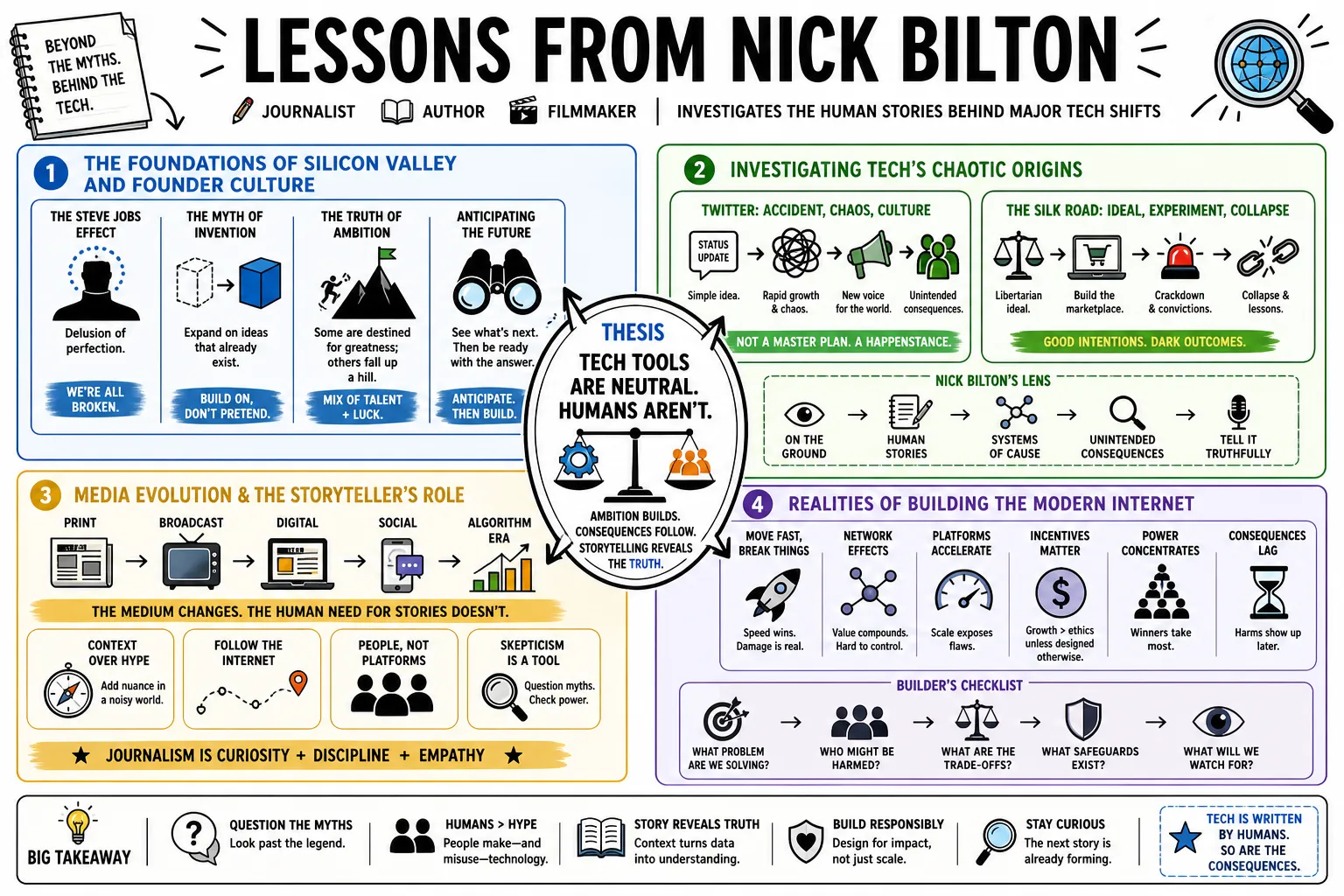
Lessons from Nick Bilton
Journalist, author, and filmmaker Nick Bilton investigates the human stories behind major tech shifts, stripping away the polished mythology of Silicon Valley to document the chaotic origins of Twitter and the Silk Road. His work focuses on the unintended consequences of digital tools. This profile collects his observations on ambition, media evolution, and the realities of building the modern internet.
Part 1: The Foundations of Silicon Valley and Founder Culture
- On the Steve Jobs effect: "This is the fault of Steve Jobs, who created this nonsensical delusion in Silicon Valley that he had it all figured out. That it's all perfect together. They all want to be the next Steve Jobs because of that. The reality is we're all broken in some way." — Source: [Los Angeles Review of Books]
- On the myth of invention: "People don't invent things on the Internet. They simply expand on an idea that already exists." — Source: [Hatching Twitter]
- On the truth of ambition: "Some people are destined for greatness; others fall up a hill to get there." — Source: [Hatching Twitter]
- On anticipating the future: "Over time he learned that the way to have a leg up on everyone else was to anticipate something before it happened and then have the answer to it." — Source: [Hatching Twitter]
- On tech industry delusions: "Startups frequently rely on sly trickery and manufactured narratives to appease Wall Street or maintain a facade of inevitable success." — Source: [Vanity Fair]
- On founder philosophy: "Many tech leaders share a fixation on Ayn Rand and libertarian philosophies, using them to justify building platforms that operate outside traditional regulations." — Source: [The Jordan Harbinger Show]
- On the reality of success: "Mark Zuckerberg once described Twitter's early success as being like they had a clown car. They drove into a gold mine and fell in." — Source: [Hatching Twitter]
- On the limitations of tech leaders: "The galaxy brain mentality of billionaires often creates incentive structures that ignore the very real risks of the attention economy." — Source: [Big Technology Podcast]
- On money and character: "When people ask Biz about his wealth, he tells them that money rarely changes people; it often just magnifies who they really are." — Source: [Hatching Twitter]
Part 2: The Chaos of Twitter's Early Days
- On the forgotten founders: "Noah gave Twitter its soul, and then he was erased." — Source: [Hatching Twitter]
- On the platform's global influence: "Has Twitter changed the world? It absolutely has. Look at how it's used today: you have the Pope, you have the presidents of Iran and the US responding to each other on Twitter. You have revolution on Twitter." — Source: [Los Angeles Review of Books]
- On isolation within connection: "Social media was partially built to erase an emotion that its creators felt while staring into computer screens night after night: deep, profound loneliness." — Source: [Hatching Twitter]
- On rewriting the past: "In the past, history was always written by the victors. But in the age of Twitter, history is written by everyone." — Source: [Hatching Twitter]
- On the inadequacy of documentation: "Quoting Julian Barnes to describe early Twitter lore, history is that certainty produced at the point where the imperfections of memory meet the inadequacies of documentation." — Source: [Hatching Twitter]
- On corporate betrayal: "The origin of Twitter was less a story of harmonious engineering and more a saga of power, money, and friends quietly pushing each other out of the boardroom." — Source: [Hatching Twitter]
- On accidental success: "The early architecture of Twitter was so unstable that its survival was a testament more to user demand than to visionary engineering." — Source: [Hatching Twitter]
- On digital permanence: "If there is no X to mark the spot, there is no spot." — Source: [Hatching Twitter]
- On the speed of information: "The platform fundamentally altered how breaking news operates, shifting authority from traditional news desks directly to the witnesses on the ground." — Source: [Hatching Twitter]
- On early social media culture: "What began as a tool to update friends on mundane activities quickly morphed into an uncontrollable global microphone." — Source: [Hatching Twitter]
Part 3: The Dark Web and the Silk Road
- On absolute power online: "There are no laws here except your laws. You decide who is given power and who is not. And then you wake up one morning and you're not you anymore. You're one of the most notorious drug dealers alive." — Source: [American Kingpin]
- On modern authority: "This is one of those rare government buildings in which someone who uses a calculator for a living can wield more power than a person who carries a gun." — Source: [American Kingpin]
- On the absurdity of investigations: "You try and you try and you try, and eventually you become an agent with the Department of Homeland Security. Then the call comes in from a thankless government employee in a humongous government mail center at the airport about a single tiny pink pill. And then you are here." — Source: [American Kingpin]
- On the simplicity of dark markets: "The entire concept of the Silk Road could be distilled into a single, terrifyingly effective elevator pitch: it is like Amazon.com, but for drugs." — Source: [American Kingpin]
- On moral justification: "Even though all these people were dealing in illicit activities, they each had a moral sense that their particular outlawed product was more just than another." — Source: [American Kingpin]
- On creating new worlds: "You type lines of code into a computer, and out comes a world that didn't exist before. There are no laws here except your laws." — Source: [American Kingpin]
- On human error in digital crimes: "Despite operating within a highly encrypted, technically sophisticated system, the downfall of the Silk Road mastermind ultimately came down to simple, overlooked human mistakes." — Source: [SuperSummary]
- On internet anonymity: "The architecture of the dark web creates a space where absolute freedom inevitably collides with absolute chaos." — Source: [American Kingpin]
- On the entrepreneurial mindset of crime: "Building an illegal marketplace requires the same resourcefulness and drive as a legitimate Silicon Valley startup, but with exponentially higher stakes." — Source: [Bookey]
Part 4: The Unintended Consequences of Technology
- On societal derangement: "While early social media felt novel and convenient, it has since deranged us in ways we couldn't have imagined." — Source: [Longform Podcast]
- On developer responsibility: "These things, they're unintended consequences always, but our responsibility is to fix those. We never know what they are with technology." — Source: [Podscripts]
- On protecting children: "One example is kids should not be using social media like this. It is just so unhealthy." — Source: [Podscripts]
- On the creators' own habits: "When asked about the iPad, Steve Jobs admitted they hadn't used it, noting that they limited how much technology their kids used at home." — Source: [The New York Times]
- On algorithms and anger: "Modern audiences are stalked by algorithms, which have figured out that anger is the only way to make sure they come back day after day after day." — Source: [The Daily Beast]
- On personal addiction: "I don't have it on my phone because I can't stop looking at it. And I'm a grown adult who's written about it for twenty something years." — Source: [Podscripts]
- On the attention economy: "Escaping the cycle requires stepping away from chasing dangling digital carrots and reclaiming ownership of one's own time." — Source: [Good For You Network]
- On virtual reality experiences: "Reporting on the Apple Vision Pro, immersive computing can feel almost religious, fundamentally altering how we interact with physical spaces." — Source: [Vanity Fair]
- On continuous engagement: "The architecture of modern apps is specifically designed to exploit psychological vulnerabilities, transforming users from active participants into passive consumers." — Source: [Inside the Hive Podcast]
- On technological blind spots: "Founders often build tools to solve their own minor inconveniences, remaining willfully blind to how those same tools might be weaponized by bad actors." — Source: [Vanity Fair]
Part 5: The Evolution of Media and Journalism
- On the shifting definition of press: "The press pass and the title of journalist had been replaced by a smart phone and a Twitter account." — Source: [Hatching Twitter]
- On adapting to change: "My peers aren't going to wake up one day and crave newsprint. The world is shifting; ignoring it won't make it go away." — Source: [I Live in the Future & Here's How It Works]
- On McLuhan's update: "The medium is no longer the message, meaning the message is now inherently tied to the individual consuming it." — Source: [I Live in the Future & Here's How It Works]
- On institutional reform: "An insider can’t change an institution from inside so you need an outsider looking from a different perspective." — Source: [The Daily Beast]
- On user-centric news: "Media has transitioned from being institutionally focused to placing the self at the absolute center of the experience." — Source: [I Live in the Future & Here's How It Works]
- On modern storytelling: "Effective journalism in the digital age requires breaking out of traditional formats and engaging with audiences across multiple fragmented platforms." — Source: [How I Write Podcast]
- On the decay of gatekeepers: "The democratization of publishing means that authority is no longer granted by a masthead, but earned or manipulated via engagement metrics." — Source: [Vanity Fair]
- On interactive consumption: "The future of reading and news consumption is inherently nonlinear, demanding a mix of text, video, and immediate digital feedback." — Source: [I Live in the Future & Here's How It Works]
- On the reality of television news: "Legacy broadcasts must confront the reality that the way news is manufactured and digested has been irreversibly altered by the internet." — Source: [Business Insider]
Part 6: Technochondria and Our Fear of the Future
- On resisting change: "You can lament the changes that are happening today, tomorrow's history, convincing yourselves of the negatives and refusing to be a part of a constantly changing culture." — Source: [I Live in the Future & Here's How It Works]
- On historical patterns of fear: "Societal anxiety about smartphones and social media mirrors historical panics over the telephone, comic books, and the advent of television." — Source: [I Live in the Future & Here's How It Works]
- On embracing metamorphosis: "Or you can shake off your technochondria and embrace and accept that the positive metamorphosis will continue to happen, as it has so many times before." — Source: [I Live in the Future & Here's How It Works]
- On temporal bias: "There's an all too human tendency to believe that what we know and experience now is the way it will and always should be." — Source: [I Live in the Future & Here's How It Works]
- On technological optimism: "Despite the severe disruptions to traditional industries, new technologies consistently provide powerful, unprecedented tools for community building." — Source: [PCMag]
- On the speed of adaptation: "Humans are incredibly resilient in the face of new interfaces; what seems alien and terrifying today becomes invisible infrastructure tomorrow." — Source: [I Live in the Future & Here's How It Works]
- On the myth of the good old days: "Nostalgia for analog media often ignores the gatekeeping, inefficiencies, and exclusions inherent in those older systems." — Source: [I Live in the Future & Here's How It Works]
- On evaluating new tools: "Instead of asking if a technology is purely good or bad, society must analyze who controls it and what behaviors it actively incentivizes." — Source: [Vanity Fair]
- On generational divides: "The friction between digital natives and older generations is less about the technology itself and more about differing baseline expectations of privacy and speed." — Source: [I Live in the Future & Here's How It Works]
- On the inevitability of disruption: "Trying to pause technological advancement to preserve an existing industry is like trying to hold back the tide with a broom." — Source: [I Live in the Future & Here's How It Works]
Part 7: Human Nature in a Digital Age
- On the new nature of fame: "Fame is not what it used to be. It's not about talent anymore. It's about who can game the system the best." — Source: [Fake Famous Documentary]
- On the illusion of influence: "The influencer economy relies heavily on manufactured reality, where fake followers and staged photosets create genuine financial value." — Source: [Fake Famous Documentary]
- On urban isolation: "In the centre of every big city in the world, surrounded by noise and teeming millions of people, are lonely people. Loneliness is not so much where you are, but instead is your state of mind." — Source: [Hatching Twitter]
- On fulfilling potential: "Most people go through life thinking that tomorrow they're going to do something great. Tomorrow will be the day that they wake up and discover what they were put on this earth." — Source: [QuoteFancy]
- On offline fulfillment: "Giving up constant connectivity allows individuals to feel so much more fulfilled and that their days belong to them again." — Source: [Good For You Network]
- On the persistence of character: "Digital tools do not invent new human flaws; they simply provide unprecedented scale and speed for our existing vanities and insecurities." — Source: [Hatching Twitter]
- On seeking validation: "The feedback loops of likes and retweets tap directly into a primal human need for community approval, often bypassing our logical defenses." — Source: [Inside the Hive Podcast]
- On the fragility of trust: "In an ecosystem where anyone can be an author, the burden of verifying truth shifts entirely onto the exhausted consumer." — Source: [Vanity Fair]
- On digital permanence: "We have built a society where our worst moments and most casual mistakes are indexed, searchable, and immortalized forever." — Source: [Hatching Twitter]
Part 8: The Power and Illusion of the Internet
- On the illusion of control: "Founders quickly discover that once a network reaches a certain scale, it takes on a life of its own, becoming impossible for its creators to fully govern." — Source: [Hatching Twitter]
- On the hidden labor of tech: "Behind the seamless interfaces of modern apps are armies of content moderators and low wage workers absorbing the worst of human behavior." — Source: [Vanity Fair]
- On digital borders: "The internet promised a borderless utopia, but instead fractured into heavily guarded corporate walled gardens designed to trap user attention." — Source: [I Live in the Future & Here's How It Works]
- On the commodification of data: "In the modern web, the user is no longer the customer; the user behavioral data is the product being sold to the highest bidder." — Source: [Vanity Fair]
- On the aesthetics of startups: "The sleek, minimalist design of Silicon Valley hardware often masks the chaotic, ruthless business practices required to produce it." — Source: [Hatching Twitter]
- On algorithmic radicalization: "Platforms inherently favor extreme content because nuance does not drive the sustained engagement metrics required by digital advertisers." — Source: [The Daily Beast]
- On the myth of the lone hacker: "The narrative of the solitary genius coding in a basement obscures the reality that modern cybercrime and innovation both rely on vast, decentralized networks of collaboration." — Source: [American Kingpin]
- On Silicon Valley endgame: "The ultimate goal of many tech giants is not merely to provide a service, but to become an inescapable layer of infrastructure for human existence." — Source: [Vanity Fair]
- On the cost of convenience: "Every time we trade privacy for a slightly more personalized digital experience, we incrementally surrender our autonomy to opaque corporate algorithms." — Source: [Vanity Fair]