Lessons from Nick Sleep
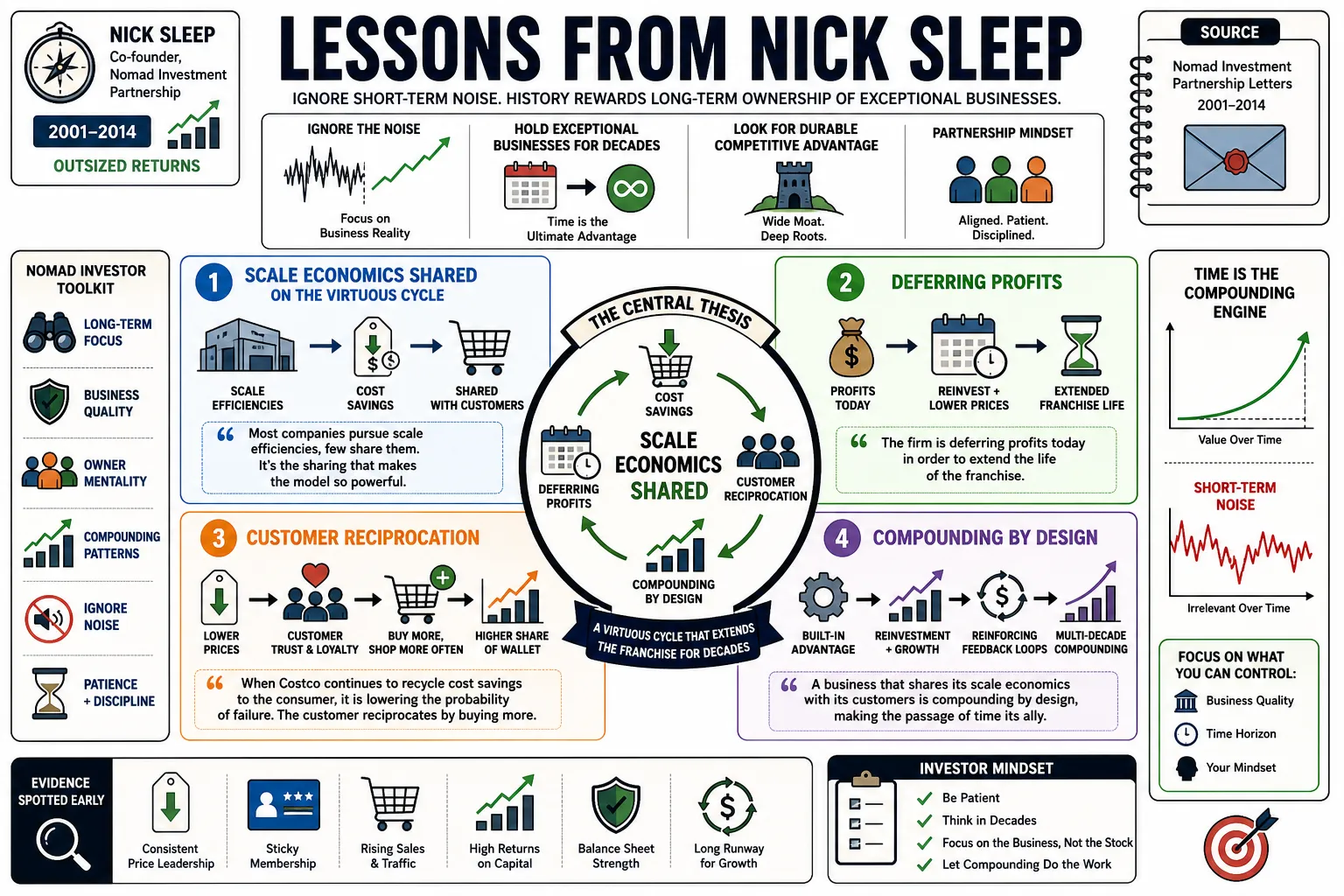
Nick Sleep co-founded the Nomad Investment Partnership, generating outsized returns from 2001 to 2014 by simply ignoring short-term market noise. He recognized early that companies like Costco and Amazon win through "scale economics shared," continuously passing cost savings down to customers to build a durable advantage. His partnership letters remain a practical guide to the extreme psychological discipline required to hold exceptional businesses for decades.
Part 1: Scale Economics Shared
- On the Virtuous Cycle: "Most companies pursue scale efficiencies, few share them. It’s the sharing that makes the model so powerful." — Source: Nomad Investment Partnership Letters
- On Deferring Profits: "The firm is deferring profits today in order to extend the life of the franchise." — Source: Nomad Investment Partnership Letters
- On Customer Reciprocation: "When Costco continues to recycle cost savings to the consumer, it is lowering the probability of failure. The customer reciprocates by buying more." — Source: Nomad Investment Partnership Letters
- On Compounding by Design: "A business that shares its scale economics with its customers is compounding by design, making it virtually impossible for competitors to catch up." — Source: Invest with Thesis
- On the Deep Reality: "The simple deep reality for many of our firms is the virtuous spiral established when companies keep costs down, margins low and in doing so share their growing scale." — Source: Morningstar
- On Growth: "The company grows by giving back to the customer, rather than extracting every last cent of margin." — Source: Nomad Investment Partnership Letters
- On Margin Caps: "Costco caps its margins and returns all scale advantages to members, resulting in sales per square foot far higher than traditional supermarkets." — Source: Quartr
- On Competitive Moats: "Sharing scale economics creates a moat that widens automatically as the business grows." — Source: The Cap Stack
- On Amazon's Flywheel: "Amazon utilizes the same shared economics framework; Bezos passes savings to the consumer, which drives volume and further lowers costs." — Source: Nomad Investment Partnership Letters
- On Longevity: "By sharing the wealth with the customer, the business builds an enduring trust that extends its lifespan infinitely." — Source: IGY Foundation
Part 2: Patience and Time Horizons
- On Outperforming the Crowd: "Only by looking further out than the short-term crowd can we expect to beat them." — Source: YouTube
- On the True Test: "We think about whether we’d be happy owning the business if the stock market closed for ten years." — Source: Nomad Investment Partnership Letters
- On Active Inaction: "The decision not to do something is still an active decision; it is just that the accountants don’t capture it." — Source: Marcellus
- On Management Interference: "Great businesses do not require frequent interference. They need space to grow." — Source: Gainify
- On the Ultimate Investors: "The best investors are not investors at all. They’re entrepreneurs who have never sold." — Source: Founders Podcast
- On the Minority Sport: "Good investing is a minority sport, which means that in order to earn returns better than everyone else we need to be doing things different to the crowd. And one of the things the crowd is not, is patient." — Source: Sleepy Capital
- On the Enemy of Fees: "Almost no one does this, in part because it requires patience—and the locker room set does not do patience—but also because inactivity is the enemy of high fees." — Source: Substack
- On Emotional Control: "We can all do momentum investing, but it is emotional investing and I just don't think it is that intelligent or profitable." — Source: Nomad Investment Partnership Letters
- On Doing Nothing: "The ability to sit quietly and do nothing is one of the most powerful and underutilized skills in the financial world." — Source: Nomad Investment Partnership Letters
- On Time Arbitrage: "Our edge is simply a willingness to wait longer than the person on the other side of the trade." — Source: Nomad Investment Partnership Letters
Part 3: Destination Analysis
- On the Core Framework: "Destination analysis is consciously central to how we analyse businesses these days. It helps us ask better questions and get to a firm's DNA." — Source: Masters Invest
- On True Risk: "The only real, long term risk, is the risk of mis-analysing a company's destination." — Source: Re-Think Wealth
- On Distractions: "Traveling comfortably dominates people's thinking when they should be thinking about destinations." — Source: Substack
- On Bumpy Rides: "To our way of thinking the question is, what good habits and techniques ensure that the destination is secure (even if the ride is bumpy)." — Source: Nomad Investment Partnership Letters
- On Long-Term Focus: "In the long run, destination will be more important in determining outcomes for our firms than the distractions of the day." — Source: Morningstar
- On Forecasting: "We don't try to predict the next quarter's earnings; we try to determine where the business will logically end up in two decades." — Source: Nomad Investment Partnership Letters
- On the End Game: "If you know where a company is going, the daily fluctuations in its stock price become noise rather than signal." — Source: Nomad Investment Partnership Letters
- On Assessing DNA: "You must look at the foundational habits of a company to understand if it has the right DNA to reach a dominant destination." — Source: IGY Foundation
- On Ignoring the Journey: "Investors spend too much time trying to smooth out the journey, sacrificing the ultimate destination in the process." — Source: Nomad Investment Partnership Letters
Part 4: Psychology and Behavioral Edge
- On the Ultimate Advantage: "Informational edges are fleeting, and analytical edges are hard to maintain. A psychological edge is the only enduring advantage." — Source: Everything Money
- On Client Expectations: "One common psychological trap that agents may fall into is that clients expect action, or to be more accurate, fund managers expect their clients to expect action!" — Source: Marcellus
- On Social Proof: "Institutional investors often sell because their peers are selling, driven by the fear of looking foolish to their clients." — Source: Economic Times
- On the Availability Heuristic: "Investors over-weight vivid but transient information, while ignoring the axiomatic long-term DNA of the business." — Source: Fiscal AI
- On Ego and Denial: "When facts change, ego prevents investors from admitting they were wrong or updating their static thesis." — Source: Economic Times
- On Sitting Still: "Once you find a Scale Economics Shared business, the most valuable thing you can do is simply sit on your assets." — Source: Nomad Investment Partnership Letters
- On the Mindset of Holding: "The hardest part of investing is doing nothing when there is nothing to do, yet everything around you is demanding action." — Source: Nomad Investment Partnership Letters
- On Groupthink: "If you are thinking the same way as everyone else on Wall Street, you are virtually guaranteed to get average results." — Source: Nomad Investment Partnership Letters
- On Independence: "True independence of thought requires a psychological fortitude that is very rare in institutional finance." — Source: Nomad Investment Partnership Letters
Part 5: Quality and Business DNA
- On the Engine of Success: "The answer lies in analyzing not the effects and outputs of a business, but digging down to the underlying reality of the company, the engine of its success." — Source: DS Compounding
- On High Incremental Returns: "We look for businesses that can deploy capital at high incremental returns for a very long time." — Source: Gainify
- On Value Migration: "We like the idea that value migrates to where it’s treated best." — Source: Nomad Investment Partnership Letters
- On Corporate Culture: "A great culture allows a company to sacrifice short-term gains in order to deliver long-term value." — Source: Gainify
- On Quality Thinkers: "We are constantly looking for super high-quality thinkers who manage businesses with a long-term, owner-oriented mindset." — Source: Tech Book of the Month
- On Predictability: "We want to invest in businesses where the economic outcome is highly predictable over a long period, even if the short-term path is opaque." — Source: Nomad Investment Partnership Letters
- On Customer Trust: "The greatest asset a business can build is unshakeable customer trust. It is the hardest thing for a competitor to replicate." — Source: Nomad Investment Partnership Letters
- On Axiomatic Truths: "We focus on axiomatic truths about a business—things that will still be true decades from now." — Source: Fiscal AI
- On Identifying Greatness: "Greatness in a business is often found in its willingness to do things that hurt short-term margins to build long-term loyalty." — Source: Nomad Investment Partnership Letters
Part 6: Capital Allocation and Portfolio Concentration
- On Knowable Things: "In our opinion, just a few big things in life are knowable. And it is because just a few things are knowable that Nomad has just a few investments." — Source: Nomad Investment Partnership Letters
- On Diversification: "Over-diversification is the enemy of outstanding returns. If you find something great, you should allocate heavily to it." — Source: Nomad Investment Partnership Letters
- On Building Conviction: "Conviction is built slowly, through deep research and observing the business execute on its destination over time." — Source: Nomad Investment Partnership Letters
- On Portfolio Weightings: "The size of a position should be directly correlated to the predictability of the business's destination." — Source: Nomad Investment Partnership Letters
- On Lethargy in Allocation: "A lethargic approach to trading allows capital to compound uninterrupted, which is the most efficient form of allocation." — Source: Nomad Investment Partnership Letters
- On Letting Winners Run: "You do not trim a blossoming flower just because it has grown larger than the other plants in the garden." — Source: Nomad Investment Partnership Letters
- On Opportunity Cost: "The true cost of a new investment is the capital you must take away from your best existing idea." — Source: Nomad Investment Partnership Letters
- On Finding Rare Ideas: "Truly great investment ideas are exceptionally rare; when you find one, you must act decisively and hold tightly." — Source: Nomad Investment Partnership Letters
- On Capital Discipline: "We treat every dollar of our partners' capital as if it were our own, which means we are incredibly stingy about what we buy." — Source: Nomad Investment Partnership Letters
Part 7: Mistakes and Opportunity Cost
- On the Biggest Error: "The most expensive mistake an investor can make is not a stock that goes to zero, but selling a compounding machine prematurely." — Source: Everything Money
- On the Math of Omission: "The opportunity cost of selling a great business is mathematically far greater than the total loss of a single position." — Source: Fiscal AI
- On the Baltimore Example: "What we are trying to do today is to avoid the Baltimore company’s second mistake which was to sell an equally big stake in Walmart in the 1970s." — Source: YouTube
- On Taking Profits: "Investors often sell because a stock looks expensive or they want to lock in profits, which is a failure to focus on the long-term destination." — Source: Nomad Investment Partnership Letters
- On Anchoring Bias: "My own mistake with Amazon was anchoring to a zero percent starting weight, rather than betting heavily on my highest-conviction idea immediately." — Source: OMD Ventures
- On Reframing Mistakes: "A mistake is only a mistake if you call it so. Otherwise, it is a learning opportunity." — Source: Nomad Investment Partnership Letters
- On Positive Value Errors: "Once a lesson is learned, the mistake becomes net present value positive because it informs better behavior for the rest of one's life." — Source: Nomad Investment Partnership Letters
- On Regret: "Regret is a wasted emotion in investing unless it is harnessed to improve your future decision-making process." — Source: Nomad Investment Partnership Letters
- On Early Selling: "Selling a great company because of a short-term valuation concern is the surest way to interrupt compounding." — Source: Nomad Investment Partnership Letters
- On Learning: "We study our mistakes rigorously, not to punish ourselves, but to ensure we do not pay tuition for the same lesson twice." — Source: Nomad Investment Partnership Letters
Part 8: Life, Ethics, and The Bigger Picture
- On the Adventure: "Investing is a wonderful, thoughtful adventure, but it can also be self-centered... real meaning comes with reinvesting in society through charitable giving." — Source: DS Compounding
- On Broadening Horizons: "From time to time we swap slippers for brogues and head out into the world with the expectation that what we learn through investing helps us in other activities." — Source: DS Compounding
- On Reciprocal Learning: "What we learn doing other activities outside the office helps us directly as investors." — Source: Nomad Investment Partnership Letters
- On Full Reality: "In the end, all reality has to respect all other reality. And that’s what a full life is all about." — Source: DS Compounding
- On the Purpose of Wealth: "The accumulation of capital is only half the job; the second, and arguably more important half, is the intelligent distribution of it." — Source: IGY Foundation
- On Ethics in Business: "We prefer to align our capital with management teams that view their customers as partners rather than resources to be extracted." — Source: Nomad Investment Partnership Letters
- On Simplicity: "A simple life, focused on a few meaningful pursuits, is vastly superior to a complex life filled with distractions." — Source: Nomad Investment Partnership Letters
- On Giving Back: "We closed Nomad because we realized our passion had shifted from compounding capital to applying that capital toward solving social problems." — Source: IGY Foundation
- On Legacy: "A true legacy is not the fund returns you generate, but the positive compounding impact you leave on the people and communities around you." — Source: IGY Foundation