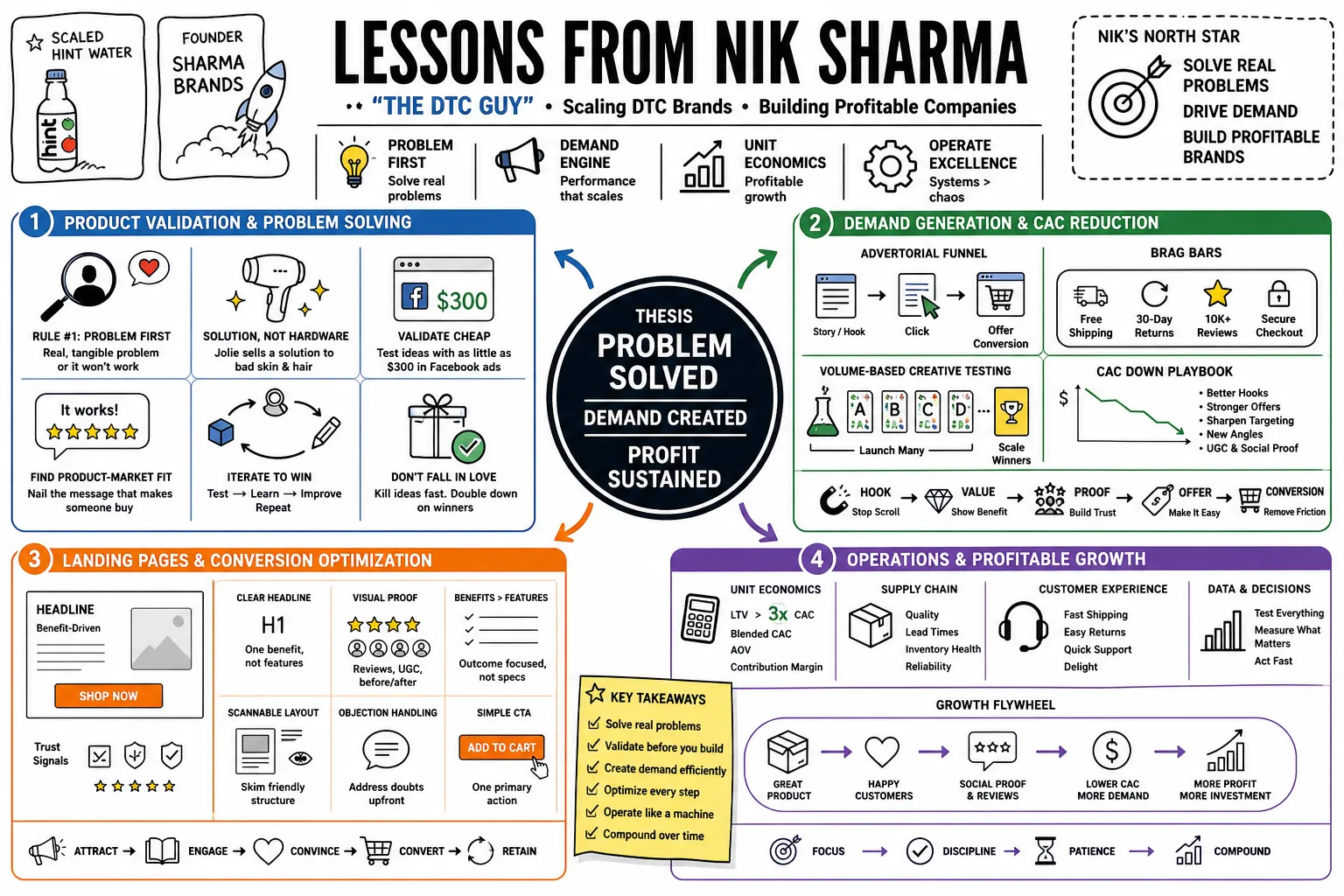
Lessons from Nik Sharma
E-commerce strategist Nik Sharma earned the title "The DTC Guy" by scaling direct-to-consumer brands like Hint Water and founding Sharma Brands. This profile breaks down his specific tactics for driving down customer acquisition costs, from advertorial funnels and brag bars to volume-based creative testing. It also outlines his frameworks for building profitable brands, optimizing landing pages, and managing the operational realities of modern retail.
Part 1: Product Validation and Problem Solving
- On the first rule of DTC: "If your product doesn't solve a real, tangible problem, no amount of performance marketing will save it." — Source: [Sharma Brands]
- On hardware as beauty: "Brands like Jolie succeed because they don't sell a piece of hardware; they sell a solution to bad skin and hair." — Source: [Retail Brew]
- On validating ideas cheaply: "You can validate a product concept with as little as $300 in Facebook ads before ever ordering inventory." — Source: [Privy]
- On finding product-market fit: "Stop testing basic value propositions. The hardest part of starting from zero is nailing the precise messaging that makes someone pull out their credit card." — Source: [Sharma Brands]
- On iterative design: "Winning is about testing faster, designing smarter, and iterating relentlessly." — Source: [Deezer Podcast Interview]
- On building for outcomes: "Customers don't buy your ingredients. They buy what your ingredients will do for them." — Source: [David Perell Podcast]
- On avoiding gimmicks: "Creating a new version of an existing item isn't enough. It has to actually fix a pain point the customer actively hates." — Source: [Limited Supply Podcast]
- On asking the right questions: "Your product must clearly answer: What is it? Why does it exist? And how will it benefit me?" — Source: [Deezer Podcast Interview]
- On early adoption: "Leverage your early adopters to tell you what they actually use the product for, not what you intended it to be used for." — Source: [David Perell Podcast]
- On the core offer: "If the offer isn't compelling, tweaking the creative won't move the needle." — Source: [Sharma Brands]
Part 2: Landing Pages and Conversion Rate Optimization
- On the Brag Bar: "Every landing page needs a Brag Bar right at the top: press quotes, customer reviews, and testimonials to build immediate credibility." — Source: [David Perell Podcast]
- On the red carpet analogy: "Imagine you're Kim Kardashian's assistant on the red carpet. You have to give her all the information she needs before she takes a step. Your landing page must do exactly that for the consumer." — Source: [Tydo]
- On advertorials: "Advertorial-style landing pages played a massive role in growing Hint Water into a $100M business by educating the customer before they hit the checkout button." — Source: [SplitBase]
- On answering objections: "Your landing page must make sure the consumer has zero questions left. Address the friction points head-on." — Source: [Tydo]
- On building trust quickly: "A customer needs to know why they should trust your brand within seconds of clicking the link." — Source: [Deezer Podcast Interview]
- On mobile optimization: "If your landing page isn't designed primarily for the mobile thumb scroll, you are burning money." — Source: [Sharma Brands]
- On clear logistics: "Consumers need to know exactly how fast they will get the product. Put shipping times directly on the page." — Source: [Deezer Podcast Interview]
- On continuous auditing: "Audit your landing pages constantly. Look at where people drop off and rewrite that specific section." — Source: [Sharma Brands]
- On visual hierarchy: "Don't make users read long paragraphs. Break it up with clear subheadings, bullet points, and social proof." — Source: [Privy]
- On the singular goal: "The only job of a landing page is to move the user to the next step of the funnel. Remove any link that distracts from that." — Source: [Sharma Brands]
Part 3: Performance Marketing and Customer Acquisition
- On cold versus hot water: "Performance marketing is the cold water that wakes you up and gets you moving. Brand equity is the hot water that makes you want to stay." — Source: [Levels Health Podcast]
- On slashing CAC: "Volume-based creative testing is the most reliable way to slash Customer Acquisition Costs over time." — Source: [Nik Sharma Operator Content]
- On finding equilibrium: "You have to find the right equilibrium between paid media, owned channels, and earned media." — Source: [Limited Supply Podcast]
- On channel focus: "Early-stage brands need to master a small number of core channels rather than trying to be everywhere at once." — Source: [Privy]
- On squeezing the juice: "When a funnel starts to perform, don't immediately expand to new channels. Squeeze the juice out of that winning formula until it is fully scaled." — Source: [Sharma Brands]
- On data-backed scaling: "Scale based on what the data tells you, not on what you feel should work." — Source: [Retail Brew]
- On the trap of being on-brand: "Many founders over-index on 'being on-brand' at the expense of actually driving conversions in their ad accounts." — Source: [Levels Health Podcast]
- On the role of SEO: "SEO and content are deeply underrated drivers of long-term, low-CAC growth." — Source: [Nik Sharma Operator Content]
- On testing budgets: "Allocate a specific percentage of your budget entirely to testing weird, off-the-wall ideas that might lower your CPA." — Source: [Sharma Brands]
Part 4: Creative Strategy and Copywriting
- On raw creative: "Less-polished, 'shaky video' content often converts much better than highly produced, expensive ad spots." — Source: [David Perell Podcast]
- On volume-based testing: "You can't rely on one hero video anymore. You need a massive volume of creative assets to constantly test and cycle through." — Source: [Nik Sharma Operator Content]
- On hiring creators: "Hire internal content creators. The speed at which an in-house creator can iterate beats an external agency every time." — Source: [Nik Sharma Operator Content]
- On authentic copy: "Write copy like you are texting a friend about a product you genuinely love." — Source: [Sharma Brands]
- On addressing the pain: "The first three seconds of a video need to immediately agitate the pain point the customer is experiencing." — Source: [Sharma Brands]
- On avoiding generic ads: "If your ad could easily have another company's logo slapped on it and still make sense, it's too generic." — Source: [Sharma Brands]
- On iterative creative: "Don't throw away a failing video. Change the hook, change the text overlay, and test it again." — Source: [Sharma Brands]
- On showing the product: "Stop hiding the product. Show what it looks like, how it works, and the result it produces within the first five seconds." — Source: [Sharma Brands]
- On reading the comments: "The best copywriting inspiration comes directly from the comments section of your own ads." — Source: [Limited Supply Podcast]
Part 5: Influencer Marketing and User-Generated Content
- On the OG way: "The old way of paying for a static Instagram post is dead. You have to build genuine relationships with creators." — Source: [Hashtag Paid]
- On unsolicited seeding: "Send product to influencers without a contract. If they genuinely like it, the organic content they make will perform infinitely better." — Source: [Nik Sharma Operator Content]
- On creator networks: "Move beyond one-off sponsorships. Build a long-term network of creators who actually use your product in their daily lives." — Source: [Nik Sharma Operator Content]
- On the power of UGC: "Authentic user-generated content acts as a real-time referral engine for people who have never heard of your brand." — Source: [David Perell Podcast]
- On influencer whitelisting: "Run ads through the influencer's handle rather than your brand's page. It lowers CAC because the content feels native to the feed." — Source: [Privy]
- On micro-influencers: "Don't chase massive follower counts. A micro-influencer with a highly engaged, niche audience will drive more sales than a celebrity." — Source: [Sharma Brands]
- On providing creative freedom: "Give influencers the talking points, but let them say it in their own voice. Scripted UGC defeats the purpose." — Source: [Sharma Brands]
- On treating creators like partners: "Treat creators as an extension of your growth team, not just a media channel you rent." — Source: [Nik Sharma Operator Content]
- On the shaky camera effect: "If an influencer video looks too produced, people scroll past it. It needs to look like it was shot on an iPhone in their kitchen." — Source: [David Perell Podcast]
Part 6: Customer Retention and Lifetime Value
- On the post-purchase experience: "Retention starts the moment the customer hits 'buy.' The unboxing experience and transactional emails matter." — Source: [Nik Sharma Operator Content]
- On maximizing LTV: "Focus heavily on post-purchase offers and upsells to immediately increase your average order value and lifetime value." — Source: [Nik Sharma Operator Content]
- On SMS marketing: "SMS is an intimate channel. Don't use it to blast generic sales; use it to send timely, relevant updates." — Source: [Privy]
- On email segmentation: "Stop sending the exact same email to your VIPs and your one-time buyers." — Source: [Sharma Brands]
- On building community: "A strong community is the ultimate moat. It reduces your reliance on paid media for repeat purchases." — Source: [Nik Sharma Operator Content]
- On leveraging reviews: "Use your five-star reviews not just on the site, but as the core text in your retention emails to remind them why they bought in the first place." — Source: [Nik Sharma Operator Content]
- On subscription models: "Subscriptions only work if the product is a true daily habit. You can't force a subscription on a product people use once a month." — Source: [Limited Supply Podcast]
- On proactive support: "Customer service is a revenue channel. If you fix a problem quickly, that customer will likely buy from you again." — Source: [Sharma Brands]
- On audience as a moat: "Building an audience that wants to hear from you is the only true competitive advantage in a crowded e-commerce space." — Source: [Sharma Brands]
Part 7: Brand Positioning and Identity
- On the TRACE framework: "Structure your growth around five pillars: Audience, Creative, Experience, Reporting, and Technology." — Source: [Nostra AI]
- On brand personification: "A brand needs to have a distinct personality to earn consumer trust from day one." — Source: [Mailchimp]
- On outsmarting competitors: "You don't need a bigger budget than your competitors; you just need to communicate the value faster than they do." — Source: [Sharma Brands]
- On standing out: "If you blend in with the aesthetic of every other brand in your category, you are paying a premium for customer acquisition." — Source: [Retail Brew]
- On launch strategies: "When launching, carefully handle the supply and demand equilibrium. Use exclusivity to drive initial momentum." — Source: [David Perell Podcast]
- On extreme branding: "If you want to be known for something, do it to the extreme. Outfit the craziest, most over-the-top fridge to get people talking." — Source: [David Perell Podcast]
- On consistency: "Brand equity is built through thousands of tiny, consistent interactions across every touchpoint." — Source: [Levels Health Podcast]
- On packaging: "Packaging isn't just a vessel; it's the first physical interaction the customer has with the promise you made online." — Source: [Sharma Brands]
- On defining the enemy: "Great brands often position themselves against a common enemy, whether that is terrible ingredients, bad design, or an annoying process." — Source: [Sharma Brands]
Part 8: The Realities of DTC Growth and Operations
- On financial literacy: "A lack of financial literacy among founders is a major red flag for investors and the quickest way to kill a company." — Source: [Limited Supply Podcast]
- On unit economics: "If you lose money on the first purchase and rely solely on the third purchase to become profitable, you are playing a very dangerous game." — Source: [Limited Supply Podcast]
- On honest realities: "The DTC industry looks glamorous on social media, but behind the scenes, it is a brutal game of supply chains, cash flow, and ad platform updates." — Source: [Limited Supply Podcast]
- On agency dynamics: "Don't hire an agency expecting them to fix a broken product. Agencies scale what works; they don't invent product-market fit." — Source: [Sharma Brands]
- On the operator mindset: "You have to think like an operator. Understand exactly how much it costs to pick, pack, and ship a single box." — Source: [Limited Supply Podcast]
- On surviving algorithm updates: "Changes to ad tracking will happen. If your entire business collapses because a platform changed an algorithm, you didn't have a business; you had a hack." — Source: [Limited Supply Podcast]
- On scaling phases: "Going from zero to one is entirely about finding the messaging that converts. Going from one to ten is about supply chain and logistics." — Source: [Limited Supply Podcast]
- On capital efficiency: "Raise only what you need to hit the next milestone. Capital efficiency is a feature, not a bug." — Source: [Limited Supply Podcast]
- On doing unscalable work: "In the early days, you have to be willing to do the unscalable work, whether that is replying to customer messages or literally packing boxes." — Source: [Shopify Masters]
- On continuous learning: "The operators who win are the ones who are constantly auditing their own assumptions and adapting to where consumer attention is moving." — Source: [Sharma Brands]