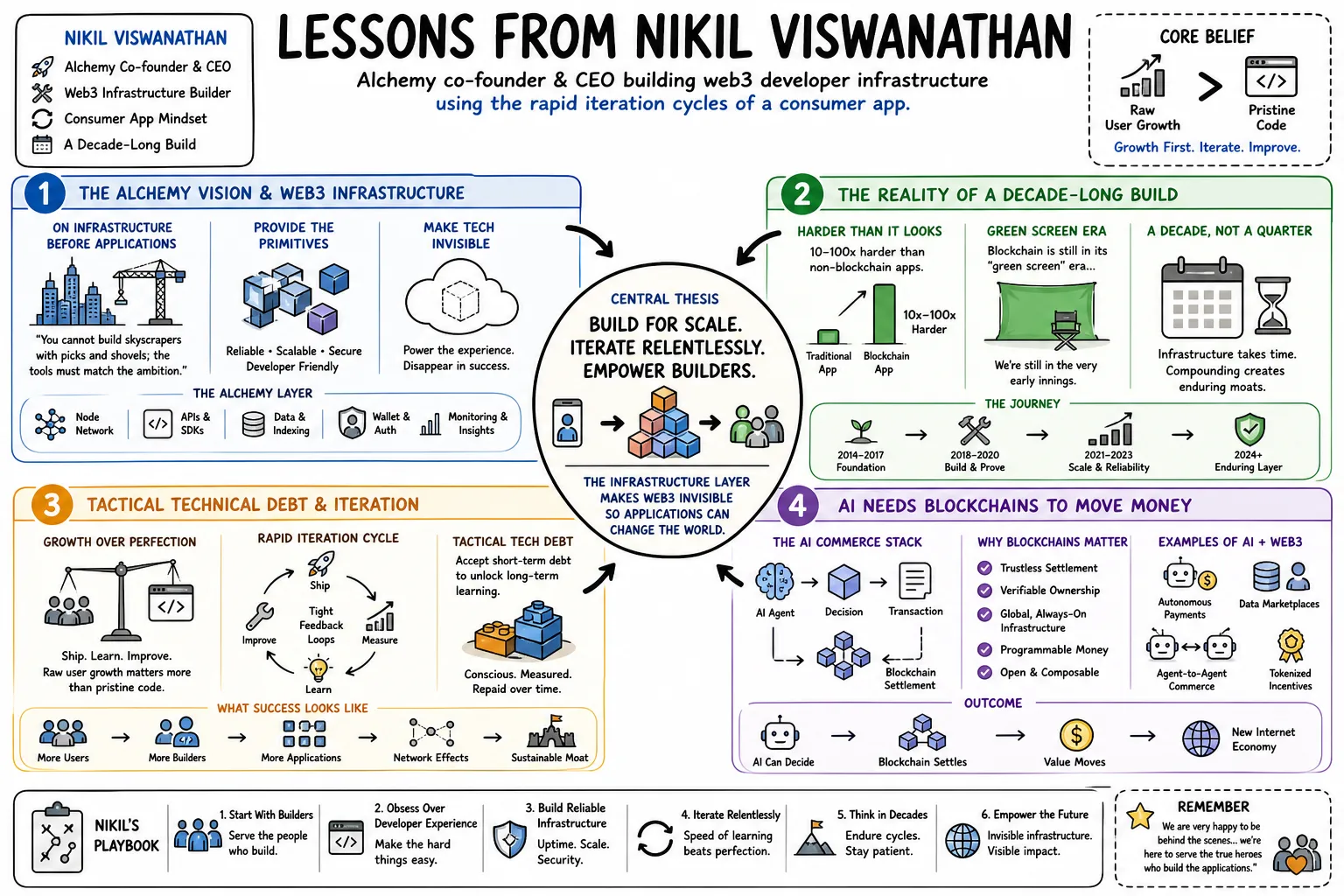
Lessons from Nikil Viswanathan
Alchemy co-founder and CEO Nikil Viswanathan builds web3 developer infrastructure using the rapid iteration cycles of a consumer app. He argues that raw user growth simply matters more than pristine code. This profile covers his approach to tactical technical debt, the reality of a decade-long build, and why AI needs blockchains to move money.
Part 1: The Alchemy Vision and Web3 Infrastructure
- On infrastructure before applications: "You cannot build skyscrapers with picks and shovels; the tools must match the ambition." — Source: [Alchemy]
- On the state of development: "We realized that developing a blockchain application was 10-100 times harder than creating any non-blockchain application." — Source: [Forbes]
- On the green screen era: "Blockchain is still in its 'green screen' era... we’re still in the very early innings." — Source: [YouTube]
- On making tech invisible: "When the technology is pervasive, you won't think about using it. You don't say 'I used an internet app to pay,' you just say 'I used Apple Pay.'" — Source: [YouTube]
- On providing the primitives: "We are very happy to be behind the scenes... we're here to serve people who are the true heroes who are building the applications." — Source: [Medium]
- On building the trust layer: "Blockchain is the internet's missing property rights layer—a trust and authenticity layer that will be essential for verifying the digital world." — Source: [HighPerformr]
- On geographic bias: "Silicon Valley is often late to global trends because local infrastructure works well enough, making it hard to see the desperate need for these technologies in developing nations." — Source: [Medium]
- On digital ownership: "NFTs represent the first step toward universal digital ownership, where real estate and financial assets will eventually have a digital representation on-chain." — Source: [HighPerformr]
- On institutional adoption: "The playbook for traditional financial institutions starts with custody and ETFs, moves to stablecoin orchestration, and eventually leads to their own chains or tokenized real-world assets." — Source: [YouTube]
- On solving their own problem: "We’re huge nerds, we’re engineers, we’ve coded every single day of our lives for 15 years... if it’s hard for us to code on blockchain, this industry can't explode." — Source: [YouTube]
Part 2: Speed, Execution, and Growth
- On the primary driver of success: "The big don't eat the small, the fast eat the slow." — Source: [Medium]
- On rapid iteration cycles: "Cut down iteration cycles from months to minutes." — Source: [Medium]
- On the primacy of growth: "Growth is the only thing that matters in a startup. If you're growing, everything else is easy. If you're not growing, everything else is hard." — Source: [Business Insider]
- On fixing problems via growth: "Growth allows a company to solve all other problems—hiring, infrastructure, product bugs—whereas a lack of growth makes even the smallest issues insurmountable." — Source: [Business Insider]
- On the speed of consumer apps in enterprise: "Bring a consumer-grade speed to enterprise software, iterating on products daily rather than quarterly." — Source: [Inc.]
- On validating the market fast: "Scale the messy version as far as it will go while validating the market before you rebuild." — Source: [YouTube]
- On continuous building: "Keep creating until something sticks; most great entrepreneurs produce a high volume of projects before finding the one that works." — Source: [Medium]
- On dominating small markets: "Most great companies start by dominating a small market that then grows exponentially. Alchemy was a bet that if crypto worked, the infrastructure for it would be massive." — Source: [YouTube]
- On the danger of slow execution: "A lack of speed is the silent killer of early-stage startups." — Source: [Medium]
- On extreme ownership: "Every team member is expected to act like a founder, moving with speed and taking full responsibility for the outcome." — Source: [Greylock]
Part 3: The Co-Founder Relationship and Team Building
- On the cause of failure: "The number one cause of early-stage failure is co-founder disputes." — Source: [YouTube]
- On selecting a co-founder: "The most successful teams are defined not by the leaders' individual skills or experience, but by how well they get along." — Source: [YouTube]
- On the 'marriage' of co-founders: "Success requires extreme trust and shared responsibility: don't leave the dishes in the sink, finish the code." — Source: [Medium]
- On building shared history: "The best co-founder bonds often come from long-term, low-stakes interactions like dorm conversations or shared classes, rather than forced networking." — Source: [Medium]
- On team selection: "Full stop period, the most important thing you do is pick your team. If you have the right team, you'll be able to figure all that out." — Source: [Greylock]
- On hiring former founders: "We specifically look for former founders because they have an innate sense of speed, hustle, and the reality of building from scratch." — Source: [Inc.]
- On flat hierarchy: "No one at Alchemy would call me their boss. We just work together, and I think that's the way we always wanted to be." — Source: [Greylock]
- On titles versus impact: "In a high-performing culture, titles should matter far less than the collective mission and what you actually deliver." — Source: [Greylock]
- On maintaining a tight circle: "What would we do if we had infinite money? It would literally just be like what we're doing now, except we'd have all our friends live with us and it would be a lot of fun." — Source: [Medium]
Part 4: Product and Engineering Philosophy
- On avoiding the root of all evil: "Premature optimization is the root of all evil... We are here not to build technology; we're here to build products that actually change people's lives." — Source: [YouTube]
- On the real purpose of engineering: "We are here not to build technology; we're here to build products that actually change people's lives." — Source: [Stanford ETL]
- On the nature of technical debt: "Tech debt is the benefit you get from being able to serve users." — Source: [YouTube]
- On taking out a loan for speed: "Tech debt is a loan that a founder takes out to buy speed. In the early days, the goal is to find product-market fit quickly." — Source: [YouTube]
- On the futility of perfect code: "Writing perfect code for a product that no one wants is a complete waste of resources." — Source: [YouTube]
- On building for Day One: "If you spend six months building a system that can handle a billion users before you have ten users, you have optimized prematurely." — Source: [YouTube]
- On paying back the debt: "Once you find product-market fit and scale, you must hire world-class engineers to pay back the debt and rebuild for long-term stability." — Source: [YouTube]
- On the danger of AI code generation: "Blindly embracing AI can cause legacy codebases, tech debt, and bugs to skyrocket if engineers don't maintain a deep understanding of the underlying systems." — Source: [YouTube]
- On customer obsession: "Build only what provides immediate, tangible value to the user, and discard the rest." — Source: [Greylock]
- On the necessity of rebuilds: "Most massive platforms rebuilt their entire stack multiple times early on; do not be afraid to throw away code once it has served its validation purpose." — Source: [YouTube]
Part 5: The "Down to Lunch" Era and Early Lessons
- On explosive growth: "Down to Lunch started as a Sunday afternoon project that spontaneously exploded across the country." — Source: [Business Insider]
- On direct user feedback: "We used to dress up as Berkeley students to get feedback from users, recoding the app in minutes based on what they heard." — Source: [Medium]
- On the double-edged sword of virality: "The reviews spread like wildfire on social media, and the app lost 90% of its user growth in less than 48 hours." — Source: [Business Insider]
- On college as an incubator: "College is the best time to start a company because you have three unique advantages: speed, risk tolerance, and energy." — Source: [Medium]
- On the value of university networks: "The single most important thing you can do in college is build meaningful connections with great people, rather than focusing entirely on coursework." — Source: [Medium]
- On iterating in public: "We built the initial version of Down to Lunch in a single night, intentionally taking on massive tech debt to launch immediately." — Source: [YouTube]
- On identifying the real problem: "The app was designed to solve a personal problem: the difficulty of spontaneously meeting up with friends after leaving the close-knit dorm environment." — Source: [Business Insider]
- On building consumer muscles: "The experience of scaling a viral consumer app taught us how to rapidly handle server crashes and user demands, which translated perfectly to enterprise infrastructure." — Source: [Inc.]
- On surviving early PR crises: "Dealing with false social media rumors taught us that product resilience must be matched by operational resilience." — Source: [Business Insider]
Part 6: The Founder Mindset and Persistence
- On the hidden timeline of success: "The headlines say fastest company ever to a $10 billion valuation... but I was 11 years out of college, nine years out of grad school, and we had been working on startups for nine years with basically nothing to show before 2021." — Source: [YouTube]
- On the necessity of pivots: "Alchemy was actually our 16th pivot. You must be willing to throw away your specific product or approach if it isn't working." — Source: [YouTube]
- On long-term consistency: "Speed is necessary to get something off the ground, but consistency over time is what creates something enduring." — Source: [Stanford ETL]
- On learning from unlikely sources: "Look at figures like Taylor Swift as examples of how long-term consistency and relentless hustle build lasting success." — Source: [Medium]
- On the true definition of risk: "Startups are less risky than traditional jobs because the worst-case scenario is still a fine outcome, whereas the 'what if' of not trying is the true risk." — Source: [YouTube]
- On foundational traits: "The two most important traits for an early-stage founder are extreme confidence and relentless persistence." — Source: [YouTube]
- On mental confidence: "Mental confidence allows you to take necessary risks and weather the inevitable periods where nothing seems to be working." — Source: [YouTube]
- On the illusion of overnight success: "Success often takes much longer than the 'overnight' narrative suggests; you must be prepared to grind in obscurity for years." — Source: [YouTube]
- On staying focused on the mission: "It wasn't really about the money. We want to align ourselves with the best partners in the space that help us bring blockchain to the world as quickly as possible." — Source: [Forbes]
Part 7: The Convergence of AI and Blockchain
- On the future users of blockchain: "AI agents will be the primary users of blockchain technology in the future." — Source: [YouTube]
- On why AI needs crypto: "Because AI agents need to transact globally, 24/7, and without a physical ID, blockchain rails are the only logical financial system for them." — Source: [YouTube]
- On programmable capital: "Smart contracts are the ideal mechanism for AI to manage, allocate, and deploy capital autonomously." — Source: [YouTube]
- On infrastructure requirements for AI: "As AI begins executing complex economic tasks, it will require trustless, decentralized infrastructure that cannot be shut off by a single centralized entity." — Source: [YouTube]
- On the collision of megatrends: "The intersection of AI executing logic and blockchain handling value transfer is the most critical technological convergence of this decade." — Source: [YouTube]
- On verifying truth in the AI era: "As AI-generated content becomes indistinguishable from reality, blockchain will serve as the essential verification layer for authenticity." — Source: [HighPerformr]
- On autonomous economies: "We are moving toward a world where AI agents negotiate and settle transactions with other AI agents entirely on-chain." — Source: [YouTube]
- On moving beyond human users: "Designing infrastructure today means preparing for a surge in transaction volume driven by algorithmic intent rather than human clicks." — Source: [YouTube]
- On the inevitability of digital currency: "Digital currency is inevitable; the shift from physical barter to paper money to digital currency is a natural progression of humanity." — Source: [Medium]
Part 8: Long-Term Impact and the Future
- On shaping history: "I know to a lot of people it'll sound crazy, but we have the chance to shape the course of history... this is of a similar impact to the internet." — Source: [Medium]
- On the scale of modern leverage: "We live in a day and age where you can press buttons on this magic metal box and build something every person on the planet uses. And that was never possible before." — Source: [Greylock]
- On the third major shift: "Blockchain is the third major shift in computing, following the personal computer and the internet, fundamentally altering how value and trust are distributed." — Source: [Inc.]
- On the real purpose of infrastructure: "Our core technology will be as revolutionary as the internet and the computer—our goal is to bring those benefits to the entire world." — Source: [Forbes]
- On proven use cases: "While many focus on speculation, the proven products of crypto are digital money, global crowdfunding, and digital ownership." — Source: [YouTube]
- On democratizing capital: "Crypto enables anyone, anywhere—in India or Africa—to raise capital without needing Silicon Valley connections." — Source: [YouTube]
- On the end goal of technology: "When you stop hearing the word blockchain, and you just talk about the utility you get from it, that’s when it’ll be really successful." — Source: [YouTube]
- On building enduring value: "We are not building for the next hype cycle; we are laying the concrete for the next fifty years of the internet." — Source: [YouTube]
- On the privilege of building: "Imagine if you could help build the early internet and bring computers to the world—that is the exact opportunity we have right now." — Source: [Forbes]