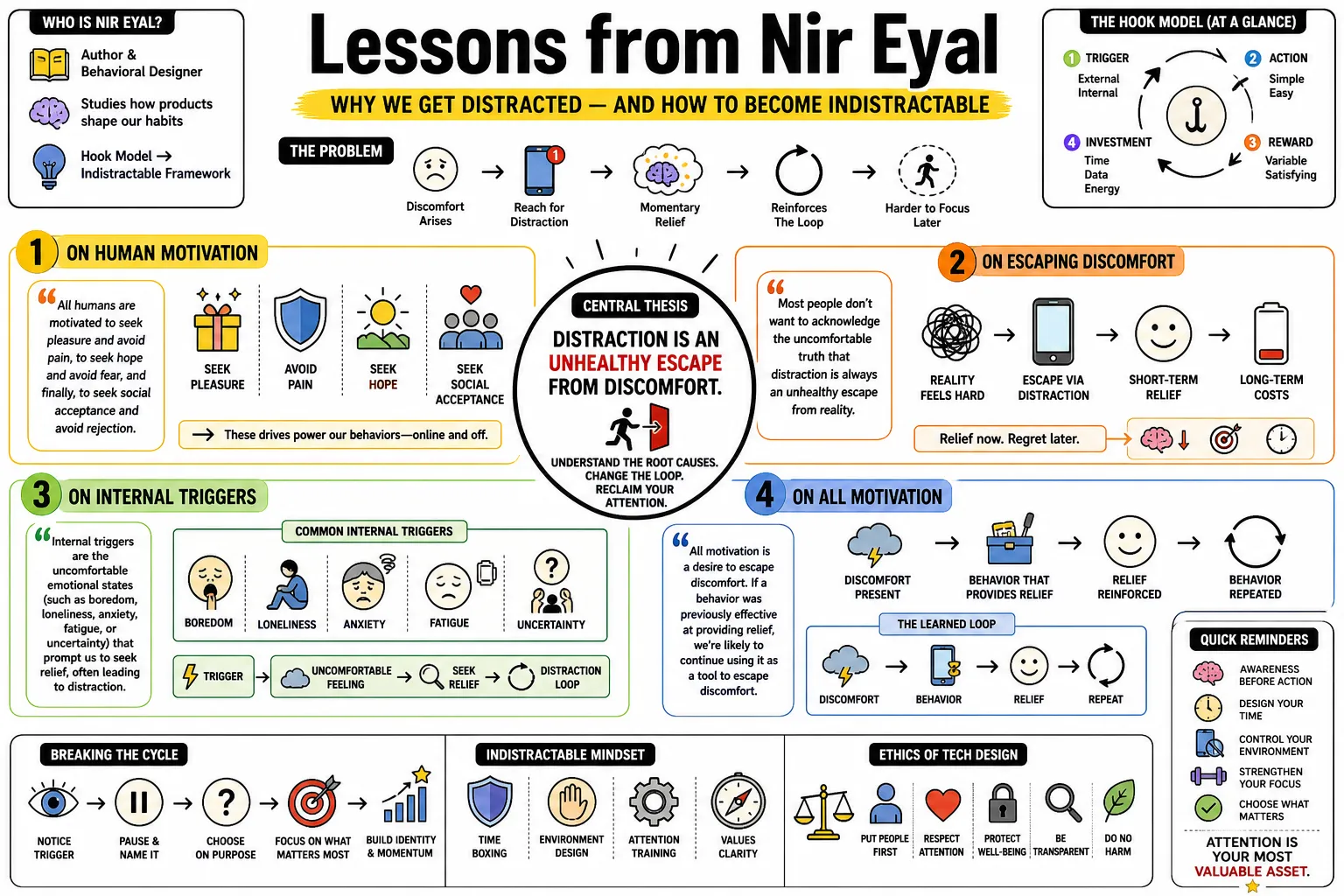
Lessons from Nir Eyal
Nir Eyal is an author and behavioral designer who studies how products shape our habits and how we direct our attention. After creating the Hook Model to explain why digital tools keep us coming back, he developed a framework to help people become "indistractable." These lessons cover his advice on managing time, identifying internal triggers, and the ethics of tech design.
Part 1: The Root Causes of Distraction
- On Human Motivation: "All humans are motivated to seek pleasure and avoid pain, to seek hope and avoid fear, and finally, to seek social acceptance and avoid rejection." — Source: [Goodreads]
- On the Nature of Distraction: "Most people don't want to acknowledge the uncomfortable truth that distraction is always an unhealthy escape from reality." — Source: [Indistractable]
- On Escaping Discomfort: "All motivation is a desire to escape discomfort. If a behavior was previously effective at providing relief, we're likely to continue using it as a tool to escape discomfort." — Source: [Psychology Today]
- On Internal Triggers: "Internal triggers are the uncomfortable emotional states (such as boredom, loneliness, anxiety, fatigue, or uncertainty) that prompt us to seek relief, often leading to distraction." — Source: [NirAndFar]
- On Identifying Discomfort: To master distraction, you must first look for the discomfort that precedes it. Identify the specific emotion occurring just before you feel the urge to check your phone or switch tabs. — Source: [NirAndFar]
- On Managing Negative Emotions: Rather than trying to suppress negative emotions, we can simply acknowledge and observe them without judgment. When we stop fighting them, they often dissipate on their own. — Source: [Medium]
- On the Myth of Tech Addiction: Blaming technology for all our distractions is a form of learned helplessness. Technology is usually the proximate cause. The root cause is almost always an internal trigger we haven't resolved. — Source: [Mozilla Interview]
- On Boredom: We reach for our phones because our brains are desperate to escape the mild, creeping discomfort of being bored. — Source: [NirAndFar]
- On Liminal Moments: Pay close attention to transitions between tasks. These liminal moments are the danger zones where we are most susceptible to falling into a time-wasting diversion. — Source: [NirAndFar]
- On Emotional Reconditioning: We can train ourselves to respond differently to emotional discomfort. Instead of reacting by opening social media, we can reflect on the feeling and use it as fuel for traction. — Source: [Psychology Today]
Part 2: The Hook Model and Habit Formation
- On How Habits Form: "Habits form when the brain takes a shortcut and stops actively deliberating over what to do next. The brain quickly learns to codify behaviors that provide a solution to whatever situation it encounters." — Source: [Hooked]
- On the Hook Cycle: The Hook Model consists of four distinct phases: a trigger, an action, a variable reward, and an investment. Repeatedly guiding users through these phases builds a strong habit. — Source: [NirAndFar]
- On Triggers: A habit must begin with a trigger. While products initially rely on external triggers like notifications, the ultimate goal is to attach the product's use to an internal trigger, like a routine emotion. — Source: [Amplitude]
- On Friction and Action: The action phase of the Hook must be as frictionless as possible. It is the simplest behavior done in anticipation of a reward, like scrolling a feed or clicking a play button. — Source: [NirAndFar]
- On Variable Rewards: Predictability breeds apathy. It is the element of surprise and unpredictability that makes a product genuinely sticky and keeps users engaged. — Source: [Medium]
- On User Investment: "Businesses that leverage user effort confer higher value to their products simply because their users have put work into them. The users have invested in the products through their labor." — Source: [Hooked]
- On the Value of Data: When users invest data, content, or social capital into a platform, they make their next experience with the product even better, increasing the likelihood they will return. — Source: [NirAndFar]
- On Product Innovation: "Many entrepreneurs fall into the trap of building products that are only marginally better than existing solutions... better products don't always win—especially if a large number of users have already adopted a competing product." — Source: [Goodreads]
- On Overcoming Old Habits: "John Gourville stipulates that 'many innovations fail because consumers irrationally overvalue the old while companies irrationally overvalue the new.'" — Source: [Hooked]
- On User Control: "To change behavior, products must ensure the users feel in control. People must want to use the service, not feel they have to." — Source: [Hooked]
Part 3: Traction, Distraction, and Timeboxing
- On Traction vs. Distraction: The opposite of distraction is not focus. It is traction. Traction is any action that moves you toward your goals, while distraction is anything that pulls you away from them. — Source: [NirAndFar]
- On the Definition of Wasted Time: "After all, the time you plan to waste is not wasted time." If you intend to play video games or watch television, and you do it on purpose, it is traction. — Source: [Indistractable]
- On Timeboxing: Timeboxing is the practice of assigning a specific activity to a defined block of time in advance. It is the most effective way to turn your intentions into an actionable plan. — Source: [Psychology Today]
- On Ditching To-Do Lists: Traditional to-do lists allow you to work reactively and often leave you stressed. A timeboxed calendar serves as a proactive template for exactly how you intend to spend your day. — Source: [NirAndFar]
- On Implementation Intentions: Deciding exactly what you will do and when you will do it dramatically increases the likelihood that you will actually follow through. — Source: [NirAndFar]
- On Parkinson's Law: Work expands to fill the time available for its completion. By placing a strict time limit on a task via timeboxing, you defend against this expansion and force yourself to focus. — Source: [Medium]
- On Eliminating Ambiguity: When you know exactly what you should be doing at 10:00 AM, it becomes much easier to identify anything else you might do as a distraction and resist it. — Source: [Reddit AMA]
- On Planning for Rest: If you don't schedule time for rest, relaxation, and relationships, you will inevitably end up distracted because your brain needs a break. Schedule your leisure time just like your work. — Source: [NirAndFar]
- On Measuring Success: The goal of timeboxing is working without distraction on the intended task for that specific period, rather than finishing everything perfectly on time. — Source: [NirAndFar]
- On Adaptability: If your schedule gets derailed by an emergency, the goal isn't to be rigid or punish yourself. The goal is to be intentional about how you adapt your plan for the rest of the day. — Source: [Psychology Today]
Part 4: Hacking Back External Triggers
- On External Triggers: While internal triggers drive the urge to escape, external triggers like pings and notifications are the environmental cues that actively interrupt our traction. — Source: [Indistractable]
- On Questioning Notifications: For every notification you receive, ask yourself if the trigger is serving you or if you are serving it. If it doesn't serve your goals, turn it off. — Source: [NirAndFar]
- On Email Management: We waste countless hours reacting to email. The solution is to batch your email processing into scheduled timeboxes rather than checking your inbox constantly throughout the day. — Source: [NirAndFar]
- On Defending Your Workspace: Open-plan offices are notorious for external triggers. Using a simple signal, like a monitor sign or headphones, can communicate to colleagues that you are in a focused timebox and shouldn't be interrupted. — Source: [Indistractable]
- On Smartphone Hygiene: Remove all non-essential apps from your phone's home screen. Hide social media and news apps in folders on the second or third page to introduce friction before you open them. — Source: [Medium]
- On Managing Group Chat: Tools like Slack or Teams can become constant external triggers. Treat group chat like a sauna: stay in for a short, planned period, get out, and don't spend all day there. — Source: [NirAndFar]
- On the Cost of Interruption: It takes the average person more than 20 minutes to regain their original level of focus after being interrupted by a simple notification or a tap on the shoulder. — Source: [YouTube Interview]
- On Designing Your Environment: Your physical and digital environments should be designed for the behavior you want. Clear the clutter from your desk and your desktop to remove subtle visual triggers. — Source: [NirAndFar]
- On the Value of Unplugging: Sometimes the most effective way to manage external triggers is to physically separate yourself from your devices when you need to do deep, reflective work. — Source: [Indistractable]
Part 5: The Power of Pacts and Commitments
- On Pre-commitments: A pre-commitment is a choice you make in the present that restricts your options in the future. It is a powerful way to prevent distraction before it even happens. — Source: [NirAndFar]
- On Effort Pacts: An effort pact prevents distraction by adding friction to the unwanted behavior. If it takes extra effort to access a distraction, you give yourself a moment to reconsider. — Source: [Indistractable]
- On Using Blocking Software: Apps and browser extensions that temporarily block access to distracting websites are excellent examples of effort pacts. They enforce the boundaries you set for yourself. — Source: [Medium]
- On Price Pacts: A price pact puts your money on the line. Committing to pay a penalty if you fail to stick to your intended schedule is a highly effective motivator to stay on track. — Source: [Indistractable]
- On Identity Pacts: An identity pact involves tying your behavior to your self-image. When you publicly declare who you are or what you stand for, you are more likely to act in accordance with that identity. — Source: [NirAndFar]
- On the Timing of Pacts: Pacts only work after you have addressed your internal triggers, planned your time, and managed external triggers. They are the final line of defense. — Source: [Psychology Today]
- On Accountability Partners: Pairing up with a friend or colleague to co-work in silence, or simply sharing your goals with them, uses our natural desire for social consistency to keep us focused. — Source: [NirAndFar]
- On the Danger of Price Pacts: Be careful with price pacts. They are effective for behaviors you can fully control, but they can backfire and cause anxiety if the outcome relies on external factors. — Source: [Indistractable]
- On Burning the Ships: Making a pact is like burning your ships when you arrive on a new shore. By removing the option to retreat into distraction, you force yourself to move forward. — Source: [NirAndFar]
Part 6: Identity, Mindset, and Belief
- On the Word "Indistractable": "Being indistractable means striving to do what you say you will do." It is an identity you adopt, not a state of perfection you achieve. — Source: [Indistractable]
- On Self-Fulfilling Prophecies: "Labeling yourself as having poor self-control actually leads to less self-control." The stories we tell ourselves about our attention spans directly impact our behavior. — Source: [Goodreads]
- On Ego Depletion: The idea that willpower is a finite resource that runs out is largely a myth. Believing your willpower is limited actually makes you more likely to give up. — Source: [NirAndFar]
- On the Power of Belief: "Addicts' beliefs regarding their powerlessness was just as significant in determining whether they would relapse... Mindset mattered as much as physical dependence!" — Source: [Indistractable]
- On Self-Compassion: When you inevitably slip up and get distracted, practicing self-compassion is more effective than self-criticism. Beating yourself up only creates more of the negative emotion that causes distraction in the first place. — Source: [NirAndFar]
- On Nouns vs. Verbs: Calling yourself an "indistractable person" is often more powerful for changing behavior than saying "I want to stop getting distracted." It shifts your core identity. — Source: [Medium]
- On Reframing Tasks: If you tell yourself you "have to" do a task, you will likely resist it. If you reframe it as something you "get to" do, you reduce the internal friction that leads to procrastination. — Source: [Psychology Today]
- On Managing Expectations: Becoming indistractable is a practice, like yoga or meditation. You don't fail if your mind wanders; you only fail if you don't notice it and gently bring your attention back. — Source: [YouTube Interview]
- On Personal Responsibility: While tech companies design products to be engaging, the ultimate responsibility for our attention rests with us. We have the power to change our habits if we change our mindset. — Source: [Mozilla Interview]
Part 7: Navigating Technology with Children
- On Setting an Example: "Consider our children. How can they flourish if they can't concentrate long enough to apply themselves? What example are we setting for them if our loving faces are replaced by the tops of our heads as we constantly stare into our screens?" — Source: [Goodreads]
- On Tech Tantrums: When kids act out over having their devices taken away, it is usually because they feel a lack of autonomy. They need to be part of the rule-making process regarding screen time. — Source: [NirAndFar]
- On Psychological Nutrients: Children turn to the digital world when they are starved of three essential psychological nutrients in the real world: autonomy, competence, and relatedness. — Source: [Indistractable]
- On Fostering Autonomy: Instead of strictly dictating limits, parents should teach children how to self-regulate. Ask them how much screen time they think is fair, and help them build their own timeboxed schedules. — Source: [NirAndFar]
- On Building Competence: Video games provide clear feedback and a sense of growth. If kids don't feel competent in school or sports, they will naturally gravitate toward games where they do. — Source: [Medium]
- On Social Relatedness: A lot of what looks like excessive social media use is actually just teenagers trying to connect with their peers. If they lack unstructured playtime in the real world, they will find it online. — Source: [NirAndFar]
- On Tech-Free Zones: Establish clear tech-free zones in the house, such as the dining room table or the bedroom. This sets an environmental boundary that applies equally to both children and parents. — Source: [Indistractable]
- On Monitoring vs. Mentoring: Parents should shift from merely monitoring their children's device usage to mentoring them on how to have a healthy, intentional relationship with technology. — Source: [Psychology Today]
- On the Importance of Sleep: One of the most damaging effects of technology on children is sleep deprivation. Devices should be kept out of bedrooms at night to protect their rest and cognitive development. — Source: [NirAndFar]
Part 8: Ethical Design and the Creator's Responsibility
- On the Definition of Superpowers: "If it can't be used for evil, it's not a superpower. Building habit-forming products is indeed a superpower. If used irresponsibly, bad habits can quickly degenerate into mindless, zombielike addictions for some users." — Source: [Medium]
- On Ethical Boundaries: Product designers must ask themselves two questions to determine if a product is ethical: "Would I use this product myself?" and "Will this product materially improve the user's life?" — Source: [NirAndFar]
- On The Manipulation Matrix: If a creator builds a product they would not use themselves and that doesn't improve the user's life, they are acting as a dealer. This is exploitative design. — Source: [Hooked]
- On Facilitators vs. Peddlers: A facilitator builds habit-forming products that they use and believe improve lives. A peddler builds products they believe improve lives, but wouldn't use themselves. Facilitation is the highest ethical standard. — Source: [NirAndFar]
- On Corporate Responsibility: Companies that build engaging products have a moral obligation to help the small percentage of users who become genuinely addicted. They have the data to identify these users and should intervene. — Source: [Medium]
- On the Future of Product Design: As users become more aware of how their attention is harvested, the most successful companies will be those that respect user time and design for traction rather than mindless distraction. — Source: [NirAndFar]
- On Protecting Vulnerable Users: Habit-forming design should never be used on populations that lack the capacity for self-regulation, particularly young children. — Source: [YouTube Interview]
- On Building for Good: We can use the exact same psychology that keeps people scrolling social media to help them build healthy habits, like exercising, saving money, or learning a new language. — Source: [Hooked]
- On the Creator's Intent: Ultimately, behavioral design is a tool. The morality of the product depends entirely on the intent of the creator and the outcome for the user. We must choose to build products that empower users. — Source: [Mozilla Interview]