Lessons from Oliver Burkeman
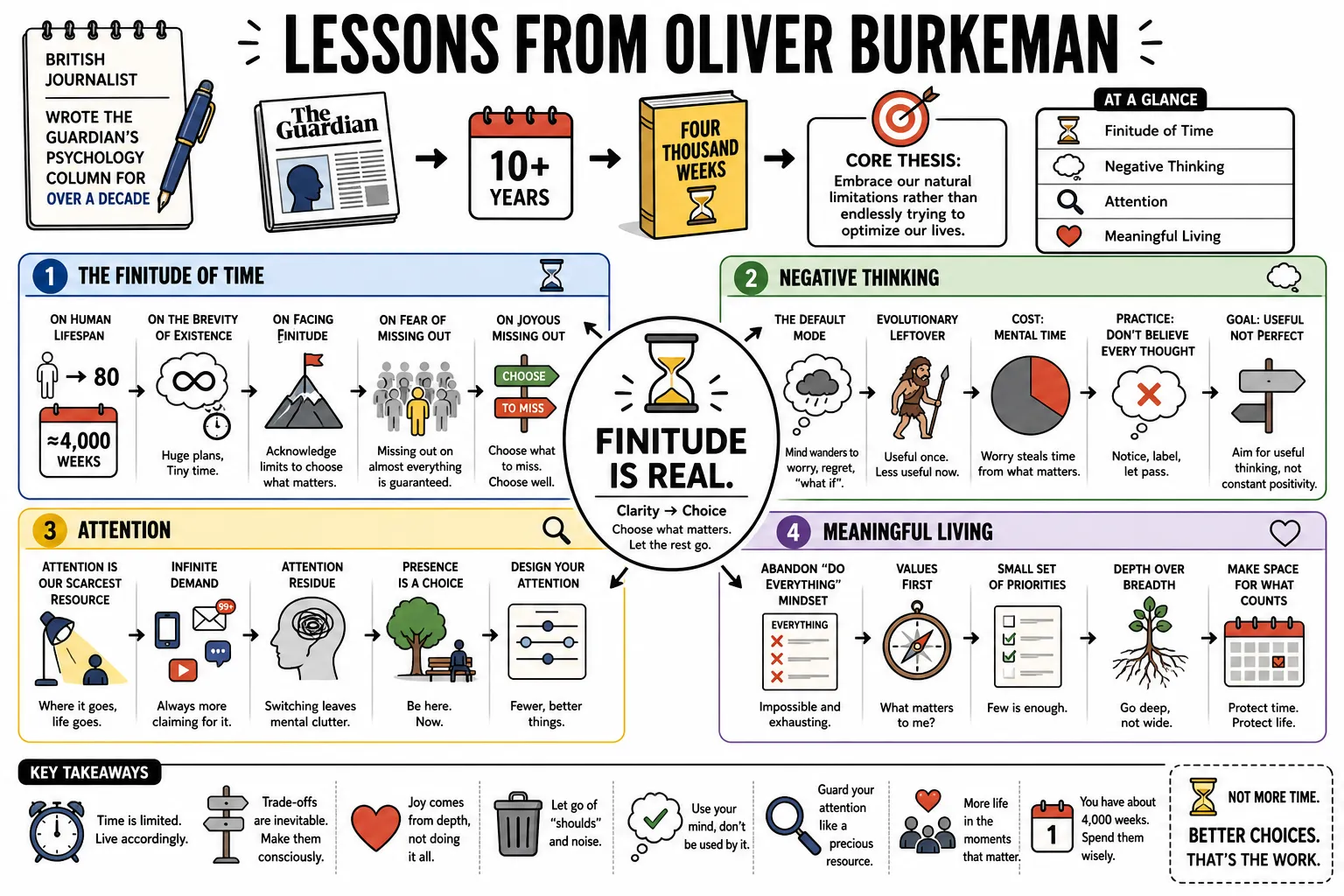
British journalist Oliver Burkeman wrote The Guardian’s psychology column for over a decade before publishing Four Thousand Weeks, a book that argues against modern productivity culture. He suggests we embrace our natural limitations rather than endlessly trying to optimize our lives. This profile outlines his core arguments on time management, negative thinking, and attention.
Part 1: The Finitude of Time
- On Human Lifespan: "Assuming you live to be eighty, you'll have had about four thousand weeks." — Source: [Four Thousand Weeks]
- On the Brevity of Existence: "We've been granted the mental capacity to make almost infinitely ambitious plans, yet practically no time at all to put them into action." — Source: [Goodreads]
- On Facing Finitude: Acknowledging our limited time on earth is the only way to actually make meaningful choices about what to prioritize. — Source: [The Imperfectionist]
- On Fear of Missing Out: Missing out on almost everything is mathematically guaranteed, making it better to consciously choose what to miss. — Source: [Four Thousand Weeks]
- On the Futility of Having It All: The attempt to do everything is an unconscious strategy to avoid the pain of our own mortality and limitations. — Source: [Four Thousand Weeks]
- On Joyous Missing Out: The realization that you cannot do everything allows you to fully commit to the few things you decide to do without regret. — Source: [Goodreads]
- On the Paradox of Choice: Infinite options combined with finite time create an impossible standard that inevitably leads to disappointment. — Source: [The Guardian]
- On Settlement: Committing to a specific path, relationship, or location provides more freedom than constantly keeping all options open. — Source: [Four Thousand Weeks]
- On Denial of Time: Most time management techniques are secretly mechanisms designed to help us pretend our time is unlimited. — Source: [Goodreads]
Part 2: The Efficiency Trap
- On Productivity: "Productivity is a trap. Becoming more efficient just makes you more rushed, and trying to clear the decks simply makes them fill up again faster." — Source: [Goodreads]
- On Clearing the Decks: The feeling of finally getting everything done is an illusion because the tasks will always outnumber the time available. — Source: [Four Thousand Weeks]
- On Inbox Zero: Replying to emails faster simply trains the world to send you more emails in return. — Source: [The Guardian]
- On Optimization: When you optimize your life to fit more things in, you usually end up doing more trivial and tedious things. — Source: [Goodreads]
- On Working Harder: Pushing yourself to be more efficient merely generates new demands and expectations from those around you. — Source: [The Imperfectionist]
- On Convenience Culture: Technologies that save us time often strip away the friction that makes life feel meaningful and grounded. — Source: [Four Thousand Weeks]
- On Time-Saving Tools: The better we get at managing our time through apps and schedules, the more stressed and behind we feel. — Source: [Four Thousand Weeks]
- On the Bottomless Pit: The supply of incoming demands on your time is effectively infinite, meaning you can never handle them all by simply working faster. — Source: [Goodreads]
- On Meaningful Sacrifice: Because you cannot do it all, true productivity means getting comfortable with leaving many things entirely undone. — Source: [The Imperfectionist]
Part 3: The Antidote to Positivity
- On Positive Thinking: "A person who has resolved to 'think positive' must constantly scan his or her mind for negative thoughts... yet that scanning will draw attention to the presence of negative thoughts." — Source: [The Antidote]
- On Embracing Failure: Recognizing that things will go wrong is far more comforting and practical than forcing yourself to believe everything will be perfect. — Source: [Goodreads]
- On Goal-Setting: Obsessively fixating on rigid goals can blind you to new opportunities and make you miserable in the present moment. — Source: [The Antidote]
- On Negative Capability: "The greatest benefit of negative capability, the true power of negative thinking, is that it lets the mystery back in. Uncertainty is where things happen." — Source: [Goodreads]
- On Happiness: "At best, it would appear, happiness can only be glimpsed out of the corner of an eye, not stared at directly." — Source: [The Antidote]
- On Insecurity: "True security lies in the unrestrained embrace of insecurity, in the recognition that we never really stand on solid ground, and never can." — Source: [Goodreads]
- On Suffering: "Pain is inevitable... but suffering is an optional extra, resulting from our attachments, which represent our attempt to try to deny the unavoidable truth." — Source: [The Antidote]
- On Pessimism: Defensive pessimism, the practice of preparing for the worst-case scenario, can significantly reduce anxiety compared to relentless optimism. — Source: [The Guardian]
- On Visualization: Visualizing success can sometimes trick the brain into thinking the goal has already been achieved, reducing the motivation to actually work for it. — Source: [The Antidote]
- On Accepting Flaws: Trying to eliminate all negative emotions only amplifies them, while accepting their presence diminishes their power. — Source: [Goodreads]
Part 4: Distraction and Attention
- On the Nature of Attention: "Your experience of being alive consists of nothing other than the sum of everything to which you pay attention." — Source: [Four Thousand Weeks]
- On Reality: "What you pay attention to will define, for you, what reality is." — Source: [Goodreads]
- On the Attention Economy: Social media platforms do more than distract us from our work; they actively monetize our finite lifespan. — Source: [Four Thousand Weeks]
- On Seeking Distraction: We often seek out distractions intentionally when we encounter the discomfort of difficult or meaningful work. — Source: [The Guardian]
- On Discomfort: Distraction is primarily a way to escape the emotional unpleasantness of facing our own limitations. — Source: [The Imperfectionist]
- On Deep Work: The capacity to sustain attention on a single task is becoming increasingly rare, making it uniquely valuable. — Source: [Four Thousand Weeks]
- On Boredom: Allowing yourself to be genuinely bored without reaching for a screen is a necessary skill for restoring your capacity to focus. — Source: [Goodreads]
- On Multitasking: Multitasking does not save time; it merely fractures your attention so severely that you experience less of your own life. — Source: [The Guardian]
- On the Urge to Check: The impulse to check your phone during a quiet moment is a flight from the reality of being alone with yourself. — Source: [Four Thousand Weeks]
- On Protecting Focus: You must decide in advance what to ignore rather than trying to filter out distractions in real-time. — Source: [The Imperfectionist]
Part 5: Embracing Limitation
- On Accepting Defeat: "Let's start by admitting defeat: none of this is ever going to happen. But you know what? That's excellent news." — Source: [Goodreads]
- On the Fantasy of Mastery: We hold onto the illusion that one day we will perfectly master our routines and finally feel in control. — Source: [Four Thousand Weeks]
- On Human Constraints: Acknowledging that you cannot do it all is a massive relief because it frees you from the burden of an impossible standard. — Source: [Goodreads]
- On Ordinary Life: Rejecting the pressure to do something extraordinary allows you to appreciate the quiet dignity of a normal, decent life. — Source: [The Imperfectionist]
- On Radical Finitude: Embracing our limitations is about channeling our limited energy into what genuinely matters instead of giving up. — Source: [Four Thousand Weeks]
- On Perfectionism: Perfectionism is a defensive mechanism against the fear of being judged, making the acceptance of imperfection an act of courage. — Source: [The Guardian]
- On Strategic Underachievement: You must intentionally decide which areas of your life you are willing to be merely adequate at. — Source: [Four Thousand Weeks]
- On Limits as Tools: Constraints are the source of creativity because without a boundary it is impossible to shape anything meaningful. — Source: [Goodreads]
- On the End of the Struggle: Peace comes not from solving the problem of time, but from recognizing that it cannot be solved. — Source: [The Imperfectionist]
Part 6: Procrastination and Action
- On Motivation: "The problem, from this perspective, isn't that you don't feel motivated; it's that you imagine you need to feel motivated." — Source: [The Antidote]
- On Waiting: "Who says you need to wait until you 'feel like' doing something in order to start doing it?" — Source: [Goodreads]
- On Good Procrastination: Procrastination is inevitable, so the skill is learning how to procrastinate well by delaying the things that matter least. — Source: [Four Thousand Weeks]
- On Starting: Action often precedes motivation rather than the other way around. — Source: [The Guardian]
- On Taking the Next Step: When overwhelmed by a massive project, the only logical move is to identify the smallest possible next action and do it. — Source: [The Imperfectionist]
- On Avoiding the Work: We put off important tasks precisely because we care about them, making the prospect of doing them poorly feel threatening. — Source: [Four Thousand Weeks]
- On Daily Progress: Incremental, steady progress on a single priority is vastly superior to frantic, sporadic bursts of effort across many. — Source: [Goodreads]
- On Small Steps: It is better to do a tiny bit of meaningful work every day than to wait for a mythical clear afternoon that will never arrive. — Source: [Four Thousand Weeks]
- On the Cost of Delay: Putting off a difficult conversation or task only prolongs the underlying anxiety without changing the outcome. — Source: [The Guardian]
Part 7: Planning and Control
- On the Future: Planning is just a thought happening in the present moment that cannot actually bind the future. — Source: [Four Thousand Weeks]
- On Uncertainty: The anxiety we feel about the future comes from our demand that it must unfold exactly according to our plans. — Source: [Goodreads]
- On Living for Tomorrow: "Mortality makes it impossible to ignore the absurdity of living solely for the future." — Source: [Goodreads]
- On the Illusion of Control: We obsess over managing time because we mistakenly believe it will eventually grant us total control over our lives. — Source: [Four Thousand Weeks]
- On Results: "Results aren't everything. Indeed, they'd better not be, because results always come later, and later is always too late." — Source: [Goodreads]
- On Curiosity: "Choose curiosity (wondering what might happen next) over worry (hoping that a certain specific thing will happen next) whenever you can." — Source: [The Imperfectionist]
- On When Life Begins: We habitually treat the present as merely a rehearsal for some future moment when our real life will supposedly begin. — Source: [Four Thousand Weeks]
- On Letting Go: Releasing the grip on how things must turn out paradoxically makes it easier to navigate whatever actually happens. — Source: [The Antidote]
- On Instrumentalizing Time: Treating time purely as a resource to be spent for future rewards drains all the joy from the present act of living. — Source: [Goodreads]
Part 8: Mortality and Cosmic Insignificance
- On Cosmic Insignificance Therapy: Remembering that your life is a microscopic blip in the vast timescale of the universe removes the crushing pressure to do something momentous. — Source: [Four Thousand Weeks]
- On Importance: The fear that we are not living up to our potential fades when we realize the universe does not care what we do with our time. — Source: [Goodreads]
- On Leaving a Legacy: The pressure to leave a lasting legacy is a vanity project because most of us will be entirely forgotten within a few generations. — Source: [Four Thousand Weeks]
- On Everyday Magic: When you accept your own insignificance, doing the dishes or drinking a cup of coffee can become genuinely satisfying. — Source: [The Imperfectionist]
- On the Hubris of Ambition: Modern ambition often stems from a delusion that we alone are responsible for changing the world. — Source: [The Guardian]
- On Awe: "There's never any closure in an awe-inspired life, only constant acceptance of the mysteries of life." — Source: [Goodreads]
- On Finality: Acknowledging that every action you take is one you will inevitably do for the very last time adds a bittersweet depth to everyday routines. — Source: [Four Thousand Weeks]
- On Being a Blip: You are merely a tiny fragment of history, and accepting this is the ultimate antidote to existential anxiety. — Source: [The Imperfectionist]
- On Meaning: Meaning isn't found by escaping ordinary constraints, but by fully inhabiting the small, finite life you actually have. — Source: [Four Thousand Weeks]
- On the Present Moment: The present is the only place you ever are, the only time you ever have, and the only realm where anything real can occur. — Source: [Goodreads]